

The Salty Dawg Rendezvous started the evening of February 13th with a welcome dinner at the PAYS pavilion. Despite the 2-3 weeks’ worth of uncooperative sea conditions, about 21 boats made it to the rendezvous. They don’t call them “salty” dawgs for nothing. We are so glad that we made the effort to get to this rendezvous. We had an amazing time and made many new friends.
PAYS (Portsmouth Association of Yacht Security) coordinated with the Salty Dawg organization to host this event, but PAYS developed the itinerary. Each day offered 1-3 tour options led by PAYS guides, and the evenings found us gathering at the PAYS pavilion or Cabrit Cruise Ship pavilion for dinner, music and dancing. Most of us who were in Dominica for the first time opted to join every tour, so Dave and I were quite busy the entire week. We did so much over six days that I couldn’t possibly retain everything I learned about the island and its culture, but I can give you an overview.
I want to tell you a little about PAYS [link], first. Dominica was not a very safe place for cruisers to visit in the 90s and early 2000s. The government wasn’t particularly interested in doing anything about this, so a small group of local tour guides took things into their own hands and established PAYS, with the overarching goal of ensuring cruisers felt welcomed and safe. They operate at Prince Rupert Bay, outside the town of Portsmouth, on the NW side of Dominica. All members are trained and registered tour guides, and many also own other businesses like a taxi service or restaurant. Over time, they have built what we saw while we were there- an office and attached pavilion where they host BBQs every Wednesday and Sunday from December-May, a good dinghy dock, showers & bathrooms (not the greatest), a mooring field, and they take it in turns to patrol the mixed mooring field/anchorage at night.
This is a well-run business. You always know who the PAYS members are because their boats are clearly marked and they proudly display their tour guide credentials. They are incredibly helpful, very pleasant, and eager to share their knowledge and love of their island. Yes, they do this to bring in money, but they are not pushy, at least we didn’t find them to be so. Someone might stop by if they see you aboard and ask if you need a ride, water, fuel, tour, etc., but if the answer is “no, thank you,” they move on. We found their prices to be reasonable. Moorings are $12 US per night, with a slightly better deal if you pay for a whole week. Tours that are 6-8 hours run about $60 US for the driver/guide, although there are often other fees, but those are paid directly to whoever established the fee, like the government or a landowner; they were in the $5-$10 US range. We spent more than anticipated, but it was money well spent, and we couldn’t have done anything close for the same price tag in the US or any other developed nation.
Back to the fun stuff- what we DID.
Day 1- Welcome dinner
The welcome dinner occurred during the weekly Saturday BBQ, so there were more than just Salty Dawgs attending. We were welcomed by PAYS and an overview of the week was given by the Dawgs volunteer coordinator, Mary. Dinner was BBQ chicken, rice and salad, a recurring theme to our meals, with endless rum punch. I guess the punch fueled the dancing. We only stayed for a little bit of the dancing because the next day was an early, all-day tour and we wanted to be rested.
Day 2- Northern Treasures Tour
Guess which part of the island this tour covered 😉. Our driver/guide was Marlon, a fairly new guide with a good knowledge of local plants that he was also eager to expand. As we drove to our first stop, Marlon gave us a little history; he’s still learning that, too. Our first stop was for a hike to Chaudière Pool. Since this crossed someone’s private land, we paid $10 US each for that, but it also got us an additional guide called Anit, who knows the area and flora very well. She and Marlon pointed out various plants along the trail and told us about their uses, both as food and medicine, we even sampled some. Marlon learned a lot from Anit along the way.
The pool was lovely and both Dave and I changed into swimsuits to bathe in it, and I mean bathe. Anit had collected soap leaf en route and showed us to crush it up, mix it with some water and rub it over our skin. Darned if it didn’t create a little green lather. It felt refreshing, too, though that may have just been the cool water 😁. On the way back, Anit brought us down off the road to her farm and gave us some of the very sweet, tiny bananas I have forgotten the name of, as well as some sugar cane. She was lovely.

After Chaudière Pool, we had lunch in Calabishe. It was delicious and very big! We then went to the Sea Cliff Gin Distillery for a free tour and tasting (yes, free for anyone, so far). We then made a quick stop at Red Rocks ($2 US per person), thus named because of the iron oxide in the volcanic rocks that form them. The rock is very soft, which surprised me. Our final stop for the day was at the Pointe Baptiste Chocolate Factory ($20 EC per group). It’s a small operation that started in the couple’s kitchen and expanded to a lower level and behind their house. They produce about 2 tons of chocolate a year, all sold locally. It is dark chocolate flavored with local plant products. Even better, we got to taste as many of the 20 different flavors as we wanted. We left with only two bars, but we bought two more when we returned another day with our visiting family. Yum!
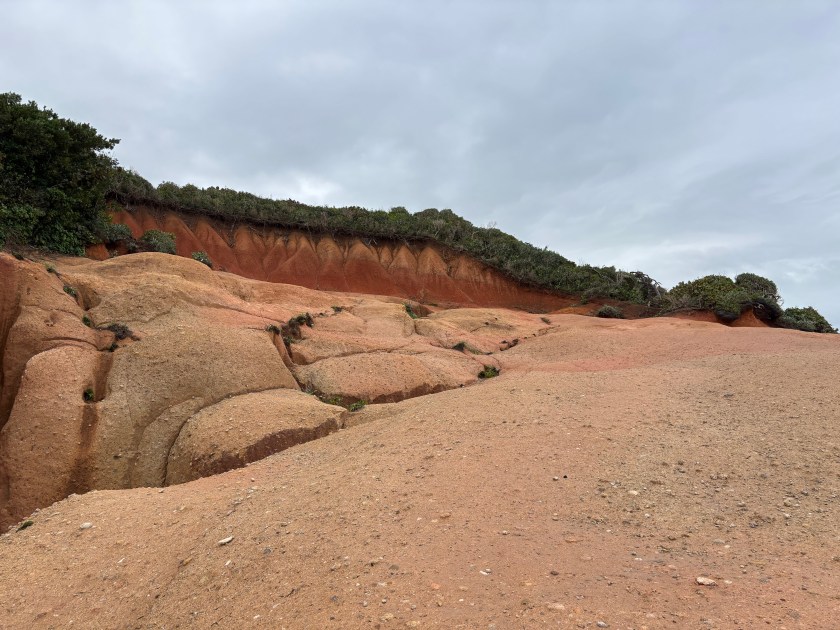
Dinner that night was a fundraiser for the local cancer society and was served at the Cabrits Cruise Ship dock. It was well-catered and consisted of chicken and fish options, rice, salad, and a couple of other starchy sides (local root vegetables). Too tired for dancing that night! We did not stay long after finishing the meal.
Day 3- Kalinago Territory Tour
This day started with a 2-hour drive across the island to the east side. Our driver/guide was “Uncle Sam.” As we crossed the island he told us a bunch of its history, described the little towns and villages we passed through, pointed out various plants, and told us about the international airport being built by the Chinese. Once we arrived in the Kalinago village, a local guide took over. The information I provide below is partly from the tour, but also from a Dominican history website [link].
The Kalinago, formerly referred to as the Caribs, are the original inhabitants of the island, believed to have arrived from South America. Their history on the island goes back to about 1000 A.D. Today’s Kalinago are the last remaining descendants, most now of mixed heritage. In the not so distant past, they kept themselves to themselves, separate from the rest of the island’s society. As our guide told us this day, however, that is changing and they are integrating more, some even choosing not to live in the territory.
Theirs is a familiar story, their simple life in harmony with nature was disrupted by the arrival of Christopher Columbus and later, European settlers, with whom they fought. They eventually escaped to the less hospitable eastern side of the island where, in 1763, the British gave them their first, dedicated 232 acres of land. In 1903, the territory was expanded to 3700 acres spanning about 8 miles of the east coast. The original name of Dominica, Waitukubuli, was from their language. It means “tall is her body,” referencing her volcanic mountains.
There are eight villages in the Kalinago territory. We visited their model village, Kalinago Barana Aute. I read that they offer a variety of other tours. Perhaps we’ll do one on our next visit. They are self-governing, with a democratically elected chief and council, but they work in cooperation with the Dominican government and have a representative there. Like most indigenous cultures in the world, they struggle to maintain their culture and traditions, striving to pass them on to younger generations, while also trying to integrate to some extent with modern society. In the case of the Kalinago, they have started to prioritize a rounded education as well as good health care. While they continue to value and practice organic agricultur, and continue their weaving and other crafts, which bring income, they are also looking toward ecotourism and other opportunities.
As he spoke, our guide led us along a well-groomed trail through this model village with some stunning views. We ended with a simple lunch and the opportunity to peruse and purchase some of their crafts. If I had room on the boat for one of their gorgeous baskets, or thought I could get it back to the US safely, I would have purchased one. Instead, I bought a lovely necklace and matching pair of earrings made of white and red seeds.
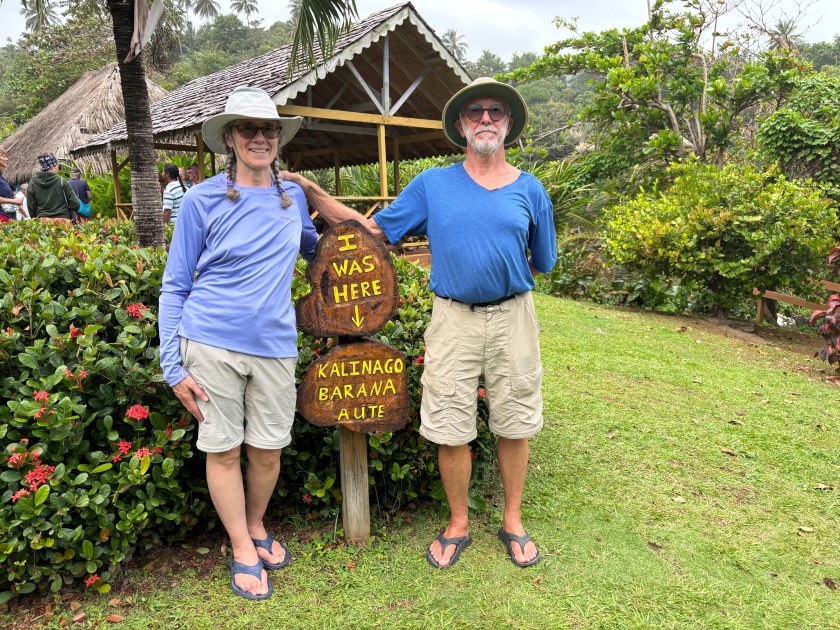
We returned to the west side of the island, and that evening enjoyed a dinner of “Caribbean Flavors.” This included salt cod, roasted bananas and breadfruit, green papaya, and cucumber and cabbage salad. For “dessert,” there was cocoa tea, a wonderfully flavorful combination of local cocoa, cinnamon, nutmeg and coconut milk. Delicious! After two long, tiring, exciting days in a row, we did not stay for the music and dancing.
I’m going to stop here for now, since you’ve had to read so much already. I’ll finish up describing the rendezvous and tours in Dominica- part 3, which I’ll post in a few days.
Until then, stay safe and take care of each other!

 Life on Lady
I think I would have enjoyed that. If I had enough energy.
LikeLike