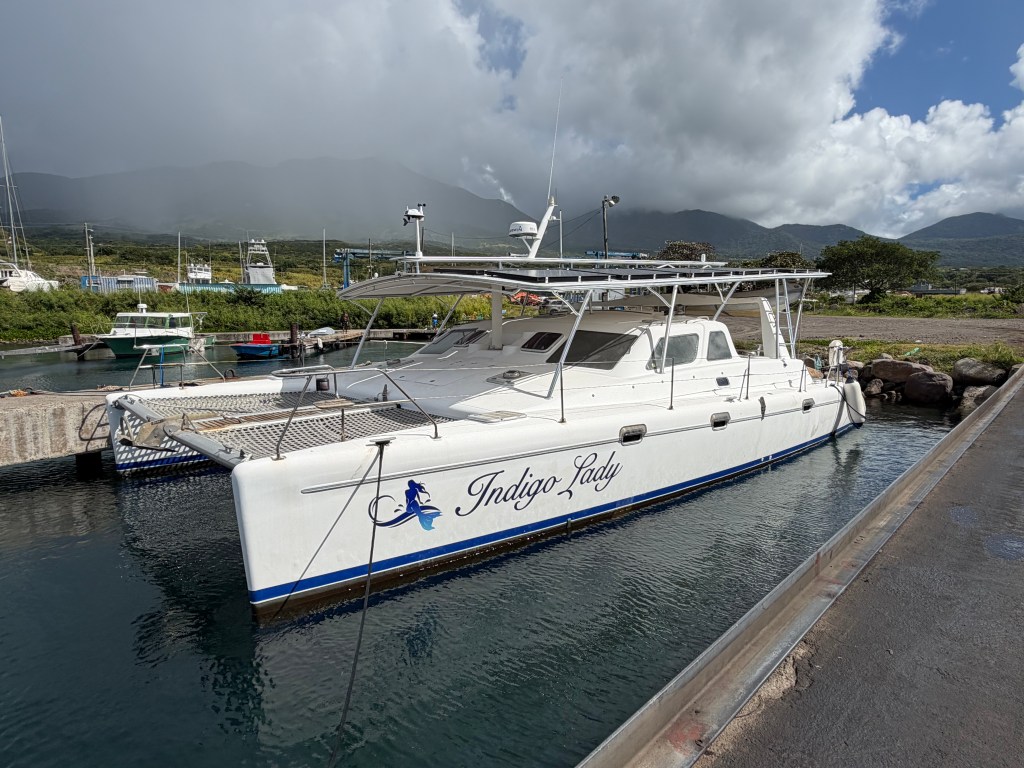
I created this video in June of 2024 at the end of that cruising season. I had intended to post this then, but apparently I forgot.
We have Indigo Lady stored on the hard (on land) for hurricane season and through the holidays. A ton of work goes into preparing her for longterm storage in a hot and humid environment, and we take several days to complete it. Fortunately, we’re getting more efficient the longer we cruise, which is nice. Lists also help us stay on target.
Indigo Lady doesn’t seem all that big until we start to close her up (or open her up). We have four cabins and heads, plus the salon and galley to clean. All things fabric are stowed in tubs and bags with dessicant packets so they don’t grow mold. We move everything near the salon and galley windows into the cabins to give them a break from the UV light. We stow electronics cables and such in tubs with dessicants. There are numerous systems that have to be prepped for storage as well. Finally, because we store her in hurricane belt, we have to take everything that normally lives in the cockpit and move it indoors, so the items can’t become wind-blown hazards should a storm hit. June in the eastern Caribbean is HOT, so this is very sweaty work. It’s for that reason that we do most of the work while at anchor, that way we can easily cool off by jumping into the water.
So here’s a sample of what it takes to get just one cabin ready for longterm storage.
Until next time, stay safe and take care of each other!
I had never even heard the name, flying gurnard, until the last day of our cruising season in June of 2024. Indigo Lady had been anchored in White House Bay at the southeastern end of St. Kitt’s for a couple of weeks. We had spent several of the latter days at anchor deep cleaning and otherwise preparing Lady to be hauled out for hurricane season. Each afternoon, we’d wrap up our hot, sweaty work somewhere around 3-4 pm and go for a snorkel in the anchorage. On our last day at anchor before heading up to the boatyard, we knocked off work as usual and suited up for a snorkel. We’d snorkeled the area a lot and would see the usual sea life suspects, so this time I decided not to take my camera. I joked with Dave that he should thank me, because it meant we’d see cool stuff. The joke was on me, because that one snorkel excursion revealed to us two banded coral shrimp, several constellations of cushion sea stars sporting 4-6 legs, a mass migration of whelk, a golf ball-sized octopus, and the prize of them all, a flying gurnard!
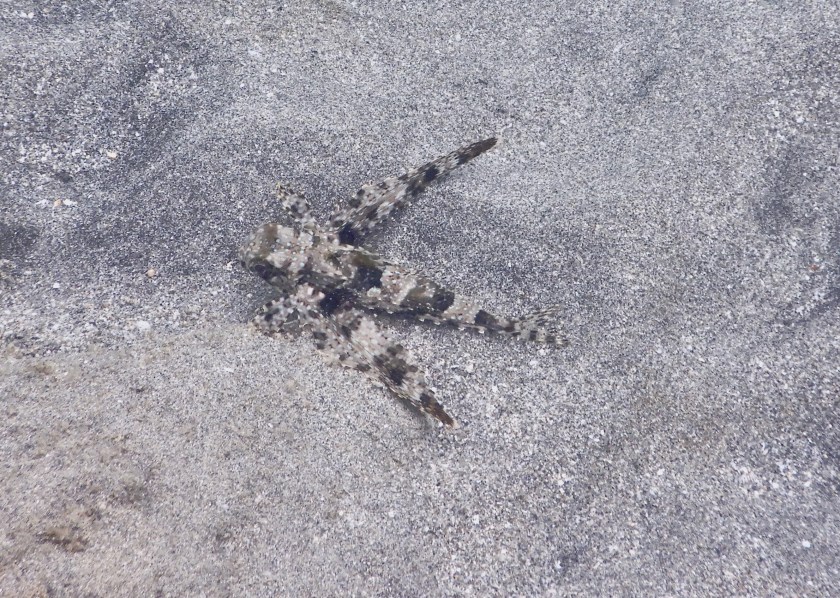
We were snorkeling over a shallow, sandy patch, maybe twelve feet deep. We both saw the creature at the same time and stopped to examine it. It sort of looked like a lizard fish, of which we’ve seen many, but not quite. Its pectoral fins were quite long, almost the full length of its body, and pointed backward. We popped our heads up and wondered aloud at what it might be, then stuck our heads under water again. Then the creature started to crawl! It looked like there were two tiny hook-like claws near where the pectoral fin joined the body. A crawling fish?
We popped our heads up again and wondered some more. Dave decided to dive down and encourage it to swim, so back down we went. When he flicked near its tail, the fish opened up “wings” (its pectoral fins) that were edged in a beautiful iridescent blue, and it “flew” across the bottom for several feet before settling again. We were determined to burn the image into our brains so we could identify it later back onboard. As soon as we dried off after our return to Lady, we pulled out our identification book and started searching. We found the flying gurnard. With that name, we searched the internet and found various other pictures that looked just like our fish. What a find! Too bad we could only describe it to people and show them other peoples’ pictures online.
Cruising season 2025 started in January. We spent a few days in that same anchorage, but only had time for a couple of snorkels. We did not see a flying gurnard. In early March, we were in the Îles des Saintes in Guadeloupe. While reading the section of our cruising guide about those islands, we read that flying gurnards could be spotted at Îlet a Cabrit. We snorkeled there four or five times over three days, and again in April once or twice. We saw several species we hadn’t encountered before, but no flying gurnard. Bummer! We kept our eyes peeled during every subsequent snorkel and dive, of which there were many, in Guadeloupe and later Antigua, but we never saw a flying gurnard. Until our last snorkel of the season…
We were back in White House Bay, St. Kitt’s by late May for an early haul out this year. It was a much shorter stay this time, so our close-up tasks were condensed to only three days. We were too exhausted at the ends of the first two days and did not snorkel, but we vowed to snorkel on our last day before moving up to the boat yard for haul out. Into the water we went on that last day, and this time I took my camera. We stopped at every patch of sand we crossed over, searching for the elusive flying gurnard. At last, it happened. We both saw the fish at the same time- lizardfish looking but with pectoral fins too long. We popped up our heads at the same time and planned for Dave to flick its tail and for me to have my camera ready with recording already started. So that’s what we did, and we got video! The fish just scooted away a bit from Dave’s first attempt, without opening its wings, but eventually, Dave coaxed it to display all its glory and I captured it on film. Quest complete!
So here are a couple of pictures and a video I took of the flying gurnard for you to enjoy. If you’d like to learn more about this fish and its unusual fins, go here.
We got back to our land home in the wee hours of May 22nd, about 1:30am, actually. Indigo Lady is nestled into her hurricane holes (they dig holes for the keels in St. Kitt’s), ready to ride out the season until our return.
Why did we come home so early? We had already planned to fly home May 29th so we could settle in and then attend my niece’s high school graduation the following weekend. So really we only came home a week earlier than planned. There were a few factors that contributed to our decision. First of all, when our friend Ian left us, there were still two weeks until our departure for home. We’d seen all of Antigua that we wanted to see, so staying there wasn’t an enticing idea. We wanted to go to Montserrat, but the reality was that we would have been going for the sole purpose, given our timing, of a single day tour. Turned out that the window we would have needed would have made for an uncomfortable ride across the 25 miles of ocean, and then we’d need a decent window to go St. Kitt’s. We didn’t think a single day tour was worth the hassle. Heading directly to St. Kitt’s and spending two weeks there didn’t appeal either. In addition, I had been dealing with gastric issues since February, which were fine when I took Prilosec, but restarted once I finished. On top of that, my back had been bothering me pretty much daily since early April. It was time to see my doctor and get diagnosed and treated, and we all know how long that can take in the US; best to start early. So we decided to just call it a season and come home.
I still have some stuff to post about our cruising season, and will do so at random points during the summer. For now, we have family and friends to catch up with (and a boat to launch, and a garden to work on, and, and, and).
Maybe next time I’ll tell you about our quest for a flying gurnard. Until then, stay safe and take care of each other!
We left Barbuda at 8:00am on May 4th to return to Antigua. There was a strange vibration around our starboard motor, so for half the trip we ran just using the port motor. Once we got into the calm waters inside Boone Reef on the north side of Antigua, we started the starboard motor again, because the vibration was only happening when we were slewing to the left during a roll over a swell, and the water inside the reef was flat. Dave later discovered that the vibration is due to something minor related to how the external pieces abut each other. It can wait to be fixed once we’re on the hard in St. Kitt’s.
We were anchored in Parham Bay, on the north shore, just before 4:00pm and shortly thereafter dinghied ashore to pick up a few items at the local market. We asked one of the fishermen where the market was and he gave us directions. It closed about 20 minutes before we got there. Bummer! There was supposed to be another market around the other side of town, but we decided not to walk that far lest it also be closed, being Sunday, after all. Plus, we were exhausted from our seven-hour cruise down from Barbuda, and it was hot. We’d come back in the morning.
It was a good thing we decided not to seek out that second market Sunday evening, because when we went in search of it the next morning, it was not where Google Maps and our cruising guide (which also had the wrong market name) had it marked. We did find it, however, thanks to the directions of another local, and procured the handful of items we sought. We went back to Lady and moved about three miles east to anchor off Great Bird Island. It was a much prettier and quieter anchorage than Parham Bay, which hosted a boatyard and a power plant, the latter emitting a low, persistent, rumbling sound. In addition, we could see the bottom at Great Bird. After lunch, we snorkeled some bits of reef in the shallow water off Great Bird. It was both depressing and a bit hopeful. We anchored dinghy in sand, but her stern was floating over an immense stand of dead staghorn coral. So sad. Looking closely, however, I noticed that there is new staghorn growth coming off the ends of some of the old, dead base. These bits were 6” long or less, but it’s a sign of rebirth. Coral grows very slowly; perhaps in the not too distant future this reef will thrive again (she says, hopefully, not really believing the words she types). At other parts of this shallow reef, there were also some soft and encrusting corals, also signs of hope.
The following morning started with rain and solid overcast, but by early afternoon the rain had stopped and the sun was peeking out occasionally, so we decided to snorkel again. This time we took dinghy to Whelk Rock, about ¾ of a mile from Great Bird. This reef is immense! It was at spots breaking the surface and got down as much as 15-20 feet in other spots. The base coral structure was, again, dead, but there was a lot of regrowth of soft and encrusting corals, and there were some fish, the usual suspects. Again, this reef system must have been amazingly beautiful in the not too distant past. 😔
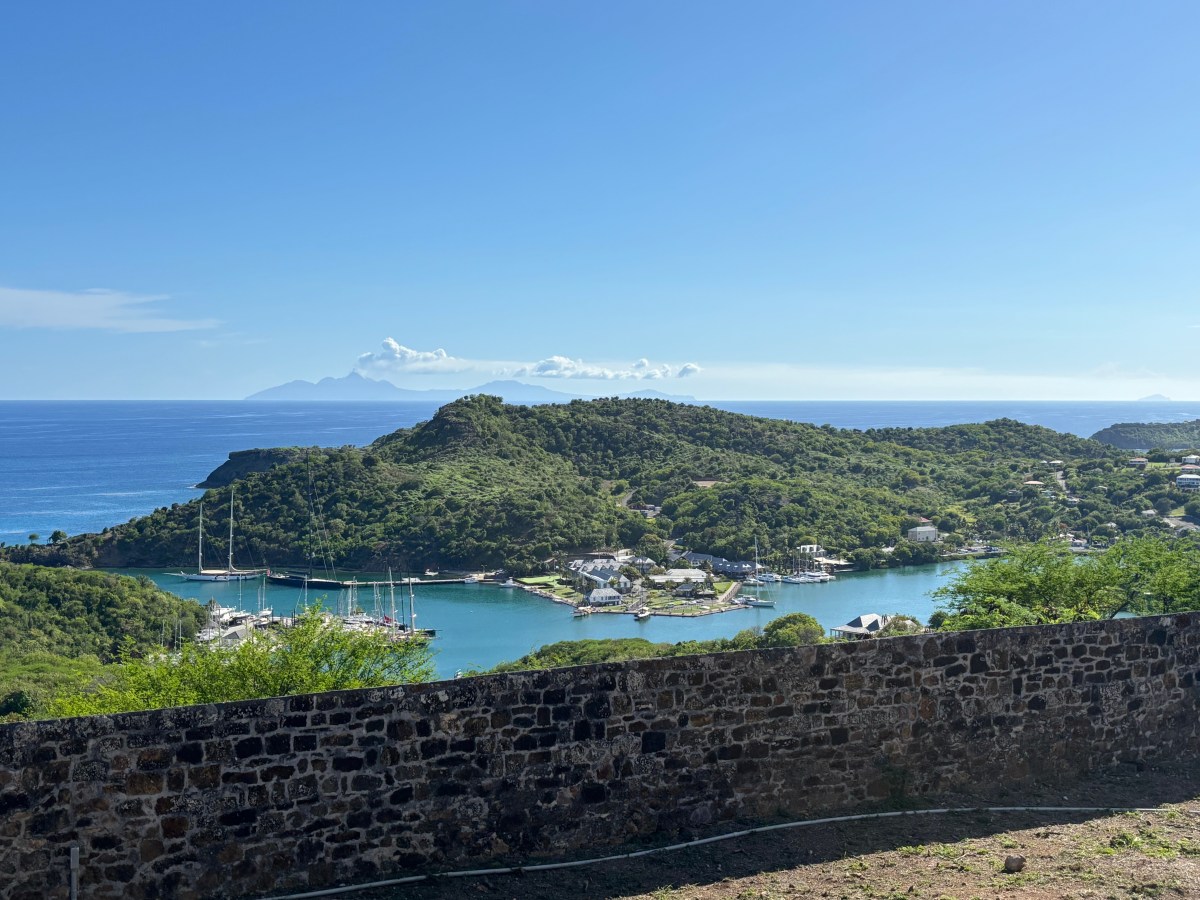
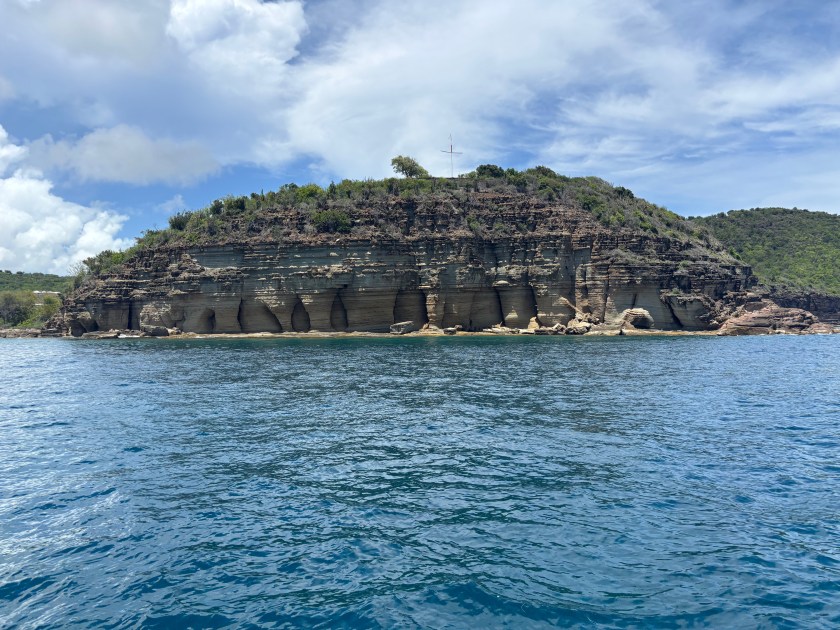
We’d had enough of mostly dead reefs, so the following morning we headed to the south coast to anchor in Freeman Bay, just outside of English Harbor, home of the historic Nelson’s Dockyard. Conditions were quite calm, so we were able to take the shorter route through a channel at the north end of the reef system, then cruised down the east coast of Antigua. It only took about three hours, so we were anchored in plenty of time to snorkel the Pillars of Hercules. The snorkeling, as expected, was pathetic, although we did see some good-sized fish, as well as scattered corals and sponges, the latter of which we had not seen on the other Antiguan and Barbudan reefs. The Pillars, however, are quite impressive. These limestone structures were carved out of the cliff by thousands of years of erosion by wind, rain and crashing waves.
Pillars of Hercules
We swam directly from Lady to the Pillars and back. Once we dried off, we made ourselves presentable and went ashore to the Port Authority to pay the requisite fees for staying in this anchorage. Both English and neighboring Falmouth Harbors, plus the land immediately surrounding both, are part of the Nelson’s Dockyard National Park, thus the fees. We paid a one-time per person entry fee for the park, a daily per person garbage and environmental fee, and a per-foot/per night boat length anchoring fee. Our 5-day/4-night total for three people was under $100 US. Not too bad.
After paying our fees, we bopped around Nelson’s Dockyard a bit so Ian could see it. Then, we walked the short distance to Falmouth and found a restaurant for dinner. Just as we were leaving the restaurant, it started to sprinkle. By the time we got back to dinghy, tied up at Nelson’s Dockyard, it was raining. By the time we got back to Lady, we were soaked to the point where we had to wring out our clothes. Then we had to make room for our wet clothes and ourselves inside, which we managed. It could have been much worse, because there were thunderstorms around us, but they, and their associated lightning, stayed away as we passed the wet evening inside playing cards.
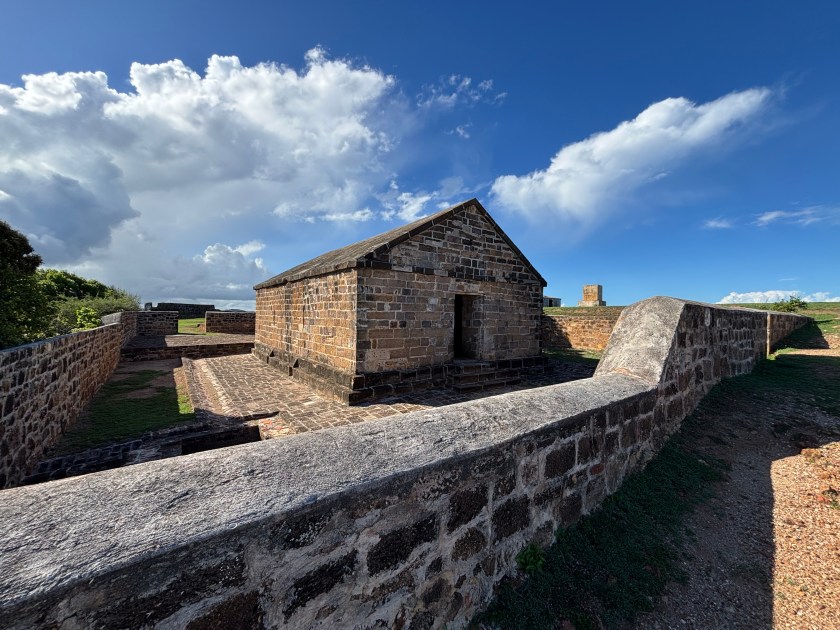
The Freeman Bay anchorage is small and very close to land, and therefore bugs, so we moved over to Falmouth Harbor the next morning, right after breakfast. There was a better breeze and we were further from land, but still only a short ride to a dinghy dock. Shortly after anchoring, we dinghied ashore to pick up our rental car, then we set off to tool around the island for the day. First we followed a largely coastal route across the south coast and up the west coast, stopping at a little place in the town of Five Islands for lunch. We inadvertently drove right through the busy heart of St. John’s after our attempts to circumnavigate it failed (thanks, Google Maps 🙄), then headed east/southeast stopping at Betty’s Hope Sugar Factory ruins to explore those. They had a concise, informative display about its history and that of the sugar industry on Antigua, and the remaining ruins are clustered nearby. It was worth the $2 US donation per person, even though we only got 30 minutes to tour it before they closed for the day. We continued back toward English Harbor to Shirley Heights Lookout for Reggae night, stopping to look at some of the Shirley Heights Fort ruins first. Dave and I had gone a few weeks earlier to their Sunday night music event, but didn’t eat because the line was hours long. This time, there were far fewer people and no line for the food, so we had a nice dinner, listed to the introductory steel drum band, and left before the Reggae even started. We were all tired, and our early departure got us back to Lady before it was fully dark.
Betty’s Hope windmill and old gears (on the ground)Block House at Shirley Heights
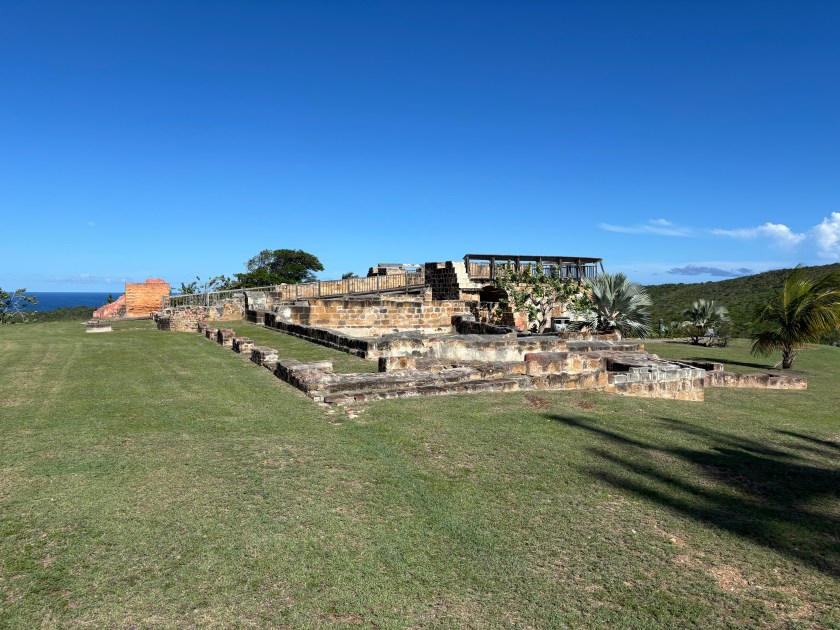
Yesterday we spent another day with the rental car exploring Antigua. We started by going to Clarence House which has served as home to British Navy Commissioners and later to Governors of the Leeward Islands. Sadly, they only do private tours on certain days, and Fridays was not one of them. So, we headed over to the Dow Interpretation Center to look at the limited remains of Fort Dow, and to watch the 15-minute audio-visual presentation about the history of Antigua and English Harbor. It was a good overview, but Dave and I had already learned the content when we visited the museum in St. John’s shortly after arriving here.
Fort Dow
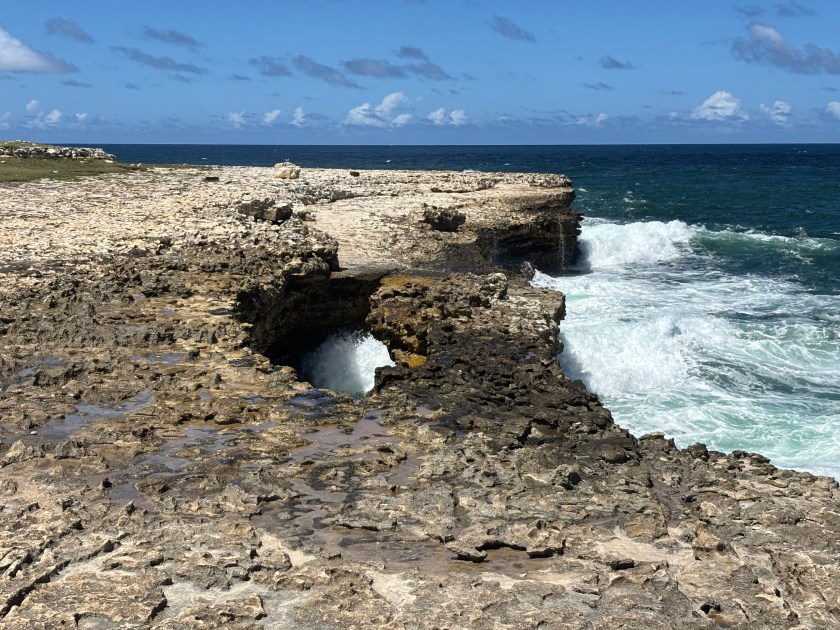
With our history lesson finished, we continued our driving exploration of the island by heading up to Devil’s Bridge National Park at the northeast corner of the island, stopping for lunch in Long Cove first. Devil’s Bridge is a low, natural limestone rock arch and surrounding blowholes, carved out by the crashing waves from the open Atlantic- nothing between it and Africa other than ocean. It was interesting enough. The seas weren’t that big, so the wave crashing was less impressive than I would imagine it is when the Trade Winds are higher. I took some photos, but our timing was bad for sun position, so they don’t really show the bridge well. Alas!
Devil’s Bridge
After Devil’s Bridge, we just tooled around the island a bit longer on the speed-bump and pothole-riddled roads. We attempted to reach Body Ponds Nature Park, but our attempts were foiled, at both its entrances, because Google Maps, at least on this island, does not distinguish between paved roads and unpaved/heavily rutted/almost washed out roads/cow paths. (Thanks again, Google Maps!) We gave up and headed back to Falmouth, stopping for a beer at a little craft beer brewery before heading back to Lady. (The boys report that the beer was “okay.”)
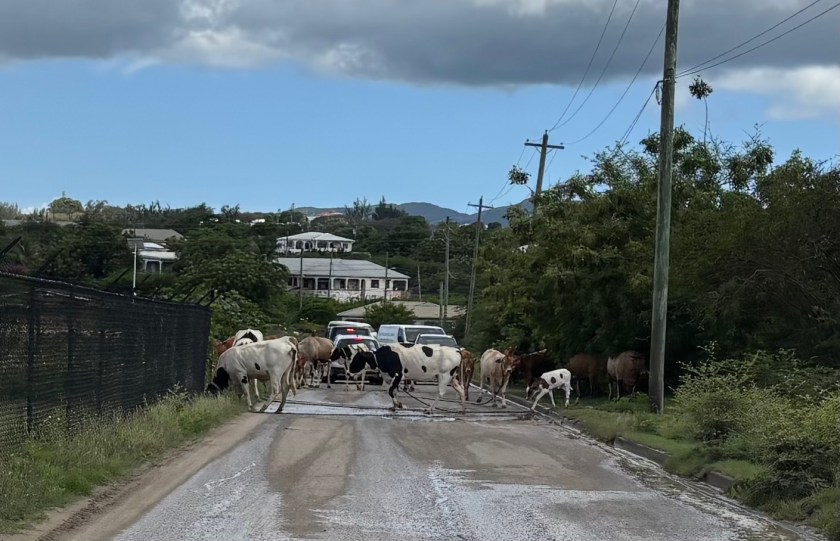
Antigua traffic jam 🙂
This morning we gassed up and returned the rental car after making a stop at Budget Marine for a couple of replacement blower fans and a cabin fan. We also popped over to Port Authority to see about renewing our cruising permit, which expires today. We learned that (a) cruising permits can only be renewed in Jolly Harbor, where we are not, and (b) if we stay anchored where we are until we leave the country, we don’t need to renew the permit at all.
Ian leaves us tomorrow. We want to head to Montserrat for a few days before heading up to St. Kitt’s. We’ll probably choose option “b” from above, since we’ll probably head to Montserrat early this coming week.
My next post will either be from Montserrat or St. Kitt’s & Nevis. Until then, stay safe, and take care of each other!
We didn’t do much in Antigua after my last post on 4/26, other than prepare for the arrival of our friend, Ian. We moved back to Jolly Harbor, did a little provisioning and some boat chores. Ian arrived Sunday afternoon and we just talked the rest of the day, through dinner and until bed. The morning of the 29th we popped ashore so I could use some WiFi and see a doctor to make sure there was nothing wrong with my right ear, which had been off and on extremely itchy deep in the eustachian tube. Other than a little irritation, all was clear. Good. That afternoon we moved up to Dickenson Bay at the NW part of the island to stage for our jump to Barbuda the following morning.
We hauled anchor around 8:00am the morning of 4/29 and had a comfortable 6-hour cruise up to Barbuda. Thus far, it’s been the most comfortable crossing we’ve had this season. We were anchored up near Codrington Lagoon by 2:00pm.
Barbuda, with a population around 1600-2000, lies about 30 miles north of Antigua. Together with Antigua, they gained their independence from Great Britain in 1981. Barbudans didn’t necessarily want to be part and parcel of a single nation-state with Antigua, and their relationship is fraught, to say the least, especially since Hurricane Irma, but that’s a story I don’t know much about. The 62 square mile island’s length is oriented NW to SE. It is composed largely of limestone and volcanic rocks from a long-extinct volcanic arc. The highest point of land on the east side tops out at about 125 feet above sea level. The west side of the island is characterized by Codrington Lagoon, a saltwater lagoon about 6 miles long and about 1½ miles wide at its widest point.
For most of its existence, the lagoon’s connection to the open ocean has been an inlet through the mangroves on the northwest corner of the island. It is otherwise separated from the open ocean by a long, narrow, sand spit. Codrington Lagoon is ecologically important for several reasons. First, it serves as the nesting grounds for the largest Magnificent Frigatebird colony in the world. It is also home to several other bird species, the rare Antiguan racer snake, and the smooth-headed iguana. It is a nursery for lobster, conch and fish that are important to the Barbudan economy. For example, they export lobster throughout the world. The lagoon and its sand spit also protect the island’s main settlement of Codrington from impacts of storm surge and hurricanes. In the past, two hurricanes (one the 1960s and the other in the 1990s, I believe) have breached this sand spit, but it repaired itself within two years or so. Hurricane Irma in 2107 breached this divider again, only instead of repairing itself over the past several years, the breach has become wider, reaching almost 2 miles! If this breach doesn’t repair itself, it will have lasting impacts on the island and its inhabitants, both human and non-human. (Cited from Smith Warner International.)
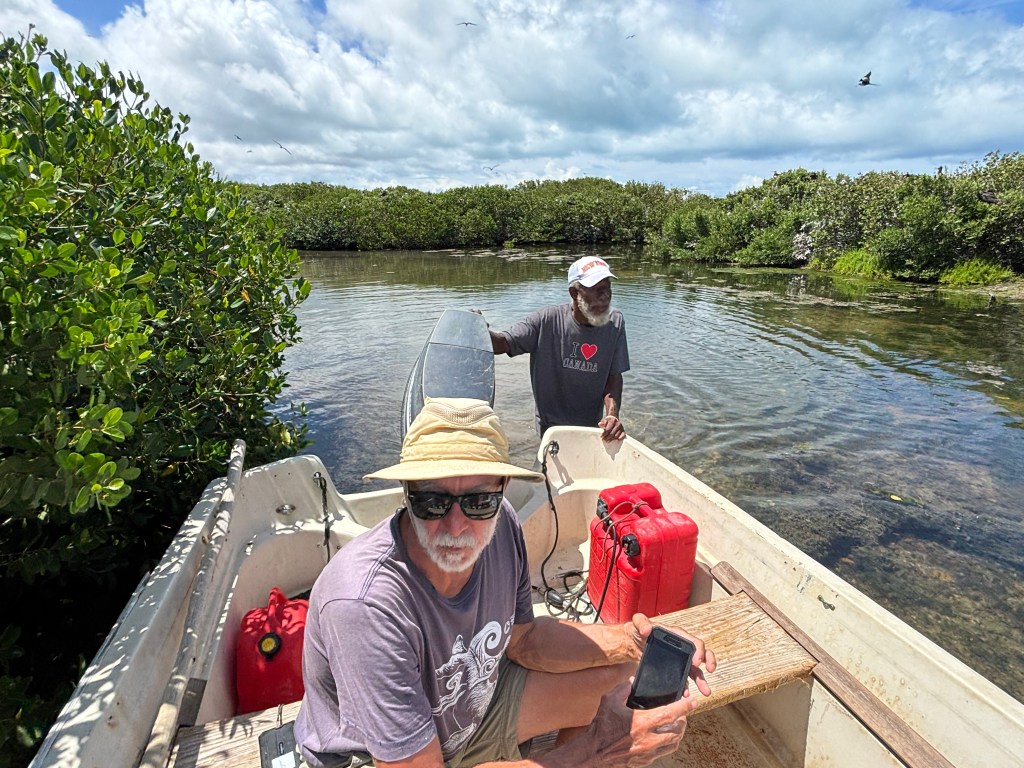
The morning after we arrived at Barbuda, we set out in dinghy at 8:30am to meet our guide for the Frigate Bird Sanctuary, a tour we had arranged before our arrival. We met George Jeffrey at the Codrington fishing dock, and the three of us, plus two other cruisers set off with George to see the birds. The first stop he made was well outside of the sanctuary where George told us a bit about the sand spit breaches I mentioned before, plus a little about the current troubles between Barbuda and Antigua. Then he took us to a small sandbar where he stopped again. That sandbar, devoid of all but a handful of tiny new growth mangroves, is the former site of the sanctuary. In 1960 (maybe 1961?) a hurricane hit Barbuda. Before its arrival, the Frigatebirds flew off to evade the storm. Upon their return, they found their mangroves gone, so they just flocked to another section of mangroves a little further north, and they’ve been there ever since. Then it was time to meet the birds.
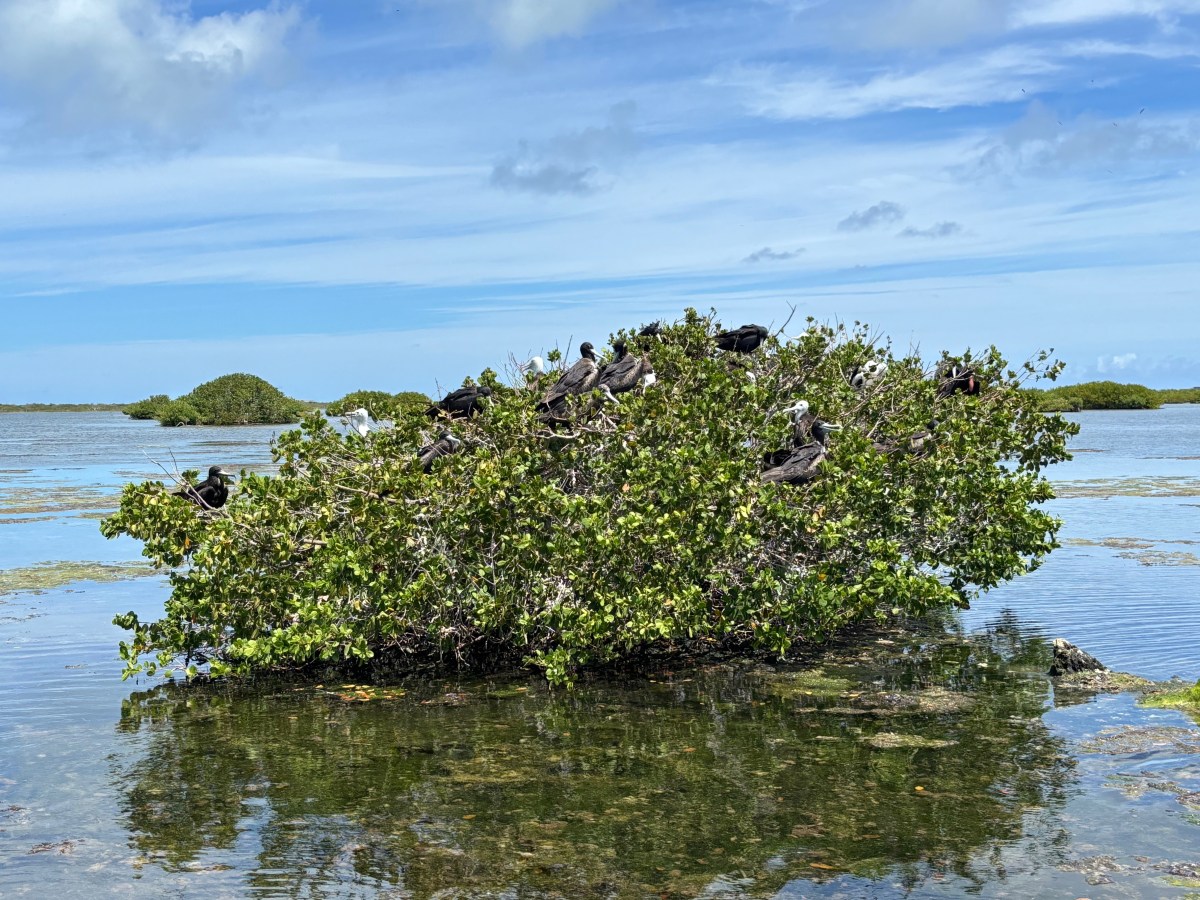
What an amazing sight! In a stretch of mangroves approximately ¼ x ¾ of a mile, are thousands upon thousands of birds (I’ve seen estimates ranging from 12,000-20,000). The mangroves were heavily laden with (mostly female) adults and chicks of various ages. They were squawking, but it wasn’t as loud as I’d expected. George got out of the boat and slowly maneuvered us through the shallow waters, through upsidedown jellyfish-infested waters (they don’t sting) around the mangroves so we could observe them closely. We spent about a half hour just watching the birds. They are the national bird of Antigua & Barbuda and are on the Barbudan flag. George told us a bit about them, and I looked up more information later, all of which I share below (and include the links I used so you can read more if you like). There are pictures at the end of this post.
Frigatebirds are agile aerialists, that can fly for days on end, but they don’t go into the water. Their feathers, in fact, are not waterproof; they would be unable to lift themselves back out of the water. They feed on small fish (locally, flying fish are a favorite) which they scoop from the water’s surface, or steal from other birds. Adults are about 3½ feet long (beak to tail) with a wingspan of about 7½ feet. They have a deeply forked tail. All adults have black feathers, but the females’ chests are white while the males sport a bright red throat pouch. That throat pouch is how they woo females during mating season, which generally runs from September-April (peaking in December), which explains why we saw chicks of varying ages. Once a female has chosen her mate, the two build a nest where the female deposits a single egg. Both parents share the work of incubating the egg, which lasts about 50 days, and then feeding the chick. The males take off after about three months. The chicks fledge at about five months. The female continues to feed the chick for another four months or so. The chicks are fuzzy white and grow into their black feathers over time, with their heads changing color last. We saw newer chicks of fluffy white with only a few small black feathers forming on their wings, and we also saw older chicks just waiting for their heads to go black. (Audubon)(Lonely Planet)(Wikipedia)
Codrington Lagoon, where this colony resides, became a National Park in 2004. One can only enter the sanctuary with a local guide. The National Park only charges $5 per person to enter the sanctuary. Our tour with George cost $60 for all five of us together, so $12 per person. If you’re ever in Barbuda, I highly recommend taking this tour. If you can’t get George, there are several other guides as well.
The day after our Frigatebird tour, May 1st, we hauled anchor late morning and moved Lady to a reef anchorage on the south side of Barbuda, settling in Gravenor Bay. We spent two nights there, and this morning we moved about a mile closer to Spanish point at the southeast end of the island. There is a lot of shallow patch reefs to explore in this area, and we’ve explored many of them over the past 3 days. These are not very healthy reefs, but they’re better than what we’ve seen in Antigua. They are certainly heavily storm damaged, as evidenced by the coral rubble, and they also suffer from what ails all the reefs we’ve snorkeled and dived on in the Caribbean- bleaching, disease, and overuse (by incautious tourists). Unlike our experiences in Antigua, however, there is more sign of recovery here. We did not see any sponges, but there were many corals. A large number of them were sea rods, but there was quite a variety of other corals as well, just in smaller numbers. There were the usual fish suspects, and we saw several southern stingrays and sea turtles, and Dave saw an eagle ray. It was nice to finally have some snorkeling worth doing, and it was encouraging to see the regrowth.
Either tomorrow or Monday we will head back to Antigua to do some snorkeling on the north side reefs. Then we may move south to Falmouth Harbor to do some snorkeling there and explore the island’s interior by car before Ian returns home.
Until next time, stay safe and take care of each other!
Young chickChick gaining black wingsFledgling (note the white head)Adult femaleAdult maleMangroves full of FrigatesDave and our guide, George
I’m probably not being fair to Antigua. It’s not Antigua’s fault that we’re feeling a little disappointed and bored. It’s just that here there’s not as much of what we like to do when we visit a new island. Antigua is a very popular vacation destination, and with over 300 beaches, I can understand why many choose to travel here. It’s also popular with many cruisers, but we didn’t think to ask those we’ve met who have been here why they like it. It just hasn’t suited our tastes thus far, though we’re not quite done exploring yet. We’ve left the north coast and some inland places that require a car rental for when our friend, Ian arrives this weekend. Just having a friend visit will make things more interesting.
The biggest disappointment has been the lack of good snorkeling, which, along with diving, are our favorite activities. Our two snorkels on the west coast had extremely poor visibility of 1-2 feet in milky blue water, likely due to silt. We snorkeled our anchorage, and saw little, even clear water wouldn’t have made it interesting- sand, grass, a few small fish and a few upside down jellyfish. Boring. A couple of miles north in Deep Bay we hoped to snorkel the shallow wreck of the Andes. Good thing it was shallow, because we only caught a glimpse of one part of it by diving down to within 2 feet of its hull. If it had been any deeper, we wouldn’t have even seen that. We saw a drone picture of it through crystal clear water that someone took this March. Sadly, we got the milky blue water this month <sigh>. The Andes was a three-masted merchant ship hauling a load of tar to Chile in 1905. Unfortunately, said tar caught fire en route and the ship burned to the water line and sank in Deep Bay. It would have been fun to explore it more, since it’s only in 30 feet of water. Even I can dive down almost that deep and hold my breath for 30 seconds. Alas!
When we finally found clear water on the south coast, we were disappointed again. We visited 3 sections of the 2-mile long stretch of Cades and Middle Reefs only to find a lot of coral rubble (probably from past hurricanes), and any standing coral mostly dead, like 99% dead. Not surprisingly, there were very few fish. Our final snorkeling disappointment was in Nonsuch Bay on the east coast. The bay is protected by a very extensive reef. It’s a beautiful anchorage, but again, the reef, though in crystal clear water, was mostly rubble and dead, although there were some signs of recovery/regrowth here in the form of some small, healthy brain corals, a few soft corals, and a few more fish. So, it was maybe 10% recovered. We even saw a 3-4 foot black grouper and a 4 foot barracuda, but they were probably just passing through from the deeper waters beyond the reef. We also visited the mangrove-lined Ayers Creek on the SW side of Nonsuch Bay. Sadly, and perhaps it’s due to the time of year and the influx of sargassum, the water was an opaque, murky brown, and the water stunk. Yuck! So much for a dinghy safari through the mangroves.
We also had a land-based disappointment over Easter weekend. Both Good Friday and the Monday after Easter are public holidays, so everything is closed, likewise on Easter Sunday, though not much is open on Sunday around here anyway. That gave us Saturday the 19th to try to do something ashore. We decided to visit the Donkey Sanctuary, run by the Antigua & Barbuda Humane Society. We did start out for the sanctuary by taking the first bus to St. John’s. Unfortunately, Google Maps had the sanctuary in the wrong place. It was much further away and required a bus from the East Bust Station across town. We went as far as to walk there and inquire about getting to the sanctuary, but after waiting 25 minutes for the necessary bus without it showing up, we decided to ditch the trip. That bus was only going to get us within 20-25 minutes walking distance anyway, and we’d just have to repeat that walk and the wait for a bus in the peak heat of the day. No thank you. Maybe we’ll stop by with Ian when we have a rental car.
Okay, I know I’m being Debbie Downer, but this is reality. Just because we’re in the Caribbean doesn’t mean we’re having fun every minute of every day. Disappointments happen anywhere. You all know that. Still, I don’t want to leave you thinking Antigua is completely horrible, because it’s not. Like the other volcanically formed islands, the coasts are impressive and beautiful! In Carlisle Bay, on the south coast, I fell asleep the other night to the sound of the frogs chirping onshore. Nonesuch Bay on the east coast offered an amazing view of the open ocean, which our bow was pointing at most of the time. If you sailed out through the reef due east, the next land you’d encounter would be Africa. That’s both awe-inspiring and humbling. Just today, we returned to Carlisle Bay from Nonsuch, only this time we snorkeled the shoreline. Yes, much of the coral is dead, but there is some living coral, both hard and soft, plus new growth sponges, and we actually saw numerous fish. Improvement.
Our friend Ian arrives Sunday, and like I mentioned earlier, we’ll rent a car for a couple of days and do some land stuff that I’m sure we’ll enjoy. We’ll also explore the north coast, hoping for better snorkeling. If not, we hear it’s beautiful up there, and the water is always good for a refreshing dip. Maybe we’ll get really lucky and have a chance to pop up to Barbuda. (It’s 35 miles away, so we’re not counting on that, but you never know.)
That’s all for now. I hope to have more positive things to tell you about Antigua soon. Until then, stay safe and take care of each other.
We’ve been anchored in Jolly Harbor on the west coast since our arrival on April 10th. It’s a convenient location for several reasons. It’s a very well protected harbor, so quite calm. A short dinghy ride brings us to an excellent dinghy dock at the marina where there are a variety of services available- car & bike rentals, SIM cards and data plans for two carriers, a variety of yacht services, restaurants, etc. There is a well-stocked marine supplies store (Budget Marine), and an excellent supermarket (the Epicurean). There is also a bus stop, which allows us to get to other parts of the island without costly taxis. Car rentals are pretty cheap and make it even easier to see the whole island (the buses don’t go everywhere), but we’ll save that for when our friend Ian arrives.
We spent some time with our new friends on Pulpo before they left on the 15th. They rented a car on Sunday and invited us to drive around the island with them before heading over to Shirley Heights (ruins of a British fort) for a weekly night of music. We found lunch at a great little roadside Lebanese place, then walked the sargassum-covered beach nearby. The music at Shirley Heights started just after 4pm with a steel drum band that played for a couple of hours. They were followed by a cover band that did a bunch of reggae and pop music. There is also a BBQ on Sundays, but the line was long the whole time. Also, Lobo (Pulpo’s owner) owned a restaurant in the past and he was not impressed with the pre-cooked food all sitting out at ambient temperature for hours. We decided to pass on dinner. Fortunately, our lunch had been late and substantial, so we weren’t hungry anyway. There had to have been about 500 people at this outdoor venue! The music was good, and so was the people-watching. We had Lobo and Dan over for a final dinner together Monday night.
Tuesday after breakfast, we took the bus up to St. Johns, the capital of Antigua. All the bus routes go through St. Johns, where one can transfer to other buses at the main bus depot. It’s about 20-30 minutes, with stops, from Jolly Harbor to St. Johns. We walked through the Market, a bunch of shops selling a variety of kitsch and local art, as well as produce and other food. Then we went to the Museum of Antigua and Barbuda where we learned about the history of the island, a little about its geology, and a bit about its culture. It has a lot of information packed into a small space, the bottom floor of the former courthouse built in the 1800’s. It was a bit challenging, however, because the information was in print I found too small to read without leaning forward over the glass display cases set in front, upon which we were not supposed to lean. I actually ended up using the magnifier on my phone to read everything, which worked nicely. After the museum, we found good local food nearby, checked out some other souvenir shops, and purchased a painting mounted on burlap to add to our art collection of places we’ve visited. The bus got us back to Jolly Harbor early enough to relax before dinner.
On Thursday we took two buses to get to English Harbor on the south shore of Antigua so we could visit Nelson’s Dockyard. By car the drive would have been 45-60 minutes. Between waiting for buses and all the stops they make, the trip took us almost two hours. It was a good way to see other parts of the island, though, and far less expensive than a car rental or taxi. Our round trip cost the two of us together all of $10 US. We got a later start than originally planned, so it was already time for lunch when we arrived. Once our bellies fed, it was time to tour the Dockyard.
A little history, first. There was a light British naval presence in English Harbor from 1725-1740. When the French started to ramp up their efforts to thwart British trade in the Caribbean, the British started to rely more heavily on the location and started construction on the dockyard, which back then was known as the Antigua Naval Dockyard. The peak of construction ran from 1780-1820. With Napoleon’s defeat at Waterloo in 1815, the Caribbean was quieter and the British military relied on it less. Still, they operated it until 1889 when it was closed and abandoned, then fell into disrepair. In the 1920s, the then Antiguan Governor’s efforts to raise funds to restore the yard fell short. Efforts were made again in the 1930s, including rebranding it Nelson’s Dockyard, and by 1961 it had been reopened as an historic site. In 1984, the Dockyard and 16 square miles of historical and natural sites around it was classified as a National Park. In 2016, Nelson’s Dockyard and Related Archaeological Sites was named a UNESCO World Heritage Site. If you want more detail, you can visit the National Parks Antigua page or its Wikipedia entry.
Both English and Falmouth Harbors, plus a good chunk of land around them, are part of the Nelson’s Dockyard National Park. Nelson’t Dockyard is a working marina, and there are several other marina’s in Falmouth Harbor. Anchoring in either harbor requires paying a daily anchoring fee, a daily environmental fee, and a one-time entrance fee for the park which allows one to enter the land parts for the duration of their stay. When Ian is with us, we’ll likely take Indigo Lady down there for a few days, because there is some easily accessible snorkeling nearby. We checked with the Port Authority while we were visiting the Dockyard and three days will cost us all of about $100 US. I wouldn’t want to stay any longer though; it would add up quickly.
They’ve done a lovely job restoring the old buildings, which are now all inhabited by modern businesses that cater to yachties. There are shops and restaurants, of course, but other buildings are inhabited by the marina office, Customs & Immigration, the Port Authority, a Sail loft for sail repair, an art studio, a bakery (interestingly in the building that originally served as the dockyard’s bakery), the museum, and others. Each building has a placard outside describing its original function in the dockyard. The museum is housed in the Naval Officers & Clerk’s House. It provides good information about the history of the dockyard, life in the British Navy, information about Nelson’s career, and it also has a room dedicated to the ecology of the island. I found it to be an interesting mix of historical and modern, and it really is lovely. This week is the Antigua Classic Yacht Regatta, so there were some gorgeous (VERY expensive) classic sailing vessels in the marina when we were there. They had a race that morning, but it was over by the time we arrived. It was worth the bus trip down, and we were lucky that the return trip was shorter.
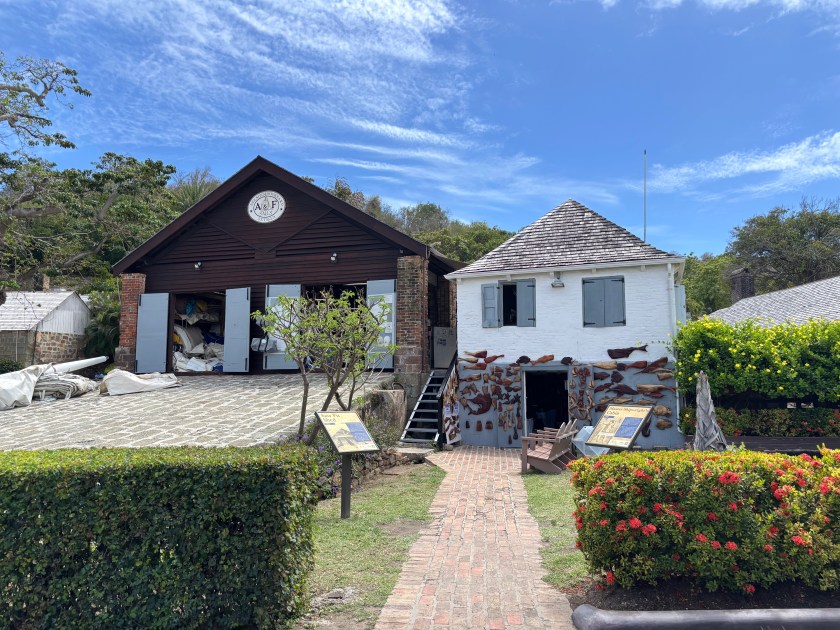
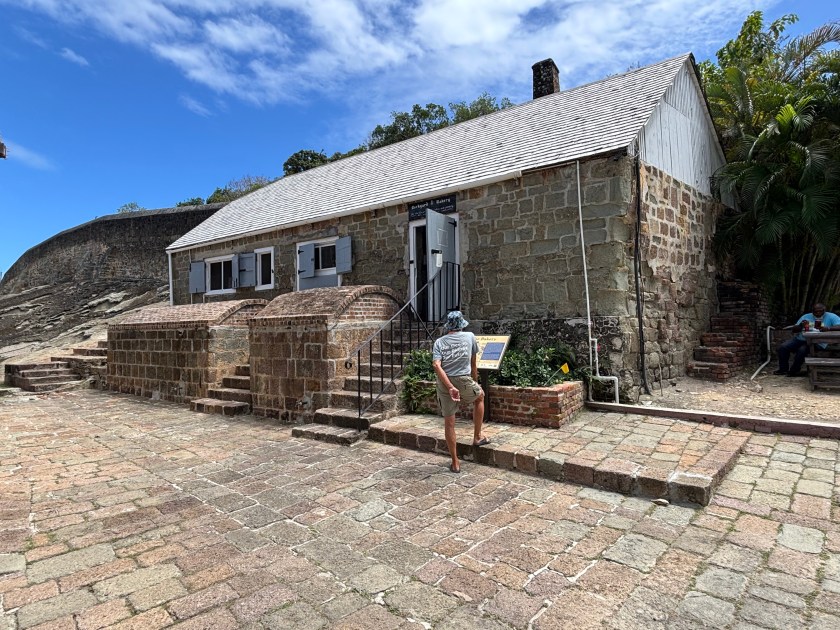
Sawmill shed (now a sail loft) & Shipwrights Cabin (now an art studio)The Bakery (still a bakery)Naval Officers & Clerk’s House (now the museum & gift shop)
There are a couple of other places we’d like to visit by bus from our base here in Jolly Harbor. However, it is now Easter Weekend, and Friday and Monday are public holidays, so most things are closed those two days, as well as on Sunday. The sugar factory ruins we want to visit by bus reopen on Tuesday. This leaves us with little to do over the long weekend. The snorkeling in this anchorage is pathetic. Visibility is poor and there’s little to see anyway. The Donkey Sanctuary is open on Saturdays and public holidays, so we may try to go there, assuming the buses are running. These “buses” are privately owned 12-15 passenger vans, so it’s up to each owner whether they run on any given day. We assume someone will be driving Saturday. There’s a wreck to snorkel about 2 miles north of here, so that’s another option. I’m sure we’ll find a way to keep ourselves busy.
That’s all for now. Until next time, stay safe and take care of each other!
I last wrote on April 1st (posted the 5th) and we were still in Guadeloupe.
We were in Guadeloupe another eight days and in that same anchorage for five of them. Honestly, we were a bit bored. We snorkeled another time and dove two more times. I mentioned last time that we had met a couple of American cruisers when we went ashore one day. They are on a sailing catamaran called Pulpo (Italian for octopus). That was the saving grace for our sanity. We told them to stop by if they wanted to see our solar electric system, since they were interested in it. A couple of days later, they did so. The tour of our system turned into a few hours of socializing with cheese, crackers, salami and apple as dinner once we realized it was too late for a real dinner and we were all hungry. 😂 A couple days after that, we invited them over for pizza and had another enjoyable, rambling conversation for several hours.
We and Pulpo ended up both moving north to Deshaies on April 7th. They picked up a mooring ball. We tried to anchor, but dragged, and the anchoring section was pretty tight anyway, so we went north one more mile to Grand Anse and anchored in lovely sand. Just the change of scenery was mood-lifting, and we spent the rest of the day reading in our hammocks and enjoying the new view.
The following day, we did some travel planning over breakfast and decided that conditions looked sufficient for moving on to Antigua two days later, on Thursday, August 10th. In the meantime, we had two days to explore. So we packed a dry bag with stuff we’d need ashore, donned our swimwear, masks, fins and snorkels, and swam ashore. The swell, though not bad at anchor, was too dangerous for landing dinghy ashore, she would have been swamped; so we swam instead.
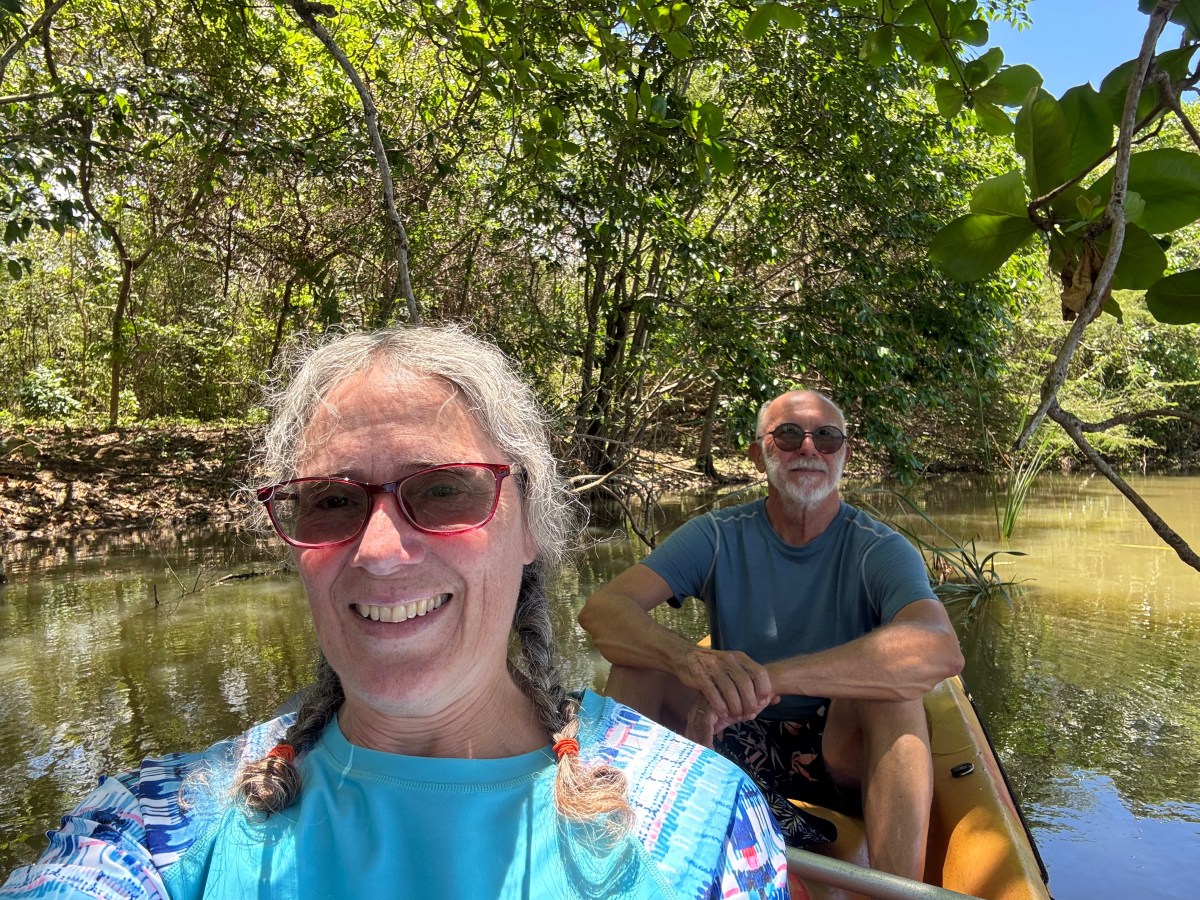
Once ashore, we put our snorkeling gear in the mesh bag we’d packed, retrieved our glasses, hats and shoes, and headed for a little shack that rents kayaks for paddling around the mangrove. We rented a two-person kayak from a very friendly man who told us the mangrove has only existed for forty years and resulted from dredging for sand to build elsewhere on the island. He gave us the mangrove map and explained the various “stopping points” labeled on it. Then we set off. It was lovely! It was mostly an open mangrove lake, but there was one area where we could wend our way up the mangrove “river” several hundred feet, dodging mangrove roots and ducking under branches. It was soothing and mystical-feeling, and absolutely beautiful. There was another spot where we could pull the kayak onto a dry patch and then hike a short path into a 200-year old stand of very tall palm trees. Imagine the storms they’ve seen and survived! They were quite impressive. There was very little growing under them, since they block most of the sun. The ground was littered with fallen palm fronds, very big palm fronds. Occasionally there was a frond still attached to the piece that wrapped it to the palm’s trunk. This felt sort of like vinyl, which surprised us both. After about 20 minutes of gazing in awe, we went back to the kayak and continued around the mangrove lake to a shady spot under a sea grape tree where we sat for a while listening to the birds all around us. One little bird perched on a low branch just in front of us and serenaded us for a while. How sweet! Eventually our tummies started rumbling, so we returned the kayak and sought out lunch.
We ate at one of the many small restaurants lining the parking area of this popular beach destination. This beach area is more like White Lake State Park in NH, minus the camping. It’s not at all like the New England beaches. Yes, it’s a long sand beach, but between the sort of paved parking and the beach is a good-sized area of sand and palm trees, offering people a place to set up for the day in the shade. The restaurants, a couple of food trucks, and one little souvenir shop outline the parking area. The restaurants are more like glorified shacks, covered but open at the front and often the sides. Lunch was yummy.
The following day, Wednesday, we needed to get our clearance papers stamped at customs in Deshaies. Although we could have dinghied from Grand Anse, we wanted the ease of dropping mooring lines rather than hauling anchor when we got underway at 6:00am the next morning, plus we wanted to see Pulpo again. So we texted them to ask if there were any mooring balls open, to which they responded yes. As soon as we finished breakfast, we hauled anchor and ended up grabbing a recently vacated mooring right next to Pulpo. Yay! We each did our own thing that day. They went for a monster bike ride around the area. Dave and I stopped at Customs for that clearance stamp, grabbed croissants at the local bakery, then walked back toward Grand Anse via the main road through town and then along a shaded road/path. We walked a bit into the forest to an old battlement, now sporting one lonely old cannon, then we exited the trees onto the far south end of Grand Anse and walked over the sand back to the main swimming area, then out to the main road and back into town. Pulpo invited us over for dinner and we spent another lovely evening eating and chatting. They would also be heading to Antigua the next day, but didn’t need to leave as early as us, since they can sail faster than we can motor.
Our alarm went off at 5:00am on the 10th. We had a quick breakfast, then dropped the mooring lines as planned at 6:00am and were off to Antigua. It was a tolerable passage, but not enjoyable. It was rolly and salty (that means we got splashed with sea water). As anticipated, Pulpo caught up with us, then passed us, arriving at Jolly Harbor about an hour ahead of us. The only two enjoyable events on the crossing included the sighting of what we think may have been a sperm whale off in the distance. We could see it tail slapping the water. The other brief event was Dave hooking a marlin, which, unfortunately, he did not land. He got to see it tail walk just before it shook off the lure. Bummer! For the first half of the trip we used the generators, until the sun was high enough that we could switch to just solar and battery. It was fairly cloudy, but the sun peeked out just often enough, and we were making good speed at an average of 6 knots, that we arrived in the anchorage at Jolly Harbor with 35% left on each battery bank. Dave dinghied into Customs to clear us in and met Pulpo there. They had brought their big boat into one of the Customs docks. They followed him back and anchored near us. They came over that evening for tacos and games.
It is so good to finally have a new place to explore! There are many anchorages all around this island, and we’ll have 5-6 weeks to explore them. Pulpo will be here for another week or so, before they have to start heading back south for hurricane season. Our friend Ian will be joining us at the end of this month.
The next time I write, it will be about our time here in Antigua. For now, enjoy the short video of our tour through the mangroves.
Until next time, stay safe and take care of each other!
From Marie Galante we popped back west to Îles des Saintes for some more snorkeling. We thought about diving, but the hookah is loud and there are a lot of people snorkeling where we wanted to dive, so we just snorkeled. The visibility is very good, so snorkeling is just fine. We spent two nights at Îlet à Cabrit, our favorite snorkel spot in Guadeloupe, and one night at Pan du Sucre. The snorkeling at the latter was good, but not as good as Îlet à Cabrit.
Hoping late March would provide an opportunity to head to Antigua, we decided to revisit the west coast of Guadeloupe, where we had spent six days back in late January/early February as we island hopped down to Dominica. On 3/22, we headed north to the anchorage about 1 nm south of Basse Terre, outside Marina de Rivière-Sens. Shortly after arriving, we dinghied into the marina and tied up to the wall so we could walk to Fort Delgrés. It was only a 20 minute walk, which turned out to be a good thing, because the fort was closed due to lack of water. Bummer! So back to the marina we went. It was hot, but at least there was a breeze, and most of the walk was along a pretty esplanade.
The next morning we traveled the 10+ nm north to the anchorage at Plage de la Malendure. We’d been here for two of those six days in early February and knew then we wanted to return. Just after our arrival and lunch, we snorkeled right off Lady on the north end of the bay, which we had not done last time. It was soon obvious why so many people from the little beach in the NE corner of this bay snorkel up and down this stretch; there is so much to see! It’s almost as good as Îlet à Cabrit. There’s lots of rock rubble for structure, covered in a fair amount of coral, including soft corals like sea fans, plus there were a ton of sea plumes (also a soft coral), many sponges, and lots of fish. The closer we got to the NW point, the more barrel sponges we saw. We snorkeled here two more times over the next few days.
Also while in this anchorage, we snorkeled the south and east sides of Pigeon island again, which we had done in early February. This visit, however, we also snorkeled the north and west sides. There is a lovely wall with lots of coral, sponges and fish. We thought it would be hookah-worthy for a dive, but weren’t sure it was worth setting up hookah for just one dive. There is also a spot with dive mooring balls just north of the NW point of the Bay, aptly named Pointe de la Malendure. We dinghied over to it and snorkeled there. Great reef! Now there were two spots we thought were hookah-worthy, and we knew there was another spot with mooring balls another mile north of this one. That afternoon, we set up hookah. We did dive the site just north of Pointe de la Malendure and the site one mile north of that, but we opted not to dive the wall at Pigeon Island. Pigeon Island is very busy with tour boats all day long, taking divers and snorkelers. Trying to navigate all that with the noisy hookah and two 60-foot hoses just seemed rude. The other two sites are much less busy. When we dove the nearer dive site, there was only one other small boat with divers, who we never saw and was gone by the time we resurfaced. At the more northerly site we had the reef to ourselves. Both were very good dives, with the nearer one being a little more diverse in its flora and fauna. We were glad we set up hookah.
About 4:00pm on 3/29, a National Park Service boat pulled up to tell us we were in a no-anchoring zone, along with 3 other boats. They kindly explained the markers that our charts simply labeled as “special purpose buoys” (not a helpful label), and gave us a QR code for their Marine Park app that shows where one can and cannot anchor in all their marine park locations. Very helpful, once I translated the French 🙄. So we and the three other boats moved a little further south in the bay. Sadly, we are no longer right next to the good snorkeling, but we had our six days, so we can’t complain. Had we recognized the official park boundaries, we wouldn’t have anchored there in the first place.
I’m writing this on April 1st (no joke) and we’re still anchored at Plage de la Malendure. Today is our 10th day here. It’s nice and all, but I am starting to get a bit bored. Yes, it is possible to be bored in paradise. We’d hoped for a weather window to head to Antigua, but that didn’t pan out. Then we thought maybe we’d go to the other marine park on the north side of the island between the “butterfly wings,” Grand Cul de Sac Marin, but that’s a lot of shallow reef navigating and there were supposed to be increasing winds and a big swell from a northerly direction, plus intermittent cloud cover which reduces the light needed to see the reef well. We don’t have local knowledge of the place, so it seemed unsafe to risk trying our hand up there. On top of that, it looks like we’re stuck on the west side of Guadeloupe at least through this coming Saturday.
Now what? We’re being indecisive. We know we don’t want to risk the marine park on the north. There’s not much sense going back to Les Saintes, because (a) it’s a bit far in the wrong direction for going to Antigua, and (b) the conditions the next several days won’t be great to head there anyway. Ditto for the south coast of Grand Terre. That leaves us three main anchorages on this side of the island. As long as we’re being indecisive, we may as well stay put and get some stuff done.
Over that past two days, I made cookies, weeded through a bunch of photos and did a small load of laundry. We went ashore to grab a few items at the nearby grocery store and discovered a reasonably priced laundromat with a washer and dryer large enough to wash two complete sets of queen sheets, plus a mattress cover in one load. On Lady that would be five loads and take two days. Score! After our grocery run, we got our bedding and headed back to the laundromat. We had lunch at the nearby boulangerie during the wash cycle. During the dry cycle, Dave explored the hardware/homegoods store next door while I caught up on email. Back at dinghy, we met two American men, cruisers just setting off for a bike ride. We chatted with them for a bit. It was our first socializing since our cousins left March 5th 😳. I miss socializing with other cruisers.
Now it’s April 1st and we still aren’t sure what we want to do with ourselves. We’re pretty certain we won’t stay in this anchorage the rest of the week. We’ve exhausted the activities we care about here. We had hoped to go to the zoo nearby, but there’s no good way to get there from here. It’s at least 1.5 hours walking each way. The bus schedule is limited and might give us at most an hour at the zoo, IF the buses are on time, which we’ve heard is an issue, and a taxi would double the cost of the excursion. Not sure the small zoo is worth it. This is an issue on this side of the island. The bus routes and schedules are limited and there are not many places accessible on foot from the anchorages. There are only two other anchorages on this side of the island that provide an opportunity to do anything ashore. If we head back south to the anchorage near Basse Terre, we may be able to rent a car and go see some sights. If we go north to Deshaies, we could rent an electric scooter, but I’m not sure how far we could range on that. At any rate, we’ll likely move someplace new tomorrow.
Mother Nature is having her April Fool’s joke today. She’s been sending us sunny moments punctuated by periods of rain. We’ve given up trying to sit in the cockpit or trying to keep the hatches fully open. We’re now inside with only our slider and the two small side hatches open. Good thing it’s not hot.
When this posts on April 5th, we’ll still be somewhere in Guadeloupe. Hopefully the post after that will be from Antigua, but we won’t hold our breath, and I suggest you don’t either.
Until next time, stay safe and take care of each other.
We had a comfortable 20 nm cruise from St. Francois to Marie Galante on Friday, March 14th. We anchored in Anse Canot (Anse = bay or cove), off Mays beach, in crystal clear turquoise water. We’d planned to go ashore to walk the beach after lunch, but just as we were finishing said meal, the starboard generator randomly started itself, more than once. Say what?! Several hours of trouble shooting ensued. The bottom line is that we have no idea why the generator did that, and the only thing that finally “fixed” it (at least for now) was shutting everything off for a while and restarting it. Basically, Dave rebooted the system. He was so frustrated. We spent the rest of the afternoon in our hammocks so Dave could decompress. Poor guy.
The following morning we did go ashore after breakfast. We beached dinghy, locked her to a tree and set off. We were heading for Plage du Vieux Fort to find a trail we’d read about in the cruising guide. The trail we found wasn’t “the” trail, but it was a lovely walk through the forest. At one point, it abutted the mangrove river, but on the side opposite what we’d been looking for. There was a small structure with educational signs (in French, of course) about various species of flora and fauna found in the area. There was also a little dock. Eventually, the trail dumped us out onto another road, but we opted to retrace our steps along the forest trail because it was a shorter distance to get back to our starting point. Once there, we continued a little further along the road along Plage du Vieux Fort and finally found what we’d been looking for, sort of. Turns out that the mangrove “trail” we thought we were looking for was really the mangrove river, but that was fine, because there were pedal boats we could rent for $9 euro per person for an hour. So we did that, and we slowly pedaled our way ¾ of a mile up the river until it was no longer navigable, then turned around and pedaled back, slowly. We even passed that educational building and dock we’d stopped at along our hike earlier. It was a lovely way to see the river and its surrounding area.
Pedal boat on Marais du Vieux Fort
Back at dinghy, I stayed with her while Dave went to unlock her from the tree. He returned with blood pouring down his face, dripping down his nose, and covering his glasses. I reached for the small med kit I always have on hand. All Dave wanted, however, was something to staunch the flow until we got back to Lady. I found some toilet paper and that did the trick. How did Dave gash his scalp, you may be wondering? The brim of the bucket hat Dave was wearing obscured his view of one of the low-hanging tree branches and he hit hard against it. Remarkably, the hat was not torn and stayed on, until Dave yanked it off his head, that is. Back at Lady he gave the 2 ½ inch gash a thorough cleaning with soap and water while sitting on the sugar scoop. It wasn’t deep, so no stitches needed. Good thing, too, because we would have had to move Lady down to the next anchorage to get to a town and hope a doctor was available on a Saturday on this small island. Instead, five wound closure strips later, the wound was sealed. Glad we have a comprehensive med kit onboard! For extra protection in bed at night, we added a gauze pad secured with two additional wound closure strips and Dave wore his thin dive beanie. Fortunately, scalps tend to heal quickly, so he was able to ditch the gauze and beanie after a couple of nights. The event rather subdued us for the rest of the afternoon, so we just swung in our hammocks.
Dave’s boo boo. Lisa’a first time applying would closure strips.
The following morning we walked the long, lovely Mays beach, then hauled anchor and popped down to Baie St. Louis, 2 nm south. We stayed aboard all day so that I could do a bunch of laundry while Dave made water. We also did a lot of reading in between.
Monday morning, 3/17, we went ashore after breakfast to rent a scooter and ride around the island. Only there were no scooters to be had. Dang! Two phone calls later, I’d managed to reserve us a scooter for 8 AM the following morning. It is not easy navigating these sorts of things in another language, one I don’t know well, so I was cranky by the time it was done. We got pastry. That helped. Then it was time for a new plan. We decided to walk a mile to a farm we’d read about that has bees and makes their own honey, honey mead, honey punch (alcoholic), and honey soaps. En route we passed a gorgeous garden at a crossroads, in what appeared to be a mini park with a couple of benches outside the garden. Whoever is in charge of that garden is an artist! The blend of colors and textures of plants was amazing!
As we neared the bee farm, it occurred to me that we probably couldn’t do the tour because it would be in French. I was correct. The farmer spoke a bit of English, however, enough for us to learn that they have 200 hives across the island, and that they were out of honey until 10 days hence. Bummer! We were able to taste the mead and punch, though, and bought a bottle of the punch and three bars of their soap. Then we returned to town and to Lady for a lazy afternoon.
Then it was scooter day! We picked up our scooter and were on our way by 8:30 AM, in large part because the young man who got us our scooter spoke a fair amount of English. We started out heading north for a scenic stop at Gueule Grand Gouffre, a natural arch in front of a 50-foot diameter chasm carved by the sea. Wooden barriers prevent one from getting too close, probably a good thing, but it was lovely. The bumpy “road” to it, not so lovely.
Dave on the scooterGueule Grand Gouffre
We then continued around and down the east side of the island, stopping for a snack in Capesterre in the southeast. We were going to walk the beach a bit, but it was covered in sargassum, so we passed on that. Next, we backtracked and headed inland a bit to a rum distillery, Distillerie Bellevue. It’s been in production for a couple of hundred years at least, though it’s all modern now. Some of the old ruins are still on the grounds. They allow visitors into the distillery far enough that one can see all the equipment, and they have placards (in French) about the distilling process. We could even go up some steps to peek into the fermentation tanks. Then we had a free tasting and left with a bottle of their old rum. French Caribbean rum is distilled from sugar cane, not molasses, so it has a different taste, which we still enjoy.
Inside Distillerie Bellevue
It had been a lovely ride to the distillery, and we took another scenic set of roads toward Grand Bourg, a town in the southwest, stopping first at the ruins of a rum distillery called Habitation Murat. We’re getting pretty good at getting the gist of the information on the French placards at these places. This distillery ran from 1660 to 1899!
Sugar factory ruins at Habitation Murat
We had lunch in Grand Bourg, then dubbed our way back to St. Louis and returned our scooter by 3:30 pm. The scooter and the 1.2L of gas we used cost us $37 euros and change, and it was a fun way to see this lovely, largely rural island.
After five days at Marie Galante, it was time to move on. More about Guadeloupe next time. Until then, stay safe and take care of each other.