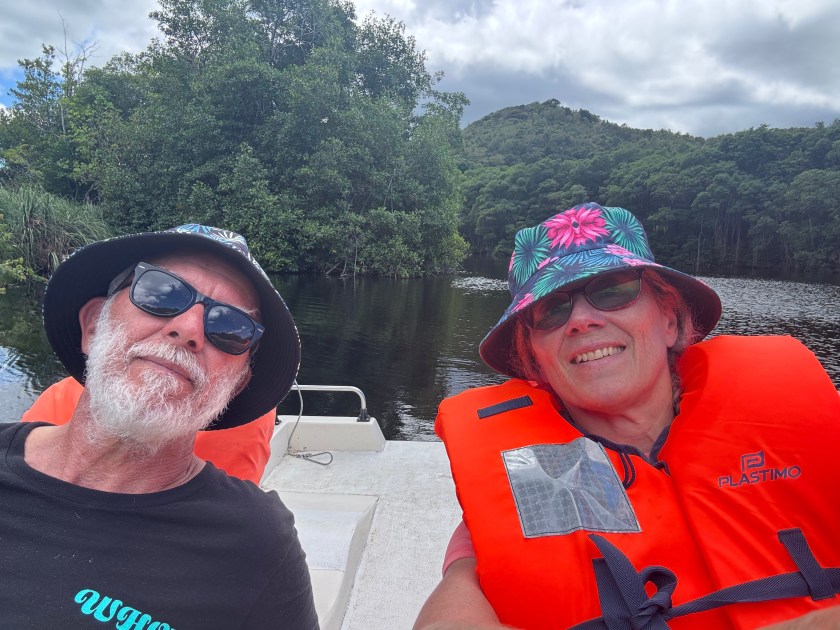
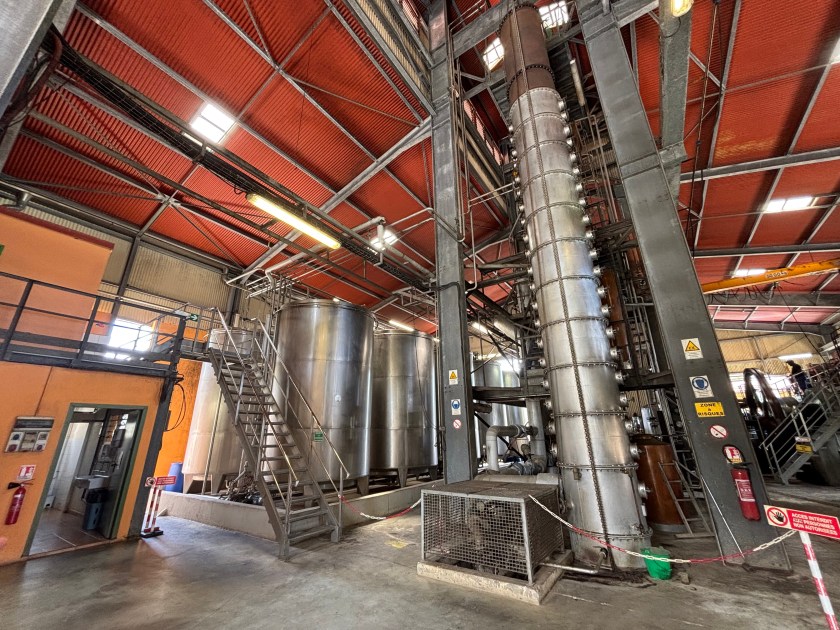
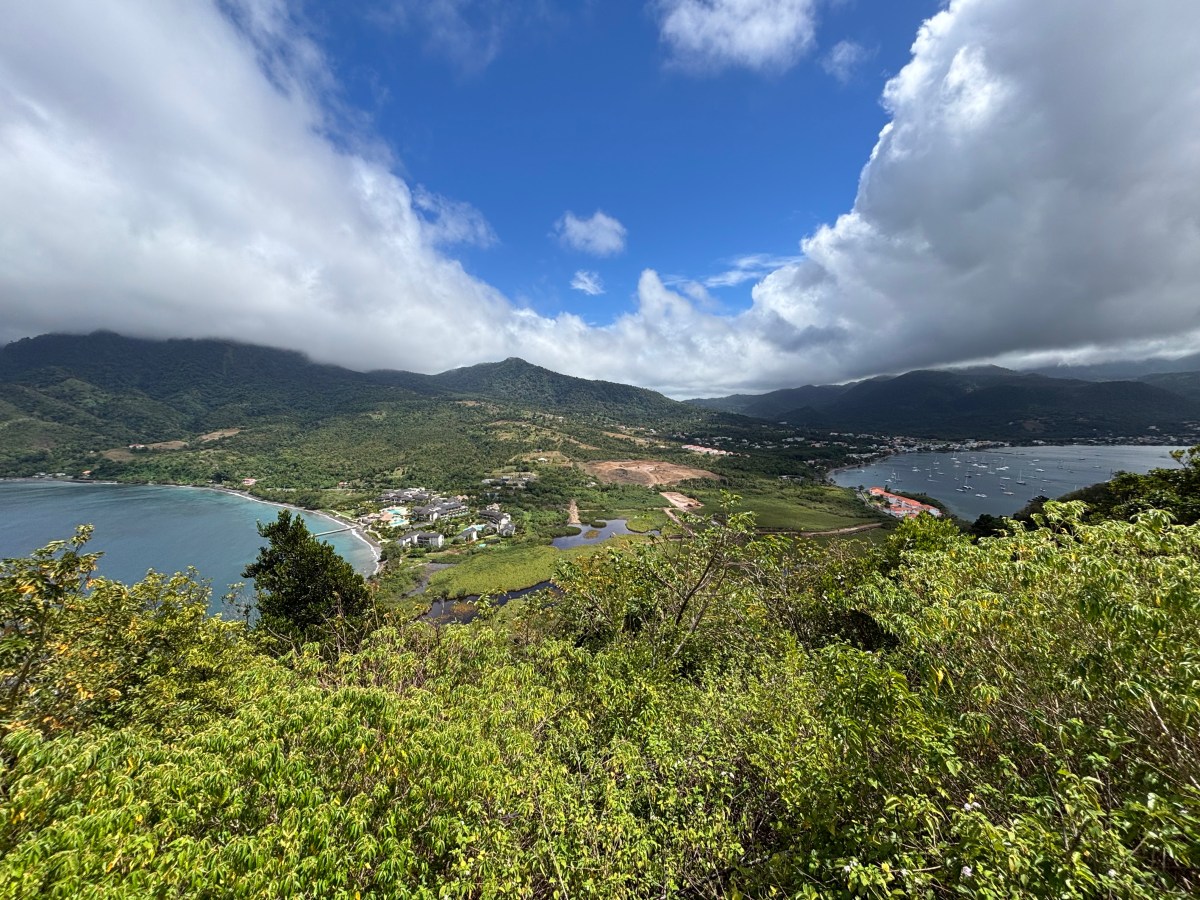
South coast of Grand Terre, Guadeloupe

I write this on 3/28 and we’re still in Guadeloupe. That weather window I mentioned a couple of posts ago wasn’t much of a window, so we decided to stay put and to explore more here. My last lengthy post covered through March 5th, and 3½ weeks is a lot to catch you up on, so I’m not going to do it all at once. You’re welcome. 😉

Last time I wrote at length, we’d just seen my cousins off on March 5th, bidding them farewell in the mall parking lot while we tried to renew our data plan. No dice. The Orange plan I’d originally purchased never let me do anything via the app or by dialing the requisite numbers on the phone and the agent in the store at the mall couldn’t help me either. The Digicel store was closed. Good thing our T-mobile plan works here; that bought us more time. The trip wasn’t a complete bust, however. We discovered that there is a supermarket in the mall. We scoped it out and realized we could do some reprovisioning here another day. For now, we just walked back to Lady to rest. The following day we did laundry, made water, worked on reassembling the boat to pre-guest status, and I took stock of our provisions. It was a productive, yet still restful day.

Freshly rested, Friday was our day to reprovision and finally get data. We didn’t need a lot of provisions, so we decided to make two separate trips to two different markets to get what we needed. After breakfast we walked to Leader Price, a smaller supermarket only 20 minutes away by foot. There was also a fresh produce market along the same route. We took our wheeled cart, stopped at both locations and returned to Lady to unpack and eat lunch before setting out again in the afternoon, this time for the mall that had both a supermarket and a Digicel store. We opted to finally take the bus rather than walk the 45 minutes to the mall. Buses are more difficult to figure out when everything is in a different language and the driver doesn’t speak any English. Thanks to my limited knowledge of French and Google Translate, I was able to tell him where we wanted to go. Unfortunately, he must have forgotten about us, because next thing we know, we’re in Point à Pitre, having passed the mall. Ultimately, we got to the mall. Dave worked on completing our shopping while I got us a SIM card and data plan, then we caught the bus back to the town of Le Grosier where Indigo Lady was still anchored in the bay. It was open market day in the park where dinghy was docked, so we scoped that out for a bit. The market is awesome, with lots of produce for sale, as well as fragrant bulk spices and spice mixes, plus food stalls galore and local made crafts (as well as some kitsch). Finally, we returned to Lady for yet more unpacking and dinner.

There were still more errands to run on Saturday. We took the bus to the marina complex, just outside of Point à Pitre. This time I used the bus’s app to figure out which bus to get on, though I still checked with the driver when we boarded, and this time I let him know that I wouldn’t know when to request a stop. That worked. We arrived at the marina quickly, went in for our $10 worth of parts to fix our microwave/convection oven and came out with $250 worth of stuff. Happens every time we go into a marine supplies store. 😂  It was all stuff we’d planned on buying eventually anyway, and this was a very well-stocked store. Our microwave works again, and we have two shiny new dock lines and a few other things.

After a week anchored at Îlet du Grosier, we finally hauled anchor on 3/10 and set out for St. Francois, 16 nm east along the south coast of Grand Terre. We did not get that far. It was a bumpy ride and we were in no rush, so instead we stopped at Petit Havre after just 3 nm. This is a pretty little open anchorage protected only by the reef, which breaks the swell so that it’s bearable. Snorkeling was out of the question, however, because the surge on the reef was too big. We enjoyed watching a group of about 8 kiteboarders playing around in the shallows. Mostly we did laundry and a few other chores. Dave was just starting to prep dinner when he noticed the freezer thermostat was reading too high. An hour later, he had the faulty valves in the freezer cooling water circulating pump repaired and went back to fixing dinner. Jazz in the hammocks seemed appropriate for that evening. It was. ☺️

From Petit Havre, we jumped another 3 nm east to St. Anne. It was still a bit bumpy traveling eastward, and we figured we may as well visit all the south coast anchorages. This is another open anchorage protected only by the reef. Shortly after anchoring, we dropped dinghy and headed to the fishing harbor just north of us and tied her up there so we could explore. We walked about town and cruised through a few shops, including the Artisan Village right near the fishing harbor. St. Anne is popular with local tourists and has a busy, touristy downtown and beach. As one might expect, the closer to the beach one is, the more expensive the food is. So we walked inland a couple of streets and grabbed inexpensive, yet still enjoyable, baguette sandwiches at a spot frequented by locals rather than tourists. We got some homemade ice cream near the beach afterward and then returned to Lady. The highlight of this anchorage was the sailing school. Not long after our return to Lady, I heard Dave call from the tramp that the sailing school was out and about the anchorage. We spent the next 90 minutes watching and cheering on the 10-14 year olds zipping around the anchorage, navigating each other, the anchored boats, and the floating markers they were supposed to be racing around. Most of the boats had a single sail and single child aboard, but there were also three slightly larger boats with two sails and a crew of four kids. They excitedly waved as they passed us. The lead boat proudly flashed us the “we’re #1” sign as they passed. It was an enjoyable way to spend part of an afternoon. 

The following day we finally made it to St. Francois, 8 nm east of St. Anne. This is another open anchorage, but it was even better protected by a more extensive reef than the prior two anchorages. It was also expansive and shallow. We anchored in about 6.5 feet of water and it was almost flat calm. After lunch aboard, we dinghied to the marina where we left dinghy on a very nice dinghy dock, then we proceeded to walk about town. It’s a big marina full of mostly local boats, though they have some dock space for transient boats. The water, however, was nasty and smelled. No thank you; I’ll stay at anchor. There were many shops and restaurants around three sides of the marina, and it all kind of spilled into the main town and down toward the fishing harbor as well. We also discovered a supermarket near the marina. Score! 

The following morning we headed ashore about 8:30AM for breakfast and WiFi at a restaurant bordering the marina that we’d scoped out the day before. Yes, we have our own data, but we needed to update operating systems and apps, and backup our phones and iPads, and that uses too much data. So we spent a couple of hours (public WiFi is slow) doing the tech thing and enjoying a leisurely breakfast. After that, we walked down to Marché le Rotunde (the round market). The building is, well, round, and inside there are crafters set up at tables, and all around the exterior, but still under an extended roof, were stall upon stall of people selling local produce, honey, syrups, jams, juices, and very fragrant spices and spice mixes. Oh the wonderful aromas! Dave succumbed and bought a couple of small samples of spice mixes. I bought a yard of the locally made Madras fabric, which is brightly colored red, blue and yellow plaid that is traditionally used for costumes for Festival. Maybe I’ll make an apron out of it. Our next stop was a quick lunch of paninis at a street vendor, then we continued on to the Musée des Beaux Artes. It’s a small art gallery run by a small non-profit and only costs $5 euros to enter. It has a large number of artworks by artists with some sort of connection to Guadeloupe. It was well laid out, and most of the signs were in both French and English. Yay. We then popped into the supermarket to pick up a few things for dinner before returning to Lady for the evening.

Sculpture and paintings at Musée des Beaux Artes

As delightful an anchorage and as nice a town as St. Francois was, the conditions were perfect for cruising south to Marie Galante, so that’s what we did the morning of 3/14. I’ll tell you about that next time.

Until then, stay safe and take care of each other. 

Octopus sighting!

I’d rather be in my hammock reading than blogging. So today I’m going to give you some eye candy.

In early March, we saw a football-sized common octopus at Îlet à Cabrit, Les Saintes, Guadeloupe. I managed to catch a video of him swimming, crawling and then hiding.

Enjoy the show!

Until next time, stay safe and take care of each other.

Be our guest

Four of my cousins from Maine arrived late evening on 2/20. They had flown into Guadeloupe on the 19th and took the ferry the following afternoon from Point à Pitre to Roseau, Dominica. Dave took a taxi to drop off that Garmin display we had to return and to pick up the cousins at the ferry dock to get them back to Portsmouth and Prince Rupert Bay. They were onboard by 7:00pm and we turned right around for dinner ashore at the Purple Turtle restaurant. The service was SLOW, but the food was well worth the wait.

The following day was pretty low key. We took everyone ashore to get local currency and to pick up some fresh produce. We were planning to stay aboard the rest of the day until our friends on Sunny Girl showed up in the afternoon and asked who wanted to hike the Cabrits. Dave and I had already done it, but the cousins joined Kevin and Marsha. When they all returned, we had Kevin & Marsha stay for drinks and apps.

One tour Dave and I did not mind at all repeating was the Indian River tour, only this time, per the recommendation of Faustin Alexis, one of the PAYS guys, we did a 7:00AM tour. It turned into an 8:00AM tour because it rained at 7AM. Alexis picked us up as soon as the rain stopped and he gave us a lovely tour. We were early enough still that there were no cruise ship groups touring the river yet. Since the bush bar at the end of the tour route was closed in the morning, Alexis instead gave us a walking tour through the forest. It was worth getting up early to do the morning tour! We got back to Lady just before lunch and were deciding what to have when lunch came to us. A man and two women came up in a small boat selling chicken roti for $15 EC each (that’s $5.50 US). Easy, cheap and yummy! We spent a lazy afternoon aboard after that.

We had a 9:00AM tour with Alexis on Sunday 2/23. He took us first to the Syndicate Nature Trails and we walked one while he pointed out the flora and described its uses. His knowledge is vast. We then backtracked through Portsmouth to Calibishie where we had lunch before proceeding on to the Chocolate Factory. After that, Alexis took us back to Portsmouth via the northernmost road that passes through the old volcano crater and past the cold sulfur springs, complete with sulfur smell. Along the way, Alexis described his island to us. Born and raised here, he’s seen a lot of changes during his lifetime, most of the recent ones not necessarily good changes, especially since their economy has been depressed since the 1980s, and it worsened after Maria hit in 2017 and the 3000+ student medical school left the island for Barbados. We were back on Lady by 5:30pm after a fabulous, but long and tiring day. Lunch had been late and large, so we had a snack-y dinner and were all in bed by 9:00PM.

We were boat bound all day on the 24th because it rained off and on all day. The weather wasn’t much better on the 25th, but we had to go ashore, despite the rain, to do some final errands and clear out of the country so we could head to Guadeloupe. We were drenched! The rain mostly stopped by the time we returned to Lady and we dropped the mooring and set off for Les Saintes. The first part of the crossing was a bit bumpy until we cleared the northern tip of Dominica and Dave could alter our course to put the seas behind us. We made good time to Les Saintes, averaging 6.5 kts, and we were even lucky enough to get the last mooring ball in the anchorage at Bourg de Saintes at the island of Terre de Haut.

It was not raining in Les Saintes, and their mountains were not under clouds! (It rained to some degree every day we were in Dominica, for three weeks.) We spent our first full day walking about town, getting a mid-morning pastry treat and lunch later. In the afternoon, we snorkeled a wrecked ferry in the anchorage, close enough that we could swim to it right from Lady. The following day we returned ashore to hike up to Fort Napoleon. It was a hot uphill walk, but well worth it. The grounds are a lovely, well-maintained garden and the fort houses and excellent museum. The placards are all in French, but I got the gist of most of it. The walk back to town was faster and less sweaty, since gravity was in our favor, and we found delicious sandwiches before returning to Lady.

The last three days of our time in Les Saintes were spent on a mooring at the Îlet à Cabrit, 1nm west of Terre de Haut. This is a quiet, uninhabited island, though several day trippers showed up by small boat on the weekend. We explored the ruins of Fort Lorraine and of a hotel that never amounted to much, but mostly we snorkeled. The west end of the island has particularly good snorkeling, despite the sad state of reefs in general. There was an extensive grass bed, plus rubble and coral, many sponges and quite a variety of fish. Richard & Sharon even saw an octopus! The rest of us were jealous. Still, Dave and I saw several fish we’d never seen before, including a coney, a chain moray eel, a sharptail eel and a goldspotted eel. 

We spent the final two days with our cousins up in the anchorage at Îlet de Gosier on the south coast of Grand Terre (the right butterfly wing of Guadeloupe), about 3 miles east of Point à Pitre. The anchorage is off a little island named for the nearby mainland town of Le Gosier, just a short dinghy ride from the anchorage. Îlet du Gosier is a park that vacationers, mostly French, and locals frequent. A small ferry runs continuously, during daylight hours, between the island and the town dock in Le Gosier. We did dinghy to the little island to explore it and the numerous little beaches around it. Late afternoon we went ashore to walk about town and to have dinner.

The following day we walked over an hour to the marina near Point à Pitre to decide if we would go there the next morning to drop off the cousins to go to the airport. It turned out to be too risky, not knowing if a mooring ball would be open or where we might anchor. When we walked out of the marina office, however, Bob talked to a cab driver who was dropping off a fare, and she spoke English! So he arranged for her to pick us all up at 1:30 PM at the aquarium (our next stop) and to also pick them up in Le Gosier near the dock the next morning. Win! So we backtracked to the aquarium and enjoyed about 90 minutes there. It’s small, but well curated, emphasizing local fish and their environs. The aquarium has the only sea turtle rescue in the eastern Caribbean. We grabbed drinks at the bar/restaurant outside the aquarium while we waited for the cab driver. Once we were back in Le Gosier, we sought out a late lunch. It was so late, in fact, that we opted to pick up baguettes, cheese and hard meats for an appetizer-like dinner later on Lady.

The morning of March 5th dawned bright and sunny. We had breakfast together, then the cousins started packing up to return home and otherwise soak in the warm atmosphere before they had to meet the taxi at noon. We joined them in the taxi and ultimately bid them adieu in the parking lot of a mall, where they graciously had us dropped off so we could sort out more data, since the data on our local SIM had been used up.

And this is where I shall leave you for now. I will tell you that I am writing this on March 22nd and Dave & I are still in Guadeloupe, eyeing a potential weather window late next week to move on to Antigua. Next time I will tell you more about our time in Guadeloupe. Until then, stay safe and take care of each other!

Swimming with a wild dolphin

A couple of posts back I promised to tell you more about Dave and I swimming with a wild dolphin. I’m finally making good on that promise. 

We were in Prince Rupert Bay, Dominica. One day before the Salty Dawg Rendezvous even started, Dave noticed a fin in the water a fair distance behind our boat, then he noticed a dinghy hanging out near the fin, and two swimmers in the water. Using our binoculars, we realized there was a dolphin playing with the two swimmers. This went on for about 30 minutes before the dolphin disappeared and the swimmers returned to their boat. We later learned from one of the PAYS guys that there was a dolphin that had been frequenting the bay for the past two years, frequently playing with swimmers.

The day after my cousins arrived, one of them noted a dolphin not far from our boat. Dave got in the water, but the dolphin disappeared, so Dave came back. Then we saw the dolphin reappear with a group of swimmers off to our starboard. This time we both got in the water and swam over to join the group. 

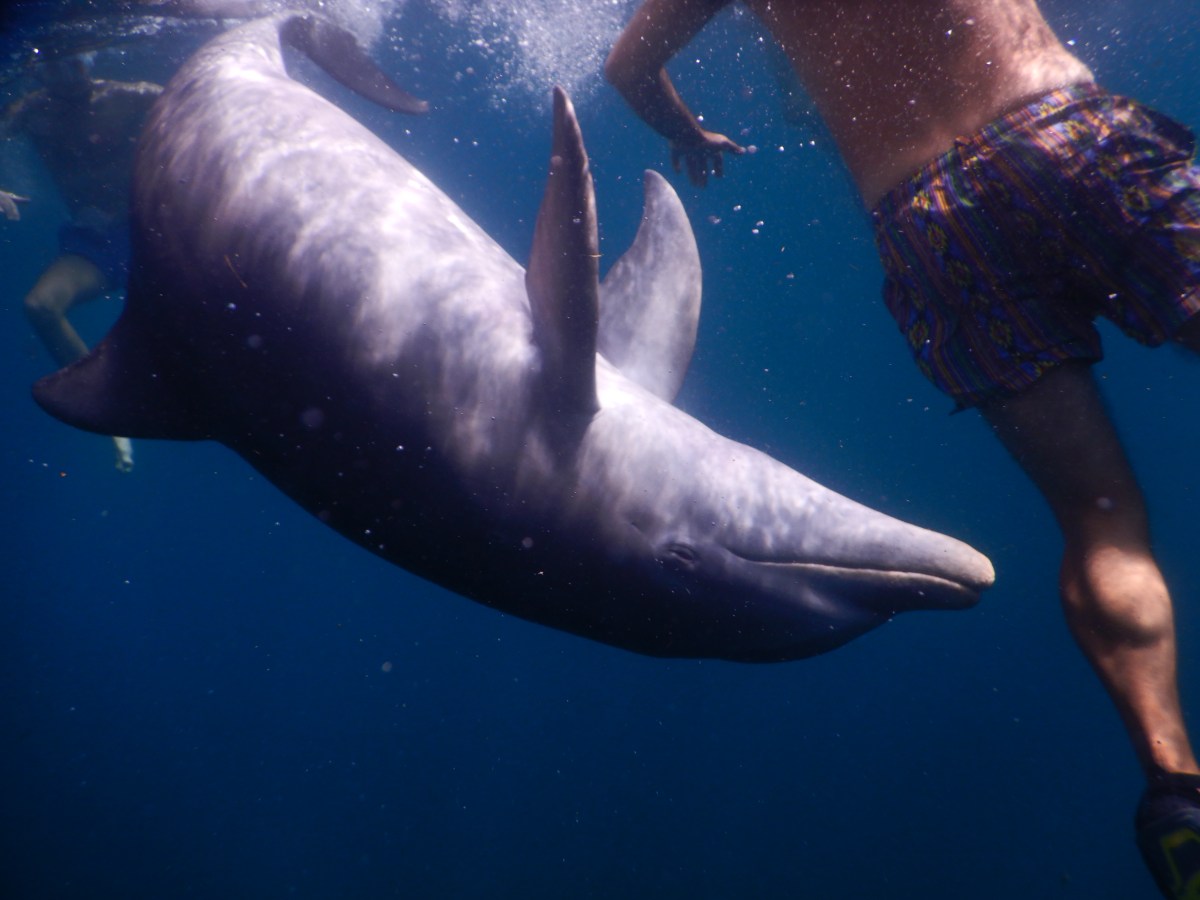
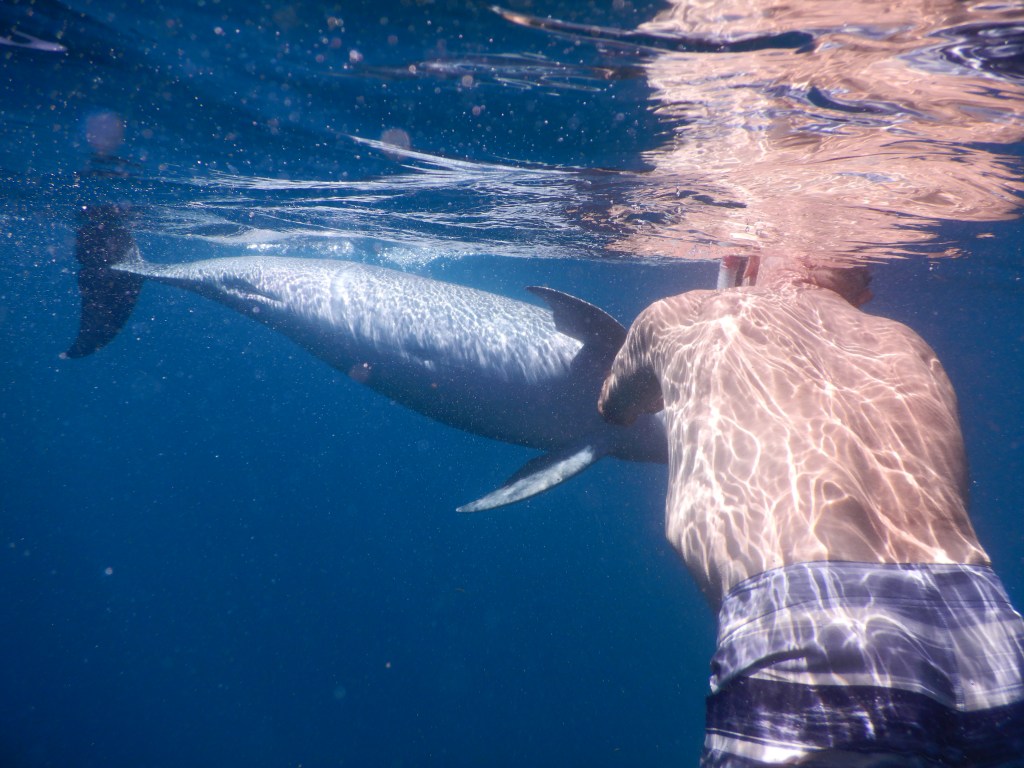
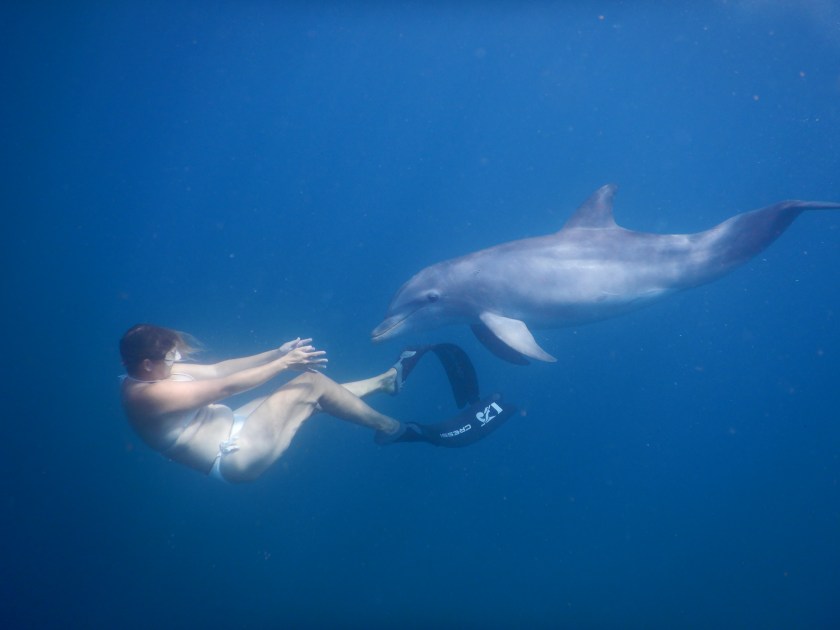
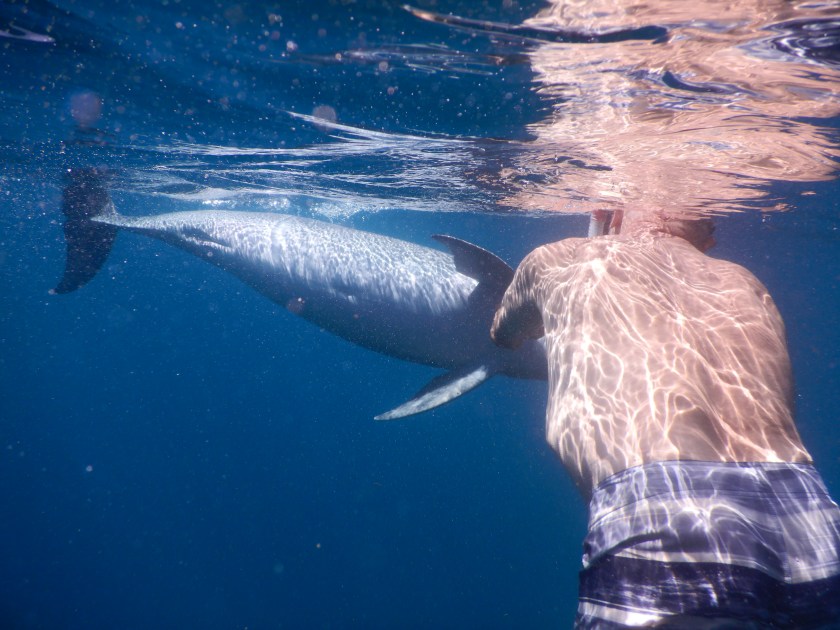
It was amazing! The dolphin swam from swimmer to swimmer for about 20 minutes, sometimes just cruising by, sometimes pausing for a moment. It appeared to enjoy belly rubs, as it would often swim up and turn its belly toward a person. Dave got a brief ride holding its dorsal fin once. We both got to run our hands along its side a few times. It felt almost like cool, hard rubber. Despite its close passes by the humans, it never hit anyone with tail or flipper; it has an amazing sense of its surroundings. When it got tired of the play, it simply swam away.

Best wildlife encounter ever!

I did remember to grab my underwater camera before jumping in, but we were more focused on interacting with the dolphin than capturing photos and video, but we got a few good shots. Enjoy the stills and the video of the first drive by the dolphin gave me.

Until next time, stay safe and take care of each other!

Dave should enter this in a photo contest!
Wish we knew who the woman is so we could send this to her.

Dominica- part 3

When we last left our heroes, they were seeking a good night’s sleep after two long tour days in Dominica (see my post from 3/12/25 if you missed that). They got that good night’s sleep and were ready for the rest of the rendezvous. Let’s rejoin them on Day 4.

Day 4- A glorious down day

Sunday is the day of rest, right? So, the PAYS folks built that into our itinerary. Can I get an amen!

We had a lazy breakfast that morning and did a little laundry. (We were running out of undies. Is that TMI? Sorry!). Our new friends, Jim & Barbara on Complexity, came over to see our solar-electric systems and to just visit for a bit. Early that afternoon, Dave and I went ashore for some Mexican Train Dominoes. We thought we’d play a round or two and go back to the boat early. What we didn’t realize is that cruisers take their Mexican Train very seriously, and this was a thirteen-round commitment. So, we committed, had a great time, and got to meet and spend time with some other Dawgs we hadn’t yet. Before we knew it, it was almost 6pm. We had just enough time to return to Lady, take quick showers, and return for the Sunday night BBQ. We even stayed to dance to a couple of songs before heading back for bed. We enjoyed our down day.

Day 5- Fort Shirley Historical Tour and Indian River Tour

In the morning we had a guided tour of Fort Shirley, which is in the Cabrits National Park. Our guide was Dr. Lennox Honeychurch, who was born and raised in Dominica and whose family goes back a ways here (some of those European settlers). He is the reason the fort has been renovated and became a National Park in 1986. He is very knowledgeable and a great storyteller. Our short, 2-3 hour tour turned into a 4+ hour tour, but it was excellent! 

Fort Shirley was started by the British in 1765, in an old volcanic crater. They cut down every tree on the Cabrit mountains; have to see the enemy coming, after all. The fort was added onto by the French, who held it briefly, then finished by the British after that. It was abandoned in 1854 but remained British-owned until they turned over ownership to the Dominican Government in 1901. A handful of the central buildings were restored by Dr. Honeychurch’s crew starting in 1982, the rest are being reclaimed by the forest that had been razed to build it. Full circle. 

The fort was part of a network of defenses along the Lesser Antilles. For you Lord of the Rings fans, there’s that scene in Return of the King where Gondor calls for aid by lighting a series of beacons along the mountains. One fire is started, and when seen by the sentries on the next mountain, they light their fire, etc. The network of Lesser Antilles defenses was like that, only they used flags. The fort’s position was fortuitous. Due to the prevailing wind and sea conditions, it was nearly impossible to pull into the bay without being within range of the guns at the fort. For those rare instances when it might be pulled off, there was a smaller battery of cannons on the southern shore of the bay.

We hiked up East Cabrit, viewing additional ruins along the way, those left to the forest. Dr. Honeychurch was just talking about how they’re always finding stuff on the ground, like grape shot and such, when Dave looked down and picked up what turned out to be the trigger lock for a musket. Wowza! He presented it to a very grateful Dr. Honeychurch, who later cleaned it up and brought it to the final rendezvous dinner to thank Dave in front of everyone and let him get a picture with it all nice and clean.

Not only did Fort Shirley play a role in the war between the British and French, it also played a roll in changing the size of the island of Dominica. The Cabrits, twin mountains volcanically formed, used to be a separate island from Dominica, separated by a stretch of water with volcanic rock below the surface. When the British denuded the Cabrits for the fort, and also an expanse of land opposite on the mainland for farming and sugar cane, years of runoff deposited enough soil over the submerged volcanic rock to join the Cabrits to the mainland. This low-lying area is mostly marshland and until recently was also part of the National Park, as was Douglas Bay abutting it. Sadly, Douglas Bay and the marshlands were removed from the National Park area this past June and the land sold for the construction of a marina that, according to Dr. Honeychurch, is destined to fail because of the underlying volcanic rock and the sea swell that enters that bay. Of course, the land is not owned by a Dominican but rather some wealthy dude from some other country. 😠

We got back to the PAYS pavilion with only about 30 minutes to eat lunch and prepare for the 3:00 pm Indian River tour, but PAYS graciously moved the start time to 3:30. Phew! The three of us going on that next tour raced back to our boats, sucked down lunch and made it back to PAYS in record time.

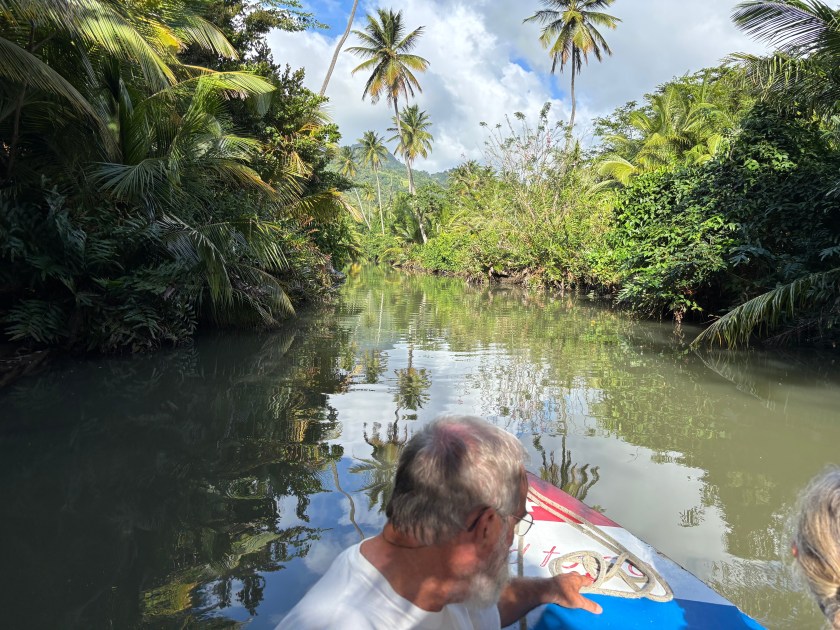
A bunch of us loaded into five boats and headed for the Indian River. We quickly took a left up a side branch that took us to the set of Calypso’s hut from Pirates of the Caribbean 2. The set was built by locals for the movie and left to them afterward for tourism purposes. You can’t go inside, but it’s neat to see from the water. Then we turned around for the main river again. Only rowing is allowed along the river, starting just before that side branch to the movie set. Our rower was Kelvin, who told us a lot about the history, flora and fauna of the river. We saw rock crabs and doctor crabs, egrets, three types of herons, kingfishers, and even jacko parrots in flight. Hurricane Maria in 2017 changed the river. Many of the old-growth trees, that used to form an enclosed overhead archway across the river, were blown down, opening most of the river to direct sunlight. Hopefully, over time, that natural archway will reform. The hurricane also made the river shallower when landslides and runoff filled it in. The tour goes about a mile up the main river, stopping at the Bush Bar, owned by one of the Indian River Tour operators/PAYS member. It was a lovely trip, so peaceful, with only the sounds of nature, the splash of the oars, and the soft talking of us tourists. We spoke in quiet tones for the most part; it just seemed appropriate for the setting. It was a glorious way to spend the afternoon. 

That night’s dinner was lionfish, courtesy of the local fishermen and a few Salty Dawgs who opted for the lionfish dive that morning. Lionfish, though beautiful, is an invasive species to the Eastern Caribbean and Atlantic Ocean, with no predators other than humans. Their appetite for reef fish is voracious and they reproduce quickly, an unfortunate combination. Fortunately, they’re easy to spear, the poisonous spines are not difficult to remove (I’m told), and they are good eating. Our lionfish fillets were accompanied by breadfruit salad, green salad, and baked banana. It was another delicious meal! It was also movie night, featuring… Can you guess? Pirates of the Caribbean 2! We didn’t make it through the whole movie, but we did see the part with Calypso’s hut. 😁

Day 6- Nature Island Water World Tour

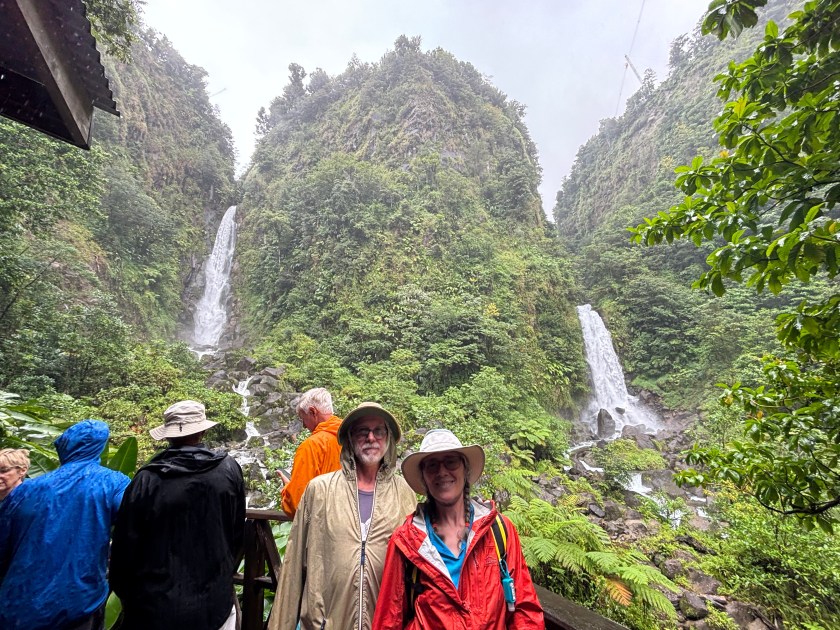
As the name implies, we visited several water features this day. We started with Titou Gorge, another Pirates 2filming site. We swam through the gorge a short distance to some falls, though I didn’t make it all the way; the current was much too strong. I was able to lean around the corner of rock from the quiet side and snap a picture of the falls, though. We had lunch nearby, then continued to Trafalgar Falls, an easy walk to a pair of lovely waterfalls. We then went to the Roseau Valley Hot Spring Baths. Dave and I were expecting natural springs, but what we found was a series of cement pools with the hot spring water piped into them on a private owner’s land. The charge to use the pools was $10 US each. The water was warm, but not hot tub hot. Still, it was nice, because it had been raining on us off and on all day, and the water at the Gorge had been chilly, so the springs warmed us up a bit. It was nice to try once, but I wouldn’t go back to those “hot springs” again. The tour was supposed to include going to Champagne Beach to snorkel the underwater fumaroles. Two of the vans, ours included, were tired of getting in and out of the water and decided not to go. Besides the snorkeling conditions weren’t great for seeing much. Instead, our driver took us home via the Roseau botanical garden and some lovely views.

Dinner was the regular Wednesday night BBQ of chicken, rice and salad. However, this evening we were treated to a Mardi Gras performance by a local youth organization. Their homemade costumes and their sheer joy of the dance was infectious. They got many of us dancing as well. 

Day 7- Community Service

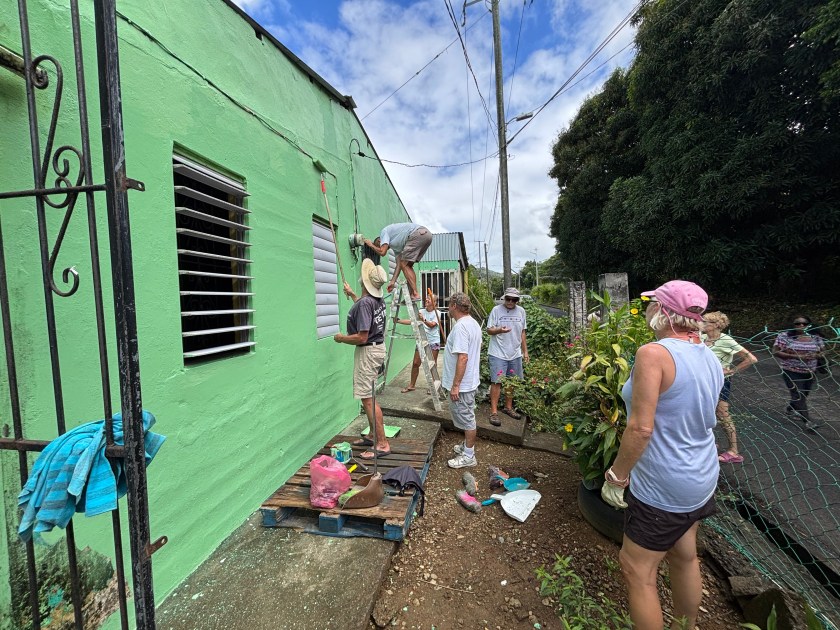
This was a day for the Dawgs to give back to the community. There were three volunteer activities to choose from. Dave & I joined the painting group. About 7 of us painted the two main exterior walls of a building that houses a nonprofit that teaches women sewing and craft skills so they can make a living with them. We painted between bouts of light rain. We didn’t quite finish, because the ladder we needed for the higher parts showed up a little late. Four of us went back the following morning to finish, though. 

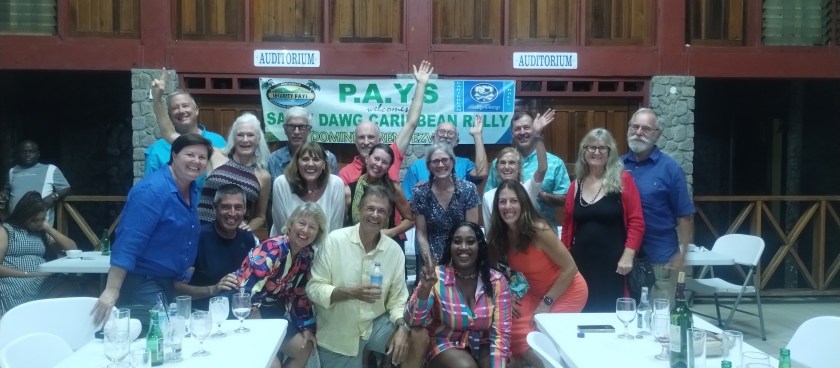
The evening brought the final, farewell appreciation dinner. This one was funded by PAYS and catered by one of their female members. Dinner was delicious! There were a couple of speakers there who thanked us for our attendance and interest in Dominica, and hoped we would return. Then there was music and dancing, which we did indulge in for a while. This was our final event together, so it was bittersweet. Many would leave within the next two days to continue their cruising north or south. We thoroughly enjoyed the rendezvous and hope we will be able to attend next year’s. We certainly hope to encounter our new friends as we continue to explore the Eastern Caribbean over the next few years.

My cousins would join us the following day and we would continue to explore Dominica for a few days together, before we all headed to Guadeloupe. I will tell you about our two weeks together next time. 

Until then, stay safe and take care of each other!

Dominica- part 2

The Salty Dawg Rendezvous started the evening of February 13th with a welcome dinner at the PAYS pavilion. Despite the 2-3 weeks’ worth of uncooperative sea conditions, about 21 boats made it to the rendezvous. They don’t call them “salty” dawgs for nothing. We are so glad that we made the effort to get to this rendezvous. We had an amazing time and made many new friends. 

PAYS (Portsmouth Association of Yacht Security) coordinated with the Salty Dawg organization to host this event, but PAYS developed the itinerary. Each day offered 1-3 tour options led by PAYS guides, and the evenings found us gathering at the PAYS pavilion or Cabrit Cruise Ship pavilion for dinner, music and dancing. Most of us who were in Dominica for the first time opted to join every tour, so Dave and I were quite busy the entire week. We did so much over six days that I couldn’t possibly retain everything I learned about the island and its culture, but I can give you an overview.

I want to tell you a little about PAYS [link], first. Dominica was not a very safe place for cruisers to visit in the 90s and early 2000s. The government wasn’t particularly interested in doing anything about this, so a small group of local tour guides took things into their own hands and established PAYS, with the overarching goal of ensuring cruisers felt welcomed and safe. They operate at Prince Rupert Bay, outside the town of Portsmouth, on the NW side of Dominica. All members are trained and registered tour guides, and many also own other businesses like a taxi service or restaurant. Over time, they have built what we saw while we were there- an office and attached pavilion where they host BBQs every Wednesday and Sunday from December-May, a good dinghy dock, showers & bathrooms (not the greatest), a mooring field, and they take it in turns to patrol the mixed mooring field/anchorage at night. 

This is a well-run business. You always know who the PAYS members are because their boats are clearly marked and they proudly display their tour guide credentials. They are incredibly helpful, very pleasant, and eager to share their knowledge and love of their island. Yes, they do this to bring in money, but they are not pushy, at least we didn’t find them to be so. Someone might stop by if they see you aboard and ask if you need a ride, water, fuel, tour, etc., but if the answer is “no, thank you,” they move on. We found their prices to be reasonable. Moorings are $12 US per night, with a slightly better deal if you pay for a whole week. Tours that are 6-8 hours run about $60 US for the driver/guide, although there are often other fees, but those are paid directly to whoever established the fee, like the government or a landowner; they were in the $5-$10 US range. We spent more than anticipated, but it was money well spent, and we couldn’t have done anything close for the same price tag in the US or any other developed nation.

Back to the fun stuff- what we DID.

Day 1- Welcome dinner

The welcome dinner occurred during the weekly Saturday BBQ, so there were more than just Salty Dawgs attending. We were welcomed by PAYS and an overview of the week was given by the Dawgs volunteer coordinator, Mary. Dinner was BBQ chicken, rice and salad, a recurring theme to our meals, with endless rum punch. I guess the punch fueled the dancing. We only stayed for a little bit of the dancing because the next day was an early, all-day tour and we wanted to be rested.   

Day 2- Northern Treasures Tour

Guess which part of the island this tour covered 😉. Our driver/guide was Marlon, a fairly new guide with a good knowledge of local plants that he was also eager to expand. As we drove to our first stop, Marlon gave us a little history; he’s still learning that, too. Our first stop was for a hike to Chaudière Pool. Since this crossed someone’s private land, we paid $10 US each for that, but it also got us an additional guide called Anit, who knows the area and flora very well. She and Marlon pointed out various plants along the trail and told us about their uses, both as food and medicine, we even sampled some. Marlon learned a lot from Anit along the way. 

The pool was lovely and both Dave and I changed into swimsuits to bathe in it, and I mean bathe. Anit had collected soap leaf en route and showed us to crush it up, mix it with some water and rub it over our skin. Darned if it didn’t create a little green lather. It felt refreshing, too, though that may have just been the cool water 😁. On the way back, Anit brought us down off the road to her farm and gave us some of the very sweet, tiny bananas I have forgotten the name of, as well as some sugar cane. She was lovely. 

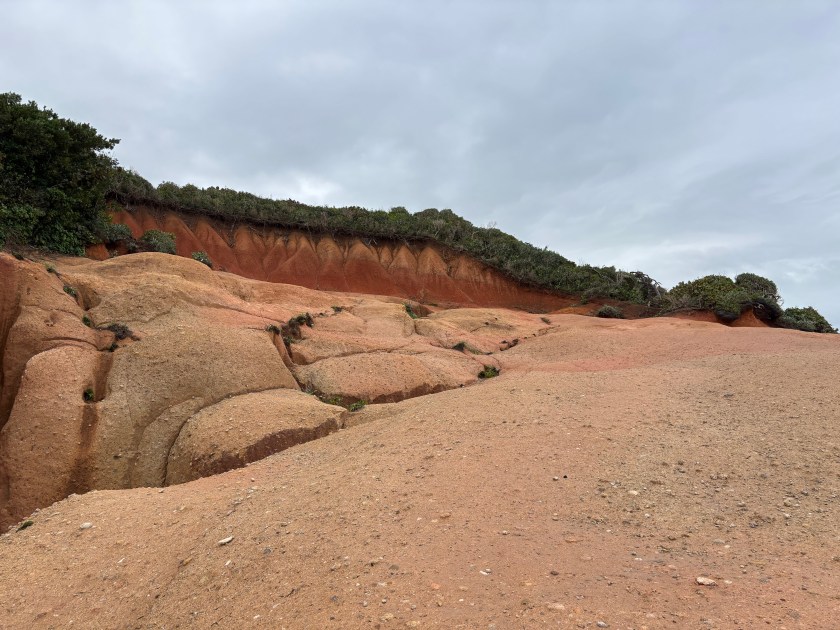
After Chaudière Pool, we had lunch in Calabishe. It was delicious and very big! We then went to the Sea Cliff Gin Distillery for a free tour and tasting (yes, free for anyone, so far). We then made a quick stop at Red Rocks ($2 US per person), thus named because of the iron oxide in the volcanic rocks that form them. The rock is very soft, which surprised me. Our final stop for the day was at the Pointe Baptiste Chocolate Factory ($20 EC per group). It’s a small operation that started in the couple’s kitchen and expanded to a lower level and behind their house. They produce about 2 tons of chocolate a year, all sold locally. It is dark chocolate flavored with local plant products. Even better, we got to taste as many of the 20 different flavors as we wanted. We left with only two bars, but we bought two more when we returned another day with our visiting family. Yum! 

Dinner that night was a fundraiser for the local cancer society and was served at the Cabrits Cruise Ship dock. It was well-catered and consisted of chicken and fish options, rice, salad, and a couple of other starchy sides (local root vegetables). Too tired for dancing that night! We did not stay long after finishing the meal.

Day 3- Kalinago Territory Tour

This day started with a 2-hour drive across the island to the east side. Our driver/guide was “Uncle Sam.” As we crossed the island he told us a bunch of its history, described the little towns and villages we passed through, pointed out various plants, and told us about the international airport being built by the Chinese. Once we arrived in the Kalinago village, a local guide took over. The information I provide below is partly from the tour, but also from a Dominican history website [link].

The Kalinago, formerly referred to as the Caribs, are the original inhabitants of the island, believed to have arrived from South America. Their history on the island goes back to about 1000 A.D. Today’s Kalinago are the last remaining descendants, most now of mixed heritage. In the not so distant past, they kept themselves to themselves, separate from the rest of the island’s society. As our guide told us this day, however, that is changing and they are integrating more, some even choosing not to live in the territory. 

Theirs is a familiar story, their simple life in harmony with nature was disrupted by the arrival of Christopher Columbus and later, European settlers, with whom they fought. They eventually escaped to the less hospitable eastern side of the island where, in 1763, the British gave them their first, dedicated 232 acres of land. In 1903, the territory was expanded to 3700 acres spanning about 8 miles of the east coast. The original name of Dominica, Waitukubuli, was from their language. It means “tall is her body,” referencing her volcanic mountains.

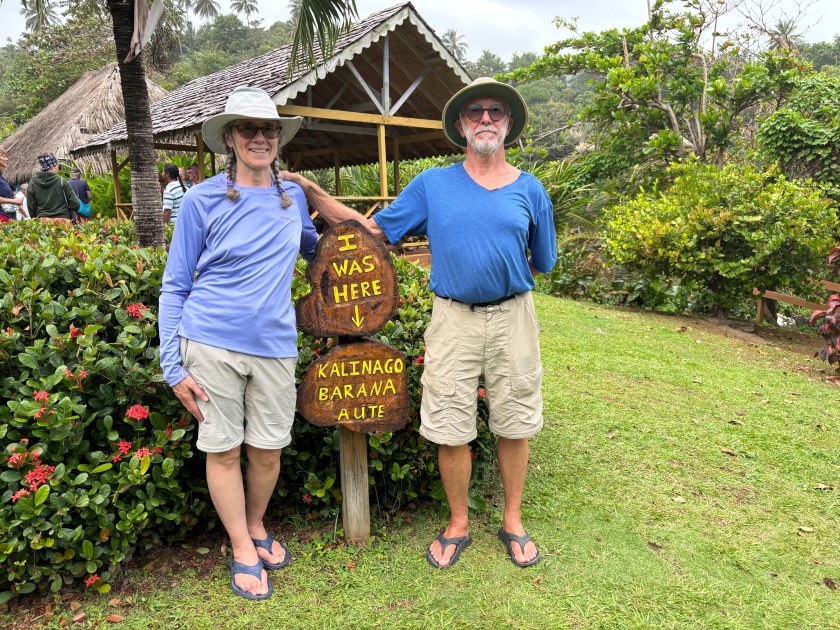
There are eight villages in the Kalinago territory. We visited their model village, Kalinago Barana Aute. I read that they offer a variety of other tours. Perhaps we’ll do one on our next visit. They are self-governing, with a democratically elected chief and council, but they work in cooperation with the Dominican government and have a representative there. Like most indigenous cultures in the world, they struggle to maintain their culture and traditions, striving to pass them on to younger generations, while also trying to integrate to some extent with modern society. In the case of the Kalinago, they have started to prioritize a rounded education as well as good health care. While they continue to value and practice organic agricultur, and continue their weaving and other crafts, which bring income, they are also looking toward ecotourism and other opportunities. 

As he spoke, our guide led us along a well-groomed trail through this model village with some stunning views. We ended with a simple lunch and the opportunity to peruse and purchase some of their crafts. If I had room on the boat for one of their gorgeous baskets, or thought I could get it back to the US safely, I would have purchased one. Instead, I bought a lovely necklace and matching pair of earrings made of white and red seeds.

We returned to the west side of the island, and that evening enjoyed a dinner of “Caribbean Flavors.” This included salt cod, roasted bananas and breadfruit, green papaya, and cucumber and cabbage salad. For “dessert,” there was cocoa tea, a wonderfully flavorful combination of local cocoa, cinnamon, nutmeg and coconut milk. Delicious! After two long, tiring, exciting days in a row, we did not stay for the music and dancing.

I’m going to stop here for now, since you’ve had to read so much already. I’ll finish up describing the rendezvous and tours in Dominica- part 3, which I’ll post in a few days. 

Until then, stay safe and take care of each other!

A brief live update

We are in Guadeloupe and have been since 2/25. The rendezvous in Dominica was a blast! Four family members joined us in Dominica the day after that ended and we’ve all been going non-stop since, in both Dominica and Guadeloupe. They just departed this afternoon and now I need time to recuperate from the fast pace of the past three weeks. Next post I will catch you up on the Salty Dawg Rendezvous in Dominica. After that, I’ll post about the two weeks spent with my cousins onboard. Notice I’m not committing to a timeframe. I’ll get to posting again eventually.

Oh, and Dave & I swam with a wild dolphin. Yes, you’re going to have to wait to hear more about that, too. I threw in two pictures to appease you for now. 😁

Until next time, stay safe and take care of each other!

Dominica- part 1

Sorry for the delay, folks. I’m not feeling the blog this year. It’s probably because I’m enjoying myself and haven’t really felt like making time to write. At any rate, I’ll catch you up a bit now.

We arrived in Dominica on February 5th, eight days before the start of the Salty Dawg Rendezvous. We landed in Prince Rupert Bay, at the town of Portsmouth. After clearing into the country with customs and immigration, we had a late lunch ashore, purchased a local Digicel SIM card in town, then spent the rest of the day relaxing on Lady.

Our time in Dominica, pre-rendezvous, wasn’t particularly interesting. We were just living normal boat life, just in another beautiful and warm place. We tended to boat tasks like minor repairs, cleaning, changing beds, doing laundry and making English muffins. We acquired some local currency, Eastern Caribbean Dollars, which required ultimately going into the bank after two ATMs refused our debit card. We explored the town of Portsmouth. We took a taxi into Roseau, the capital of Dominica on the southwest side of the island, to get one of our propane tanks filled and to pick up our new Garmin multifunction display. (I described our issue in my post on 1/15; it’s “Bump #4.”) We also met and hung out with a couple of Salty Dawgs who, like us, arrived in Dominica early.

Our explorations of the area included food, of course. We quickly discovered that one can get fresh produce any day of the week on the block near the fishing/town dock. On Saturday, however, they have an even bigger fresh market with MORE produce. Oh, the produce! This island grows quite a variety of produce. I felt like a kid in a candy store, only with healthier options. I even tried a new fruit called sapodilla, or sapotille. We had a particularly tasty Saturday lunch (after the fresh market) of broth and soup. My “broth” contained two small marlin fish steaks, a variety of “ground provisions” (root vegetables like sweet potato), banana, and smoked chicken wing. I don’t know what seasonings were used, but between those and the smoked chicken it was so flavorful! Dave also enjoyed his “soup,” which contained smoked chicken wing, smoked red meat of some kind (probably pork), some sort of root vegetables, in a savory stew-type broth. We were quite pleased.

We spent that morning of the 13th walking around Fort Shirley, located in the Cabrits (twin hills separating Prince Rupert Bay from Douglas Bay to the north). We even hiked across to a viewpoint of Douglas Bay. That evening, the rendezvous kicked off with a BBQ welcome dinner in the PAYS pavilion. I’ll tell you all about PAYS and the rendezvous next time. 

Until then, stay safe and take care of each other!

Six days in Guadeloupe

As you know, if you’ve been following us this season, we left St. Kitt’s & Nevis and eventually made it to Guadeloupe on January 30th(The details, if you missed them, are in my posts on February 1st and 5th). We landed in Deshaies (pronounced Day-ay) on the northwest corner of Basse Terre. Guadeloupe comprises two main islands that form a sort of butterfly shape, with Basse Terre to the west separated from Grand Terre to the east by a narrow mangrove channel, plus, to the south, there is Marie Galante, and west of that a group of smaller islands called Les Saintes.

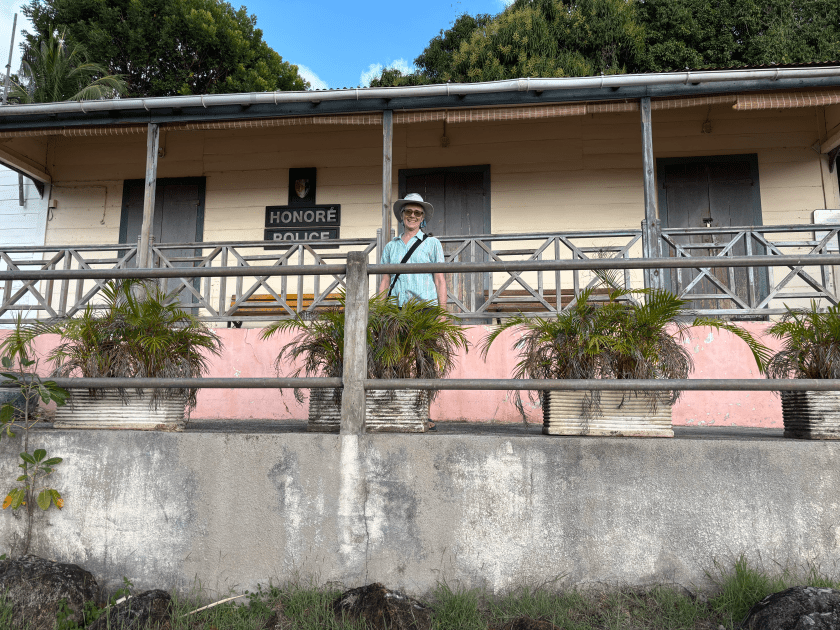
Fans of the British mystery, Death in Paradise, will know that it is filmed in various parts of Guadeloupe. The Honoré Police Department is in Deshaies, and yes, we stopped to see it, from the outside. We weren’t willing to pay $20 US each to stand in the tiny room for ten minutes and look at the police desks and cell. We heard someone say there’s a tour that takes you to several of the filming sites, for about $100 US per person. No thank you.

Death in Paradise aside, we enjoyed the two days and three nights we spent on a mooring in the harbor of Deshaies. For my birthday on the 31st, we toured the Jardin Botanique de Deshaies (the Deshaies Botanical Gardens). It was totally worth the $17.50 € ($18.54 US)  per person! They were gorgeous, and they went on and on! There were built in water features, including a couple of ponds, a river and a waterfall with a restaurant perched on top. There was also a walk-in lorikeet aviary and another area with various Macaws, most of whom were napping in their little huts when we arrived. We decided lunch would be our main meal of the day for my birthday, so we treated ourselves to a delicious lunch, including dessert, at the restaurant I mentioned atop the waterfall. The views from the deck were spectacular! We had taken the free shuttle up hill to the garden, but after that big lunch decided we should walk the 1+ miles back to the dinghy dock. We opted for a mini charcuterie for dinner, as well as music in our hammocks before bed. It was a wonderful way to spend my birthday!

The next day, February 1st, after croissants ashore for breakfast and getting some gasoline for dinghy, we prepared a picnic lunch (sandwiches on baguette, of course) and went for a hike. Actually, it was more of a rock scramble. We “hiked” up the bed of the Deshaies River, something one can only do when the water level is low, as it was this day. It was beautiful, winding its way through the tropical forest. Occasionally we had to bushwhack a bit ashore to get around parts of the river without good scrambling rocks. Dave cooled himself off in one of the pools in the river along the way. We were aiming for where the river intersected the road that would lead us back to town. About 2 hours into the hike, knowing we had to be pretty close to that road, but not quite sure how close, it started to rain. That made the rocks slippery. Ack! We waited until the downpour stopped, then continued our scramble more slowly for another 15 minutes or so until we came to a spillway across the river with a house on the south bank. Dave scrambled up the north bank toward where he thought it looked like there was a road and confirmed that there was, so I followed. The cruising guide said it was about a 15 minute walk back to town. It was more like 45 minutes and quite steep going down, but we got back uneventfully. It was just lunch time when we got back to town, so we sat on a bench in a little park and ate our yummy sandwiches. Then we visited the local rum store, bought a bottle, then I got ice cream before we returned to Lady. We were a bit sore, but it had been a lovely day.

Deshaies River hike- 5

On Sunday we decided that we wanted a change of scenery before we took the upcoming weather window to Dominica. We moved down to Plage de la Malendure (Misery Beach; sounds nicer in French). We were still sore from the previous day’s hike, so we made water and did laundry, but otherwise rested. The next day, however, we popped across to Pigeon Island in our dinghy and snorkeled around in this part of Jacques Cousteau Marine Park. The reefs are struggling these days, but there was some coral and sponges and LOTS of fish, many schools of them. It was an enjoyable snorkel. After lunch back aboard Lady, we dinghied into the beach to walk about a bit. It’s a vacationers’ spot with lots of dive/snorkel shops along the beach, as well as food shacks/restaurants and souvenir shops. 

The following day we moved down to Marina Sud Ancrage (South Anchorage Marina) on the southwest end of Basse Terre. We filled up with very expensive diesel, cleared out of the country, had lunch at the marina, and then dinghied about a mile back north to the main town of Basse Terre to get a SIM card and some parts Dave needed. I know, it sounds weird to get a SIM the day before leaving the country, but we’re pretty sure that when we return to Guadeloupe in late February, we’ll head to Les Saintes, and we knew we would not be able to purchase a SIM there. The plan we ended up buying is good for two months, so we’ll be all set when we return. It wasn’t easy getting the SIM and plan, since the employees at Orange (the cellular provider) speak little English and I speak little French. Between translators on our phones, our smattering of each other’s languages, and a lot of good-natured patience, I had what I needed, plus an extra 10 GB of data because there was a glitch and I had to wait quite a bit while the lovely woman assisting me called Orange to verify that the package I’d purchased was in fact activated. That was nice of them. We were back on Lady by 4:30 pm, had leftovers for dinner, and watched the Bruins win before retiring to bed.

We landed in Dominica before noon on February 5th and that’s where we are now. We will be here at least through the 23rd (ish). The Salty Dawg rendezvous runs from the 13th to the 20th, and we have family arriving here immediately after that. But I’m going to stop here and fill you in about Dominica later. 

Until then, stay safe and take care of each other!

Back in St. Kitt’s & Nevis

Let’s catch up on things other than traveling between islands…

We finally launched on January 17th. Dave was satisfied with the copper coat work that had been done. (He has since checked the hulls, the day we arrived in Dominica, and said there is no growth on them. Yay!) It also turned out that the hourly rate we were quoted for the work was in ECD (Eastern Caribbean Dollars), so it was only $25 USD/hour and therefore not as expensive a job as we’d thought. We tied up to one of their rickety docks on the 17th and did the bulk of our provisioning that afternoon. We spent the night listening to our lines creak loudly as we tugged bow to stern with the surge. 

The next morning we took off for Basseterre. It was nice to be at anchor again, and the anchorage wasn’t even rolly. We spent a couple of nights, completed our provisioning and bought a SIM card with some local data.

We then moved down to Ballast Bay to get away from the city. We mostly did boat stuff for the three days we stayed there, but we did a couple of fun things. We dinghied ashore for a walk and got rained on a little, but it was nice to stretch our legs in the “country.” We met up with a Salty Dawgs couple. We spent a couple of hours together at an art show hosted at Christophe Harbor Marina. It was open to the public, free, and had some mighty fine eats. We all enjoyed ourselves. Just as we were preparing to return to our boats before the sun set, it rained. We, and our clothes, got a free fresh-water rinse.

On the 23rd we moved down to Nevis, since we still had not explored that island. We encountered two catamarans we had met back in Basseterre and had them over for drinks and apps that afternoon. One was heading to St. Croix the following morning and the other to St. Martin the day after that. So we got in a little more cruiser socializing. We spent a total of 6 nights on a mooring ball in the Charlestown anchorage. The mooring was a very good deal at about $30 USD for the 6 nights. They charge that rate for 3-7 nights, so the closer to 7 nights one gets, the better the deal is. 😁

Charlestown is the only substantial town on the island. It is much cleaner than Basseterre, as were all the parts of the island we saw, and the people were friendlier. We visited the Hamilton House Museum, which has a building dedicated to the history of Nevis, and it has the house Alexander Hamilton grew up in until about the age of 12 or so when his family moved to St. Croix. It’s not set up as a house, rather it has a series of old photos plus placards of information about Hamilton’s life and accomplishments. It was worth the visit and the $10 USD each. We took a bus to the botanical garden and back. The gardens were lovely and worth the $17.50 USD each. Besides, it supports their work. The bus driver only charged us $5 USD total to take us to the garden entrance, which was a little more than ½ mile off the bus route. When we were finished at the gardens, we walked the ½ mile+ back to the main road and a covered bus stop and caught a bus back to town. Other than those two adventures, we just had lunch ashore a couple of times (both yummy!) and made too many trips to the Nevis Bakery for pastry (also yummy). We were awaiting a weather window to get to Dominica, or Guadeloupe first.  I’ve already posted about our journey from Nevis to Dominca, which ended up being three salty trips with an emergency stop in Montserrat. If you missed those posts and want the details, you can read my posts from February 1st  and February 5th.

I’ll stop here for now and fill you in on our six days in Guadeloupe later. 

Until then, stay safe and take care of each other!