Exploring Antigua by Land & Sea

We left Barbuda at 8:00am on May 4th to return to Antigua. There was a strange vibration around our starboard motor, so for half the trip we ran just using the port motor. Once we got into the calm waters inside Boone Reef on the north side of Antigua, we started the starboard motor again, because the vibration was only happening when we were slewing to the left during a roll over a swell, and the water inside the reef was flat. Dave later discovered that the vibration is due to something minor related to how the external pieces abut each other.  It can wait to be fixed once we’re on the hard in St. Kitt’s.

We were anchored in Parham Bay, on the north shore, just before 4:00pm and shortly thereafter dinghied ashore to pick up a few items at the local market. We asked one of the fishermen where the market was and he gave us directions. It closed about 20 minutes before we got there. Bummer! There was supposed to be another market around the other side of town, but we decided not to walk that far lest it also be closed, being Sunday, after all. Plus, we were exhausted from our seven-hour cruise down from Barbuda, and it was hot. We’d come back in the morning. 

It was a good thing we decided not to seek out that second market Sunday evening, because when we went in search of it the next morning, it was not where Google Maps and our cruising guide (which also had the wrong market name) had it marked. We did find it, however, thanks to the directions of another local, and procured the handful of items we sought. We went back to Lady and moved about three miles east to anchor off Great Bird Island. It was a much prettier and quieter anchorage than Parham Bay, which hosted a boatyard and a power plant, the latter emitting a low, persistent, rumbling sound. In addition, we could see the bottom at Great Bird. After lunch, we snorkeled some bits of reef in the shallow water off Great Bird. It was both depressing and a bit hopeful. We anchored dinghy in sand, but her stern was floating over an immense stand of dead staghorn coral. So sad. Looking closely, however, I noticed that there is new staghorn growth coming off the ends of some of the old, dead base. These bits were 6” long or less, but it’s a sign of rebirth. Coral grows very slowly; perhaps in the not too distant future this reef will thrive again (she says, hopefully, not really believing the words she types). At other parts of this shallow reef, there were also some soft and encrusting corals, also signs of hope. 

The following morning started with rain and solid overcast, but by early afternoon the rain had stopped and the sun was peeking out occasionally, so we decided to snorkel again. This time we took dinghy to Whelk Rock, about ¾ of a mile from Great Bird. This reef is immense! It was at spots breaking the surface and got down as much as 15-20 feet in other spots. The base coral structure was, again, dead, but there was a lot of regrowth of soft and encrusting corals, and there were some fish, the usual suspects. Again, this reef system must have been amazingly beautiful in the not too distant past. 😔

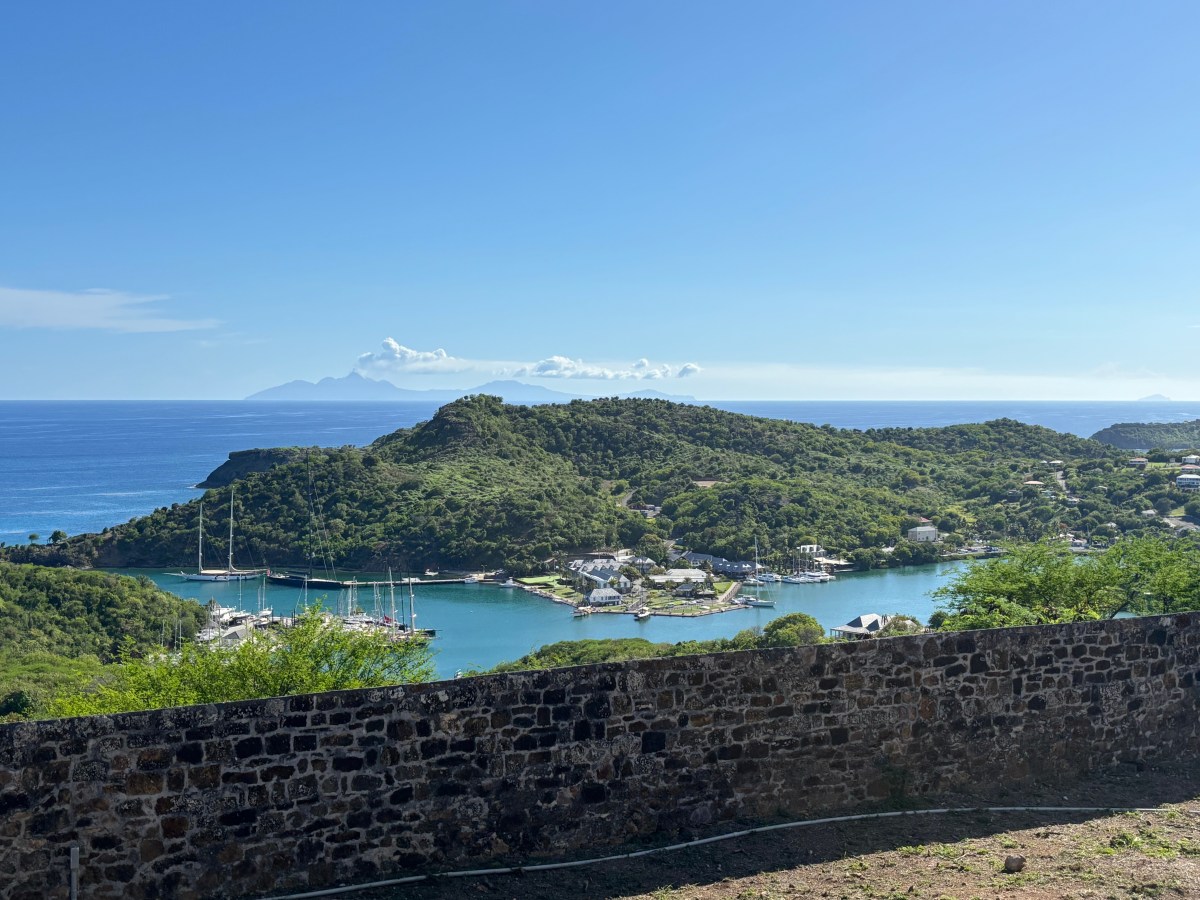
We’d had enough of mostly dead reefs, so the following morning we headed to the south coast to anchor in Freeman Bay, just outside of English Harbor, home of the historic Nelson’s Dockyard. Conditions were quite calm, so we were able to take the shorter route through a channel at the north end of the reef system, then cruised down the east coast of Antigua. It only took about three hours, so we were anchored in plenty of time to snorkel the Pillars of Hercules. The snorkeling, as expected, was pathetic, although we did see some good-sized fish, as well as scattered corals and sponges, the latter of which we had not seen on the other Antiguan and Barbudan reefs. The Pillars, however, are quite impressive. These limestone structures were carved out of the cliff by thousands of years of erosion by wind, rain and crashing waves. 
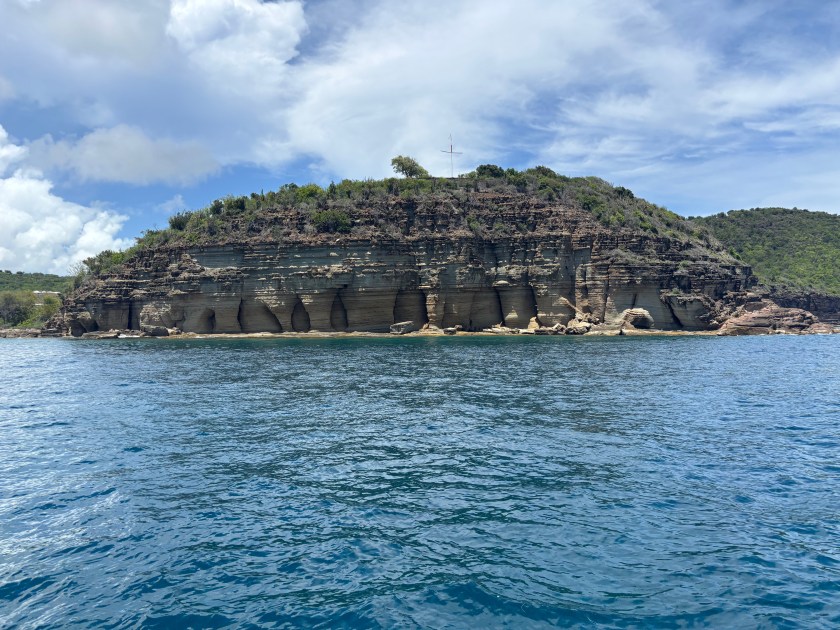
Pillars of Hercules

We swam directly from Lady to the Pillars and back. Once we dried off, we made ourselves presentable and went ashore to the Port Authority to pay the requisite fees for staying in this anchorage. Both English and neighboring Falmouth Harbors, plus the land immediately surrounding both, are part of the Nelson’s Dockyard National Park, thus the fees. We paid a one-time per person entry fee for the park, a daily per person garbage and environmental fee, and a per-foot/per night boat length anchoring fee. Our 5-day/4-night total for three people was under $100 US. Not too bad.

After paying our fees, we bopped around Nelson’s Dockyard a bit so Ian could see it. Then, we walked the short distance to Falmouth and found a restaurant for dinner. Just as we were leaving the restaurant, it started to sprinkle. By the time we got back to dinghy, tied up at Nelson’s Dockyard, it was raining. By the time we got back to Lady, we were soaked to the point where we had to wring out our clothes. Then we had to make room for our wet clothes and ourselves inside, which we managed. It could have been much worse, because there were thunderstorms around us, but they, and their associated lightning, stayed away as we passed the wet evening inside playing cards. 

The Freeman Bay anchorage is small and very close to land, and therefore bugs, so we moved over to Falmouth Harbor the next morning, right after breakfast. There was a better breeze and we were further from land, but still only a short ride to a dinghy dock. Shortly after anchoring, we dinghied ashore to pick up our rental car, then we set off to tool around the island for the day. First we followed a largely coastal route across the south coast and up the west coast, stopping at a little place in the town of Five Islands for lunch. We inadvertently drove right through the busy heart of St. John’s after our attempts to circumnavigate it failed (thanks, Google Maps 🙄), then headed east/southeast stopping at Betty’s Hope Sugar Factory ruins to explore those. They had a concise, informative display about its history and that of the sugar industry on Antigua, and the remaining ruins are clustered nearby. It was worth the $2 US donation per person, even though we only got 30 minutes to tour it before they closed for the day. We continued back toward English Harbor to Shirley Heights Lookout for Reggae night, stopping to look at some of the Shirley Heights Fort ruins first. Dave and I had gone a few weeks earlier to their Sunday night music event, but didn’t eat because the line was hours long. This time, there were far fewer people and no line for the food, so we had a nice dinner, listed to the introductory steel drum band, and left before the Reggae even started. We were all tired, and our early departure got us back to Lady before it was fully dark. 

Betty’s Hope windmill and old gears (on the ground)
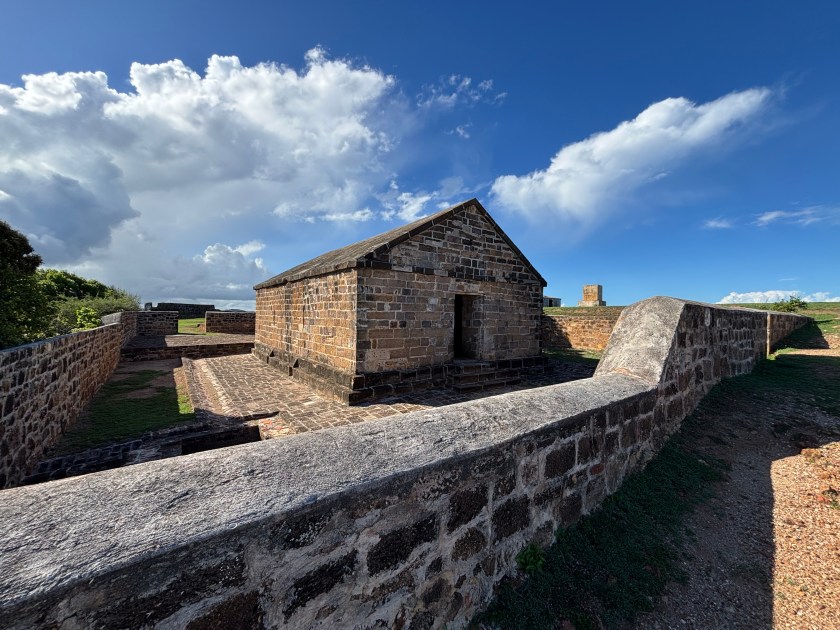
Block House at Shirley Heights

Yesterday we spent another day with the rental car exploring Antigua. We started by going to Clarence House which has served as home to British Navy Commissioners and later to Governors of the Leeward Islands. Sadly, they only do private tours on certain days, and Fridays was not one of them. So, we headed over to the Dow Interpretation Center to look at the limited remains of Fort Dow, and to watch the 15-minute audio-visual presentation about the history of Antigua and English Harbor. It was a good overview, but Dave and I had already learned the content when we visited the museum in St. John’s shortly after arriving here.
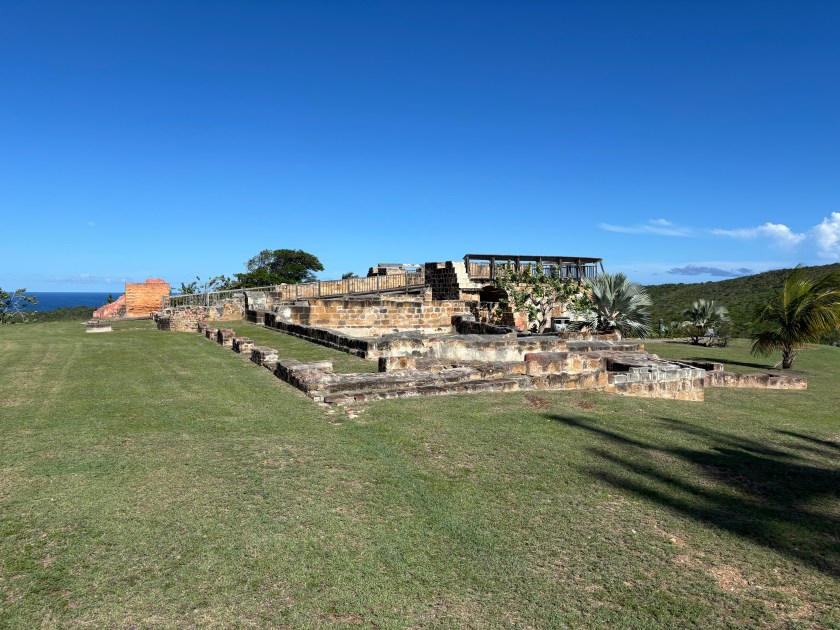
Fort Dow

With our history lesson finished, we continued our driving exploration of the island by heading up to Devil’s Bridge National Park at the northeast corner of the island, stopping for lunch in Long Cove first. Devil’s Bridge is a low, natural limestone rock arch and surrounding blowholes, carved out by the crashing waves from the open Atlantic- nothing between it and Africa other than ocean. It was interesting enough. The seas weren’t that big, so the wave crashing was less impressive than I would imagine it is when the Trade Winds are higher. I took some photos, but our timing was bad for sun position, so they don’t really show the bridge well. Alas!
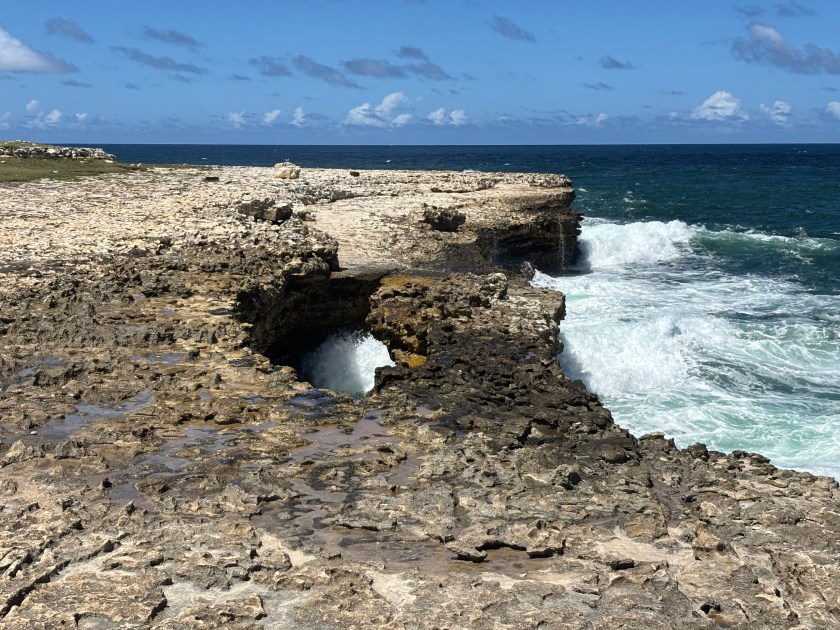
Devil’s Bridge

After Devil’s Bridge, we just tooled around the island a bit longer on the speed-bump and pothole-riddled roads. We attempted to reach Body Ponds Nature Park, but our attempts were foiled, at both its entrances, because Google Maps, at least on this island, does not distinguish between paved roads and unpaved/heavily rutted/almost washed out roads/cow paths. (Thanks again, Google Maps!) We gave up and headed back to Falmouth, stopping for a beer at a little craft beer brewery before heading back to Lady. (The boys report that the beer was “okay.”)
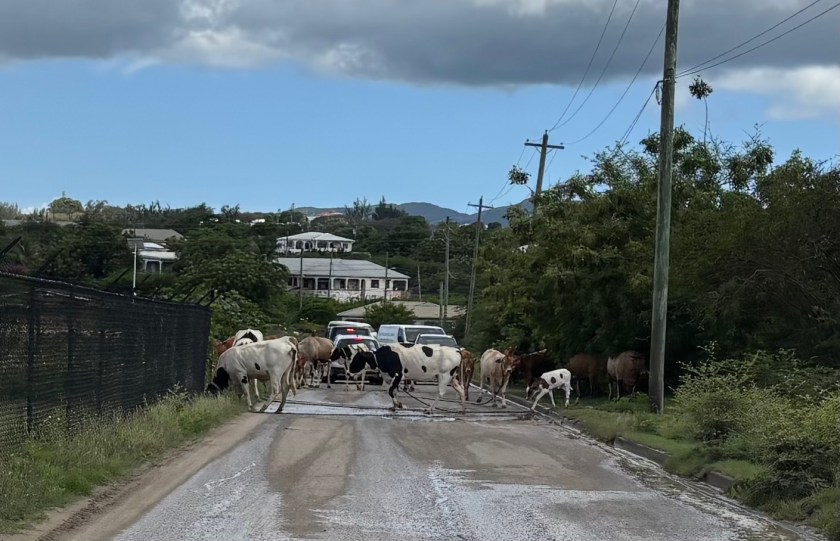
Antigua traffic jam 🙂

This morning we gassed up and returned the rental car after making a stop at Budget Marine for a couple of replacement blower fans and a cabin fan. We also popped over to Port Authority to see about renewing our cruising permit, which expires today. We learned that (a) cruising permits can only be renewed in Jolly Harbor, where we are not, and (b) if we stay anchored where we are until we leave the country, we don’t need to renew the permit at all. 

Ian leaves us tomorrow. We want to head to Montserrat for a few days before heading up to St. Kitt’s. We’ll probably choose option “b” from above, since we’ll probably head to Montserrat early this coming week.

My next post will either be from Montserrat or St. Kitt’s & Nevis. Until then, stay safe, and take care of each other!

So far, Antigua fails to impress

I’m probably not being fair to Antigua. It’s not Antigua’s fault that we’re feeling a little disappointed and bored. It’s just that here there’s not as much of what we like to do when we visit a new island. Antigua is a very popular vacation destination, and with over 300 beaches, I can understand why many choose to travel here. It’s also popular with many cruisers, but we didn’t think to ask those we’ve met who have been here why they like it. It just hasn’t suited our tastes thus far, though we’re not quite done exploring yet. We’ve left the north coast and some inland places that require a car rental for when our friend, Ian arrives this weekend. Just having a friend visit will make things more interesting. 

The biggest disappointment has been the lack of good snorkeling, which, along with diving, are our favorite activities. Our two snorkels on the west coast had extremely poor visibility of 1-2 feet in milky blue water, likely due to silt. We snorkeled our anchorage, and saw little, even clear water wouldn’t have made it interesting- sand, grass, a few small fish and a few upside down jellyfish. Boring. A couple of miles north in Deep Bay we hoped to snorkel the shallow wreck of the Andes. Good thing it was shallow, because we only caught a glimpse of one part of it by diving down to within 2 feet of its hull. If it had been any deeper, we wouldn’t have even seen that. We saw a drone picture of it through crystal clear water that someone took this March. Sadly, we got the milky blue water this month <sigh>. The Andes was a three-masted merchant ship hauling a load of tar to Chile in 1905. Unfortunately, said tar caught fire en route and the ship burned to the water line and sank in Deep Bay. It would have been fun to explore it more, since it’s only in 30 feet of water. Even I can dive down almost that deep and hold my breath for 30 seconds. Alas!

When we finally found clear water on the south coast, we were disappointed again. We visited 3 sections of the 2-mile long stretch of Cades and Middle Reefs only to find a lot of coral rubble (probably from past hurricanes), and any standing coral mostly dead, like 99% dead. Not surprisingly, there were very few fish. Our final snorkeling disappointment was in Nonsuch Bay on the east coast. The bay is protected by a very extensive reef. It’s a beautiful anchorage, but again, the reef, though in crystal clear water, was mostly rubble and dead, although there were some signs of recovery/regrowth here in the form of some small, healthy brain corals, a few soft corals, and a few more fish. So, it was maybe 10% recovered. We even saw a 3-4 foot black grouper and a 4 foot barracuda, but they were probably just passing through from the deeper waters beyond the reef. We also visited the mangrove-lined Ayers Creek on the SW side of Nonsuch Bay. Sadly, and perhaps it’s due to the time of year and the influx of sargassum, the water was an opaque, murky brown, and the water stunk. Yuck! So much for a dinghy safari through the mangroves.

We also had a land-based disappointment over Easter weekend. Both Good Friday and the Monday after Easter are public holidays, so everything is closed, likewise on Easter Sunday, though not much is open on Sunday around here anyway. That gave us Saturday the 19th to try to do something ashore. We decided to visit the Donkey Sanctuary, run by the Antigua & Barbuda Humane Society. We did start out for the sanctuary by taking the first bus to St. John’s. Unfortunately, Google Maps had the sanctuary in the wrong place. It was much further away and required a bus from the East Bust Station across town. We went as far as to walk there and inquire about getting to the sanctuary, but after waiting 25 minutes for the necessary bus without it showing up, we decided to ditch the trip. That bus was only going to get us within 20-25 minutes walking distance anyway, and we’d just have to repeat that walk and the wait for a bus in the peak heat of the day. No thank you. Maybe we’ll stop by with Ian when we have a rental car.

Okay, I know I’m being Debbie Downer, but this is reality. Just because we’re in the Caribbean doesn’t mean we’re having fun every minute of every day. Disappointments happen anywhere. You all know that. Still, I don’t want to leave you thinking Antigua is completely horrible, because it’s not. Like the other volcanically formed islands, the coasts are impressive and beautiful! In Carlisle Bay, on the south coast, I fell asleep the other night to the sound of the frogs chirping onshore. Nonesuch Bay on the east coast offered an amazing view of the open ocean, which our bow was pointing at most of the time. If you sailed out through the reef due east, the next land you’d encounter would be Africa. That’s both awe-inspiring and humbling. Just today, we returned to Carlisle Bay from Nonsuch, only this time we snorkeled the shoreline. Yes, much of the coral is dead, but there is some living coral, both hard and soft, plus new growth sponges, and we actually saw numerous fish. Improvement. 

Our friend Ian arrives Sunday, and like I mentioned earlier, we’ll rent a car for a couple of days and do some land stuff that I’m sure we’ll enjoy. We’ll also explore the north coast, hoping for better snorkeling. If not, we hear it’s beautiful up there, and the water is always good for a refreshing dip. Maybe we’ll get really lucky and have a chance to pop up to Barbuda. (It’s 35 miles away, so we’re not counting on that, but you never know.)

That’s all for now. I hope to have more positive things to tell you about Antigua soon. Until then, stay safe and take care of each other.

First week in Antigua

We’ve been anchored in Jolly Harbor on the west coast since our arrival on April 10th. It’s a convenient location for several reasons. It’s a very well protected harbor, so quite calm. A short dinghy ride brings us to an excellent dinghy dock at the marina where there are a variety of services available- car & bike rentals, SIM cards and data plans for two carriers, a variety of yacht services, restaurants, etc. There is a well-stocked marine supplies store (Budget Marine), and an excellent supermarket (the Epicurean). There is also a bus stop, which allows us to get to other parts of the island without costly taxis. Car rentals are pretty cheap and make it even easier to see the whole island (the buses don’t go everywhere), but we’ll save that for when our friend Ian arrives. 

We spent some time with our new friends on Pulpo before they left on the 15th. They rented a car on Sunday and invited us to drive around the island with them before heading over to Shirley Heights (ruins of a British fort) for a weekly night of music. We found lunch at a great little roadside Lebanese place, then walked the sargassum-covered beach nearby. The music at Shirley Heights started just after 4pm with a steel drum band that played for a couple of hours. They were followed by a cover band that did a bunch of reggae and pop music. There is also a BBQ on Sundays, but the line was long the whole time. Also, Lobo (Pulpo’s owner) owned a restaurant in the past and he was not impressed with the pre-cooked food all sitting out at ambient temperature for hours. We decided to pass on dinner. Fortunately, our lunch had been late and substantial, so we weren’t hungry anyway. There had to have been about 500 people at this outdoor venue! The music was good, and so was the people-watching. We had Lobo and Dan over for a final dinner together Monday night. 

Tuesday after breakfast, we took the bus up to St. Johns, the capital of Antigua. All the bus routes go through St. Johns, where one can transfer to other buses at the main bus depot. It’s about 20-30 minutes, with stops, from Jolly Harbor to St. Johns. We walked through the Market, a bunch of shops selling a variety of kitsch and local art, as well as produce and other food. Then we went to the Museum of Antigua and Barbuda where we learned about the history of the island, a little about its geology, and a bit about its culture. It has a lot of information packed into a small space, the bottom floor of the former courthouse built in the 1800’s. It was a bit challenging, however, because the information was in print I found too small to read without leaning forward over the glass display cases set in front, upon which we were not supposed to lean. I actually ended up using the magnifier on my phone to read everything, which worked nicely. After the museum, we found good local food nearby, checked out some other souvenir shops, and purchased a painting mounted on burlap to add to our art collection of places we’ve visited. The bus got us back to Jolly Harbor early enough to relax before dinner.

On Thursday we took two buses to get to English Harbor on the south shore of Antigua so we could visit Nelson’s Dockyard. By car the drive would have been 45-60 minutes. Between waiting for buses and all the stops they make, the trip took us almost two hours. It was a good way to see other parts of the island, though, and far less expensive than a car rental or taxi. Our round trip cost the two of us together all of $10 US. We got a later start than originally planned, so it was already time for lunch when we arrived. Once our bellies fed, it was time to tour the Dockyard. 

A little history, first. There was a light British naval presence in English Harbor from 1725-1740. When the French started to ramp up their efforts to thwart British trade in the Caribbean, the British started to rely more heavily on the location and started construction on the dockyard, which back then was known as the Antigua Naval Dockyard. The peak of construction ran from 1780-1820. With Napoleon’s defeat at Waterloo in 1815, the Caribbean was quieter and the British military relied on it less. Still, they operated it until 1889 when it was closed and abandoned, then fell into disrepair. In the 1920s, the then Antiguan Governor’s efforts to raise funds to restore the yard fell short. Efforts were made again in the 1930s, including rebranding it Nelson’s Dockyard, and by 1961 it had been reopened as an historic site. In 1984, the Dockyard and 16 square miles of historical and natural sites around it was classified as a National Park. In 2016, Nelson’s Dockyard and Related Archaeological Sites was named a UNESCO World Heritage Site. If you want more detail, you can visit the National Parks Antigua page or its Wikipedia entry

Both English and Falmouth Harbors, plus a good chunk of land around them, are part of the Nelson’s Dockyard National Park. Nelson’t Dockyard is a working marina, and there are several other marina’s in Falmouth Harbor. Anchoring in either harbor requires paying a daily anchoring fee, a daily environmental fee, and a one-time entrance fee for the park which allows one to enter the land parts for the duration of their stay. When Ian is with us, we’ll likely take Indigo Lady down there for a few days, because there is some easily accessible snorkeling nearby. We checked with the Port Authority while we were visiting the Dockyard and three days will cost us all of about $100 US. I wouldn’t want to stay any longer though; it would add up quickly.

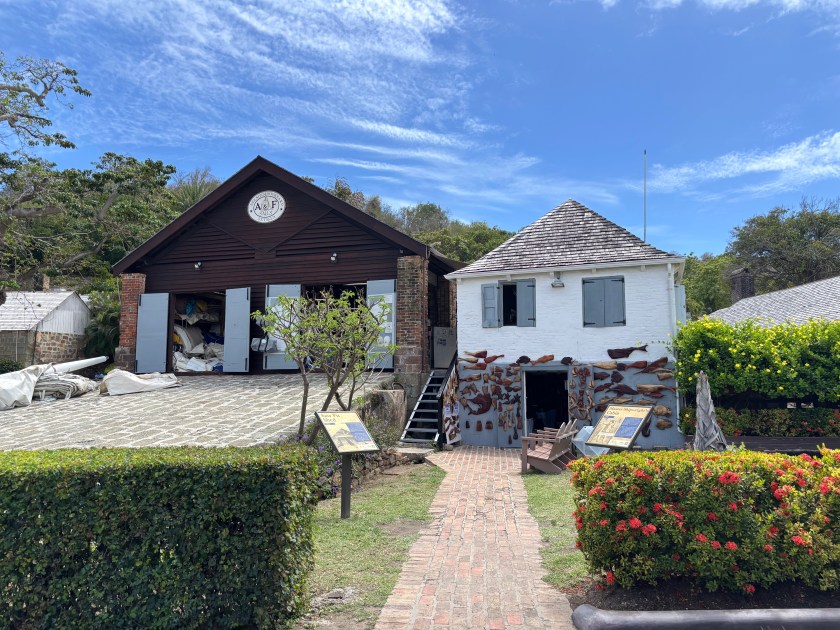
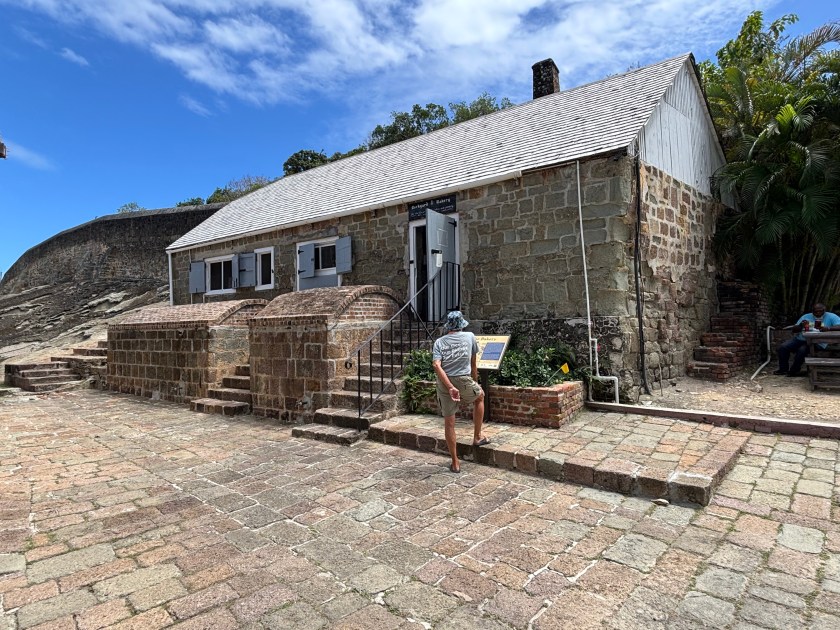
They’ve done a lovely job restoring the old buildings, which are now all inhabited by modern businesses that cater to yachties. There are shops and restaurants, of course, but other buildings are inhabited by the marina office, Customs & Immigration, the Port Authority, a Sail loft for sail repair, an art studio, a bakery (interestingly in the building that originally served as the dockyard’s bakery), the museum, and others. Each building has a placard outside describing its original function in the dockyard. The museum is housed in the Naval Officers & Clerk’s House. It provides good information about the history of the dockyard, life in the British Navy, information about Nelson’s career, and it also has a room dedicated to the ecology of the island. I found it to be an interesting mix of historical and modern, and it really is lovely. This week is the Antigua Classic Yacht Regatta, so there were some gorgeous (VERY expensive) classic sailing vessels in the marina when we were there. They had a race that morning, but it was over by the time we arrived. It was worth the bus trip down, and we were lucky that the return trip was shorter.

Sawmill shed (now a sail loft) & Shipwrights Cabin (now an art studio)
The Bakery (still a bakery)
Naval Officers & Clerk’s House (now the museum & gift shop)

There are a couple of other places we’d like to visit by bus from our base here in Jolly Harbor. However, it is now Easter Weekend, and Friday and Monday are public holidays, so most things are closed those two days, as well as on Sunday. The sugar factory ruins we want to visit by bus reopen on Tuesday. This leaves us with little to do over the long weekend. The snorkeling in this anchorage is pathetic. Visibility is poor and there’s little to see anyway. The Donkey Sanctuary is open on Saturdays and public holidays, so we may try to go there, assuming the buses are running. These “buses” are privately owned 12-15 passenger vans, so it’s up to each owner whether they run on any given day. We assume someone will be driving Saturday. There’s a wreck to snorkel about 2 miles north of here, so that’s another option. I’m sure we’ll find a way to keep ourselves busy.

That’s all for now. Until next time, stay safe and take care of each other!