We got back to our land home in the wee hours of May 22nd, about 1:30am, actually. Indigo Lady is nestled into her hurricane holes (they dig holes for the keels in St. Kitt’s), ready to ride out the season until our return.
Why did we come home so early? We had already planned to fly home May 29th so we could settle in and then attend my niece’s high school graduation the following weekend. So really we only came home a week earlier than planned. There were a few factors that contributed to our decision. First of all, when our friend Ian left us, there were still two weeks until our departure for home. We’d seen all of Antigua that we wanted to see, so staying there wasn’t an enticing idea. We wanted to go to Montserrat, but the reality was that we would have been going for the sole purpose, given our timing, of a single day tour. Turned out that the window we would have needed would have made for an uncomfortable ride across the 25 miles of ocean, and then we’d need a decent window to go St. Kitt’s. We didn’t think a single day tour was worth the hassle. Heading directly to St. Kitt’s and spending two weeks there didn’t appeal either. In addition, I had been dealing with gastric issues since February, which were fine when I took Prilosec, but restarted once I finished. On top of that, my back had been bothering me pretty much daily since early April. It was time to see my doctor and get diagnosed and treated, and we all know how long that can take in the US; best to start early. So we decided to just call it a season and come home.
I still have some stuff to post about our cruising season, and will do so at random points during the summer. For now, we have family and friends to catch up with (and a boat to launch, and a garden to work on, and, and, and).
Maybe next time I’ll tell you about our quest for a flying gurnard. Until then, stay safe and take care of each other!
We left Barbuda at 8:00am on May 4th to return to Antigua. There was a strange vibration around our starboard motor, so for half the trip we ran just using the port motor. Once we got into the calm waters inside Boone Reef on the north side of Antigua, we started the starboard motor again, because the vibration was only happening when we were slewing to the left during a roll over a swell, and the water inside the reef was flat. Dave later discovered that the vibration is due to something minor related to how the external pieces abut each other. It can wait to be fixed once we’re on the hard in St. Kitt’s.
We were anchored in Parham Bay, on the north shore, just before 4:00pm and shortly thereafter dinghied ashore to pick up a few items at the local market. We asked one of the fishermen where the market was and he gave us directions. It closed about 20 minutes before we got there. Bummer! There was supposed to be another market around the other side of town, but we decided not to walk that far lest it also be closed, being Sunday, after all. Plus, we were exhausted from our seven-hour cruise down from Barbuda, and it was hot. We’d come back in the morning.
It was a good thing we decided not to seek out that second market Sunday evening, because when we went in search of it the next morning, it was not where Google Maps and our cruising guide (which also had the wrong market name) had it marked. We did find it, however, thanks to the directions of another local, and procured the handful of items we sought. We went back to Lady and moved about three miles east to anchor off Great Bird Island. It was a much prettier and quieter anchorage than Parham Bay, which hosted a boatyard and a power plant, the latter emitting a low, persistent, rumbling sound. In addition, we could see the bottom at Great Bird. After lunch, we snorkeled some bits of reef in the shallow water off Great Bird. It was both depressing and a bit hopeful. We anchored dinghy in sand, but her stern was floating over an immense stand of dead staghorn coral. So sad. Looking closely, however, I noticed that there is new staghorn growth coming off the ends of some of the old, dead base. These bits were 6” long or less, but it’s a sign of rebirth. Coral grows very slowly; perhaps in the not too distant future this reef will thrive again (she says, hopefully, not really believing the words she types). At other parts of this shallow reef, there were also some soft and encrusting corals, also signs of hope.
The following morning started with rain and solid overcast, but by early afternoon the rain had stopped and the sun was peeking out occasionally, so we decided to snorkel again. This time we took dinghy to Whelk Rock, about ¾ of a mile from Great Bird. This reef is immense! It was at spots breaking the surface and got down as much as 15-20 feet in other spots. The base coral structure was, again, dead, but there was a lot of regrowth of soft and encrusting corals, and there were some fish, the usual suspects. Again, this reef system must have been amazingly beautiful in the not too distant past. 😔
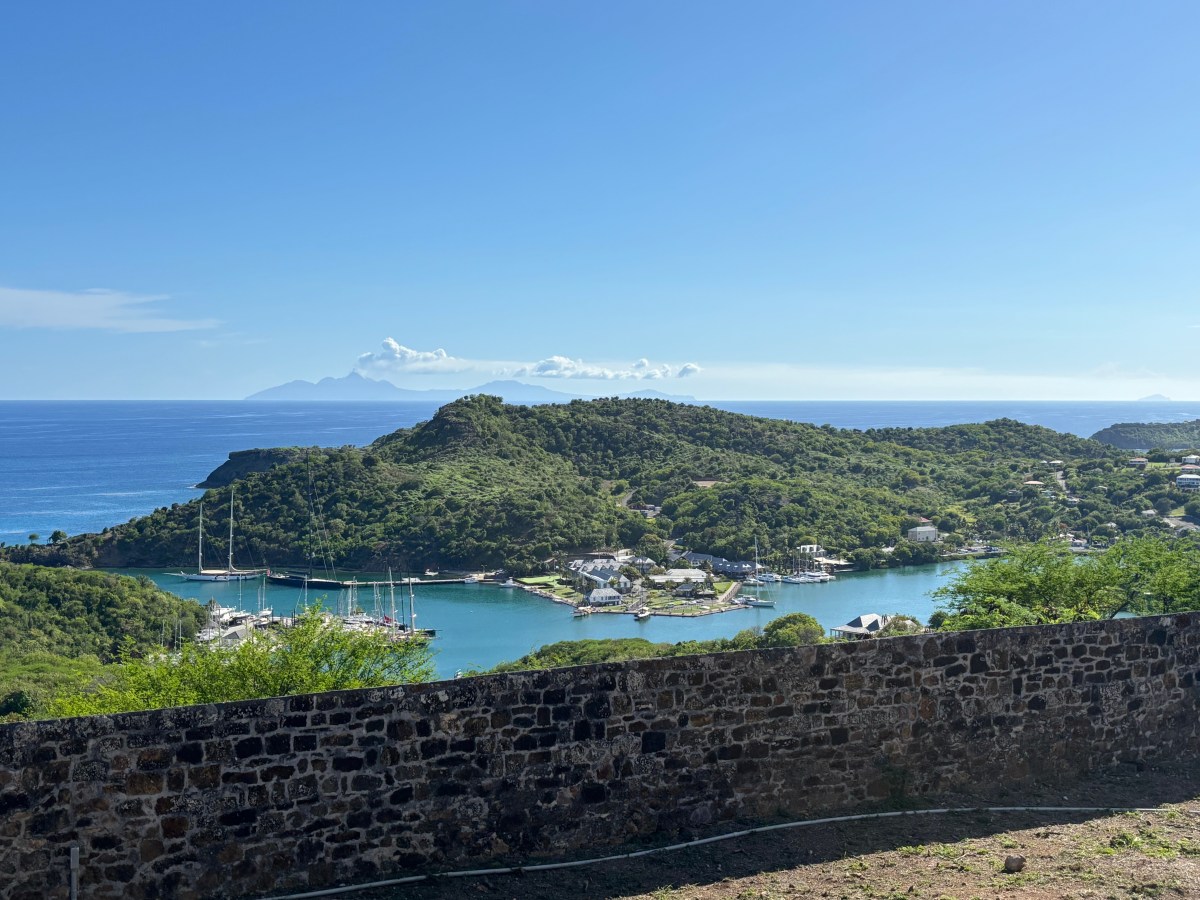
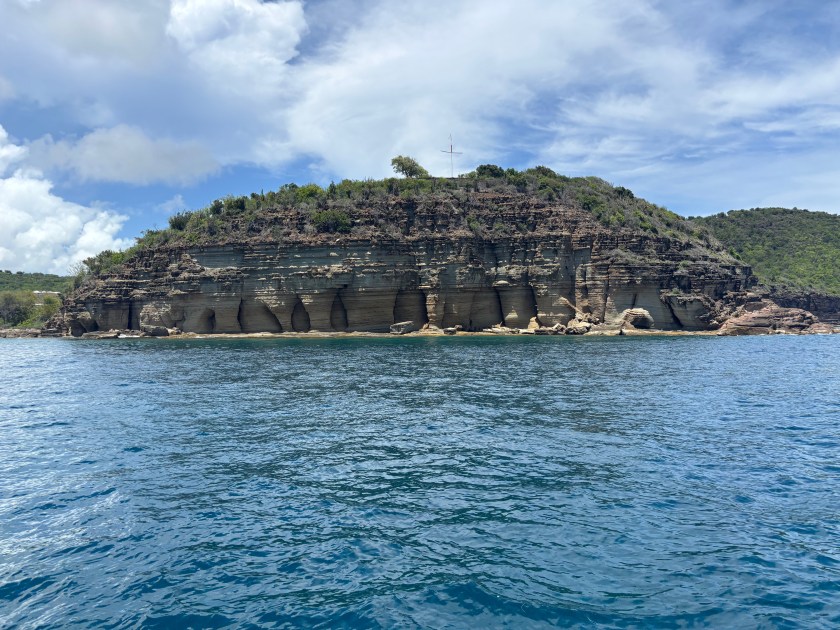
We’d had enough of mostly dead reefs, so the following morning we headed to the south coast to anchor in Freeman Bay, just outside of English Harbor, home of the historic Nelson’s Dockyard. Conditions were quite calm, so we were able to take the shorter route through a channel at the north end of the reef system, then cruised down the east coast of Antigua. It only took about three hours, so we were anchored in plenty of time to snorkel the Pillars of Hercules. The snorkeling, as expected, was pathetic, although we did see some good-sized fish, as well as scattered corals and sponges, the latter of which we had not seen on the other Antiguan and Barbudan reefs. The Pillars, however, are quite impressive. These limestone structures were carved out of the cliff by thousands of years of erosion by wind, rain and crashing waves.
Pillars of Hercules
We swam directly from Lady to the Pillars and back. Once we dried off, we made ourselves presentable and went ashore to the Port Authority to pay the requisite fees for staying in this anchorage. Both English and neighboring Falmouth Harbors, plus the land immediately surrounding both, are part of the Nelson’s Dockyard National Park, thus the fees. We paid a one-time per person entry fee for the park, a daily per person garbage and environmental fee, and a per-foot/per night boat length anchoring fee. Our 5-day/4-night total for three people was under $100 US. Not too bad.
After paying our fees, we bopped around Nelson’s Dockyard a bit so Ian could see it. Then, we walked the short distance to Falmouth and found a restaurant for dinner. Just as we were leaving the restaurant, it started to sprinkle. By the time we got back to dinghy, tied up at Nelson’s Dockyard, it was raining. By the time we got back to Lady, we were soaked to the point where we had to wring out our clothes. Then we had to make room for our wet clothes and ourselves inside, which we managed. It could have been much worse, because there were thunderstorms around us, but they, and their associated lightning, stayed away as we passed the wet evening inside playing cards.
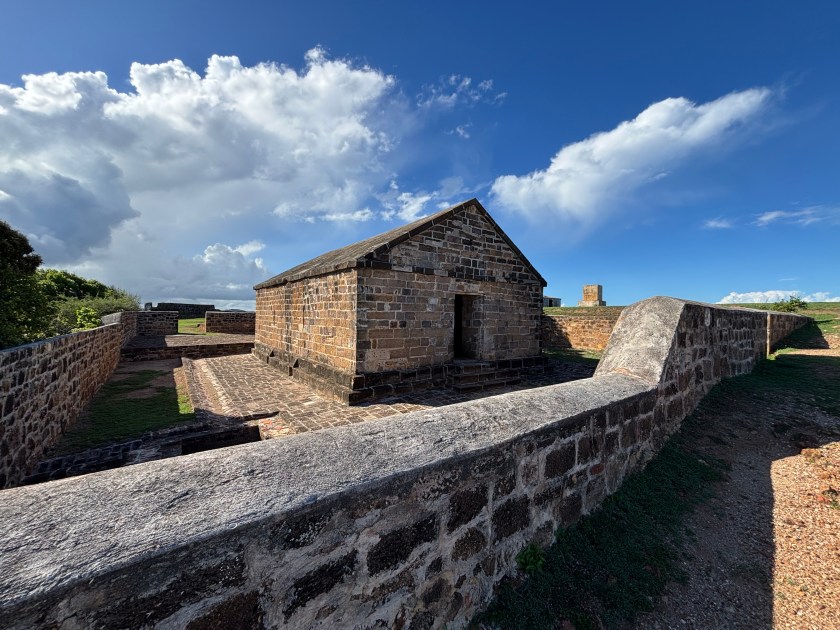
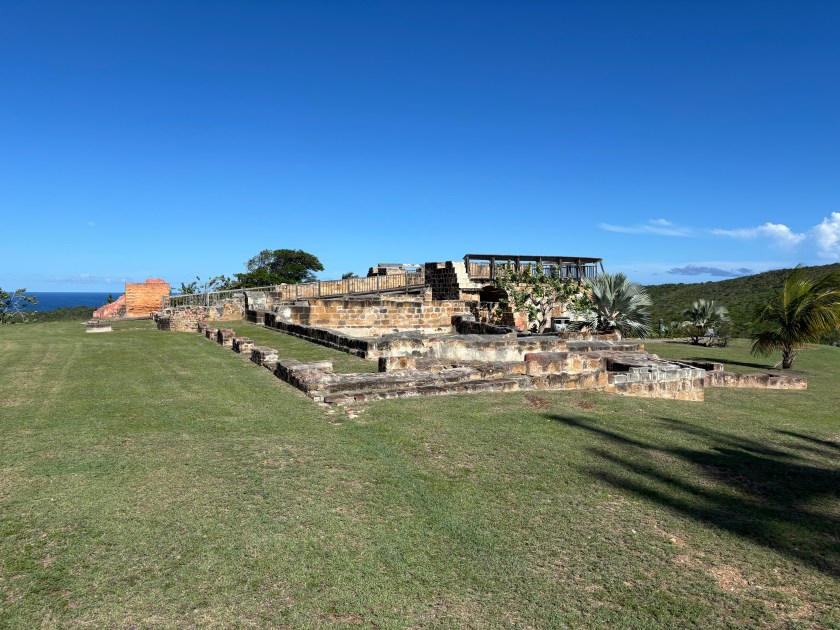
The Freeman Bay anchorage is small and very close to land, and therefore bugs, so we moved over to Falmouth Harbor the next morning, right after breakfast. There was a better breeze and we were further from land, but still only a short ride to a dinghy dock. Shortly after anchoring, we dinghied ashore to pick up our rental car, then we set off to tool around the island for the day. First we followed a largely coastal route across the south coast and up the west coast, stopping at a little place in the town of Five Islands for lunch. We inadvertently drove right through the busy heart of St. John’s after our attempts to circumnavigate it failed (thanks, Google Maps 🙄), then headed east/southeast stopping at Betty’s Hope Sugar Factory ruins to explore those. They had a concise, informative display about its history and that of the sugar industry on Antigua, and the remaining ruins are clustered nearby. It was worth the $2 US donation per person, even though we only got 30 minutes to tour it before they closed for the day. We continued back toward English Harbor to Shirley Heights Lookout for Reggae night, stopping to look at some of the Shirley Heights Fort ruins first. Dave and I had gone a few weeks earlier to their Sunday night music event, but didn’t eat because the line was hours long. This time, there were far fewer people and no line for the food, so we had a nice dinner, listed to the introductory steel drum band, and left before the Reggae even started. We were all tired, and our early departure got us back to Lady before it was fully dark.
Betty’s Hope windmill and old gears (on the ground)Block House at Shirley Heights
Yesterday we spent another day with the rental car exploring Antigua. We started by going to Clarence House which has served as home to British Navy Commissioners and later to Governors of the Leeward Islands. Sadly, they only do private tours on certain days, and Fridays was not one of them. So, we headed over to the Dow Interpretation Center to look at the limited remains of Fort Dow, and to watch the 15-minute audio-visual presentation about the history of Antigua and English Harbor. It was a good overview, but Dave and I had already learned the content when we visited the museum in St. John’s shortly after arriving here.
Fort Dow
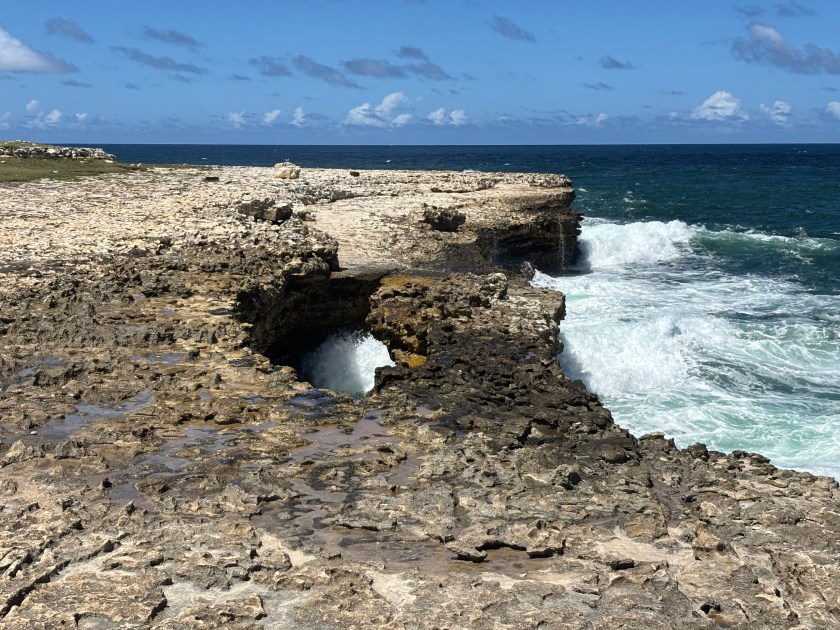
With our history lesson finished, we continued our driving exploration of the island by heading up to Devil’s Bridge National Park at the northeast corner of the island, stopping for lunch in Long Cove first. Devil’s Bridge is a low, natural limestone rock arch and surrounding blowholes, carved out by the crashing waves from the open Atlantic- nothing between it and Africa other than ocean. It was interesting enough. The seas weren’t that big, so the wave crashing was less impressive than I would imagine it is when the Trade Winds are higher. I took some photos, but our timing was bad for sun position, so they don’t really show the bridge well. Alas!
Devil’s Bridge
After Devil’s Bridge, we just tooled around the island a bit longer on the speed-bump and pothole-riddled roads. We attempted to reach Body Ponds Nature Park, but our attempts were foiled, at both its entrances, because Google Maps, at least on this island, does not distinguish between paved roads and unpaved/heavily rutted/almost washed out roads/cow paths. (Thanks again, Google Maps!) We gave up and headed back to Falmouth, stopping for a beer at a little craft beer brewery before heading back to Lady. (The boys report that the beer was “okay.”)
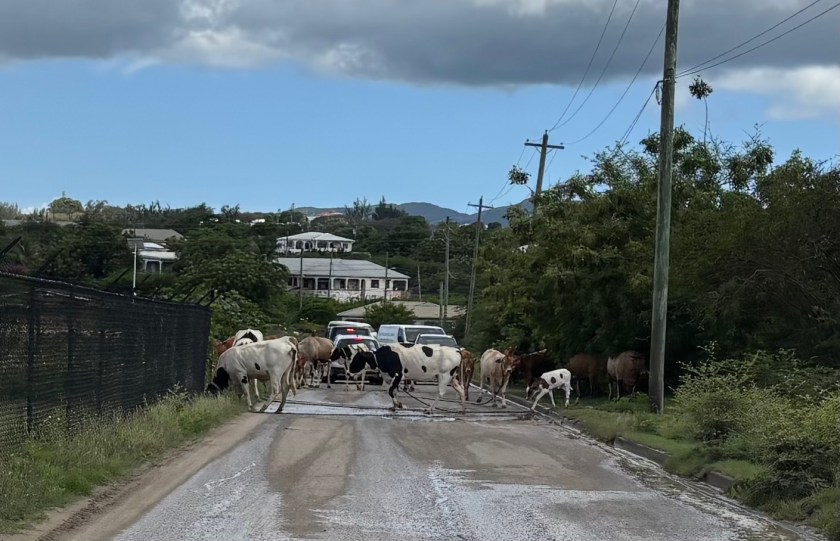
Antigua traffic jam 🙂
This morning we gassed up and returned the rental car after making a stop at Budget Marine for a couple of replacement blower fans and a cabin fan. We also popped over to Port Authority to see about renewing our cruising permit, which expires today. We learned that (a) cruising permits can only be renewed in Jolly Harbor, where we are not, and (b) if we stay anchored where we are until we leave the country, we don’t need to renew the permit at all.
Ian leaves us tomorrow. We want to head to Montserrat for a few days before heading up to St. Kitt’s. We’ll probably choose option “b” from above, since we’ll probably head to Montserrat early this coming week.
My next post will either be from Montserrat or St. Kitt’s & Nevis. Until then, stay safe, and take care of each other!
I last wrote on April 1st (posted the 5th) and we were still in Guadeloupe.
We were in Guadeloupe another eight days and in that same anchorage for five of them. Honestly, we were a bit bored. We snorkeled another time and dove two more times. I mentioned last time that we had met a couple of American cruisers when we went ashore one day. They are on a sailing catamaran called Pulpo (Italian for octopus). That was the saving grace for our sanity. We told them to stop by if they wanted to see our solar electric system, since they were interested in it. A couple of days later, they did so. The tour of our system turned into a few hours of socializing with cheese, crackers, salami and apple as dinner once we realized it was too late for a real dinner and we were all hungry. 😂 A couple days after that, we invited them over for pizza and had another enjoyable, rambling conversation for several hours.
We and Pulpo ended up both moving north to Deshaies on April 7th. They picked up a mooring ball. We tried to anchor, but dragged, and the anchoring section was pretty tight anyway, so we went north one more mile to Grand Anse and anchored in lovely sand. Just the change of scenery was mood-lifting, and we spent the rest of the day reading in our hammocks and enjoying the new view.
The following day, we did some travel planning over breakfast and decided that conditions looked sufficient for moving on to Antigua two days later, on Thursday, August 10th. In the meantime, we had two days to explore. So we packed a dry bag with stuff we’d need ashore, donned our swimwear, masks, fins and snorkels, and swam ashore. The swell, though not bad at anchor, was too dangerous for landing dinghy ashore, she would have been swamped; so we swam instead.
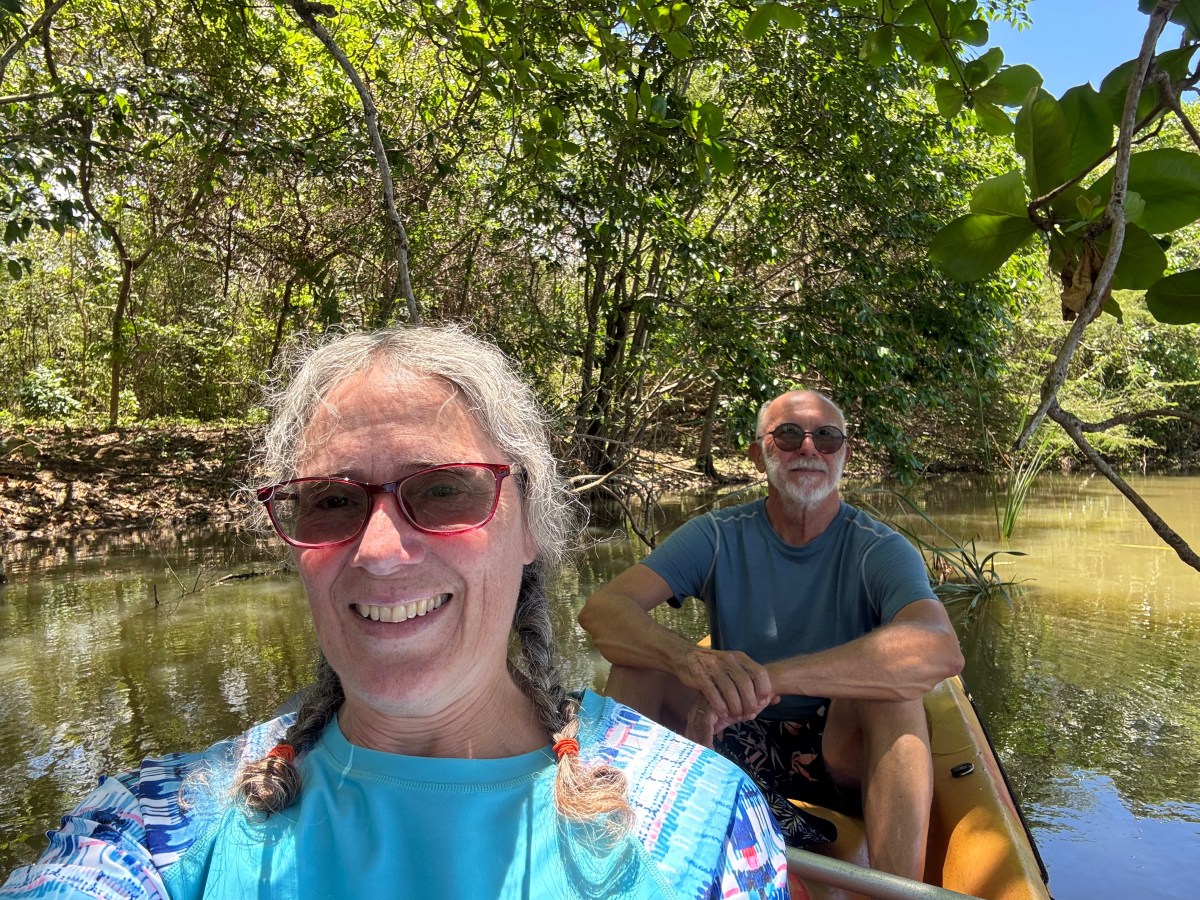
Once ashore, we put our snorkeling gear in the mesh bag we’d packed, retrieved our glasses, hats and shoes, and headed for a little shack that rents kayaks for paddling around the mangrove. We rented a two-person kayak from a very friendly man who told us the mangrove has only existed for forty years and resulted from dredging for sand to build elsewhere on the island. He gave us the mangrove map and explained the various “stopping points” labeled on it. Then we set off. It was lovely! It was mostly an open mangrove lake, but there was one area where we could wend our way up the mangrove “river” several hundred feet, dodging mangrove roots and ducking under branches. It was soothing and mystical-feeling, and absolutely beautiful. There was another spot where we could pull the kayak onto a dry patch and then hike a short path into a 200-year old stand of very tall palm trees. Imagine the storms they’ve seen and survived! They were quite impressive. There was very little growing under them, since they block most of the sun. The ground was littered with fallen palm fronds, very big palm fronds. Occasionally there was a frond still attached to the piece that wrapped it to the palm’s trunk. This felt sort of like vinyl, which surprised us both. After about 20 minutes of gazing in awe, we went back to the kayak and continued around the mangrove lake to a shady spot under a sea grape tree where we sat for a while listening to the birds all around us. One little bird perched on a low branch just in front of us and serenaded us for a while. How sweet! Eventually our tummies started rumbling, so we returned the kayak and sought out lunch.
We ate at one of the many small restaurants lining the parking area of this popular beach destination. This beach area is more like White Lake State Park in NH, minus the camping. It’s not at all like the New England beaches. Yes, it’s a long sand beach, but between the sort of paved parking and the beach is a good-sized area of sand and palm trees, offering people a place to set up for the day in the shade. The restaurants, a couple of food trucks, and one little souvenir shop outline the parking area. The restaurants are more like glorified shacks, covered but open at the front and often the sides. Lunch was yummy.
The following day, Wednesday, we needed to get our clearance papers stamped at customs in Deshaies. Although we could have dinghied from Grand Anse, we wanted the ease of dropping mooring lines rather than hauling anchor when we got underway at 6:00am the next morning, plus we wanted to see Pulpo again. So we texted them to ask if there were any mooring balls open, to which they responded yes. As soon as we finished breakfast, we hauled anchor and ended up grabbing a recently vacated mooring right next to Pulpo. Yay! We each did our own thing that day. They went for a monster bike ride around the area. Dave and I stopped at Customs for that clearance stamp, grabbed croissants at the local bakery, then walked back toward Grand Anse via the main road through town and then along a shaded road/path. We walked a bit into the forest to an old battlement, now sporting one lonely old cannon, then we exited the trees onto the far south end of Grand Anse and walked over the sand back to the main swimming area, then out to the main road and back into town. Pulpo invited us over for dinner and we spent another lovely evening eating and chatting. They would also be heading to Antigua the next day, but didn’t need to leave as early as us, since they can sail faster than we can motor.
Our alarm went off at 5:00am on the 10th. We had a quick breakfast, then dropped the mooring lines as planned at 6:00am and were off to Antigua. It was a tolerable passage, but not enjoyable. It was rolly and salty (that means we got splashed with sea water). As anticipated, Pulpo caught up with us, then passed us, arriving at Jolly Harbor about an hour ahead of us. The only two enjoyable events on the crossing included the sighting of what we think may have been a sperm whale off in the distance. We could see it tail slapping the water. The other brief event was Dave hooking a marlin, which, unfortunately, he did not land. He got to see it tail walk just before it shook off the lure. Bummer! For the first half of the trip we used the generators, until the sun was high enough that we could switch to just solar and battery. It was fairly cloudy, but the sun peeked out just often enough, and we were making good speed at an average of 6 knots, that we arrived in the anchorage at Jolly Harbor with 35% left on each battery bank. Dave dinghied into Customs to clear us in and met Pulpo there. They had brought their big boat into one of the Customs docks. They followed him back and anchored near us. They came over that evening for tacos and games.
It is so good to finally have a new place to explore! There are many anchorages all around this island, and we’ll have 5-6 weeks to explore them. Pulpo will be here for another week or so, before they have to start heading back south for hurricane season. Our friend Ian will be joining us at the end of this month.
The next time I write, it will be about our time here in Antigua. For now, enjoy the short video of our tour through the mangroves.
Until next time, stay safe and take care of each other!
We’ve been back in St. Kitt’s for a week and the boat is still not in the water. The boat work we’d asked to have done started the day before we arrived. We told them what we needed done last June when we dropped her off for storage, and again in November, and December, and earlier this month. Last January, the boat work we’d asked for started on the day we arrived, so I suppose this year is an improvement. Island time.The big job that needed doing, which Dave and I could not do, was the bottom copper coat. Dave is extremelyallergic to the hardener in this epoxy-based paint. Before we launched last January, Dave spoke to the then yard manager about the job and learned there is a guy on the island who does it as an outside contractor. We’d buy the supplies in St. Martin and bring them back with us in June, which we did. Dave met the guy in June, at the boatyard, to discuss the job; all seemed good. When November rolled around, nobody could get in touch with him. When we still hadn’t heard anything after Christmas, Dave contacted the yard owner who put Dave in touch with another guy who could do it, I’ll call him Bob. Dave and Bob texted back and forth and Dave said it sounded like Bob knew what he was doing, so told him to go ahead.
We’re pretty sure our boat is the first one Bob has copper coated. First, the hull needs to be sanded and smooth and any pits that don’t sand smooth need to be filled. Our hull is still pitted in places. The time-sensitive, epoxy-based copper coat requires a crew of 3-4 to do it well. Bob had one other guy working with him who was less than dedicated to the work. Finally, the hardened copper coat needs to be sanded smooth. Bob and the other guy showed up Monday with one battery powered sander, no way to recharge it, and not enough sandpaper. By Tuesday morning, with only about one quarter of the final sanding done, Dave suggested buying electric sanders and more paper. Away Dave & Bob went and returned with the needed supplies. That helped, because the sanding was finished this afternoon. In speaking with Dave daily, Bob has acknowledged throughout the process what he should have done differently. If he ever does this type of job again, we’re sure he’ll do it even better. Bob is a good worker and learns from his efforts. The other guy did a lot of sitting and half-hearted sanding. It stinks to have to pay $45/hour/person for amateur work, but pay we shall.
On the upside, Dave and Bob bonded a little. On Friday, Dave had given Bob a spare solar panel we’d gotten for free but couldn’t use. When Dave bought the sanders, he told Bob he could keep one after the work was done. During their drive, they discovered a shared love of hunting. Bob hunts wild boar on the island, a lot of wild boar. He gifted us with 8 pounds of boar meat! We do meet some mighty nice folk on our travels.
That was just one bump in the road.
Our windlass needed attention. (For you non-boaters, the windlass raises and lowers our anchor and chain). Dave came prepared with a rebuild kit. The job took longer than anticipated. Dave not only did the anticipated rebuild, but also a lot of correcting of things that were poorly done when it was initially built. The windlass had also been installed poorly, so he improved that before reinstalling it. I even got to play a role in this, doing a small epoxy repair job on the mounting base. Monday night, just after sunset, it was reinstalled and we tested it. As Dave punched the up and down buttons, the lights inside Lady flickered on and off. In addition, the anchor went down, but not back up. It also made some unfortunate, complaining sounds. There’s also a way to crank the gypsy (the part the chain links sit in) manuallywith a handleshould the motor die, and that wasn’t working. Ack! By early Tuesday afternoon, Dave had it sorted. Our windlass works now!
The flickering lights during our windlass test, were the result of another bump in the road. Our 12V golf cart batteries run the house load of fridge, freezer, lights, stereo, dinghy lift and windlass. Their capacity was basically non-existent, so the windlass calling for all that power tanked them, causing the lights to go off. Dave had purchased two 12V car batteries last year, so he switched the wiring to those. They’re temporary, because their capacity is not as high as a that of healthy golf cart batteries. Unfortunately, nobody sells golf cart batteries on this island, so we’ll probably have to buy those in Guadeloupe.
Still with me? I have two more bumps to go.
Bump #4 was our replacement multifunction display (the chart plotter that allows us to set routes and navigate, see our speed and depth). The original started delaminating last year, which turned out to be a warranty issue. So last June Dave removed it, lugged it home, and shipped it back to Garmin who sent us a new, bigger and better replacement for free! Too bad they sent us the wrong model. We have front and side scan sonar transducers and a depth sounder. The multifunction display they sent does not have the proper ports for these. Depth is an important thing to know, especially when traversing or anchoring in shallow areas. Dave was able to connect the front scan sonar which can also serve as a depth reader. It’s not ideal, but if Garmin can’t (or won’t) ship the correct display to the Caribbean on their dime, the exchange will have to wait until we’re back in the U.S.
The final (for now) bump in the road was the theft of the gas can out of our dinghy. Had we not stupidly left the gas can in our dinghy, unlocked, it wouldn’t have been stolen. Mea culpa. Fortunately for us, the local Budget Marine store had one in stock. Off we went to Basseterre today to purchase said gas can and requisite attachments, as well as a couple of unrelated items we needed. This trip also provided us with the opportunity to eat at one of our favorite local restaurants, El Freddo. It wasn’t a bad way to spend a few hours today.
Upon our return to the boat yard this afternoon, we learned that the bottom work is finished, the power wash has been started and will be completed in the morning, and they can launch us tomorrow, although they have to schedule us around two other boats being launched. Bob needs about 2 hours while Lady is in the lift slings to copper coat the areas where she was resting on the jack stands. They won’t be able to be sanded smooth afterward, but it’s better than not having those areas coated at all. If all goes well, we should be in the water by late afternoon. They have an open slip at a rickety old dock that we can stay at for a night or two while we do our provisioning runs.
Perhaps by the next time I post, we’ll be someplace more interesting. This season we hope to visit, in no particular order, Nevis, Montserrat, Dominica, Guadeloupe and Antigua. I will, of course, keep you posted.
Until next time, stay safe and take care of each other!
That’s right folks, we are land lubbers once again, at least until shortly after the end of hurricane season.
We’ve been home for just over a week and working on getting our house, yard and Dumbledore (our small trawler) back in shape. I think we’ve finally gotten to the point where we can start spending time visiting friends instead of working on said house and boat. If we don’t get to you first, give us a call and we’ll get together. We are so looking forward to it!
While we’re home on land, I will irregularly post to this blog. I still have some things to share from our cruising season, and we will be taking Dumbledore out this summer, mostly on day trips and an the occasional overnight. Keep your eyes peeled.
Until then, stay safe and take care of each other!
Not only are we not in Penobscot Bay, we’re not even on Dumbledore. We are still land bound.
We took Dumbledore and his new alternator for a test run up to Little Bay (near Durham, NH) on Thursday and spent the night on a mooring up there. The alternator performed admirably. So why are we not out on Dumbledore? We were having electrical issues. These manifested in two ways. First, the old microwave that came with the boat had stopped heating things, at least not consistently. We figured it was old and wanted to replace it with a microwave/convection oven anyway, which we did. Dave installed it several days ago and used the microwave feature successfully. On our alternator test run trip on Thursday, the microwave did not heat his lunch, nor did it heat something I tried to warm later in the day. Yet that night the air fryer function cooked our sweet potato fries perfectly. Hmmm. Friday morning I tried to turn on the solenoid switch that turns the propane to the stove on & off. It worked fine the six days we were onboard in July, but Friday morning the switch wouldn’t even turn on (you turn it on, then push the gas button to turn on the flow). What the heck??
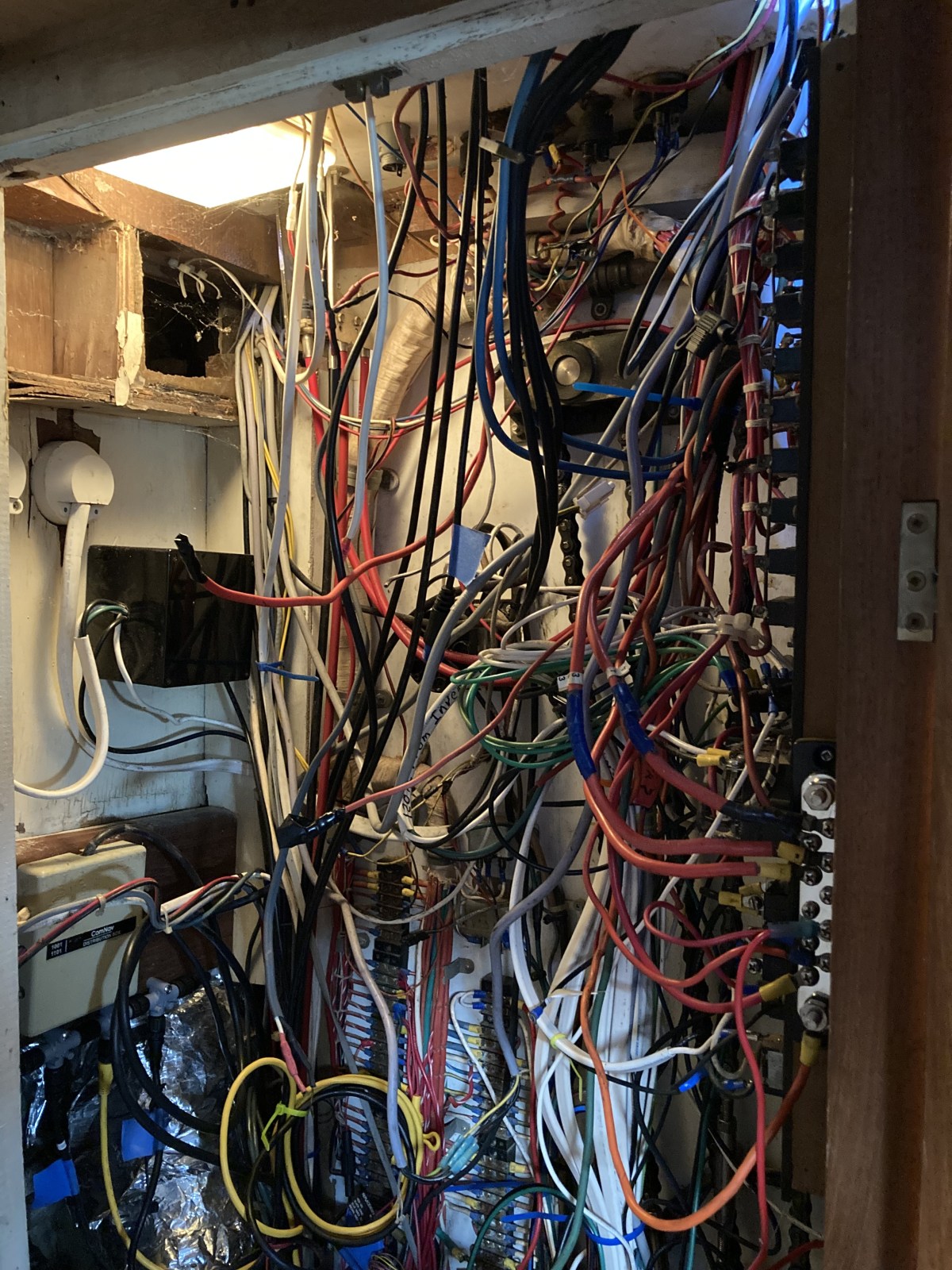
Long story short, Dave didn’t think it was a good idea to set off up the coast of Maine with wonky electricity, a sentiment with which I agree. He has never been pleased with the haphazard mishmash of wiring on Dumbledore anyway. He describes the wiring as abysmal; sometimes he calls it a “rat’s nest.” The picture above is only the wiring that’s not in the engine room. The wiring down there isn’t much better. Bottom line, for now he has ordered what he needs to create a monitored bus bar distribution system. It won’t solve all our electrical issues, but it will be an improvement that also provides data that will allow him to suss out additional problems, and it will be significantly safer.
Looks like we won’t get our extended cruise up the coast of Maine this year, but we’ll eek out some time once this piece is taken care of, which he’ll tend to as soon as all the parts arrive this week.
I will keep you all posted. Until then, stay safe and take care of each other!
St. Kitt’s is our final stop this cruising season. We arrived on Monday, June 5th after a long, slow, bumpy ride from St. Bart’s. We wanted to stop at St. Kitt’s Marine Works to arrange a haul out date for Indigo Lady and clear into the country. Fortunately, Customs & Immigration are right there. We’d arrived too late to clear in that night, which was fine by us. All we had energy for was slinging the hammocks and we had no need to go ashore; we could wait until morning.
Here’s a little information about St. Kitt’s Marine Works. Most importantly, they certainly seem to know what they’re doing with respect to long term storage and, from Dave’s perusal of the yard, with respect to repair work. That’s good. Indigo Lady is probably in good hands here for the next 6 months. Their approximately 200’ x 400’ “harbor” is human made with two retaining walls of large boulders separating it from the open ocean. It contains a cement slip from which their travel lift hauls boats weighing up to 150 tons. There is also a smaller, wooden dock with several small, local fishing boats tied up to it, and a handful of mooring balls near the smaller retaining wall, near the harbor entrance. They are not a marina and there are no real amenities, although the boat yard does have a toilet and a shower. Boat owners can do their own work without any fee charged, which is kind of rare, and they can live aboard their boat while on the hard. One can also hire the Marine Works to do work to one’s boat and their fees are very reasonable.
The Marine Works allowed us to tie up to the outside of their travel lift dock the night we arrived at St. Kitt’s, and the following one as well. The prevailing sea conditions would have made it incredibly uncomfortable to anchor in any of the nearby, open roadstead anchorages. (For those unfamiliar with the term, it’s merely a spot off land that is shallow enough to drop an anchor, but there is nothing between you and the open ocean, except more ocean.) We would have had to travel another 3+ bumpy hours to get to a protected anchorage, which would have had us anchoring after sunset. Then we would have had to backtrack the next day to clear in and talk to the Marine Works folks. So we stayed on the Marine Works dock. We spent most of our time in the hammocks reading and napping. Long, bumpy cruises are exhausting. We cleared in the next morning. Dave talked to the boat yard manager to arrange the haul out and some work we wanted done to the boat. We arranged to be hauled out on Monday, June 12th. So what to do with the interceding five days?
At the end of the past two cruising seasons, we’ve done as much cleanup and hurricane storage prep as possible while at anchor. This ensures we’re always nose into the wind to keep us cool while we work, and we can also swim and cool off. So, on Wednesday morning we cruised about 12 nm down to the southeast peninsula of St. Kitt’s to the White House anchorage. It’s a quiet, lovely spot and we’d read there was decent snorkeling along the rocky shore. Each day we were there we would work from mid-morning until about 3pm, then we’d go for a snorkel, then swing in the hammocks reading and napping until dinner, followed by a movie before going to bed. We gave the boat a deep clean- airing out the mattress toppers and mattresses, vacuuming every nook and cranny, washing the walls with a vinegar solution, cleaning out every food storage location and inventorying what we have left for non-perishables. Dave has his own separate list of boat stuff that needs doing and started on that as well. I prepped our final meals so that when we were working on Lady in the boat yard, all we’d have to do was microwave lunch and dinner. It was tiring but rewarding. Then on Sunday afternoon, we hauled anchor and went back to the Marine Works to tie up to their cement dock again in preparation for being hauled out the next morning.
The travel lift came for us at 11am Monday morning. We stayed onboard while they lifted us out of the water, which is a strange feeling, being suspended in the air. They paused near the diesel pump so we could top off our tank. Then they drove us up into the yard where they power washed our hulls of the accumulated sea life that had grown there. They did a marvelous job! Then they brought us over to our storage spot in the field, lined us up, brought over the backhoe to finalize the dug trenches in which Lady’s keels would sit atop old tires, then they finally set us down. All told, we were suspended in Lady about four hours. I got a lot of organizing and packing done during that time. We were finally able to check into the guest house we had rented for our final few days buttoning up Lady while on the hard. Thankfully it’s only 0.1 mile from our boat’s location, because it took us two trips to bring everything we needed to have up there. We were beat! We hadn’t done much work that day, but the prior five days of work, plus the underlying stress of knowing the boat was going to be hauled onto land got to us. We were a waste of space after we settled in at the guest house. We were in bed by 8:00pm and sound asleep by 8:05!
Over the next two days we spent long hours finishing our boat closeup tasks. For Dave, that was a lot of time working in the blazing heat and sun on, in, and under Indigo Lady. I spent a lot of time doing laundry up at the guest house, interspersed with stowing our clothes, bedding, etc., onboard. A big downside of St. Kitt’s is that they burn trash on the island. St. Kitt’s Marine Works is downwind of this. It also hasn’t rained much here, so everything is dry and brown, and the persistent trade winds blow dirt and dust around. This complicated the cleaning and closing process. It would have been impossible to do the necessary work without having the hatches and portholes open. Sadly, it didn’t take long for the dirt and dust to find its way inside, despite all our screens, and onto every surface. So much for all that deep cleaning we’d done earlier. We did what we could to rectify it. It was hot, sweaty work, but we made good time. By Thursday, we had only about an hour’s worth of stuff to do, mostly stowing final items, and retrieving others we needed to bring home with us. Friday morning required only a quick trip to Lady to return stuff we had used while at the guesthouse. Then we locked her up and bid her farewell until January.
Although we had almost all of Thursday to ourselves with no work to do, we lacked the energy to explore the island. It is horrendously hot and humid down here and it is horribly uncomfortable to be out of the breeze for more than 5 minutes. It takes less time than that to start sweating. I would sweat standing at the sink in front of the open window while washing dishes! Rather than exhaust ourselves tramping around the area in the heat, we holed up in the guest house with a fan pointing at each of us. I won’t lie, I was a bit bored, but that was preferable to being outside. Hopefully January will be a bit cooler, and we can take a few days to explore on land.
I’m writing this on Thursday from the guest house. Friday we should have flown from St. Kitt’s to San Juan, then from San Juan to Boston. From there taken the bus to the C&J Trailways station where we picked up our car, which my folks had delivered there for us, and driven home. We should have been in our own bed by 2:00am. That was the plan, at least. Next time, I’ll let you know how it went. Until then, stay safe and take care of each other!
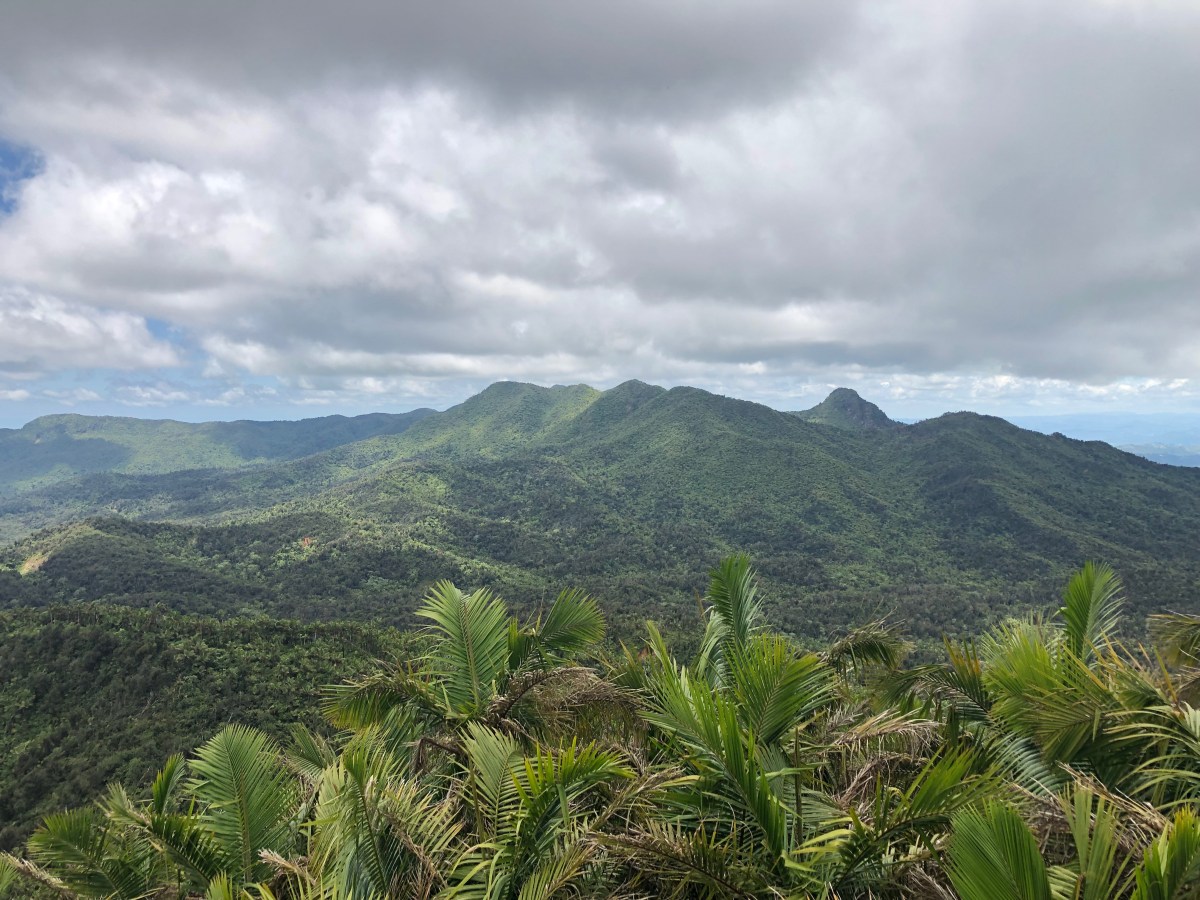
El Yunque National Forest, located in the municipality of Río Grande in the NE portion of Puerto Rico, is one of our smallest forest at around 29,000 acres, but the only tropical rainforest in our National Forest system. It is part of the Sierra Luquillo Mountains. The area was formally set aside as a reserve in 1876 by King Alfonso the XII of Spain, in order to preserve the area against the rapidly growing population, and at the time, poor agricultural practices. The U.S. acquired Puerto Rico in 1898 and in 1903, President Theodore Roosevelt established the Luquillo Forest Reserve. It became a National Forest in 1906. It was renamed the Caribbean National Forest in 1935, and renamed El Yunque National Forest in 2007. There was timber and other military use during World Wars I & II, but also reforestation efforts. There has been ongoing scientific and conservation research in several dedicated areas of the forest since 1956. Most of the recreational infrastructure was built in the 1980s. The forest and infrastructure has been assaulted and heavily damaged by hurricanes Hugo (1989), George (1998), and Irma & Maria (2017). It is home to the critically endangered Puerto Rican Parrot (we did not see any). [Wikipedia][Forest Service]
Our day in the forest
The main recreation area along Route 191 is the primary attraction. You drive along the road and make stops at designated parking areas to view the scenery and make hikes of various lengths. As of our visit, there was still damage from the 2017 hurricanes, so some trails are closed, including the one to La Mina Falls, which is typically a popular hike. We arrived around 9am, presented our tickets at the entry point, then drove on in. [Tickets must be booked in advance. If you have more time to read, see my anecdote, and additional information about the park, below the slide show.]
We stopped at several key points. Here are the highlights. Baño Grande was built in the late 1930s by the Civilian Conservation Corps (CCC), as part of the New Deal era. It’s formed by a stone and masonry dam and arched bridge with cobblestone path. It even had a restroom at one point (now a ruin). The 18-foot deep pool is fed by the La Mina River watershed. It served as a public swimming pool from 1936-1968 when it was then closed due to safety concerns. Now it’s just a scenic spot.
Our main hike of the day was up to the Mt. Britton Tower. This was another New Deal era construction of stone and masonry, built by the CCC in 1937-38 as an observation tower. The hike took us through a palm forest and cloud forest. The views from the top were marvelous! As we descended and got back to the intersection with the El Yunque Peak Trail, we decided we were pretty hot and tired and opted not to pursue that peak. So we returned to our cars and started to head back down toward the entrance, but with a couple of more stops planned.
La Mina Falls may have been closed, but the Juan Diego falls were open to hikers, and it was only about a half mile, mostly flat. Doable for tired footsies and a tired, hot pooch. We followed the Juan Diego Trail to the falls. We were not prepared for swimming, but Ocean had no qualms about laying down in the water, away from the natural pool formed by the falls, where several people were enjoying the cool, refreshing waters. Next time, I’m packing my swimsuit.
Our final stop on the way down was a the Yokahú Tower. It’s a 69-foot tower that was built by a former Forest Supervisor in the early 1960s. From its top, one can view four forest types in the National Forest area. Wish I’d read about it before hand. I just stood up there and thought, “Great views!”
After the Yokahú Tower, we headed out of the forest in search of lunch in the town of Río Grande. We ended up at a lovely roof-top restaurant for a late lunch. We got back to our apartments around 5pm for rest and showers. Around 7pm we were starting to get hungry, so we all ordered pizza from a place in Old San Juan that delivers and chowed down in Mike & Victoria’s digs. We were all beat, but in that “we’ve been enjoying the outdoors all day” kind of way.
Enjoy the slide show of El Yunque. As you read in my post last week, we returned to Salinas the following day after a ton of shopping. Our next stop would be the Spanish Virgin Islands, which is what I will tell you about next time.
Until then, stay safe and take care of each other!
Additional information about the park:
Entering the main area on route 191 requires a ticket, and those reservations are made online through the Forest Service for just $2/car. They control how many vehicles, private and tour, enter the park each day. If you just showed up, it’s highly likely you’d be turned away. Sometimes tickets are available weeks in advance, but most often they’re made available only 24 hours ahead of time, and they go fast! We did not know this in advance, so it was lucky that Dave decided to book our planned Tuesday excursion early Monday morning before we even left Salinas. He went online around 7:30 am and learned that you need to set up an account first, so he did that. At 8am, tickets for the 8-11am entry time became available. It took Dave only 15 minutes to purchase our tickets and by the time he was done, half the slots were gone. He checked about 15 minutes after that, just out of curiosity; there were only 9 slots left. Phew, that was close!
There’s also an 11am-1pm entry option and those tickets become available at 11am. Regardless of entrance time, once you’re in the park you can stay until it closes at 5pm.
The Visitor Center does not require a reservation to enter, but it does incur a fee of $8/person, payable at the gate. We did not visit this.
There are a couple of other roads that go through lesser traveled parts of the forest and do not require tickets. There are trails and scenic drives/stops, but some are closed, so check the website first.
We three buddy boats had a lovely cruise from Caja de Muertos to Salinas on April 22nd. Caretta even put up sails for a while. We were anchored in the spacious bay by 10:30am. Although our boats were anchored in the bay for six nights, we were onboard for only four of those. The other two nights we spent in San Juan.
Salinas Bay and surrounding mountains
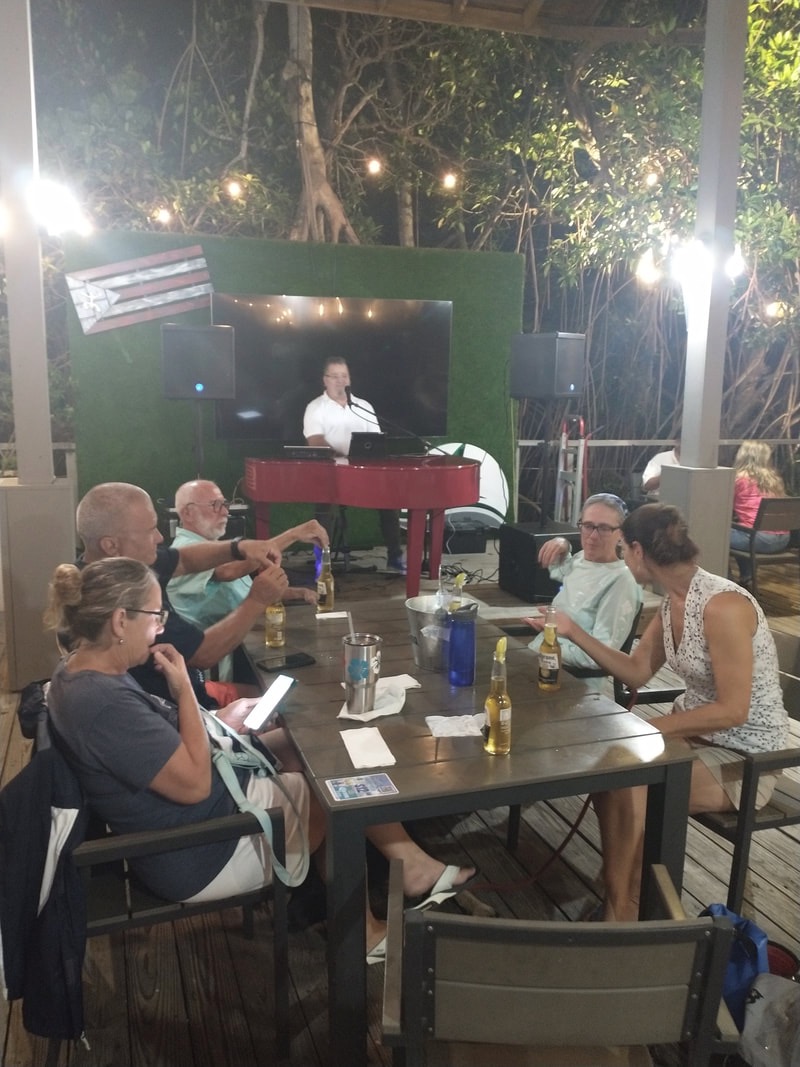
Salinas Bay is surrounded by lots of small restaurants and local shops, including a small marine store, all within easy walking distance. There are three marinas around the bay, the largest being Marina de Salinas. This area is really the outskirts of the town, which is about 1.5 miles away. Salinas is one of those stops cruisers make because it is a large bay with easy access to provisions and other boating needs. The marina is friendly and for a $50/month “bay membership” from Marina de Salinas, cruisers may receive shipments there, as well as use the facilities (though not the pool). Being centralized along the south coast of an island that is not particularly large, it’s also easy to rent a car to travel to other parts of Puerto Rico while one’s boat remains safely anchored in the bay. The three of us buddy boats took advantage of all of this. We enjoyed use of their showers, dinghy dock and dumpsters. Our friends had their new Starlinks shipped to the marina office. Our last night there, we enjoyed dinner and some fabulous live music at the marina’s restaurant. The live music was the playlist from every middle and high school dance I ever attended. We were all singing along. So much fun!
enjoying live music by Manolo Mongil
The best part of our stop in Salinas, however, was that we rented cars for a trip to Old San Juan and El Yunque National Park.
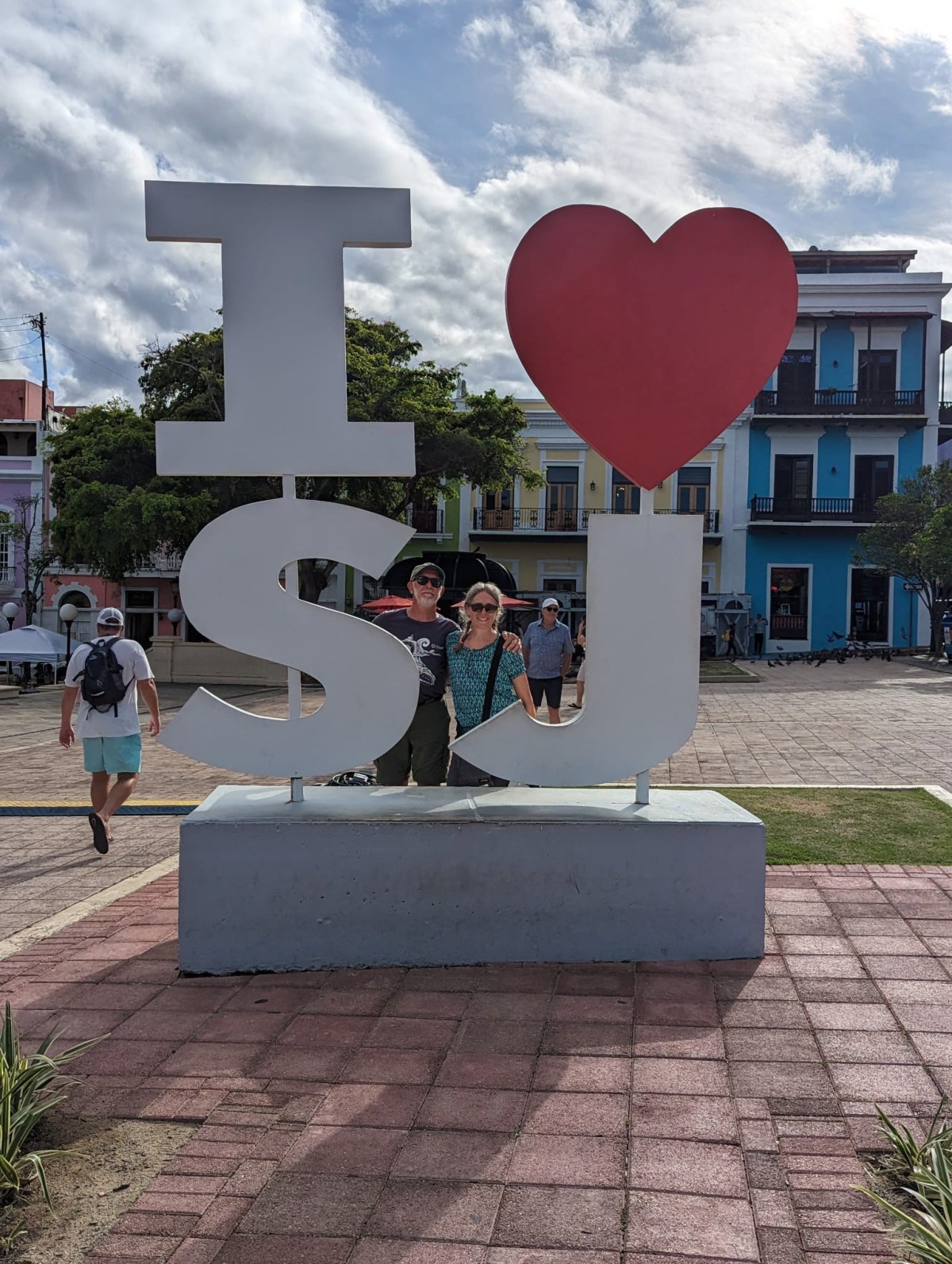
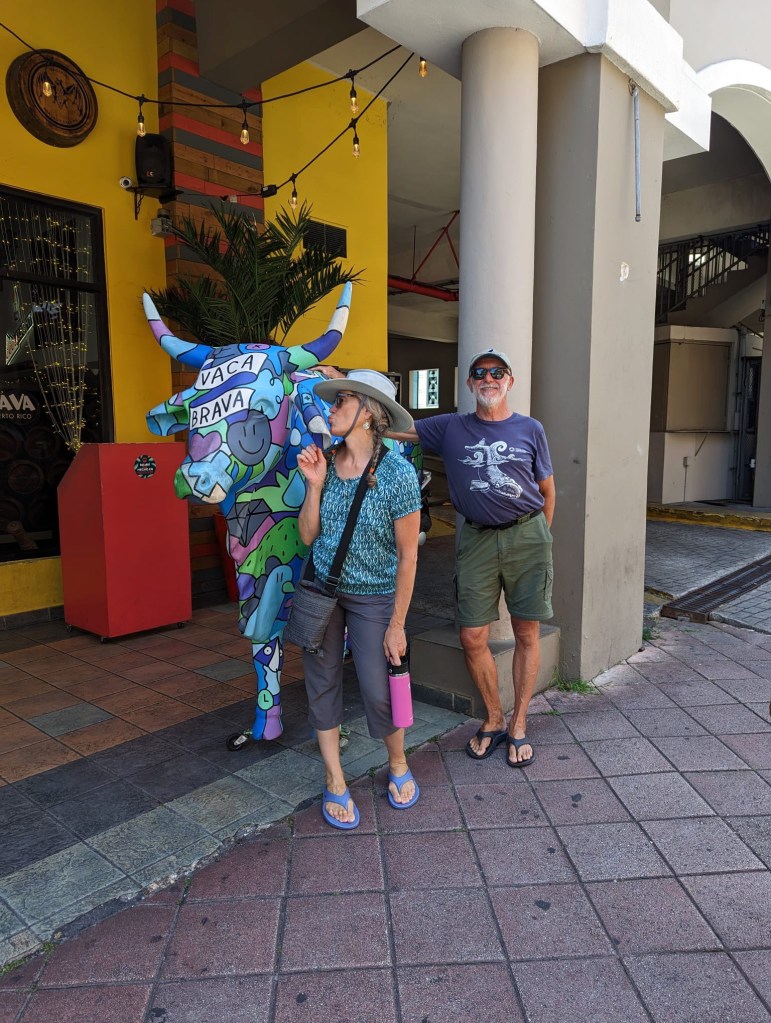
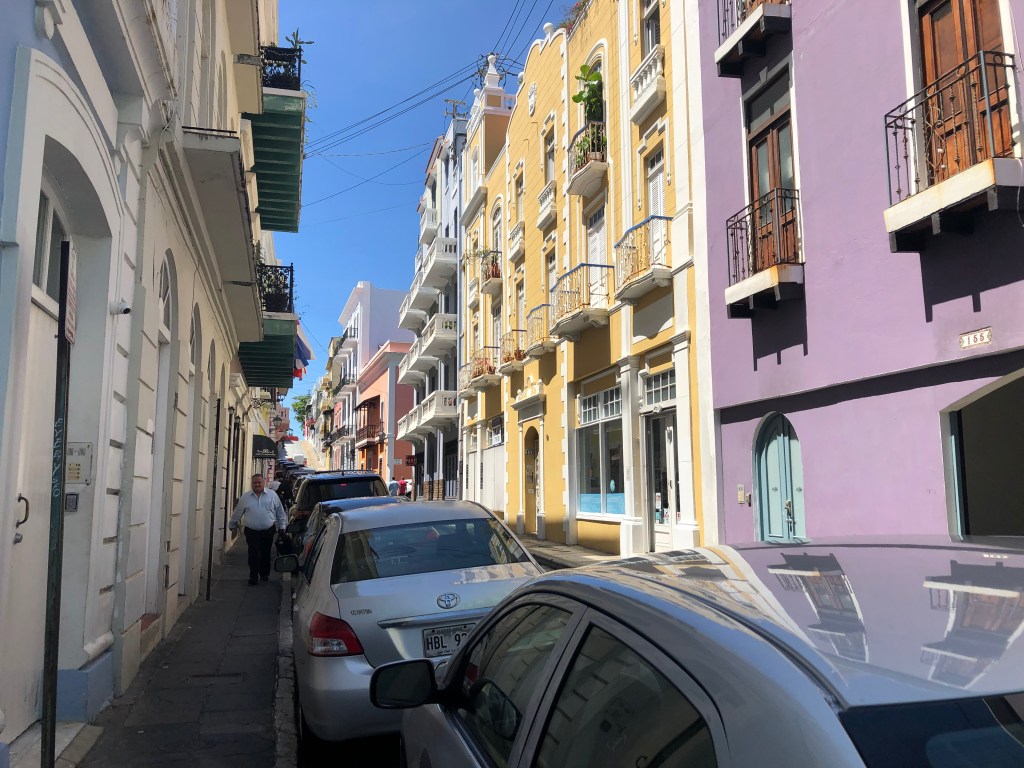
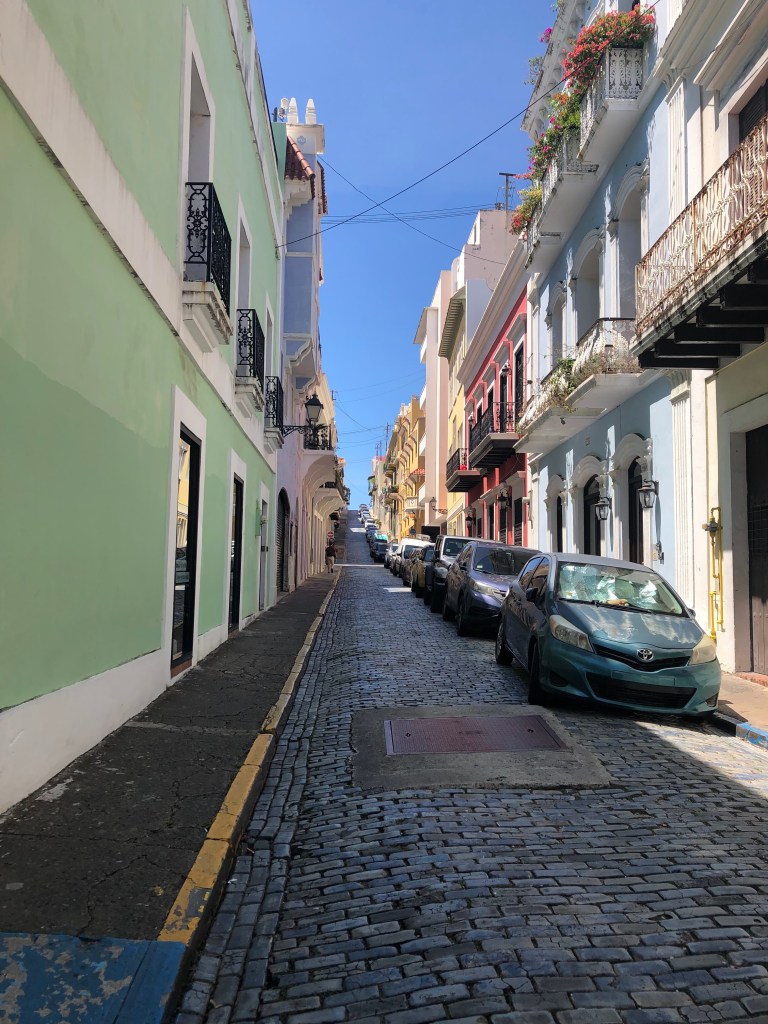
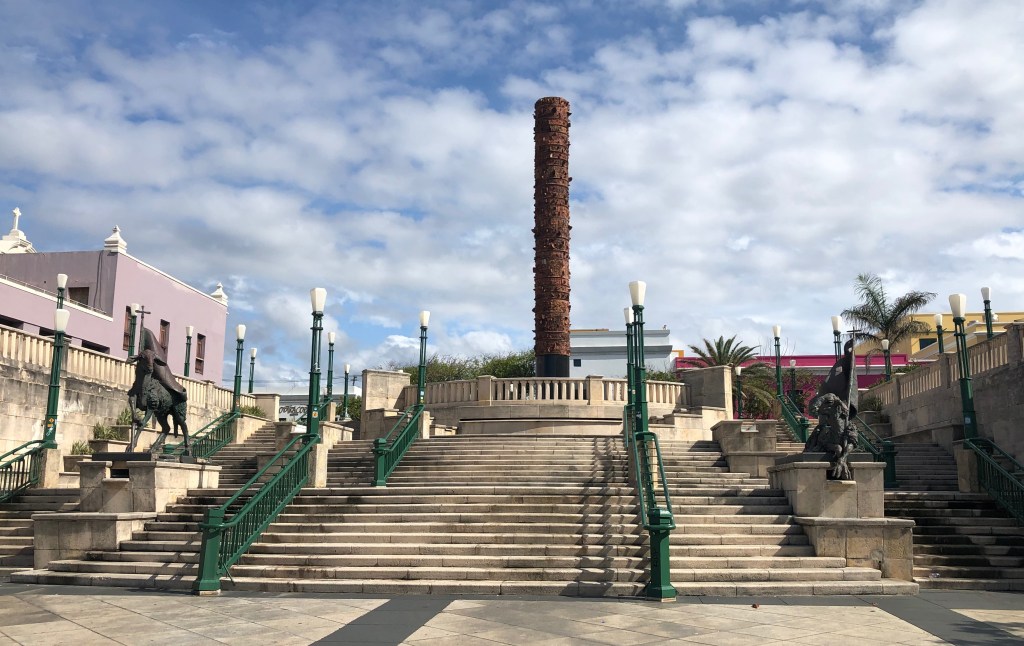
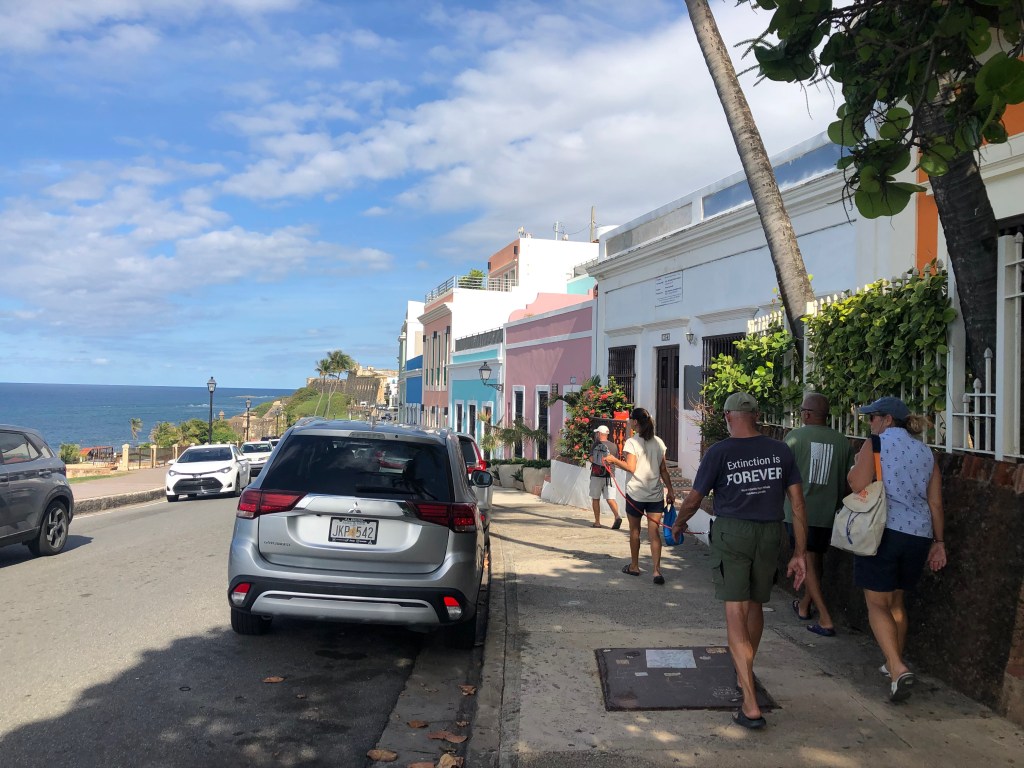
Monday, April 24th, we all piled into two rental cars and headed north for Old San Juan. The drive was easy and just over an hour long, and the mountainous scenery was beautiful. Once in Old San Juan, it took us 20 minutes to find parking, which we eventually did, three parking garages later. It was past lunch time by then, so we took care of that first. Then we started wandering around the cobblestone streets of the old town enjoying the architecture and lovely colors of the buildings.
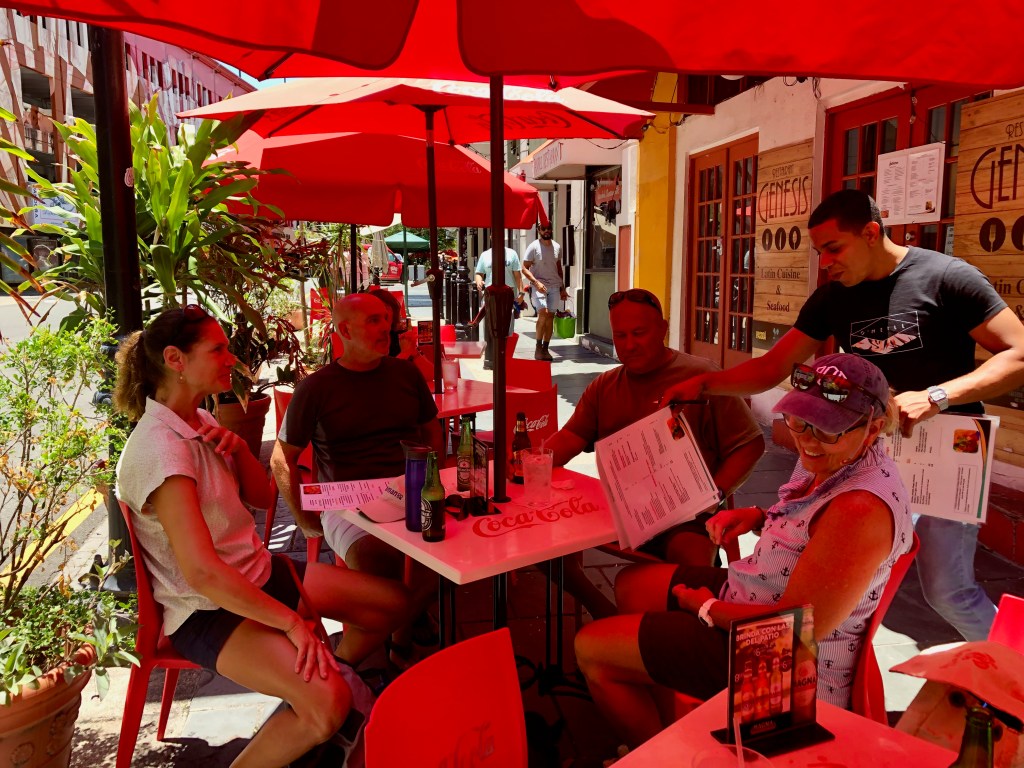
lunch
kiss the colorful cow
streets of Old San Juan
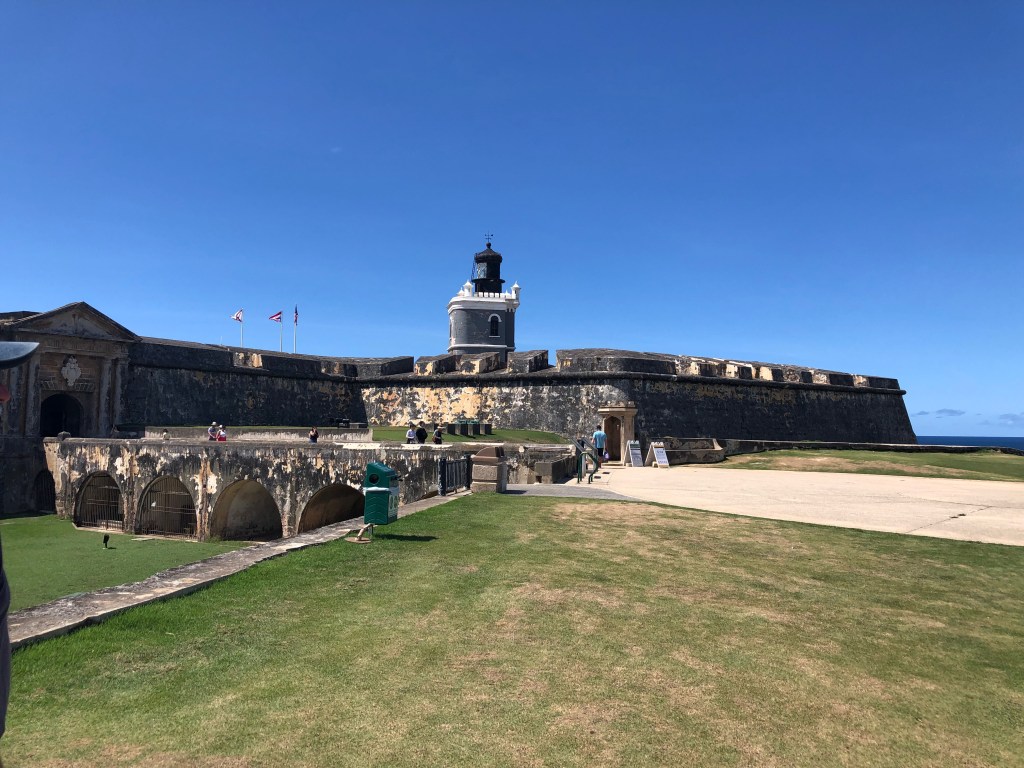
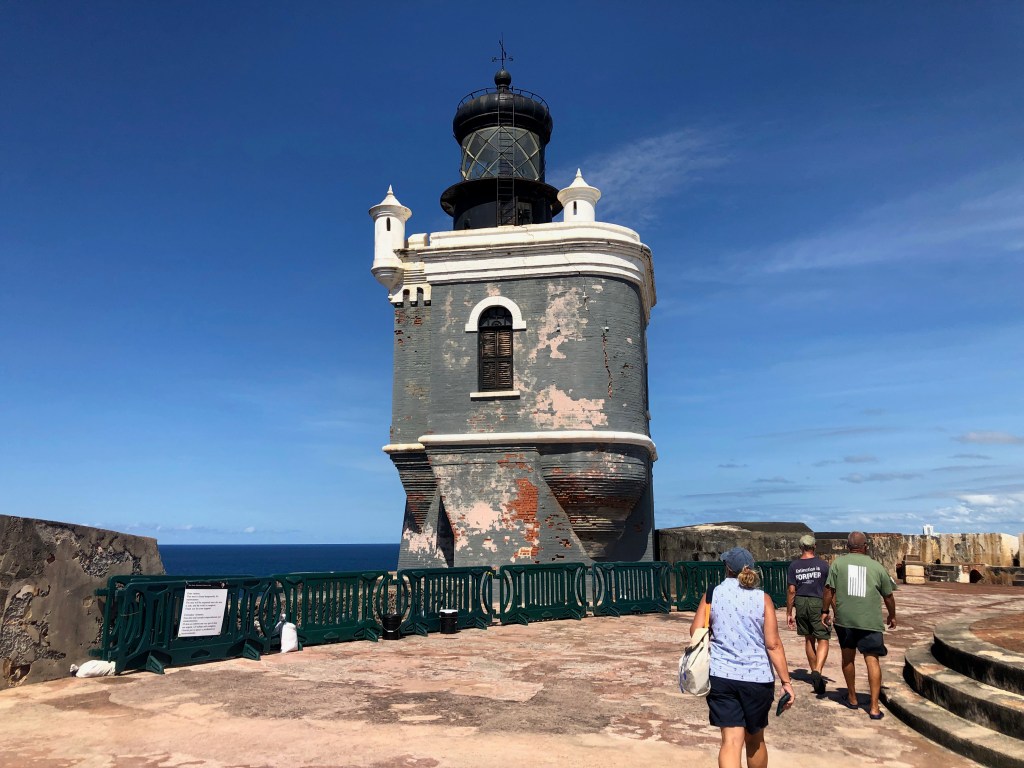
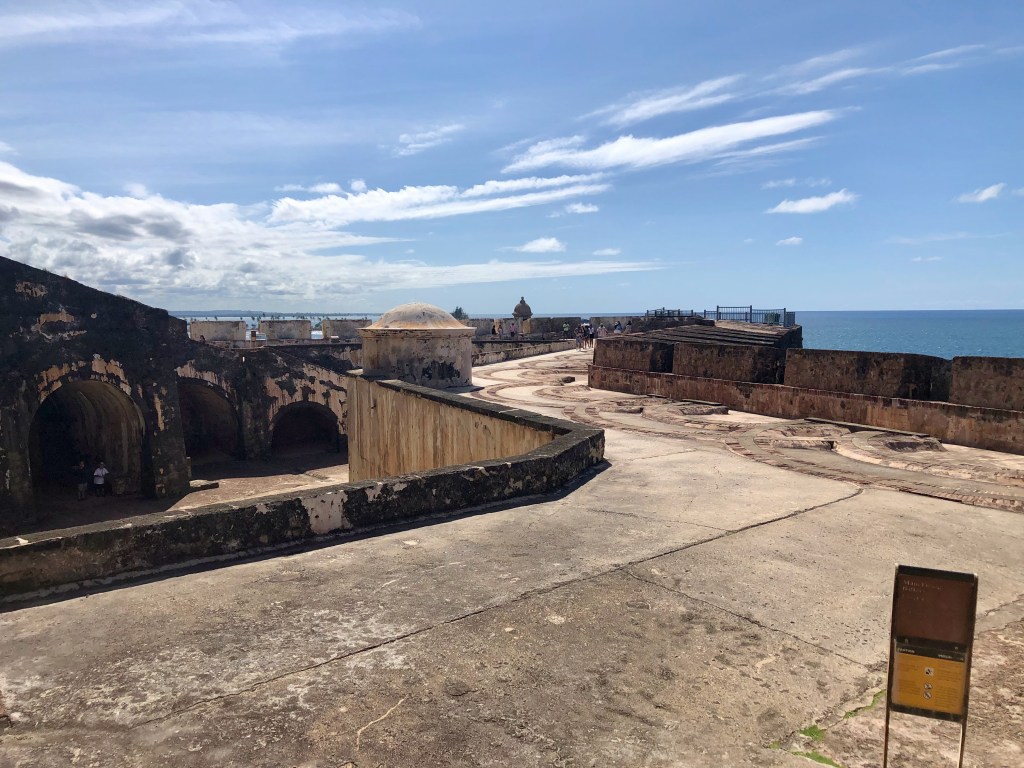
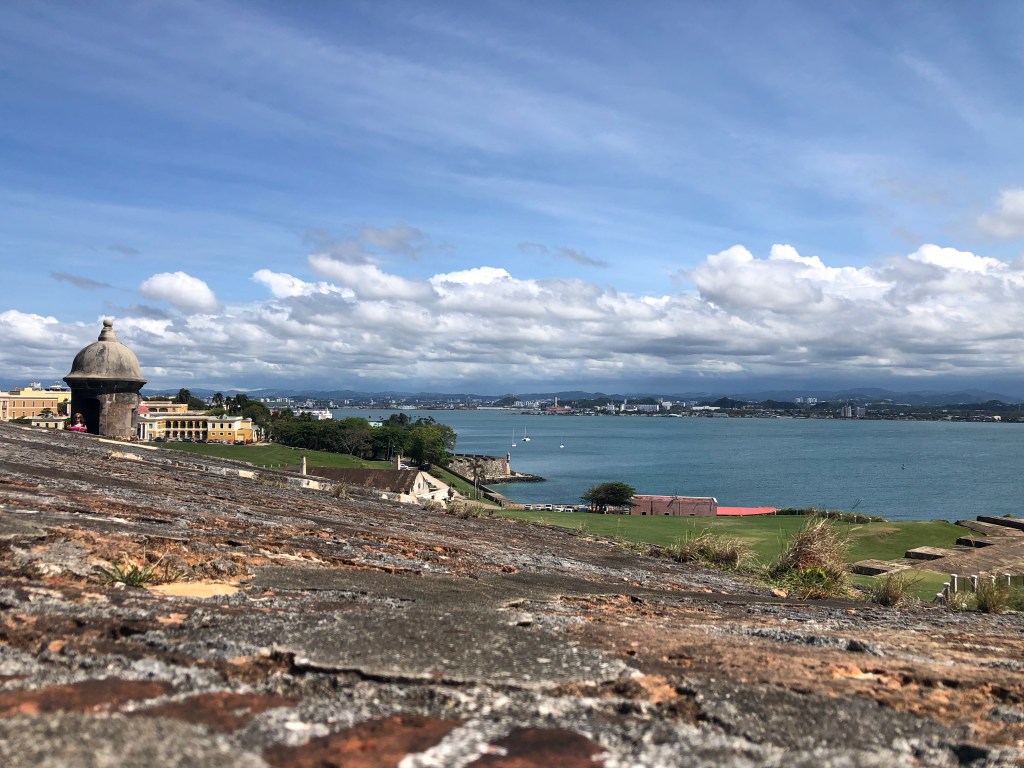
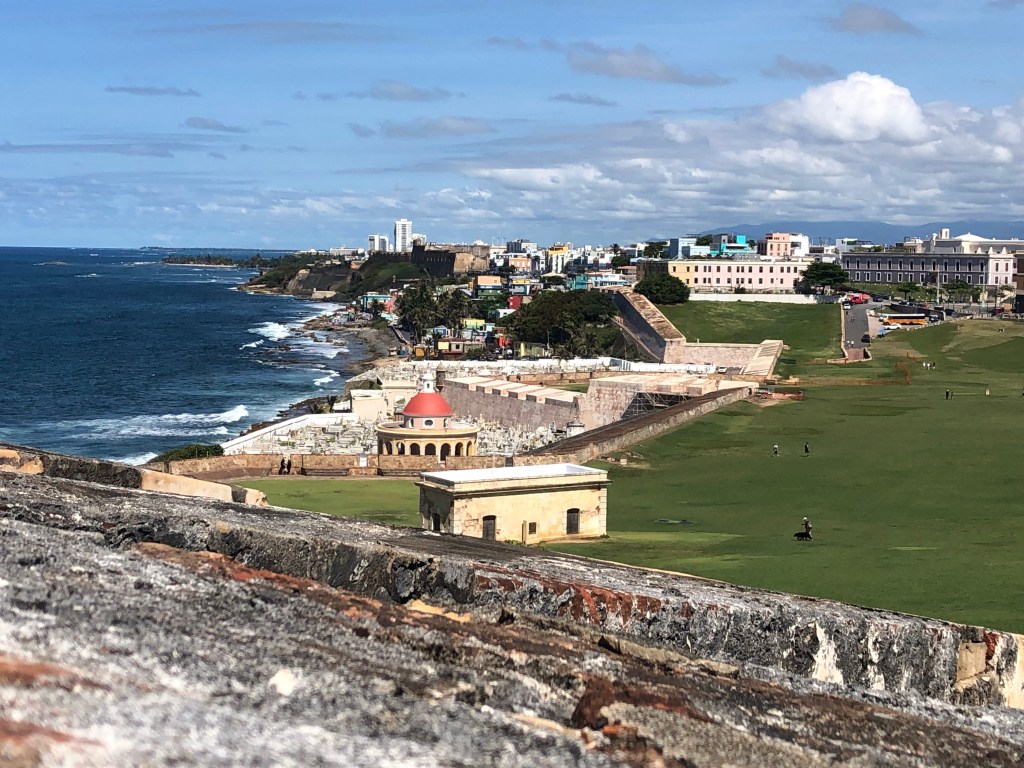
Eventually we found our way to the northeast point of San Juan Bay and El Morro (Castillo San Felipe del Morro), which is now a National Park. Dave, Barry, Andrea and I toured inside El Morro, while Mike, Victoria and Ocean explored the substantial grounds; they don’t allow dogs inside. This was the second fort build in what is now Old San Juan, with construction lasting from 1539-1790, resulting in a six-level fortress. It was under Spanish rule until 1898 when the United States won the Spanish-American war and Spain ceded Puerto Rico to the U.S. (along with Cuba, Guam and the Philippines). From then until 1961, El Morro became part of a larger U.S. Army post called Fort Brooke. The U.S. Army retired the fort in 1961, turning it over to the National Park Service to preserve as a museum. In 1983, the Castillo and city walls, many of which are still standing, were declared a World Heritage site. It’s expansive and the views from the highest level are amazing! We didn’t have much time to read placards, so this little history lesson comes from Wikipedia and the National Park Service.
from the grounds outside the main fortress
the lighthouse
the dry moat (it’s a thing)
used to be cannons here
there’s one!
only remaining original section from 1539
stunning views!
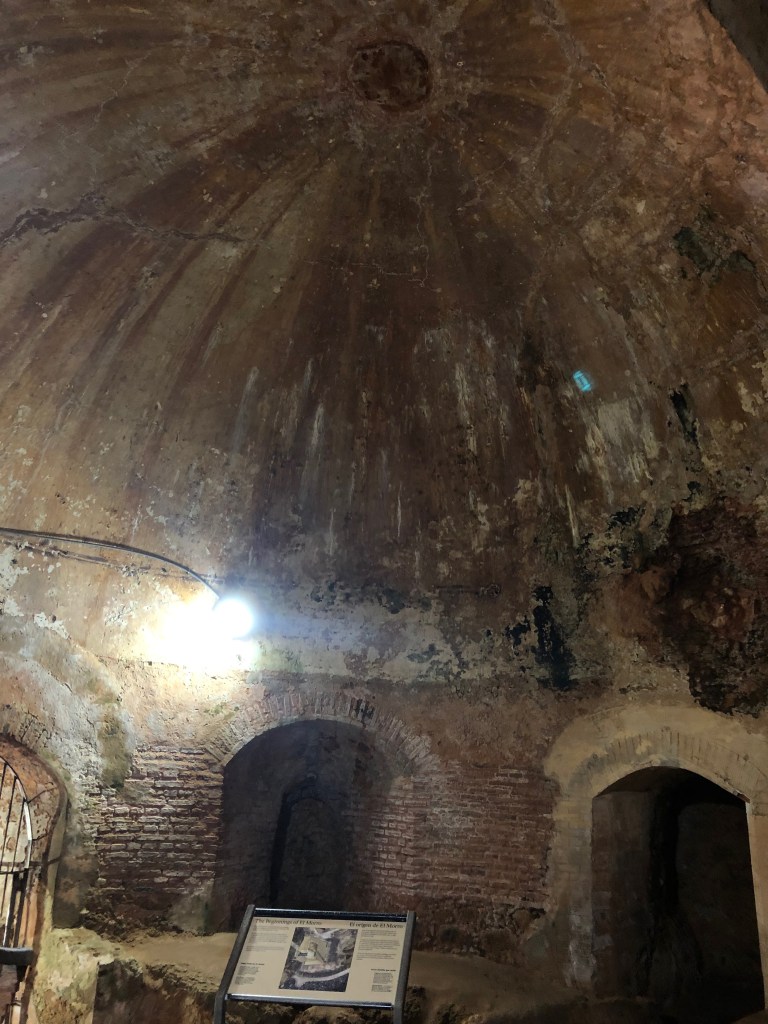
We continued our fortress tour by walking over to Castillo San Cristóbal. In 1625 the Dutch took San Juan by land. This takeover only lasted two months before they were driven out, but it prompted the Spanish to construct a fortress for protection of San Juan by land. They constructed a tiny redoubt in 1634, but it wasn’t until 1766 that the current structure was started. This one only took 17 years to build. It was even larger than El Morro, but in 1897 a large portion of it was taken down to allow the city to expand because it had been busting at the seams. We toured what’s left, but even faster than El Morro. This structure had cisterns for water storage; clever. Otherwise, it was like most fortresses we’ve visited from that time period. It was part and parcel of the larger fortress system in San Juan, so its timeline after the Spanish-American War is the same as that of El Morro. [Wikipedia][National Park Service]
Castillo San Cristóbal
plaza de armas
barracks
to the dungeon
water cistern
Tuckered out from walking around in the heat, and being almost 5pm, we decided it was time to check into our hotel. Actually, we had booked in at the San Augustin Apartments about ½ mile from the eastern end of Old San Juan. The apartments were very nice and reasonably priced when booked through bookings.com. There were two bedrooms, one twin bed and one queen bed, plus a pull-out sleep sofa in the living area. The smallish bathroom had a very nice shower. The living/dining area had the pullout sofa, a TV and table/chairs. There was also a kitchenette with a ¾ fridge, 2-burner conduction stove, sink, coffee maker, and everything you’d need to make and eat your own meals if you felt so inclined. Except the food, of course. They even have parking about half a block down the street. The apartments are gated with a code, so it felt safe. It’s in a blue-collar part of town, not pretty, but friendly. Most of the inhabitants work in Old San Juan, where it is too expensive to live. If I ever go back for a longer visit to Old San Juan, I would stay here. At any rate, we showered and rested and then went in search of dinner, which we found about ½ mile away and on the water. It was beautiful and delicious.
San Augustin Apartments
pizza after El Yunque
street art across from the apartments
da crew (couples left to right)- Victoria & Mike (s/v Wild Horses), me & Dave, Andrea & Barry (s/v Caretta)
The following day we went to El Yunque National Park, but that deserves its own blog post, so I’m skipping it for now. Moving on…
Our final morning in San Juan, Wednesday April 26th, we walked to the edge of the old city to a waffle/tea house. They had waffles topped with anything from eggs benedict to granola and fruit. We ate heartily. Our waitress is a part time singer. When she learned we were staying in Salinas on our boats, she told us about a musician we had to try to listen to if we had the chance. His name is Manolo Mongil. Guess who provided the live music I mentioned above, that we rocked out to our last night in Salinas. None other. Small world.
After breakfast we checked out of the apartments, bundled into the cars, and commenced with the shopping. We hit West Marine, Wal Mart, Costco, Petco, and an auto parts store in a huge shopping plaza just outside of San Juan. With our trunks packed full, we headed back to Salinas to unload our purchases onto our boats. Then we bundled back into the cars and headed to the nearby Econo Supermarket to finish off our provisioning, which for Dave and I was for the final portion of our trip through mid-June. It was already late when we got to the supermarket, and we all smelled the rotisserie chickens they cleverly placed at the front of the store near the checkouts. Guess what we all bought for dinner that night? It was a long, tiring, but productive day for us all.
The following day was low key. Then we went ashore to the marina restaurant for drinks, dinner, trip planning, and that awesome live music by Manolo Mongil. This wrapped our stay in Salinas, as we would depart early the following morning for the Spanish Virgin Islands.
My next post will circle back to our trip to El Yunque. I took so many pictures that I need to sort through first before putting together a slide show, and El Yunque definitely warrants a slide show. So next week El Yunque and after that, the Spanish Virgin Islands.
Until then, stay safe and take care of each other!
Our friends on S/V Guajira had arrived in Luperón almost a week ahead of us. The gorgeous weather window that brought us to Luperón from TCI the following week was supposed to have brought then to Samaná on the east end of the Dominican Republic. A day prior to that, conditions had not been great and the Armada had to rescue a boat off the coast. They kept the port shut to outgoing traffic for two days, which stranded everyone who had been banking on using that beautiful weather window. At some point I really am going to have to write about weather windows and clearing in and out of island nations. The bottom line is that Guajira was still in Luperón when we arrived.
The morning after we arrived, Guajira invited us to join them on a Wednesday-Thursday road trip to Santo Domingo, the Capitol of DR, located on the south coast. Of course we would! So we booked a room at the same hotel. Juan picked us up in their dinghy the next morning, Wednesday, around 8:30am and we met Alison and their friend, Glyn, at the Las Velas marina where they had brought the rental car. Off we went!
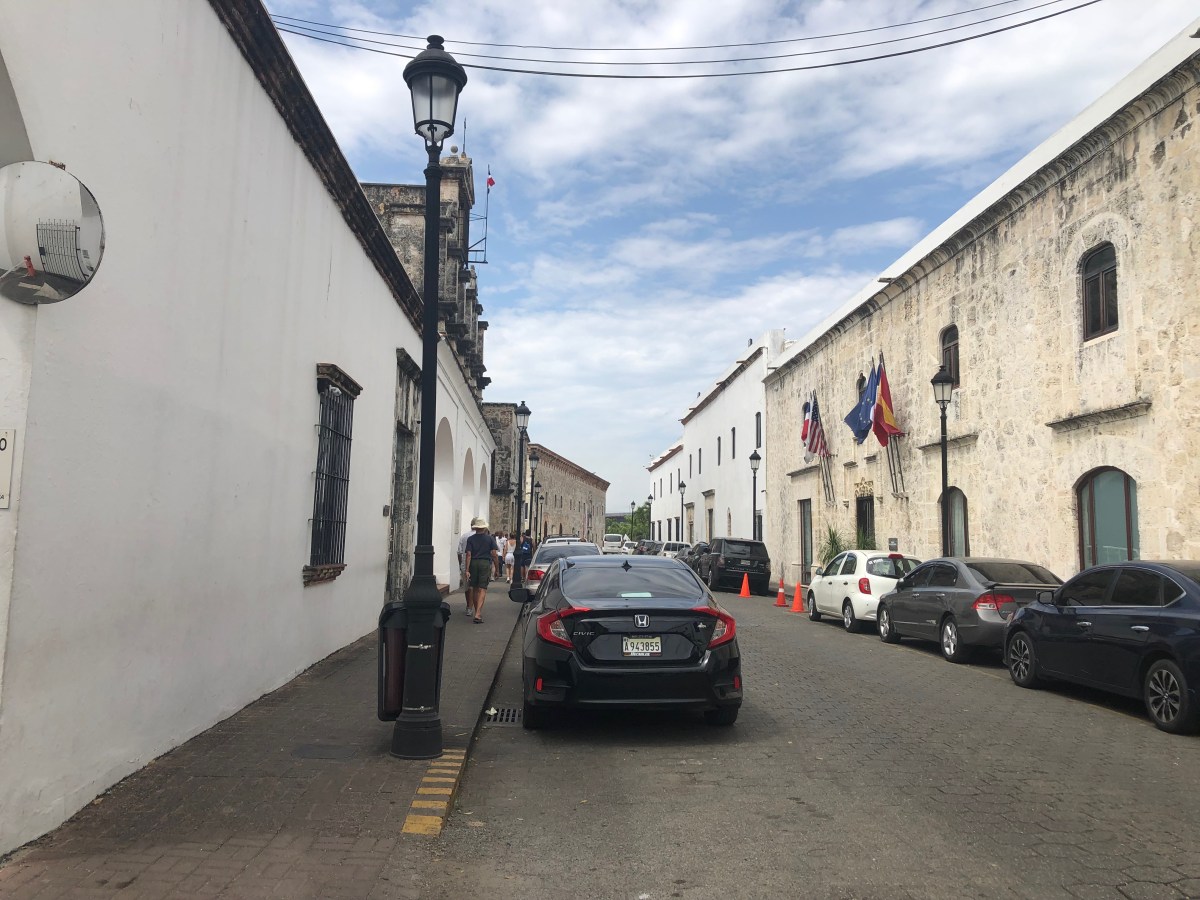
The first part of the 3-4 hour drive was through the beautiful countryside and mountains. We made good time to Santo Domingo, but it took us about 20 minutes to find parking, all on street. Turned out to be just around the corner from the hotel, so score on that one. We stayed at the lovely Mosquito Boutique Hotel in the historic Colonial Zone of the city. It was too early to check in, so we left our bags in the hotel’s laundry room and set out in search of lunch. We ended up at Buche Perico about a block and a half away and had an amazing lunch. After lunch, we went for a walk about town looking to learn a little of the history and tour some museums and ruins (often the same thing). We were thwarted at a couple of places, including the Fort, because they were closed in preparation for some big upcoming event. Alas! We did, however, get to tour the palatial home of Christopher Columbus’s eldest son. We stumbled upon a free Taino artisans’ exhibition. The Taino were the indigenous peoples of Hispaniola when the Spanish arrived and enslaved them, almost wiping out their entire population. I wish I knew more Spanish so I could have picked up more of their history. There was a man making pots, another sculpting figurines of their various gods from clay, and another grinding chocolate (which we could taste). There were women displaying and selling their knit and woven goods. There was food to sample. It was a great find!
Late afternoon we returned to the hotel to finally check in, shower and rest for a bit before meeting down in the hotel bar for drinks before dinner. Dinner was at Jalao, right next door to where we’d had lunch along a little park. I had a traditional Dominican dish called mofongo, which I’d been wanting to try. It is a mashed plantain base with spices served with spiced pork and beef, in my case. Delicious! Now I want to learn to make it. It was a beautiful evening sitting outside eating. It reminded me of eating late on Piazza Navona in Rome. We all slept well that night.
We met for breakfast in the hotel atrium the next morning. The atrium was gorgeous! It was open to the sky and surrounded by the walls of the rooms (door sides opening toward atrium), laundry room, bar, entryway and reception, and the building next door. It was filled with potted plants, a fountain, a tree, and vines dangling down from the railings of the walkways along the rooms of the second and third floors. Breakfast was included in the room price and consisted of eggs cooked to order, fresh fruit juice of choice, toast, and fresh fruit and coffee or tea. Since checkout wasn’t until noon, we had time after breakfast to tour the nearby Cathedral of Santa María la Menor. It is the first and oldest Catholic church in the Americas, constructed between 1504 and 1550. It is a lovely and still functioning Gothic-style cathedral belonging to the Archdiocese of Santo Domingo. From the cathedral, we returned to the hotel to check out, put our bags in the car, and trotted across the street to a ruin we had seen upon our arrival. It was the remains of the first hospital in the Americas, dating from 1503. The current ruins are unlikely to have much of that original hospital left as the structures there were rebuilt and repurposed several times. We gave it a quick view, then hopped back in the car.
We headed to the outskirts of the city in search of the national park called Los Tres Ojos (the Three Eyes). What a gem in the city! It’s a cave mostly open to the sky with three lakes below ground level. It is believed to have formed over 10,000 years ago, at the end of the ice age, when the ceiling collapsed. They’ve done a great job constructing paths and landscaping to guide visitors to the lakes. One lake is reached by a small, rectangular wooden ferry that seats about 10 people and is pulled across by a “driver” on a pulley & rope system. It was a lovely bit of nature in the city.
It was then time to head back to Luperón. The trip back took a little longer because we missed a U-turn on their completely divided highway that would have taken us in the direction we needed to go. There are only certain points along the highway around the Santo Domingo area that allow one to reverse direction. We ended up having to go back through the city rather than around it, and there was quite a bit of traffic. Eventually we were on the open road. When we got hungry, we stopped at one of the dozens of roadside comedores. These are small roadside, family-run cafes, open to the road, with small kitchens, limited menus, and all local food. It was good and inexpensive, but they had the music up way too loud. We made another quick stop at a combination liquor/grocery store for some rum and were back in Luperón by 6pm. We spent Friday onboard recovering from our whirlwind exploration.
Here’s a slide show of some pictures from our Santo Domingo trip. I took way too many and had to spend hours weeding them out. When will I learn? Enjoy the pictures. Until next time, stay safe and take care of each other!














 Life on Lady