Bye Bye BVI, Hello St. Martin

Happy Mother’s Day to all you mom’s out there!

Sorry for the 2 week delay in posting. The day of my last post was also the day our friend Ian arrived, so I haven’t been in the mood to write blog posts. 

We had a lovely time with Ian. We spent a lot of our BVI time relaxing onboard and did a little diving and snorkeling as well, plus had several meals ashore (most, courtesy of Ian). The weather (both atmospheric and sea) wasn’t cooperative for good diving or snorkeling, but we got some in anyway. The dive-able days followed days of wind or rain, which stirs up the water and decreases visibility. Still, we all love dubbing around in the water whenever we can. We ended up back in Benures Bay on Norman Island a couple of times. One time we launched hookah and dove the eastern point of the bay, something Dave & I had not done on our prior stops there. There was a lot of turtle grass strewn with boulders that had some healthy coral and sponges growing on them, and plenty of fish. It’s fun to look for little fish among the grass and in the boulder crevices. As a bonus, that side of the bay had good visibility. Always nice to be in the water.

We were eyeing a weather window for the weekend of May 4th to cross to St. Martin. Ian assisted us in our preparations by helping us clean our hulls. It sure goes faster with three people and the hookah. Earlier in the week I had posted in the USVI and BVI Cruisers Facebook groups, asking if anyone was heading to St. Martin on the same weather window. Wild Rose responded; they’d been thinking of making the same type of post. Indigo Lady worked her way over to Spanish Town on Virgin Gorda and cleared out of the country just before lunch Saturday. Then we moved up to Gorda Sound on the northeast end of Virgin Gorda and laid a track out through the reef, which we were going to have to navigate at night, before backtracking and anchoring next to Wild Rose on the west side of Prickly Pear. They dinghied over to meet us in the afternoon and we planned our departure time and radio check-ins. Then we each set about our night crossing preparations and napping. 

Indigo Lady and Wild Rose hauled anchor around 12:00 AM Sunday. Wild Rose opted to go around the north side of Virgin Gorda while we passed through the reef following the track line we’d laid earlier. In hindsight, we wouldn’t go out through the reef again at night. It is a very well buoyed channel, and the buoys are lit, but they also flash at different times. It was distracting. We successfully got through the reef and out to the open ocean just as Wild Rose was coming around the corner. They hailed us shortly thereafter to let us know that there were fish pots around and they had narrowly missed one. Yikes! We kept as watchful an eye as one can in the dark. I’ll spare you the suspense; we each had a close call, but neither of us snagged a fish pot. Phew! 

The crossing was quite rolly/bumpy, but there wasn’t a lot of slamming, for which I was thankful. Other than fish pots and rolling, which smoothed out a bit as we neared St. Martin, it was an uneventful crossing. I enjoyed starting out at midnight knowing we were cruising into daylight, and it was comforting having another boat with us. We were anchored in Marigot Bay (French side of St. Martin) around 3:30 PM Sunday afternoon, 15.5 hours from anchor up to anchor down. Wild Rose was anchored shortly after us. We’d arrived too late to clear into the country that day, so we ran up our yellow Q-flag, tidied up the boat and rested. Monday morning we met up with Wild Rose to clear into the country, then we went to a fabulous breakfast spot they’d found on the Dutch side last time they were here- Zee Best. It was delicious! We chatted for quite a while, taking the chance to get to know each other a little better. Eventually we each headed off to tend to our own things. Hopefully we’ll hook up with them again before they continue their trek south to Grenada for hurricane season.

Shortly after our arrival in St. Martin, we had another “small world” experience. I received a text from our friends Roxanne and Craig on Seas the Moment. It was a picture of Lady at anchor in Marigot Bay. They are here, too! We met them in Bimini, Bahamas in 2021 and have run into them each cruising season since. We arranged to have dinner together at a restaurant in Marigot. Joining us would be Tom on Imiloa. We met Tom in Charlotte Amalie in January. Turns out Roxanne and Craig know Tom because he was the broker who helped them buy their first catamaran years ago, which was a Voyage 440 just like Indigo Lady. Tom, himself, had also owned a Voyage 440 in the past. We enjoyed a lovely dinner and a lot of conversation. Again, we will hopefully hook up again before they each head off to their hurricane season locations.

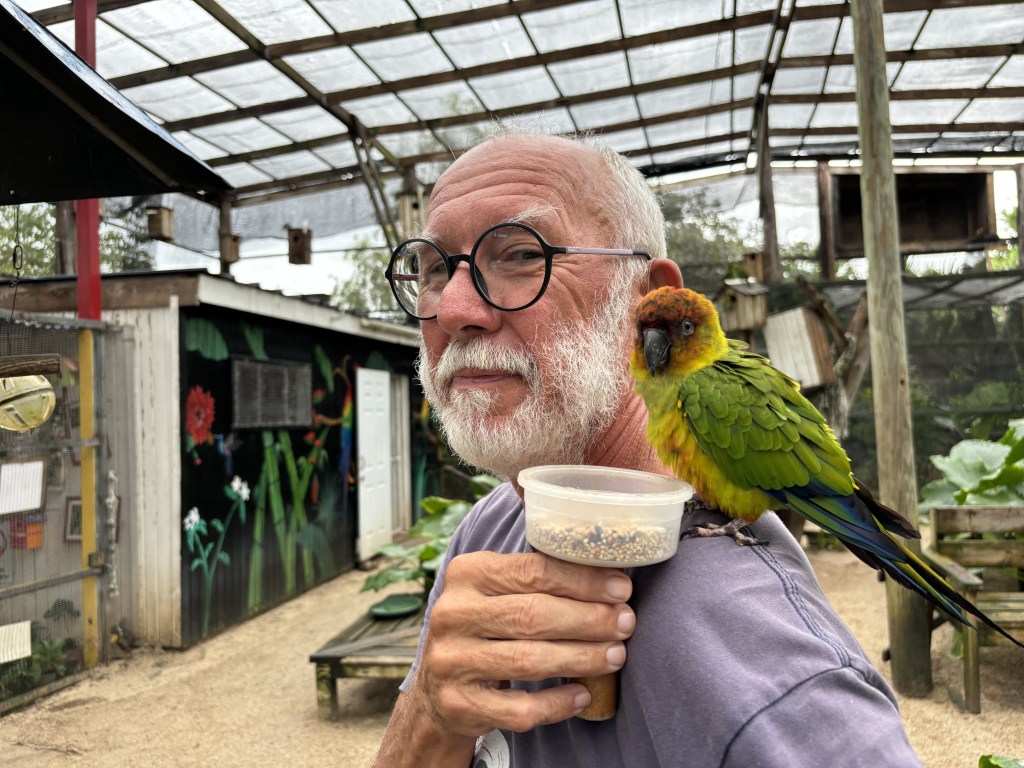
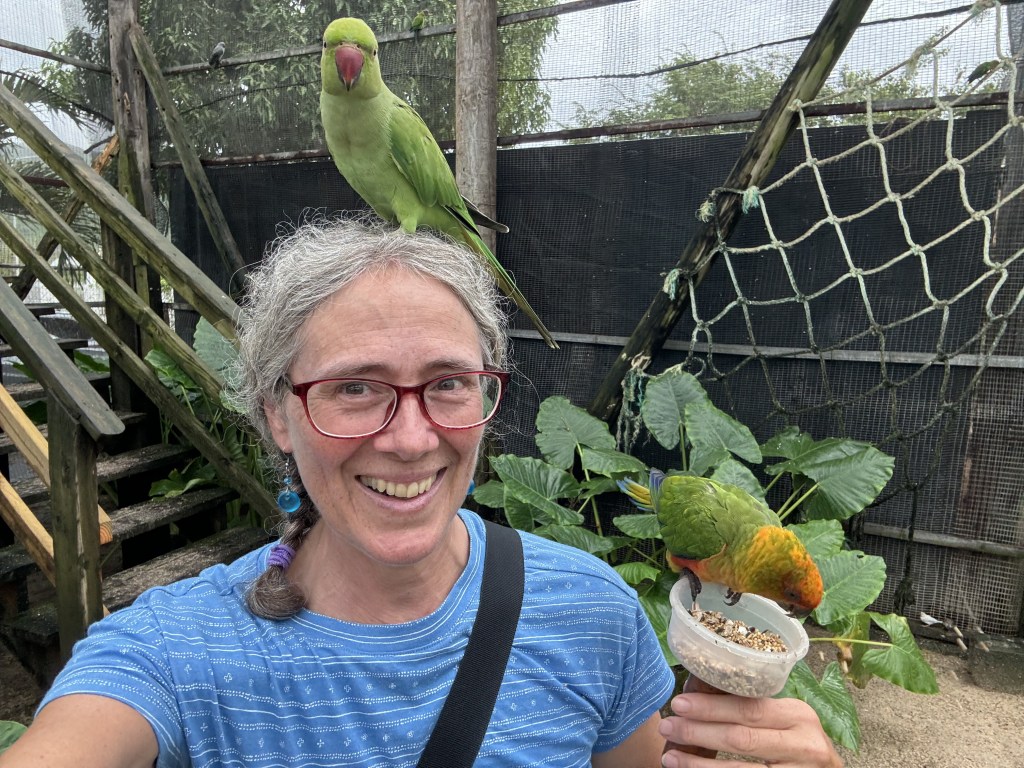
One day, we rented a car so Dave, Ian and I could drive around the island, which doesn’t take very long. It was a very rainy day, so touring by car was better than sitting on the boat playing ‘hatchlisthenics’ (jumping up to repeatedly close, and later reopen, the hatches). It was a lovely drive until we hit traffic in Philipsburg, the capital of Dutch St. Maarten, and in Simpson Bay (cruise ship port. It was crazy! We managed to find a fabulous lunch spot slightly off the beaten path with a parking spot to boot. Score! The circumnavigation of the island took us less time than we’d anticipated, so we had time to kill. We visited the Parotte Ville Bird Sanctuary where we fed the birds as they landed on our arms and heads. It was worth the $10/person. After a failed attempt to have drinks at a local brewery (closed!) we ended up at the Dinghy Dock Sailors Bar, then poked around in Budget Marine where we finally found security chain for dinghy at a reasonable price. (Dinghies are frequently stolen in the Caribbean, so we lock her to the docks we park her on during the day and hoist her into her lift each night back at Lady. We wanted to replace our thin cable and lock with a more substantial chain.) After our wonderful dinner that night with Roxanne, Craig, and Tom, we unloaded our purchases at the dinghy dock where Dave had to bail out shin-deep water. Told you it rained a lot. Thankfully, Ian found a 5 gallon bucket nearby, which expedited the task. We parked the rental and returned to Lady.

After we returned the rental car the next morning, we hauled anchor and headed up to Creole Rock for a snorkel. The leeward side (away from wind & seas) was uninspiring, and it was too rough on the windward side to swim around to that side. Alas! We crossed the channel to anchor in Grand Case Bay where we had a less than satisfactory BBQ dinner. Well, my chicken was fine, but the boys’ pork chops & ribs were tough and not very flavorful. The rice and beans were dry. Sometimes things just don’t pan out the way one hopes. We did spend a quiet, calm night in the lovely anchorage, though. After breakfast on Friday we hauled anchor and popped down to Friars Bay for a snorkel. Again, not scenic, but there were lots of boulders and canyons between them to poke around in and we had a lovely, long swim. From there we passed Marigot Bay to check out Baie Rouge (Red Bay) seeking ‘The Arch’ and ‘David’s (aka Devil’s) Hole.’ Red Bay would make a lovely day anchorage, but there was too much surge this day to safely snorkel The Arch and Devil’s Hole. Dave and I will try to come back another time before we leave. We turned Lady around and headed back to anchor in Marigot Bay. We had a lovely final dinner ashore at a restaurant on the French side of the Lagoon, again, courtesy of Ian. (Thanks for all the meals ashore, Ian!) Ian enjoyed St. Martin enough that he’s thinking of taking his wife, Linda, here for a vacation.

Yesterday morning we all went ashore for a light breakfast and then Dave & I walked Ian to the taxi stand and bid him farewell. We then walked around Marigot Market, an open square market with many tent stalls set up. Most sell tourist kitsch made in India or China, but hidden among the kitsch are some real local delights. We purchased, from the artist herself, an African face made of painted coconut fiber on wood. It will look very nice in our living room back home. We continued on to walk through the farmers/fish market, picking up some local produce, and we enjoyed a live performance from a well-known local band called Remo and the Barbwire Band. We returned to Lady for lunch and an afternoon of relaxation.

As I conclude writing this, I’ve just finished the 6th and final load of laundry. Dave has spent the day making water, attaching our new security chain and lock to dinghy, and troubleshooting our leaky holding tank (still no solution, but he thinks he’s getting closer). It’s hot and humid. Thank goodness for the breeze! We will take a dip in the ocean to cool off, then likely retire to our hammocks for the rest of the afternoon.

I’m not sure if my next post will backtrack to some stuff we did in the USVI that I haven’t written about yet, or if I’ll continue writing about our time here in St. Martin. It will depend on my mood this week. Until then, stay safe and take care of each other!
Oh my aching head!

Yes, I’m talking about toilets. For you non-boaters, toilets on boats are referred to as “heads.” I’m sure there’s a history to that name, but I don’t feel like researching it right now. This is a post about the non-glorious side of cruising and it deals with toilets and holding tanks, so keep that in mind before you decide whether to keep reading. 

Allow me to set the stage a little. Indigo Lady was a charter boat, and as such, she was set up with four sleeping cabins and four heads (head can refer to the toilet, or the bathroom in general). They were all manual pump toilets. That means that once you do your business, you have to pump a handle to empty out the “black water” (waste). On Indigo Lady, we can set a valve, per toilet, so that the black water either goes directly overboard or into the holding tanks. Our holding tanks are our keels, which are hollow and molded onto our hulls. When the heads are set to go into the holding tanks, those eventually fill up and we have to pump the entire holding tank overboard. When we bought Lady, this was also done manually, and usually required 100+ pumps. In U.S. coastal waters, emptying black water from holding tanks must be done no less than 3 miles offshore. On inland waterways, like the ICW (Intracoastal Waterway), there is no pumping overboard. Instead, one must go to a pump out station to have the tank emptied by suction, just like having a septic tank pumped at home, except it usually has to be done weekly and you have to keep a log (just in case an authority asks; nobody ever asked for ours).

When Dave converted Lady to solar electric, he also installed two electric flush toilets on the port side. Likewise, pumping out the holding tank on that side is electric. On the starboard side, Dave removed the forward toilet so we could put in a washing machine. The washing machine, being “gray water,” pumps directly overboard when it drains. The aft (rear) toilet and overboard pump out remain manual. We left starboard manual in case anything ever goes wrong with the electric heads on port. There are a couple of advantages to electric pump toilets. First, one doesn’t build up callouses by repeatedly using a pump handle. More importantly, to my mind anyway, the electric toilet pump has a macerator that grinds everything up, as does the pump to empty the holding tank overboard. This means that what gets dumped overboard is a slurry which break down faster. The manual pump toilets and overboard pump leave everything pretty much intact. How’s that for an image? You’re welcome. 💩

We keep Indigo Lady’s toilets set to empty into the holding tanks. In the coastal waters of New England, it’s really easy to get 3 miles offshore to pump out holding tanks, and pump out stations and pump out boats are also becoming more common. In the ICW, being a no discharge zone entirely, pump out stations are very common. The reality from the Bahamas to St. Kitt’s, where we’ve cruised thus far, is a little different. Pump out stations are either nonexistent or exceedingly rare. Here’s some more reality, down here nobody goes 3 miles offshore to pump out their holding tanks, and I’d wager that toilets of most cruisers and charterers, especially charterers, pump directly overboard with each flush. Those of us with holding tanks try to empty them in an open waterway where there’s good water flow, but if one gets pinned down in a particular anchorage for too many days, well, tanks have to be emptied. Courteous boaters will wait to do that until nightfall. Not everyone is courteous.

You’re still reading. I’m impressed. On to our current head issues…

Like I said earlier, we have Lady’s toilets set to flush into the holding tanks. Last Monday morning, I flushed the electric toilet like every other time. We’re used to a brief stink after a flush, especially as the tank gets more full. When we add to the tank, air gets pushed out through the vent hose to the outside of the hull. Depending on wind direction, the smell can blow back toward us. With this flush, however, the stink didn’t go away and it was stronger than usual. So, Dave lifted the bilge1 floorboard2 in the port aft companionway3. (If you need translation for that sentence, see the end of this post.) There was black water in our bilge. First, yuck! Second, that should NEVER happen. If a holding tank is full, the next flush is supposed to go directly overboard through the vent hose. Uh oh! 

The exact order of things hat happened after that are a bit of a blur, but the first step was to run a bunch of sea water through the bilge to clean it out. (Each bilge has a pump that sends any accumulated water overboard.) Then we did a variety of things that included emptying the holding tank and flushing repeatedly while Dave used a flashlight in very tight places to try to see what was leaking. After we’d emptied the holding tank, flushing toilets did NOT put toilet water into the bilge. Dave could see nothing leaking on any hoses or connections (the ones he actually could see) when we flushed. 🤔 What we learned is that we have no idea why this is happening. So we did a fresh water rinse of the bilge with dish soap, followed by a bleach and water wipe down. Then Dave cleaned himself. No, he wasn’t covered in filth, but when dealing with sewage, better safe than sorry. Everything was fine again, until it wasn’t.

After 48 hours of using our head like normal, a flush backed up into the bilge again. We caught it earlier this time because we were checking after every flush, so it wasn’t quite as messy. More flushing and looking with a flashlight. Empty the tank again. We usually go about 8 days before needing to empty the tank. Why is it full after 48 hours? Do we have a leak in our keel that is allowing in sea water, thus filling the tank faster? How much did we fill the tank with sea water during out testing on Monday after we had pumped it out? A new round of troubleshooting still revealed nothing, but our tank was full, so we emptied it again. Then Dave set our toilet to pump directly overboard. He wanted to set the aft head to do the same, but those valves haven’t been moved since 2019, and they were stuck good. Fortunately, that head is rarely used except for when we have guests aboard. 

Where does this leave us? Our head is pumping directly overboard, so it’s not contributing to the port holding tank. After 3 days of this, the level in that tank has not changed (we can tell by removing the vent cover to look in). This is very good news, because it means we don’t have a leak in our keel letting in sea water. If we’re ever in an anchorage where we think we should not be pumping directly overboard, we can either use the port aft head or the starboard head. Our guest, who arrives today, can use the port aft head, as long as we are able to pump out the holding tank every 2-3 days, otherwise he will use our head or the starboard one. I’m very thankful that we have heads on each side of the boat!

I’m sure that’s more than you ever wanted to know about marine heads. I aim to educate; it’s in my blood. 😁

I promise to return to writing about the more enjoyable parts of our travels, at least until something else inglorious arises. I want to keep it real.

Until next time, stay safe and take care of each other!
Riding out big winds in the BVI

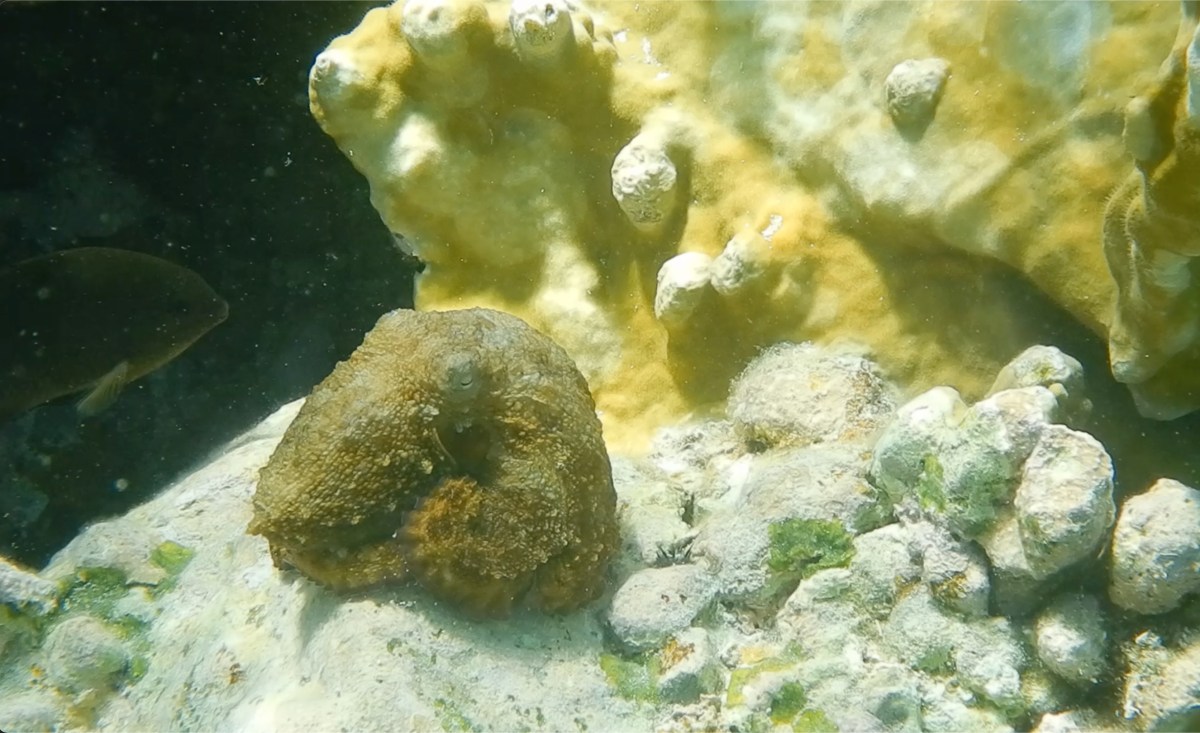
Our final night in the USVI was spent on a NPS mooring in Waterlemon Bay on the north side of St. John. The morning of 4/6 we had a final USVI snorkel around Waterlemon Cay where I saw my first octopus in the wild!  As usual, I was dubbing along quite a bit behind Dave, when I looked over at him to see him waving me over, his eyes fixed on a small coral head. I kicked over quickly and followed his finger to… a rock? The rock twitched, and it had an eye. It was a small octopus about 6-8” from head to tentacle tip. It was not happy that we were watching it, so it moved under the coral, where the fish it had replaced showed its displeasure by repeatedly nipping at it. The octopus went back to the coral’s surface, then swam on to another piece of coral. It was so exciting! After our snorkel, we set off to clear into the BVI at West End, all of 1.5 nm away. That done, we had lunch, then headed over to Benures Bay on the north side of Norman Island, a place we’d anchored when my folks were with us last month. We had a couple of days of calm seas ahead of us and we wanted to make the most of them by doing some diving. The first location was around the western side of Norman Island.

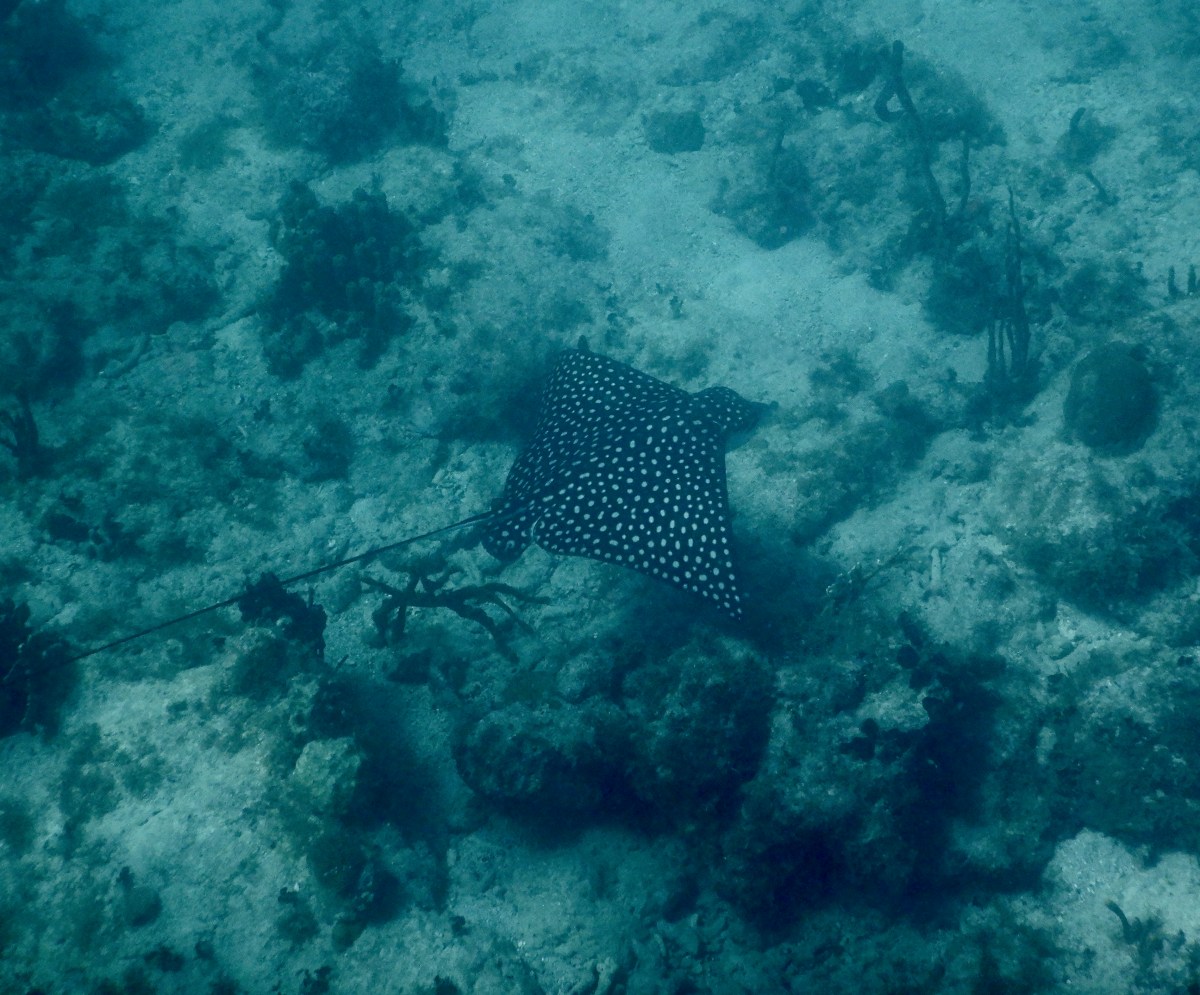
We hauled anchor right after breakfast the next morning and headed around the corner to the west side of Norman Island before it got crowded. It’s a popular spot. There were two things we wanted to do, a reef dive and a cave snorkel. We picked up a mooring ball between the two, loaded our dive equipment into dinghy, and grabbed one of the dive moorings at Angelfish Reef on the SW corner of Norman Island. At first, I was unimpressed. The reef is in a sad state, but once we got around the point to the south, there was much better coral structure, which means lots of nooks and crannies for fish. There were also a fair amount of sponges and corals. The highlights of the dive were the large eagle ray that passed within a few feet of us, and a 4’, ~80 lb snapper that emerged from a rock overhang. We believe it was a Culebra snapper. It was huge!

After our dive, we returned to Lady, grabbed a quick snack, and offloaded our dive-specific gear. Then we headed to the dinghy tether at the caves. There were three caves to explore. They do not go inward very far, and the water inside is not deep. We could easily stand in each. Most of the fish were schooling just outside the entrance to each cave, but two of them had schools of glassy sweepers inside. The cave farthest north was the deepest and required a dive light; it got dark pretty quickly in there. Dave illuminated the school of glassy sweepers, but, alas, none of my photos of them came out. Fortunately, I had video of them from an earlier dive; I just hadn’t yet identified them.

Dive and cave snorkel complete, our next stop was Deadman’s Bay on the eastern end of the north side of Peter Island. We went by way of Dead Chest, a rocky little island just outside of said bay, to scope out its three purported dive sites. The mooring ball for the western dive site was missing, but we found one on the north side and two on the south side. After a quiet night anchored in Deadman’s Bay, we popped across to the south side of Dead Chest with Lady and picked up one of those two moorings. The reef right below us was unimpressive, but Dave followed an easterly ridge and we found the good stuff. I haven’t sorted through those pictures yet. I’m backlogged on my BVI dive pictures. Back aboard Lady we had lunch, then set off for the anchorage we had selected to ride out the big winds that were forecast.

The big winds were predicted from the NE-ENE for several days, so we needed a place protected from those directions. Our other criteria were that it have cell signal so we could tend to some business, and so I wouldn’t lose my 3+ year streak on Duolingo, and we wanted to be able to anchor rather than pay $45-$55/night for a mooring ball. Many of the anchorages here in the BVI have been filled with mooring balls, greatly reducing the space available to anchor. It’s peak season here, too, so there are many boats vying for the same anchorages. We opted for the south side of Peter Island, which is not frequented by many charterers or liveaboards, and settled in at South Bay. We were there five nights, Monday-Friday. In hind sight, we probably could have spent Monday & Tuesday night elsewhere, done another dive or two, and been fine. The big winds didn’t really kick in until overnight Wednesday. Then it was very windy, overcast and rainy most of Thursday & Friday. Hind sight is always 20:20. Such is life. 

We weren’t completely idle while in South Bay. Tuesday, the day after we arrived, we hauled anchor and popped over to Key Bay and the wreck of the Willy T2. We’d already dived on the wreck, but we wanted to spend time on the extensive reef arms between which it is sandwiched. We returned to South Bay afterward. We cleaned our hulls. Dave made water, and he replaced the starboard engine room fan and a bilge switch that had failed, which he discovered when he went down to replace the fan. He also replaced the dying fan in our cabin. I did laundry and some baking and spent many hours sorting through and editing dive photos from the USVI.

This morning we decided to head elsewhere. We went around the west end of Peter Island and up into Drake’s Passage and found it manageable until we got past the east end of Peter where it’s more exposed to the open ocean. The seas were bigger there and it got a bit bumpy. We aborted our attempt to check out Cooper Island and turned toward the east end of Tortola and Buck Island, which was supposed to be a pretty sheltered, shallow anchorage. We dropped anchor in 10’ of water inside three other boats anchored there. It is indeed pretty sheltered here, just a little wrap around swell from the SE point of Buck Island, but not bad in a catamaran. We went ashore for a bit of a walk; it had been 4 days since we’d set foot on land and we wanted to stretch our legs. Dinghying back to our boat, we swung by our neighbor’s catamaran. They were about to head over the shallows into Fat Hogs Bay to go to the Riteway market, so we followed along. Fresh produce- yay!

Not sure where we’ll be off to next. The wind and seas will decide that. I ran out of energy to put together a slide show of dive pictures for you, so for now, enjoy the short video of that octopus we saw.

Until next time. Stay safe, and take care of each other!

While we were waiting…

This cruising season has felt like a lot of waiting. We’re used to waiting for weather windows, of which we fortunately don’t need many this year, but this season has been about a different kind of waiting. While we waited for a weather window to get from St. Kitt’s to the USVI, we were simultaneously waiting for our new battery cells to arrive in St. Thomas. Once they were in the USVI, we waited for winds and waves in the harbor to die down enough to be able to get the batteries onboard safely. Then we waited for my folks to arrive. We waited for our new freezer to arrive. We waited for the Salty Dawgs meetup in the BVI to start. Just as the meetup was starting, we learned that our current boat insurance provider would be dropping Caribbean coverage. That launched us into four weeks of waiting for a new policy to pan out, which included waiting for various responses to our numerous emails requesting policy and survey quotes, waiting for the day of the insurance survey we eventually booked, and waiting for the survey report to be finished (the latter happened quickly). Then we waited for the final insurance approval, which, thankfully, also arrived quickly. Yes, we have a new insurance policy that will commence as soon as our current one expires. Yay! Now we’re just waiting for wire transfer information to pay them, but that’s the icing on the insurance cake at this point. 

While we were waiting for insurance to pan out, it also meant waiting to determine the rest of our cruising plan before heading to wherever we would haul out the boat for hurricane season. This also meant waiting to book said haul out facility, as well as the lodging we’ll need during the boat closeup process. We are extremely lucky that our new policy allows us to keep our boat in St. Kitt’s again for hurricane season, so we don’t have to alter our original cruising plan. Hooray! This isn’t a cruising season where we’ve had to make a lot of miles, so we have had the luxury of being able to wait comfortably, and we have been enjoying ourselves. There are far worse places to be waiting.

There are some advantages to all this waiting. Since we’ve been staying close to good cell coverage areas in order to deal with insurance, we’ve been near easily accessible on shore WiFi where I’ve been able to do some data-intensive online stuff over WiFi rather than using our data. We’ve done a lot of snorkeling. We reconnected with cruising friends we made last year. A little over a week ago, we spent several lovely days in Brewer’s Bay where we made some new cruising friends, including Connor, Blake (@captain_blake_sparrow on IG) and Dan (Adventureman Dan on FB and IG). We’ve also had some of the best diving since Puerto Rico last April; three awesome dives in two days!

With the insurance monkey off our backs, we will continue our explorations, hopefully only with the typical waiting for the right weather conditions 🤞. Our current plan is to head to the BVIs for a few weeks, and from there to St. Martin for a few weeks before returning to St. Kitt’s. As always while cruising, we’ll see how that goes.

It will take me a while to sort through the dive pictures, but I’ll get to them eventually. For now, enjoy this slideshow compilation of our various snorkel excursions thus far. Until next time, stay safe and take care of each other!

The Wreck of the Willy T2

Last week, I promised you something fun. Here it is. 

The William Thornton Floating Bar & Restaurant has been an attraction in the BVIs since 1989, reachable only by boat. It is anchored in The Bight of Norman Island and serves lunch and dinner daily. It’s reputed to be quite the party spot at night, where many a cruiser and charterer jumps into the water from the top deck and drinks (sometimes simultaneously) until they peter out. The original “Willy T,” as it is affectionately known, was a wooden schooner named for the Jost Van Dyke-born architect, William Thornton, who designed the original U.S. Capitol. Sadly, it sank on its mooring sometime in 1996 when it sprung a leak in the night. An attempt was made to move it to become a reef, but the currents tore it apart. Its steel-hulled replacement, the Willy T2, was a decommissioned tanker that the owners fitted out for their needs. Alas, Willy T 2 was destroyed by hurricane Irma in 2017. The owners purchased a replacement in 2018 and had it renovated to look much like the Willie T2, and after a brief stint anchored in Great Harbor at Peter Island next door to Norman, it returned to its home in The Bight. Yes, we had lunch there with my folks one day, but that’s not the fun part. Keep reading.

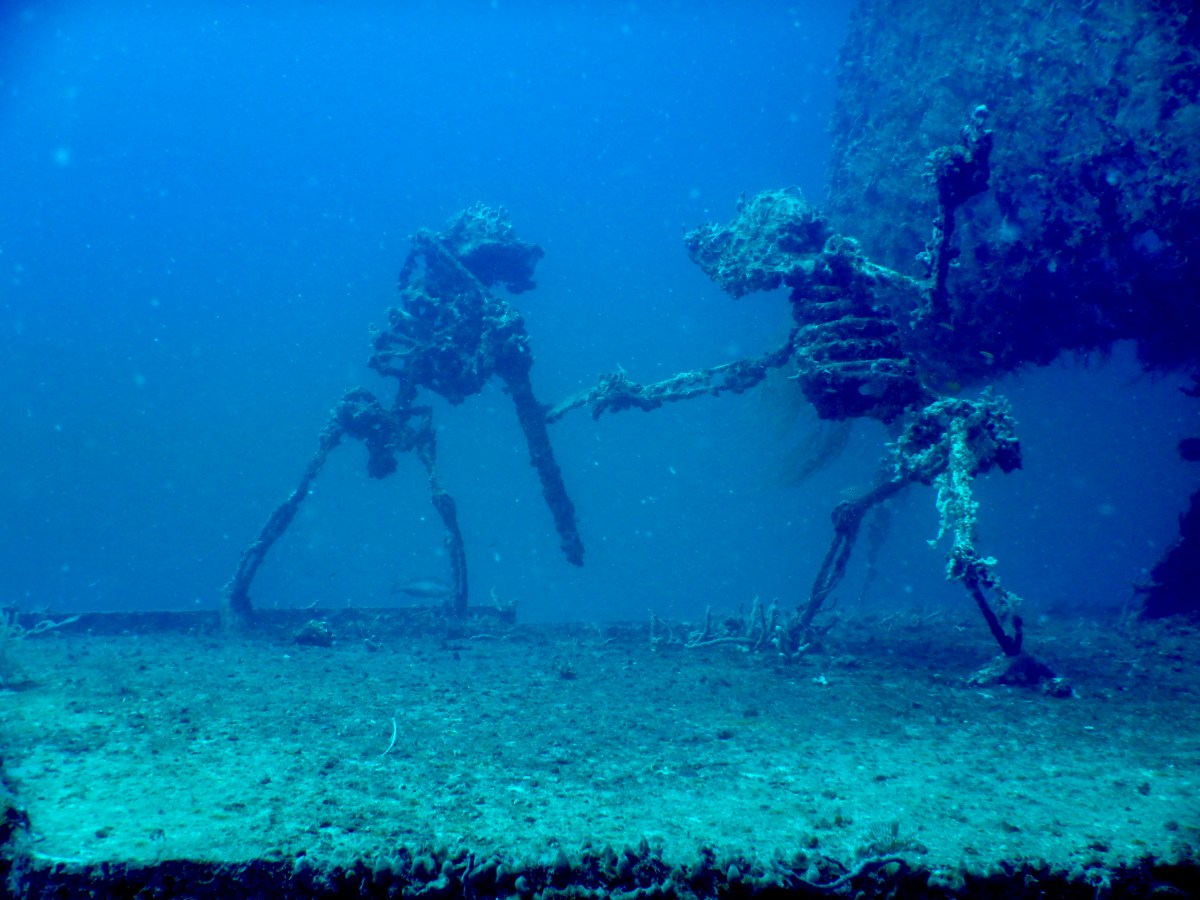
What does one do with the wreck of a floating restaurant that is languishing on the shores of Norman Island? If you’re the non-profit organization Beyond the Reef, you dress it up with some pirates, sink it, and install dive moorings so people can tie up their boats and enjoy a dive on this piece of art. (Dave says that now makes it a Wet Willy 😁.) Beyond the Reef successfully sank the Willy T2 in August of 2019 between two reef heads in Key Bay on the south side of Peter Island. All they ask is a $5 donation/person (honor system), which they donate to a local children’s swim program. You can learn more about Beyond the Reef and its other underwater artistic installations here

We anchored in the lovely Key Bay anchorage area, donned our dive gear, and towed our hookah out by dinghy to one of the dive moorings. In the water we went, about 55’-60’ down, the extent of our hoses. Due to our hose limitations, we could only enjoy the exterior of the vessel and the surrounding seabed, but enjoy it we did. It was a hoot! If you have the time, check out Beyond the Reef’s photos of the Willy T 2 build and sinking so you can compare those to the pictures I took for the slide show below. Which is where I am leaving you today.

Enjoy the slides of the Wreck of the Willy TB2. Until next time, stay safe, and take care of each other!