I hope the title got your attention, and perhaps made you chuckle. Normally we eat local dishes when we eat out during our cruising season, but every now and then we crave comfort food, and we’ve needed it over the past seven days.
If you’ve been following along this year, you know we set out for Guadeloupe from Nevis on January 29th and had to ditch at Montserrat due to generator issues. It had been a rough ride, and two stopped generators didn’t improve our mood. Lunch in Montserrat was cheeseburgers and fries. (We solved the generator issue fairly quickly, but you can read my last post on 2/1 for the details if you missed it.)
It was a bumpy ride to Montserrat on the 29th, and it was an equally bumpy ride to Deshaies, Guadeloupe on the 30th. We thought we might hang out on the west coast of Guadeloupe for about a week and a half. The weather gods had other plans. If we were going to make it to Dominica in time for the Salty Dawgs Rendezvous, we needed to take an early weather window on February 5th. Yes, that’s today. It was going to be another of those “least adverse” windows, which means bumpy and salty. The second cheeseburger and fries lunch was consumed in Basse Terre, Guadeloupe yesterday in anticipation of today’s bumpy ride.
Yup, the crossing from Guadeloupe to Dominica today was bumpy and salty. In fact, it was bumpier and saltier than the prior two. We left Guadeloupe just after first light, about 6:15am. We arrived at Prince Rupert Bay at Portsmouth, Dominica around 11:45am. At least it was a fairly quick (for us) ride, averaging about 5.25 knots. The seas started out about 3-5’, building to 4-6’ and then eventually more like 6-8’. They were anywhere from just off our port bow to on our port beam. There were two notable waves. One washed over the port bow, up the galley window and onto the cabin roof (not all the way to the cockpit), but it did deposit some water on our stovetop. I closed that hatch firmly afterward. The other notable wave washed over the port bow up onto the solar panels on the solar roof, depositing a puddle in our “rain gutter,” which then proceeded, in the wind, to drip all over Dave at the helm for several minutes. There was a lot of splashing sea water, in fact, during the 28nm trip- over the bows, up the port side, splashing up through the teak slats on the rear walkway, and up from the sugar scoops at the stern. Indigo Lady and her crew were quite salted upon arrival. Dave would say we’d been “a-salted.” You can go ahead and groan now. Today’s lunch was the third cheeseburger and fries.
All that said, we are happy to be here in Dominica. We were greeted at the harbor entrance by one of the PAYS guys (Portsmouth Association of Yacht Safety). The association was created by a group of local tour guides to help cruisers enjoy their stay in Dominica and keep them safe. They do a lot. They greet arrivals, provide inexpensive moorings, help with boat issues, provide water taxi rides, do tours, and patrol the mooring field at night for security. Alexis was the one who met us at the harbor entrance, and his cousin, Kelvin, showed us to a mooring. We got to customs before they closed for lunch and then found immigration easily. We paid our mooring fee at the PAYS office and then enjoyed those cheeseburgers and fries right behind the office. One more quick trip into town got us a Digicel SIM card, so now we have data. We relaxed in our hammocks when we got back to Lady. We will start to listen to the Bruins game tonight, but we might not make it through the whole game.
Tomorrow we don’t have to get up at any particular time. We don’t have to check the sea conditions. We don’t have to go ashore. We’ll probably rinse Lady with fresh water if tonight’s rain doesn’t take care of that. We’ll dub around with boat chores and spend time resting up. We are here for about three weeks. Happy sigh of relief.
At some point, I’ll catch you up on what we actually did while in Nevis and Guadeloupe. Until then, stay safe and take care of each other!
We are safe and happy in Guadeloupe. Our trip here did not go as planned, however.
We departed Nevis at midnight on Wednesday, 1/29, as planned. Conditions were rolly, as predicted, and we had to hold onto things to move about the boat, but it wasn’t uncomfortable. We wouldn’t normally choose these conditions, but since we decided to attend a scheduled rendezvous, it had to be. I guess I’m getting a little saltier with experience.
Being dark at midnight, we started the trip with both generators running. Starboard had been struggling to start up, but Dave did get both going that morning and we set off. Somewhere around 5:00 AM, both generators shut off. Fortunately, Dave was able to restart the port generator right away. As he worked on trying to restart the starboard generator, we let the starboard motor run on battery. When that got down to 35%, Dave turned off that battery bank, turned on the cross ship cable, and let the port generator run both motors. This was not a new situation for us. We spent an entire year with the starboard generator not working and had to use this approach. All was well.
Just around sunrise, we accidentally shut off the port generator (stupid buttons are too close!). Only this time, the generator display/control panel went blank. So Dave hooked up the computer to the generator controller in the port engine room to restart the generator that way. No dice. Okay, now my anxiety level is through the roof. One battery bank is at 35%, the other at 100% and we’re only halfway to Guadeloupe. If we don’t have at least one working generator, we are not going to make it. (Those of you who have been following me from the start of our journey, know this is my worst nightmare. If you don’t know the story, you can read it here. Dave tried for a good 15-20 minutes to restart port to no avail. The only reason this event wasn’t quite as scary for me as 2019, is because we were only 8-9 nm from the anchorage on Montserrat. We turned to head for that anchorage. That put the seas behind us, giving us a good push (6 knots speed instead of 4.5 knots), and the sun was getting higher (happens pretty quickly down here), so we knew we’d make it with battery power to spare. We did. Phew! My stress level dropped significantly.
Dave was pretty sure what the problem was. I told you in my January 15th post that we had to change out the 12V batteries that start our generators, run our anchor windlass, hoist our dinghy, and a couple other things. The only 12V batteries we could find on St. Kitt’s were car batteries. They just didn’t have enough juice. We needed something more robust. We got lucky at Montserrat. It only took 2 phone calls for Dave to find a place ashore that had 12V truck starting batteries with the cranking capacity to start our generators. Sweet!
I did our preclearance online (can’t go ashore until you clear in with Customs & Immigration, and in this case, pay a port fee). Dave went to lower dinghy – winch wouldn’t run. Not a peep. Are you kidding me?! It took Dave about 5 minutes to find a blown fuse in the port engine room, where the dinghy winch is also wired. Turns out that same fuse also prevented the helm station generator display/control AND the computer from communicating with the port generator. That’s why we couldn’t restart it. (It had been starting okay, even with the weak 12V batteries). Fortunately, Dave had spares of that fuse onboard.
By the time we finally got ashore and cleared in, it was time for lunch, so we grabbed that first. Then we set off for the car park where we’d seen some taxis. En route, a gentleman asked us how our day was and where we were heading. When we mentioned a taxi, he said we could borrow his car. We asked how much. He shrugged and said, whatever you want to give me will be fine. Wow! He handed us his keys and we set off for the auto parts store. It was closed for lunch, but it was the end of the lunch hour, so we waited. The owner came by and saw us and let us in, apologizing for our having to wait. We found the batteries, and the nice owner helped us order them via his website (the live location is really a wholesale/online place) and pay for it with Paypal because we didn’t have any local currency with us, and he couldn’t take US money and he wasn’t set up to take credit cards because the local bank is difficult about that. He was very patient, helpful and kind. By the time we were done with that purchase, we popped one door down to the retail side of his business where the salesman was back from lunch where we purchased the post connectors Dave also needed. The salesman told us he noticed we’d borrowed Moose’s car (so that’s his name! Why didn’t we think to ask?!), and told us he is a very kind man. Yes he is.
Back we went to the dinghy dock to unload the batteries and me to stay with them while Dave returned the car to Moose. He thanked Moose profusely and paid him only slightly less than a taxi would have cost us for the trip. Once we were back on Lady it took Dave about 30 minutes to connect the two new batteries up to the two old batteries. Both generators purred to life immediately. Thanks goodness!
I want to note now that we had been considering stopping at Montserrat if it worked out, but it wasn’t a top priority for us. After our emergency stop of less than 24 hours, we’ve decided that we will definitely come back, if not later this season, then at the start of next season. The people are wonderfully friendly and the island is gorgeous! We look forward to being able to spend more time for a proper visit.
Before we’d gone ashore, I’d emailed Chris Parker, the weather routing guy we use sometimes, telling him about our trip interruption and asking for a forecast/route suggestions for Thursday, 1/30. Conditions were going to be similar, but possibly deteriorating late afternoon/early evening. He suggested we leave as early as possible to arrive by mid-afternoon at the latest. Since we’d been up since midnight and stressed/busy most of that time, we were in bed by 7:30pm. We slept well, knowing our generators would work properly and that we hadn’t entirely missed the weather window to get to Guadeloupe before conditions became inclement for at least a week.
We were underway by about 6:15 am on 1/30 and were moored at Deshaies, Guadeloupe by about 3:15 pm. It was a bit saltier than the day before, but that was mostly between the south end of Montserrat and the halfway point to Guadeloupe, otherwise it was about the same as the prior day’s trip. We opted for a mooring ball instead of anchoring, partly as a treat, because they’re easier than anchoring, and partly because we still don’t have depth data, which makes it more challenging to decide how much scope to put out when anchoring. We had a good night’s sleep.
We’ll be here in Guadeloupe for a little over a week, exploring the west coast between here in Deshaies and Basse-Terre to the south. We’ll look for a window between February 8-12 to make the 5-6 hour cruise over to Dominica from the Basse-Terre area.
So there’s our two-day Nevis to Guadeloupe saga. Maybe next time I’ll actually get to catch you up on our two weeks in Nevis and the start of our time here in Guadeloupe.
Until then, stay safe and take care of each other!
Well, I was in the middle of writing a post to update you about our past two weeks here in St. Kitt’s & Nevis, but I got interrupted by a potential weather window, which turned into a real (albeit not ideal) window we’re taking to go to Guadeloupe.
So…we’re leaving at midnight for what will hopefully be not a horrible passage that will hopefully land us in Guadeloupe before sunset Wednesday. I’ll post sometime later this week to let you know how the passage went, and to fill you in on our past couple of weeks.
Howdy folks! Sorry I’ve been silent for so long. My life on land does not inspire me to post about cruising very often. We’ve been spending a lot of time on land, and also taking friends and family out on Dumbledore for day trips. No big New England cruising plans for us this season. But now I have something to share that I didn’t have to create. So here you go.
One of my favorite parts of cruising is meeting new people, both the locals in the countries we visit, and other cruisers. Dave & I enjoy meeting cruisers of all ages; it gives us different perspectives on cruising and just living life in general. I also follow a lot of cruisers on social media, and occasionally we run into one of them. That happened this spring when we were anchored in Brewers Bay on St. Thomas in the USVI.
One afternoon, a young man dinghied over to introduce himself. He’d seen our boat before in the Bahamas and had been curious about it. Turns out that the young man was Adventureman Dan, whom I follow on social media. He chatted with us a bit, then asked if we’d mind if he interviewed us for a full boat tour and discussion about our solar electric setup. Of course we said yes. So here’s installment one, the boat tour. In the next week or so he’ll be posting a second video where he talks with Dave about the details of our solar electric system.
The video is a little over an hour, but if click to watch it IN YouTube, Dan created a clickable table of contents that allows you to choose to watch certain segments of interest. The table of contents is in the description under the video (click …more and scroll down a bit).
Since Dan posted the video yesterday, Dave has received about 20 requests for information. We’re looking forward to seeing more solar electric boats out there!
Thanks, Dan, for the fabulous video!
If you’re interested in learning more about Adventureman Dan, check out the rest of his YouTube channel, Facebook, or his Instagram- adventureman_dan.
Until next time, stay safe and take care of each other!
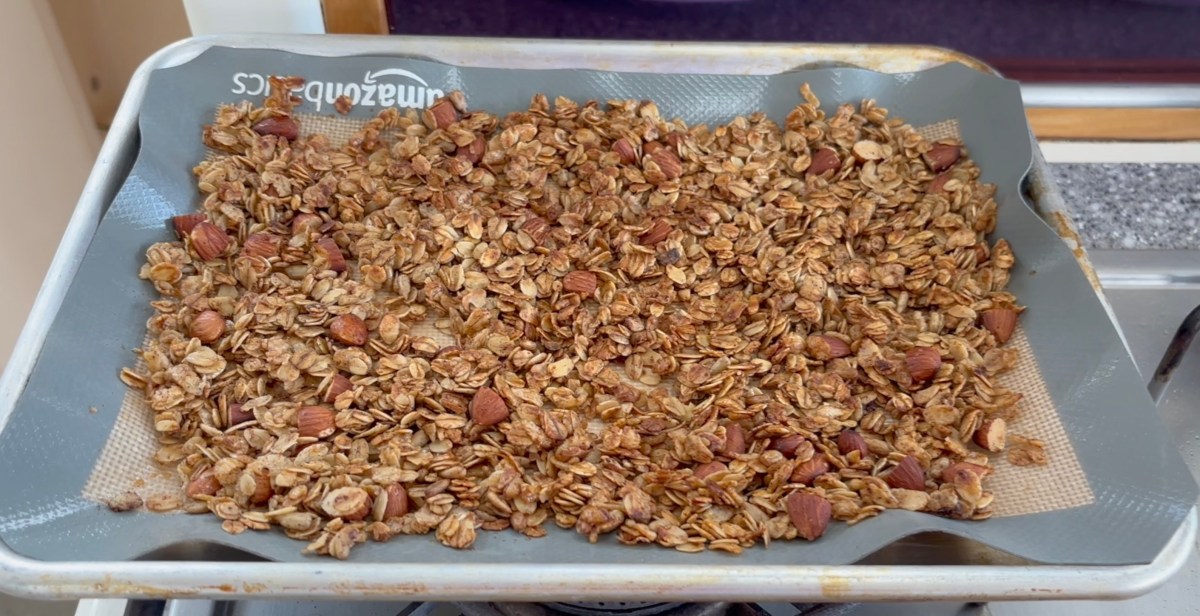
Okay, folks, this is our last day on Lady this year. Tomorrow we will pull into the boat yard’s harbor and move ourselves into the guest house. Lady gets hauled out for hurricane storage sometime in the next few days. We’ve been busy getting her prepped, and there’s more to do before we fly home Thursday, so I don’t have time to write much of a blog post. Instead, here’s a video in which I share the recipe I use to make granola onboard (complete with a blooper). If you want to know why I don’t just buy granola, you’ll have to watch the video. 😁
I will continue to post when I get home, because I have a bunch of stuff from this cruising season that I haven’t shared yet. Guaranteed I’ll post as consistently as I’ve been doing thus far this year. 😂
Until next time, stay safe and take care of each other!
Get comfy; this one is long. I threw in a few subtitles so you can scroll to pick & choose what you want to read.
It’s hard to believe we’ve been in St. Martin almost three weeks. As I wrote two weeks ago, our friend Ian was with us the first week here. Since then, time has been doing that thing where it seems to be racing by and slowly ticking along simultaneously. You know what I mean?
We stayed anchored in Marigot Bay for nine nights. It’s a busy harbor, so there’s lots of rolling during the day due to boat wakes, but it sure is convenient for getting places ashore. There is an excellent public dinghy dock on the bay side and another on the French side of the lagoon. From either, it’s a short walk to numerous stores and restaurants. Sometimes it’s a little too convenient, because we’ve eaten a lot of easily accessible croissants and baguettes. This country is not good for my waistline, but oh do the French know how to do pastry and bread! From where we anchored in Marigot Bay, it was also less than a 3-mile dinghy ride to the Dutch side. Visiting the Dutch side from the French side by dinghy or land transport does not require a passport nor clearing into the country. Convenient.
Our time in St. Martin has included some socializing with cruising friends, a little snorkeling, several shore excursions, and a lot of boat tasks, especially for Dave. The convenience of Marigot Bay made it easier for us to do the shore-based things we wanted and needed to do. When those items were ticked off the list, we popped up one bay to Friars Bay. It’s quieter, not busy, and less the 3 miles by dinghy back to Marigot should the need arise.
Shore excursions fell into the categories of meeting friends for meals, making purchases, and touring. We got in two dinners with our friends from Seas the Moment before they had to continue their journey to the Dominican Republic. Running into and spending time with them has been something we’ve looked forward to each cruising season. St. Martin boasts 4 very well stocked marine stores- Ile Marine on the French side, Budget Marine on the Dutch side, and an Island Water World on each side. We have made several stops for a variety of items we’ve needed for specific installation or repair jobs, plus some upgrades and replacements. We made three tourist excursions on the French side and two on the Dutch side, which I will write about separately.
Fort Louis
One day we made the less than ½ mile walk from the Marigot public dock up to Fort Louis for some great views of the surrounding area. Shore excursions like this always involve food ashore as well. After the fort, we went to our favorite bakery (photo at top of post). We split a scrumptious cinnamon roll and availed ourselves of their free WiFi to update apps and operating systems. That always takes longer than we think it will, so of course by the time we were done it was lunchtime and we “had to” eat ashore. We ate at one of the small restaurant stalls down at the Marigot Market. There’s a boardwalk of sorts lined with a dozen or more of these, each capable of seating maybe 30 people, all serving local fair with a variety of influences including Caribbean, Creole and French. It was a delicious way to conclude this trip ashore.
Pic Paradis and the AMuseum
Our second shore excursion on the French side required a rental car. We picked up our car around 9am. It was a bit of a beater, but perfect for the first part of our day when we took it up some precarious roads to within a ½ mile of the peak of Pic Paradis, the highest point on the French side of St. Martin. We hiked the last ½ mile to the summit for the views. Our first view was of two pairs of radio & cell phone towers surrounded by fencing with both razor and barbed wire. The nearer set was that demolished by hurricane Irma in 2017, the second set was the replacement. Hmmm… not very scenic. A narrow path around the fencing brought us to a small overlook of part of Marigot Bay to a bit north. Surely there was more than that? There was. A trail perpendicular to the pair of defunct towers led us to a better overlook. That view extended from Ile Pinel on the north end of Baie Orientale to the eastern part of Philipsburg on the Dutch side, on gthe south end of the island. If it had been a clearer day, we would have been able to see all the way to St. Bart’s. As it was, it was lovely, and we were thankful for the partial overcast; it kept it cooler. From Pic Paradis we drove around to French Quarter on the east side of the island to the Amuseum Naturalis, a free outdoor museum highlighting the nature and heritage of St. Martin. We had briefly visited it with Ian, but Dave & I wanted more time to explore it. It is well laid out with engaging signage that is both informative and succinct, and includes excellent photographs. The exhibits include local/endemic and invasive animal and plant species, a beautiful and well-labeled general garden, plus medicinal garden and more. We enjoy these kinds of exhibits and spent about 2 hours exploring. Unfortunately, the cloud cover was gone and it was ridiculously hot and humid. We were dripping sweat standing still reading signs. We ran out of energy partway through the medicinal plants exhibit and didn’t even get to the local poetry display. We dragged our soggy bodies back to the air conditioned car, sucked down more ice water, and went in search of lunch, which we found at a small place near Orient Beach. Nothing fancy, just paninis, but there was a breeze from both the sea and ceiling fans. Relief from the heat! Restored to full charge by lunch and more cool drinks, we set off back to Marigot and then on to the Dutch side to make our final provisioning run of the season. It was an enjoyable, productive and thoroughly exhausting day.
Excursions to the Dutch side
We made two land-based excursions to the Dutch side that did not involve marine stores. Our destinations were not accessible by dinghy, and were too far to walk to from the closest dinghy dock on the Dutch side. We could have taken a bus from Marigot, but had read that some of the buses, which are really 12-15 passenger minivans, were not all air conditioned. Marigot to Philipsburg, with traffic and stops, would have been about 45 minutes. That would be too long on a packed bus with no AC. We opted, instead, to dinghy just under 3 miles through the lagoon to the dinghy dock we’d used before in Simpson Bay (the town, not the actual bay). Then we asked a nice local which bus we should take to Philipsburg. Oddly, it was not one labeled Philipsburg, go figure. So, we crossed the street and flagged down the next bus labeled ‘Maho.’ It was air conditioned, and only a 15 minute ride- Yay! The ride was also cheap, just $2 USD per person each way, significantly cheaper than a taxi. Learning how to use public transportation on the islands takes a bit of work and tapping into local knowledge, but we find it more than worth the effort. Where were we heading? Keep reading.
This first Dutch side trip was to The Yoda Guy Movie Exhibit, created, curated and still run by Nick Maley. Nick worked on 50+ movies during his career doing creature creation and actor prosthetics before retiring to settle in the Caribbean. This is a specialty exhibit that pre-CGI SciFi movie geeks like me and Dave enjoy. Enjoy it we did! The exhibits mostly had to do with creatures and prosthetics created for movies Nick worked on, and models used in movies (some actual, some Nick recreated). There were also similar items from movies on which Nick did not work. But there was so much more- pages from scripts, samples of old contracts, comics based on movies, photos from movie sets, etc. It’s amazing how much he fit into such a small footprint. Nick also interspersed a few DVDs of himself explaining exhibits, plus interviews with others. The first big movie Nick worked on was Star Wars: The Empire Strikes Back. It is because of this work that he refers to himself as “The Yoda Guy.” He was one of a team of four whose job it was to create the Taunton, the Wampa, and, most importantly, Yoda. His favorite movie he worked on (we asked him) was Krull, which we now want to watch. The two things I most enjoyed about this exhibit were 1) we got to talk with Nick for quite a while, not only about movies, but also about cruising, because he used to do that too, and 2) the stories interspersed throughout the exhibit that only someone who was there could tell. Oh my goodness, I could go on and on about this place! I won’t do that, though, because I’d bore most of you more than I already do. Instead, here’s a link to the official web page for The Yoda Guy Movie Exhibit and Nick’s own web page. Moving on…
Another day, we repeated our dinghy/bus ride to Philipsburg, this time to visit the Sint Maarten Museum. This is a small, one floor, two room museum in a nondescript setting in what is otherwise a shopping and eatery area for cruise ship people. It was a gem, if, like me and Dave, you enjoy museums that tell you stories about the local history and culture. They did a nice job collecting and displaying items from various time periods- from the original Amerindian inhabitants through Dutch settlement of the area, the plantation period & industry of the island, abolition of slavery, plus a little about the natural environment and geology. I would have liked to have seen more individual items labeled, but there were informative signs that gave a general overview of each display. It didn’t take long to go through, and we followed it with lunch at a little restaurant on Old Street before our return trip to Lady.
A brief snorkel at the Arch
After nine days in Marigot Bay, and all of that land stuff, we needed a change of scenery. We hauled anchor one morning and cruised a mile south to Baie Rouge to snorkel through ‘The Arch,’ a natural rock arch at water level, and the surrounding point. Always hopeful, we’d heard there was great snorkeling. It wasn’t. The reef must have been amazing when it was alive, but all that remains now is the base structure, a bunch of algae growth and very little else. We swam out to a rock a little further out where we did see some coral regrowth and more fish. Maybe there’s hope for that reef yet. We did enjoy snorkeling through the arch, and we enjoyed lunch aboard Lady in the pretty anchorage. After lunch, we cruised back north to Friars Bay, one bay up from Marigot, where we have been for four days as I write this on Wednesday, May 22nd.
Boat tasks
Finally, boat tasks; they seem never ending. Many are the typical chores of laundry, cleaning and cooking. I do most of the laundry and cleaning; we split the cooking. Repairs and installations fall to Dave; I occasionally play a supporting role. Two such tasks were tended to since Ian departed.
First, for those of you who read my post about our holding tank woes, I am happy to report that we finally resolved the issue. As you may recall, our holding tank was backing up into our bilge when it got to just shy of being full. If you need more detail than this, you’ll have to go back and (re)read that post. According to the original Voyage boat drawings, all the hose connections Dave needed to see should have been accessible under the port aft companionway deck plate (that’s the removable floorboard at the bottom of the stairs on the left side of the boat). They weren’t. Even down on his belly with a bright flashlight Dave couldn’t see the connections well and certainly could not access them. They were under the floor of one or both port side heads. In each head there is a shower grate (big rectangle with draining holes) over a recessed area just above the bilge with a collection drain leading to a sump pump that pumps shower water overboard. Dave cut a 12” x 14” hole in the recessed floor of the port aft head so he could see into the bilge. Well, that gave him access to all the connections to the holding tank, but they weren’t the problem. Dang! Then he cut a similar hole in the forward head, our head. Bingo! There was a 5” or so crack in the ¼” thick fiberglass layer that creates the top of the holding tank. How the heck did a crack form inside? We’ll never know for sure, but some stress or sequence of stresses over time resulted in the crack forming and/or enlarging to the point where we noticed it this year. This is where I come in. Dave has become highly allergic to the hardener in 2-part epoxies, and this allergic reaction occurs in his lungs resulting in pneumonia-like symptoms. When diagnosed seven years ago, he was told that if he continued to work with epoxy, he would either need a lung transplant, or he’d die. Okay, time for Lisa to learn to work with epoxy. Dave routed out the area around the crack and set me up to do the epoxy-fiberglass work. I was nervous, because I’d only ever used epoxy alone to fill small holes. Under Dave’s tutelage, and his inspection of my first two layers of fiberglass (on a held breath) I knew I was doing okay. I put on a third layer, then set up the fan to blow from the companionway into the head and out its porthole so no fumes got inside while it cured for the next seven hours. Dave stayed in the cockpit until dinner time, at which point even I couldn’t detect any smell anymore (my nose being much more sensitive to such odors than Dave’s is). Two days later we filled the holding tank with sea water and watched. No leaking into the bilge- hooray! Dave took the opportunity to replace sixteen rusty hose clamps with brand new ones, installed an access plate in each hole he’d made in the heads, and replaced the shower grates. Now he has easy access to that area, should it be necessary in the future.
The next big task was/is an installation. Our freezer has always been inefficient and is now on its last legs. We ordered a new one from a store in Martinique in December and it met us in the USVI in late February, having been back ordered for a while. Since it was going to be a multi-day project that ended with our shutting off the freezer for at least one of those days, Dave opted to do it near the end of our cruise and in St. Martin where it’s easy to get the plumbing and wiring pieces he needed to do the installation. Buying the “freezer” included only the condenser, compressor, thermostat and cooling pump. Over the past three days, he has done some of the prep work by installing most of the plumbing and wiring elements. Sometime in the next week or so, once there’s less food in our freezer, he will finish the installation, which requires a new through-hull for the drain (through-hull = cutting a hole in the hull, this one above water line), and installing the condenser, compressor, thermostat, and cooling pump. That’s a lot of work in cramped, hot spaces for Dave. He’s a trooper. It’s just fortunate that he can do all this stuff, because if we had to hire someone to do the work, yikes $$$!
Sometime within the next two weeks we need to get to St. Kitt’s. We’re hoping for a good weather window but may have to settle for a less favorable one. Our one firm deadline this cruising season is hauling out in mid-June because we have stuff to do back home the latter part of the month. Our move to St. Kitt’s could happen as soon as this weekend, Memorial Day weekend.
UPDATE: We are in St. Kitt’s! A weather window presented itself yesterday, Saturday 5/25. It took us 12 hours from anchor up to anchor down, 2am-2pm, to travel the 60 nm. It was a decent passage. My apologies for posting this so long after I wrote it. Cell signal in St. Martin is abysmal and I couldn’t even upload a picture, let alone the slide show. Great signal here in St. Kitt’s, though, so I finished up today, Sunday 5/26.
Until next time, stay safe and take care of each other!
Sorry for the 2 week delay in posting. The day of my last post was also the day our friend Ian arrived, so I haven’t been in the mood to write blog posts.
We had a lovely time with Ian. We spent a lot of our BVI time relaxing onboard and did a little diving and snorkeling as well, plus had several meals ashore (most, courtesy of Ian). The weather (both atmospheric and sea) wasn’t cooperative for good diving or snorkeling, but we got some in anyway. The dive-able days followed days of wind or rain, which stirs up the water and decreases visibility. Still, we all love dubbing around in the water whenever we can. We ended up back in Benures Bay on Norman Island a couple of times. One time we launched hookah and dove the eastern point of the bay, something Dave & I had not done on our prior stops there. There was a lot of turtle grass strewn with boulders that had some healthy coral and sponges growing on them, and plenty of fish. It’s fun to look for little fish among the grass and in the boulder crevices. As a bonus, that side of the bay had good visibility. Always nice to be in the water.
We were eyeing a weather window for the weekend of May 4th to cross to St. Martin. Ian assisted us in our preparations by helping us clean our hulls. It sure goes faster with three people and the hookah. Earlier in the week I had posted in the USVI and BVI Cruisers Facebook groups, asking if anyone was heading to St. Martin on the same weather window. Wild Rose responded; they’d been thinking of making the same type of post. Indigo Lady worked her way over to Spanish Town on Virgin Gorda and cleared out of the country just before lunch Saturday. Then we moved up to Gorda Sound on the northeast end of Virgin Gorda and laid a track out through the reef, which we were going to have to navigate at night, before backtracking and anchoring next to Wild Rose on the west side of Prickly Pear. They dinghied over to meet us in the afternoon and we planned our departure time and radio check-ins. Then we each set about our night crossing preparations and napping.
Indigo Lady and Wild Rose hauled anchor around 12:00 AM Sunday. Wild Rose opted to go around the north side of Virgin Gorda while we passed through the reef following the track line we’d laid earlier. In hindsight, we wouldn’t go out through the reef again at night. It is a very well buoyed channel, and the buoys are lit, but they also flash at different times. It was distracting. We successfully got through the reef and out to the open ocean just as Wild Rose was coming around the corner. They hailed us shortly thereafter to let us know that there were fish pots around and they had narrowly missed one. Yikes! We kept as watchful an eye as one can in the dark. I’ll spare you the suspense; we each had a close call, but neither of us snagged a fish pot. Phew!
The crossing was quite rolly/bumpy, but there wasn’t a lot of slamming, for which I was thankful. Other than fish pots and rolling, which smoothed out a bit as we neared St. Martin, it was an uneventful crossing. I enjoyed starting out at midnight knowing we were cruising into daylight, and it was comforting having another boat with us. We were anchored in Marigot Bay (French side of St. Martin) around 3:30 PM Sunday afternoon, 15.5 hours from anchor up to anchor down. Wild Rose was anchored shortly after us. We’d arrived too late to clear into the country that day, so we ran up our yellow Q-flag, tidied up the boat and rested. Monday morning we met up with Wild Rose to clear into the country, then we went to a fabulous breakfast spot they’d found on the Dutch side last time they were here- Zee Best. It was delicious! We chatted for quite a while, taking the chance to get to know each other a little better. Eventually we each headed off to tend to our own things. Hopefully we’ll hook up with them again before they continue their trek south to Grenada for hurricane season.
Shortly after our arrival in St. Martin, we had another “small world” experience. I received a text from our friends Roxanne and Craig on Seas the Moment. It was a picture of Lady at anchor in Marigot Bay. They are here, too! We met them in Bimini, Bahamas in 2021 and have run into them each cruising season since. We arranged to have dinner together at a restaurant in Marigot. Joining us would be Tom on Imiloa. We met Tom in Charlotte Amalie in January. Turns out Roxanne and Craig know Tom because he was the broker who helped them buy their first catamaran years ago, which was a Voyage 440 just like Indigo Lady. Tom, himself, had also owned a Voyage 440 in the past. We enjoyed a lovely dinner and a lot of conversation. Again, we will hopefully hook up again before they each head off to their hurricane season locations.
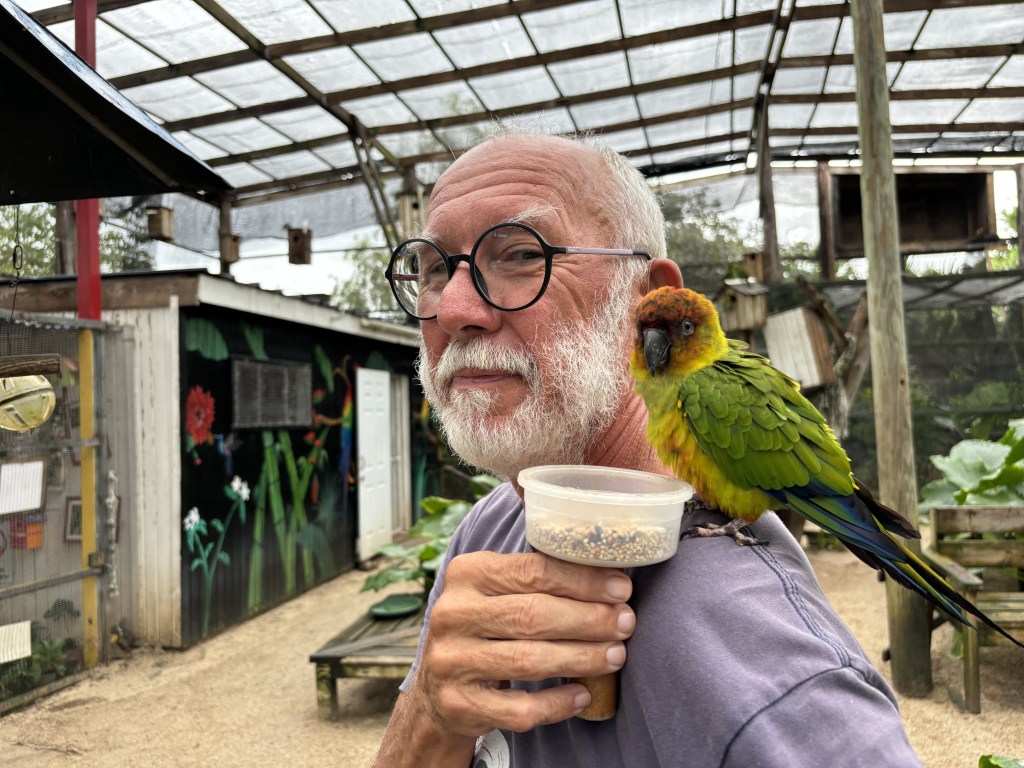
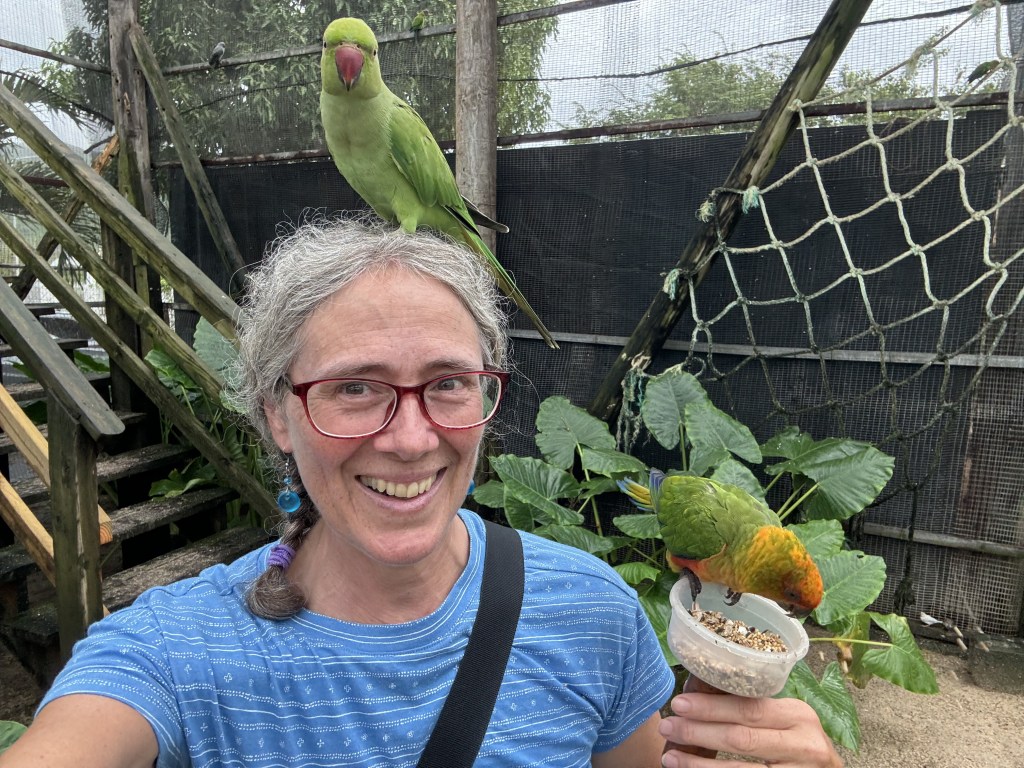
One day, we rented a car so Dave, Ian and I could drive around the island, which doesn’t take very long. It was a very rainy day, so touring by car was better than sitting on the boat playing ‘hatchlisthenics’ (jumping up to repeatedly close, and later reopen, the hatches). It was a lovely drive until we hit traffic in Philipsburg, the capital of Dutch St. Maarten, and in Simpson Bay (cruise ship port. It was crazy! We managed to find a fabulous lunch spot slightly off the beaten path with a parking spot to boot. Score! The circumnavigation of the island took us less time than we’d anticipated, so we had time to kill. We visited the Parotte Ville Bird Sanctuary where we fed the birds as they landed on our arms and heads. It was worth the $10/person. After a failed attempt to have drinks at a local brewery (closed!) we ended up at the Dinghy Dock Sailors Bar, then poked around in Budget Marine where we finally found security chain for dinghy at a reasonable price. (Dinghies are frequently stolen in the Caribbean, so we lock her to the docks we park her on during the day and hoist her into her lift each night back at Lady. We wanted to replace our thin cable and lock with a more substantial chain.) After our wonderful dinner that night with Roxanne, Craig, and Tom, we unloaded our purchases at the dinghy dock where Dave had to bail out shin-deep water. Told you it rained a lot. Thankfully, Ian found a 5 gallon bucket nearby, which expedited the task. We parked the rental and returned to Lady.
After we returned the rental car the next morning, we hauled anchor and headed up to Creole Rock for a snorkel. The leeward side (away from wind & seas) was uninspiring, and it was too rough on the windward side to swim around to that side. Alas! We crossed the channel to anchor in Grand Case Bay where we had a less than satisfactory BBQ dinner. Well, my chicken was fine, but the boys’ pork chops & ribs were tough and not very flavorful. The rice and beans were dry. Sometimes things just don’t pan out the way one hopes. We did spend a quiet, calm night in the lovely anchorage, though. After breakfast on Friday we hauled anchor and popped down to Friars Bay for a snorkel. Again, not scenic, but there were lots of boulders and canyons between them to poke around in and we had a lovely, long swim. From there we passed Marigot Bay to check out Baie Rouge (Red Bay) seeking ‘The Arch’ and ‘David’s (aka Devil’s) Hole.’ Red Bay would make a lovely day anchorage, but there was too much surge this day to safely snorkel The Arch and Devil’s Hole. Dave and I will try to come back another time before we leave. We turned Lady around and headed back to anchor in Marigot Bay. We had a lovely final dinner ashore at a restaurant on the French side of the Lagoon, again, courtesy of Ian. (Thanks for all the meals ashore, Ian!) Ian enjoyed St. Martin enough that he’s thinking of taking his wife, Linda, here for a vacation.
Yesterday morning we all went ashore for a light breakfast and then Dave & I walked Ian to the taxi stand and bid him farewell. We then walked around Marigot Market, an open square market with many tent stalls set up. Most sell tourist kitsch made in India or China, but hidden among the kitsch are some real local delights. We purchased, from the artist herself, an African face made of painted coconut fiber on wood. It will look very nice in our living room back home. We continued on to walk through the farmers/fish market, picking up some local produce, and we enjoyed a live performance from a well-known local band called Remo and the Barbwire Band. We returned to Lady for lunch and an afternoon of relaxation.
As I conclude writing this, I’ve just finished the 6th and final load of laundry. Dave has spent the day making water, attaching our new security chain and lock to dinghy, and troubleshooting our leaky holding tank (still no solution, but he thinks he’s getting closer). It’s hot and humid. Thank goodness for the breeze! We will take a dip in the ocean to cool off, then likely retire to our hammocks for the rest of the afternoon.
I’m not sure if my next post will backtrack to some stuff we did in the USVI that I haven’t written about yet, or if I’ll continue writing about our time here in St. Martin. It will depend on my mood this week. Until then, stay safe and take care of each other!
Yes, I’m talking about toilets. For you non-boaters, toilets on boats are referred to as “heads.” I’m sure there’s a history to that name, but I don’t feel like researching it right now. This is a post about the non-glorious side of cruising and it deals with toilets and holding tanks, so keep that in mind before you decide whether to keep reading.
Allow me to set the stage a little. Indigo Lady was a charter boat, and as such, she was set up with four sleeping cabins and four heads (head can refer to the toilet, or the bathroom in general). They were all manual pump toilets. That means that once you do your business, you have to pump a handle to empty out the “black water” (waste). On Indigo Lady, we can set a valve, per toilet, so that the black water either goes directly overboard or into the holding tanks. Our holding tanks are our keels, which are hollow and molded onto our hulls. When the heads are set to go into the holding tanks, those eventually fill up and we have to pump the entire holding tank overboard. When we bought Lady, this was also done manually, and usually required 100+ pumps. In U.S. coastal waters, emptying black water from holding tanks must be done no less than 3 miles offshore. On inland waterways, like the ICW (Intracoastal Waterway), there is no pumping overboard. Instead, one must go to a pump out station to have the tank emptied by suction, just like having a septic tank pumped at home, except it usually has to be done weekly and you have to keep a log (just in case an authority asks; nobody ever asked for ours).
When Dave converted Lady to solar electric, he also installed two electric flush toilets on the port side. Likewise, pumping out the holding tank on that side is electric. On the starboard side, Dave removed the forward toilet so we could put in a washing machine. The washing machine, being “gray water,” pumps directly overboard when it drains. The aft (rear) toilet and overboard pump out remain manual. We left starboard manual in case anything ever goes wrong with the electric heads on port. There are a couple of advantages to electric pump toilets. First, one doesn’t build up callouses by repeatedly using a pump handle. More importantly, to my mind anyway, the electric toilet pump has a macerator that grinds everything up, as does the pump to empty the holding tank overboard. This means that what gets dumped overboard is a slurry which break down faster. The manual pump toilets and overboard pump leave everything pretty much intact. How’s that for an image? You’re welcome. 💩
We keep Indigo Lady’s toilets set to empty into the holding tanks. In the coastal waters of New England, it’s really easy to get 3 miles offshore to pump out holding tanks, and pump out stations and pump out boats are also becoming more common. In the ICW, being a no discharge zone entirely, pump out stations are very common. The reality from the Bahamas to St. Kitt’s, where we’ve cruised thus far, is a little different. Pump out stations are either nonexistent or exceedingly rare. Here’s some more reality, down here nobody goes 3 miles offshore to pump out their holding tanks, and I’d wager that toilets of most cruisers and charterers, especially charterers, pump directly overboard with each flush. Those of us with holding tanks try to empty them in an open waterway where there’s good water flow, but if one gets pinned down in a particular anchorage for too many days, well, tanks have to be emptied. Courteous boaters will wait to do that until nightfall. Not everyone is courteous.
You’re still reading. I’m impressed. On to our current head issues…
Like I said earlier, we have Lady’s toilets set to flush into the holding tanks. Last Monday morning, I flushed the electric toilet like every other time. We’re used to a brief stink after a flush, especially as the tank gets more full. When we add to the tank, air gets pushed out through the vent hose to the outside of the hull. Depending on wind direction, the smell can blow back toward us. With this flush, however, the stink didn’t go away and it was stronger than usual. So, Dave lifted the bilge1 floorboard2 in the port aft companionway3. (If you need translation for that sentence, see the end of this post.) There was black water in our bilge. First, yuck! Second, that should NEVER happen. If a holding tank is full, the next flush is supposed to go directly overboard through the vent hose. Uh oh!
The exact order of things hat happened after that are a bit of a blur, but the first step was to run a bunch of sea water through the bilge to clean it out. (Each bilge has a pump that sends any accumulated water overboard.) Then we did a variety of things that included emptying the holding tank and flushing repeatedly while Dave used a flashlight in very tight places to try to see what was leaking. After we’d emptied the holding tank, flushing toilets did NOT put toilet water into the bilge. Dave could see nothing leaking on any hoses or connections (the ones he actually could see) when we flushed. 🤔 What we learned is that we have no idea why this is happening. So we did a fresh water rinse of the bilge with dish soap, followed by a bleach and water wipe down. Then Dave cleaned himself. No, he wasn’t covered in filth, but when dealing with sewage, better safe than sorry. Everything was fine again, until it wasn’t.
After 48 hours of using our head like normal, a flush backed up into the bilge again. We caught it earlier this time because we were checking after every flush, so it wasn’t quite as messy. More flushing and looking with a flashlight. Empty the tank again. We usually go about 8 days before needing to empty the tank. Why is it full after 48 hours? Do we have a leak in our keel that is allowing in sea water, thus filling the tank faster? How much did we fill the tank with sea water during out testing on Monday after we had pumped it out? A new round of troubleshooting still revealed nothing, but our tank was full, so we emptied it again. Then Dave set our toilet to pump directly overboard. He wanted to set the aft head to do the same, but those valves haven’t been moved since 2019, and they were stuck good. Fortunately, that head is rarely used except for when we have guests aboard.
Where does this leave us? Our head is pumping directly overboard, so it’s not contributing to the port holding tank. After 3 days of this, the level in that tank has not changed (we can tell by removing the vent cover to look in). This is very good news, because it means we don’t have a leak in our keel letting in sea water. If we’re ever in an anchorage where we think we should not be pumping directly overboard, we can either use the port aft head or the starboard head. Our guest, who arrives today, can use the port aft head, as long as we are able to pump out the holding tank every 2-3 days, otherwise he will use our head or the starboard one. I’m very thankful that we have heads on each side of the boat!
I’m sure that’s more than you ever wanted to know about marine heads. I aim to educate; it’s in my blood. 😁
I promise to return to writing about the more enjoyable parts of our travels, at least until something else inglorious arises. I want to keep it real.
Until next time, stay safe and take care of each other!
I have finally caught up with my dive photos from our time in the USVI. I managed to get my count down from about 250-300 photos/videos clips to 56 photos and 10 video clips. I’m going to attempt to stop taking so many underwater pictures. How many photos of barracuda does one need, really? I’m going to try to focus creatures of which I don’t yet have pictures. Sure, that’s gonna work. 😂 There are some sea creatures I enjoy so much that I can’t help but take just one more photo. (I’m looking at you, porcupinefish.)
I don’t have a fancy underwater camera, so the camera doesn’t always capture the way things looked to my eyes. I use Photos and iMovie to edit the lighting aspects of my images to get them closer to how I saw them. Nothing fancy; I don’t want to misrepresent the reality.
I spend quite a bit of time trying to identify the creatures I capture in photos; I like to know what I’m looking at. Take my identifications with a grain of salt, though; I’m not an expert. We have a good set of identification books onboard by Humann & DeLoach, but sometimes my pictures don’t jive with the books’ pictures and descriptions, in which case I can only attach a general level identification- sponge, parrotfish, etc. I’m especially bad at identifying specific sponges and corals, so when I name those in a slideshow, you may just see “pretty orange sponge” as a label. Those who know me personally, know that I used to be a biology teacher, but I’m not going to bore you with taxonomy. I will, however, say that sponges and corals are animals; perhaps not everyone knows that. Now you do.
In this post I have divided my underwater finds into two separate slideshows- “scenery” and “creatures.” Just enjoy the scenery; I didn’t label anything in that one. The “creatures” slideshow names the organisms and organizes them into “not fish” and “fish.” No label beyond the name of a fish indicates that it’s an adult. Some reef fish young don’t look like the adult version, however. You may see me include in my labels: Juv (juvenile) or Int (intermediate) if the picture is not of an adult. For parrotfishes and wrasses, IP (Initial Phase), indicates an adult, while TP (terminal phase) identifies a sexually mature adult male. You can, of course, ignore the labels and just enjoy the pretty pictures.
We’re in the BVI for another couple of weeks and have a friend coming to visit a week from today. (Looking forward to having you aboard again, Ian!) At some point I’ll sort through my BVI dive photos, but since we’re not done diving here yet, that won’t happen for a while. Don’t worry, I have other things to write about.
Until next time, enjoy the USVI dive pics, stay safe, and take care of each other!
From our dives at Sprat Point on the south end of Water Island, at Buck Island off St. Thomas, and at Cow & Calf.
From the same dives as mentioned in the caption of the Scenery video.
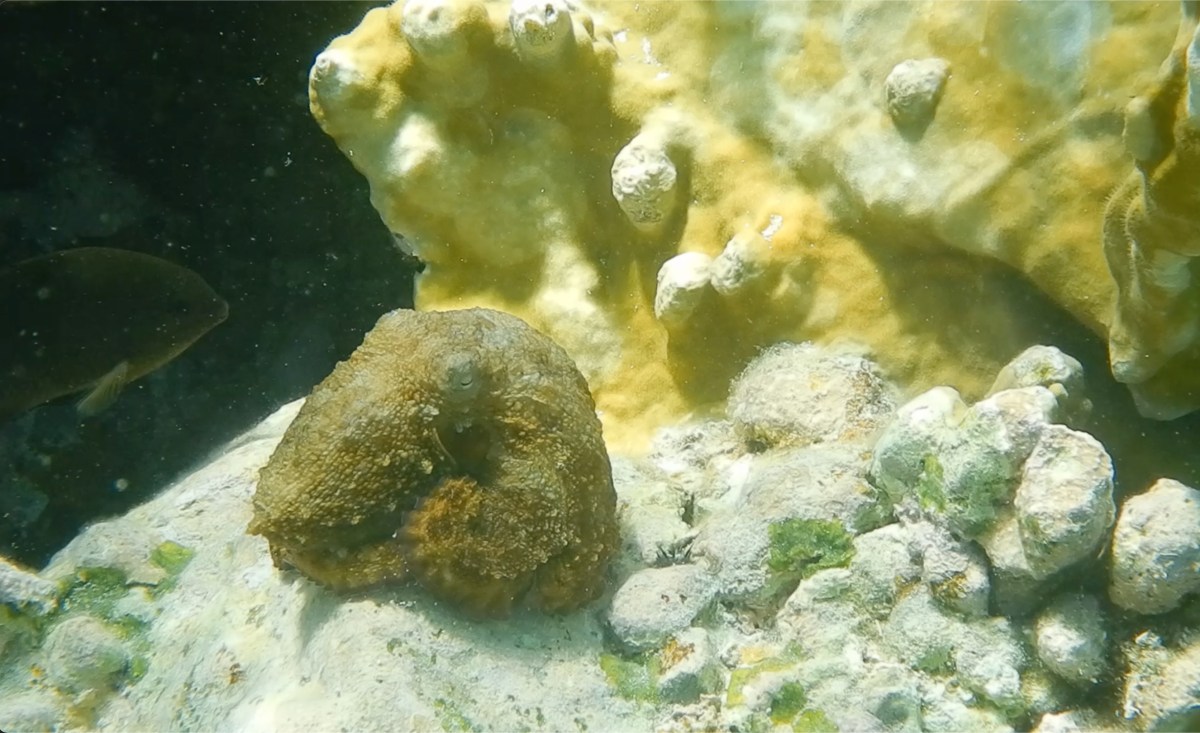
Our final night in the USVI was spent on a NPS mooring in Waterlemon Bay on the north side of St. John. The morning of 4/6 we had a final USVI snorkel around Waterlemon Cay where I saw my first octopus in the wild! As usual, I was dubbing along quite a bit behind Dave, when I looked over at him to see him waving me over, his eyes fixed on a small coral head. I kicked over quickly and followed his finger to… a rock? The rock twitched, and it had an eye. It was a small octopus about 6-8” from head to tentacle tip. It was not happy that we were watching it, so it moved under the coral, where the fish it had replaced showed its displeasure by repeatedly nipping at it. The octopus went back to the coral’s surface, then swam on to another piece of coral. It was so exciting! After our snorkel, we set off to clear into the BVI at West End, all of 1.5 nm away. That done, we had lunch, then headed over to Benures Bay on the north side of Norman Island, a place we’d anchored when my folks were with us last month. We had a couple of days of calm seas ahead of us and we wanted to make the most of them by doing some diving. The first location was around the western side of Norman Island.
We hauled anchor right after breakfast the next morning and headed around the corner to the west side of Norman Island before it got crowded. It’s a popular spot. There were two things we wanted to do, a reef dive and a cave snorkel. We picked up a mooring ball between the two, loaded our dive equipment into dinghy, and grabbed one of the dive moorings at Angelfish Reef on the SW corner of Norman Island. At first, I was unimpressed. The reef is in a sad state, but once we got around the point to the south, there was much better coral structure, which means lots of nooks and crannies for fish. There were also a fair amount of sponges and corals. The highlights of the dive were the large eagle ray that passed within a few feet of us, and a 4’, ~80 lb snapper that emerged from a rock overhang. We believe it was a Culebra snapper. It was huge!
After our dive, we returned to Lady, grabbed a quick snack, and offloaded our dive-specific gear. Then we headed to the dinghy tether at the caves. There were three caves to explore. They do not go inward very far, and the water inside is not deep. We could easily stand in each. Most of the fish were schooling just outside the entrance to each cave, but two of them had schools of glassy sweepers inside. The cave farthest north was the deepest and required a dive light; it got dark pretty quickly in there. Dave illuminated the school of glassy sweepers, but, alas, none of my photos of them came out. Fortunately, I had video of them from an earlier dive; I just hadn’t yet identified them.
Dive and cave snorkel complete, our next stop was Deadman’s Bay on the eastern end of the north side of Peter Island. We went by way of Dead Chest, a rocky little island just outside of said bay, to scope out its three purported dive sites. The mooring ball for the western dive site was missing, but we found one on the north side and two on the south side. After a quiet night anchored in Deadman’s Bay, we popped across to the south side of Dead Chest with Lady and picked up one of those two moorings. The reef right below us was unimpressive, but Dave followed an easterly ridge and we found the good stuff. I haven’t sorted through those pictures yet. I’m backlogged on my BVI dive pictures. Back aboard Lady we had lunch, then set off for the anchorage we had selected to ride out the big winds that were forecast.
The big winds were predicted from the NE-ENE for several days, so we needed a place protected from those directions. Our other criteria were that it have cell signal so we could tend to some business, and so I wouldn’t lose my 3+ year streak on Duolingo, and we wanted to be able to anchor rather than pay $45-$55/night for a mooring ball. Many of the anchorages here in the BVI have been filled with mooring balls, greatly reducing the space available to anchor. It’s peak season here, too, so there are many boats vying for the same anchorages. We opted for the south side of Peter Island, which is not frequented by many charterers or liveaboards, and settled in at South Bay. We were there five nights, Monday-Friday. In hind sight, we probably could have spent Monday & Tuesday night elsewhere, done another dive or two, and been fine. The big winds didn’t really kick in until overnight Wednesday. Then it was very windy, overcast and rainy most of Thursday & Friday. Hind sight is always 20:20. Such is life.
We weren’t completely idle while in South Bay. Tuesday, the day after we arrived, we hauled anchor and popped over to Key Bay and the wreck of the Willy T2. We’d already dived on the wreck, but we wanted to spend time on the extensive reef arms between which it is sandwiched. We returned to South Bay afterward. We cleaned our hulls. Dave made water, and he replaced the starboard engine room fan and a bilge switch that had failed, which he discovered when he went down to replace the fan. He also replaced the dying fan in our cabin. I did laundry and some baking and spent many hours sorting through and editing dive photos from the USVI.
This morning we decided to head elsewhere. We went around the west end of Peter Island and up into Drake’s Passage and found it manageable until we got past the east end of Peter where it’s more exposed to the open ocean. The seas were bigger there and it got a bit bumpy. We aborted our attempt to check out Cooper Island and turned toward the east end of Tortola and Buck Island, which was supposed to be a pretty sheltered, shallow anchorage. We dropped anchor in 10’ of water inside three other boats anchored there. It is indeed pretty sheltered here, just a little wrap around swell from the SE point of Buck Island, but not bad in a catamaran. We went ashore for a bit of a walk; it had been 4 days since we’d set foot on land and we wanted to stretch our legs. Dinghying back to our boat, we swung by our neighbor’s catamaran. They were about to head over the shallows into Fat Hogs Bay to go to the Riteway market, so we followed along. Fresh produce- yay!
Not sure where we’ll be off to next. The wind and seas will decide that. I ran out of energy to put together a slide show of dive pictures for you, so for now, enjoy the short video of that octopus we saw.
Until next time. Stay safe, and take care of each other!








 Life on Lady