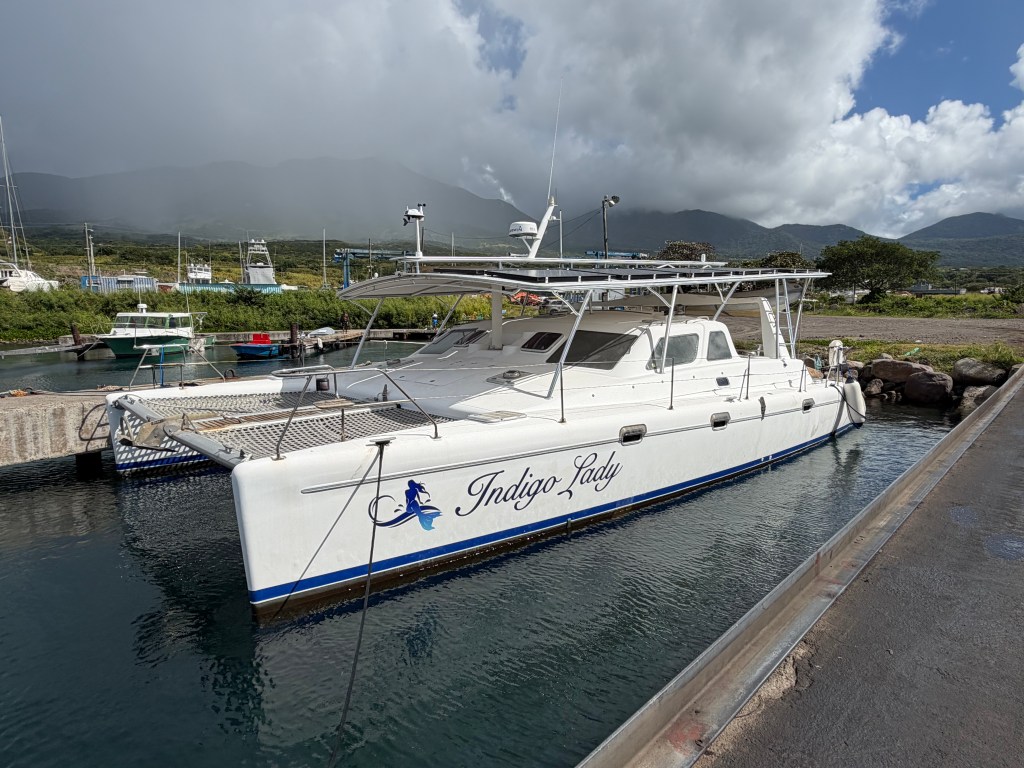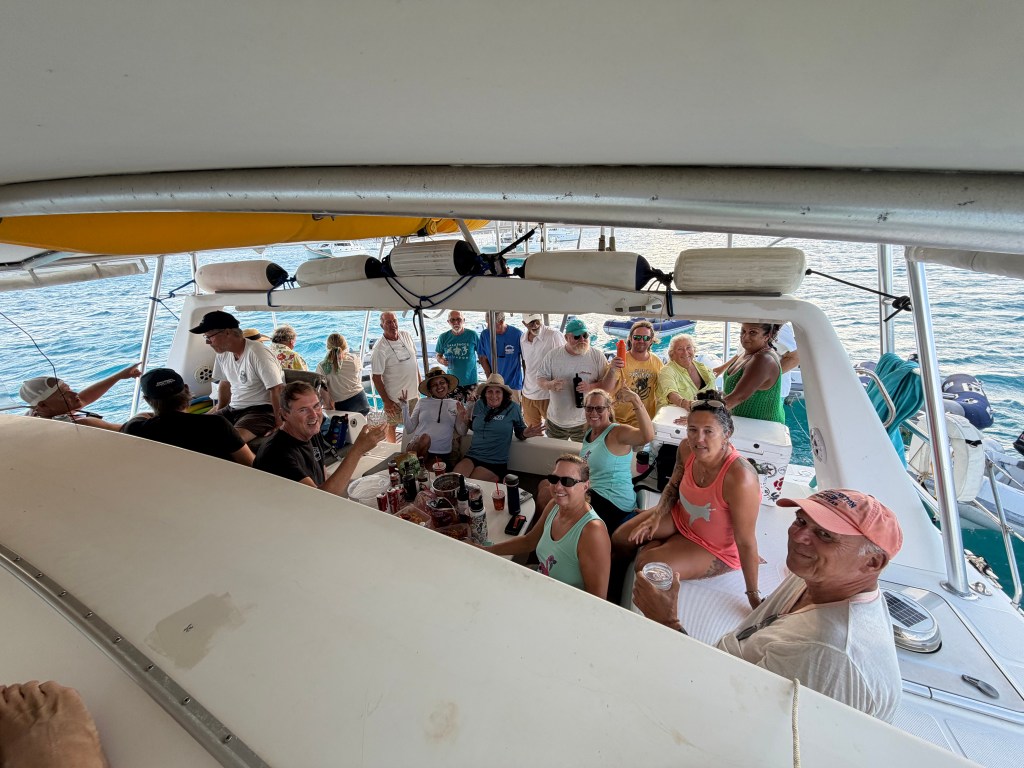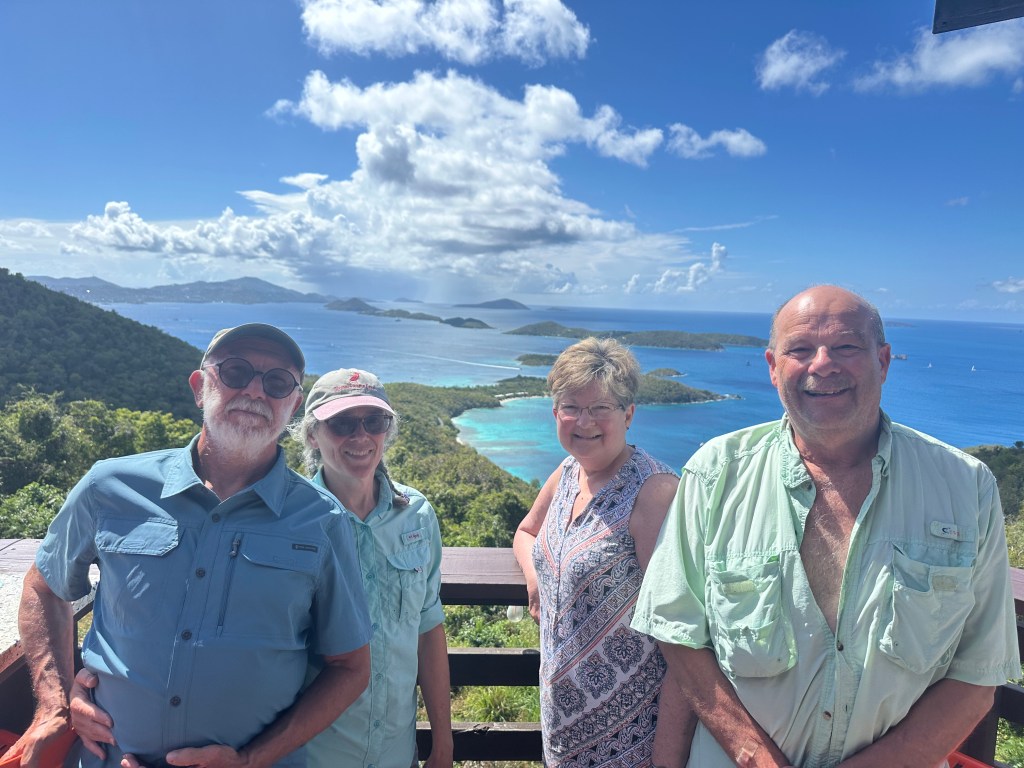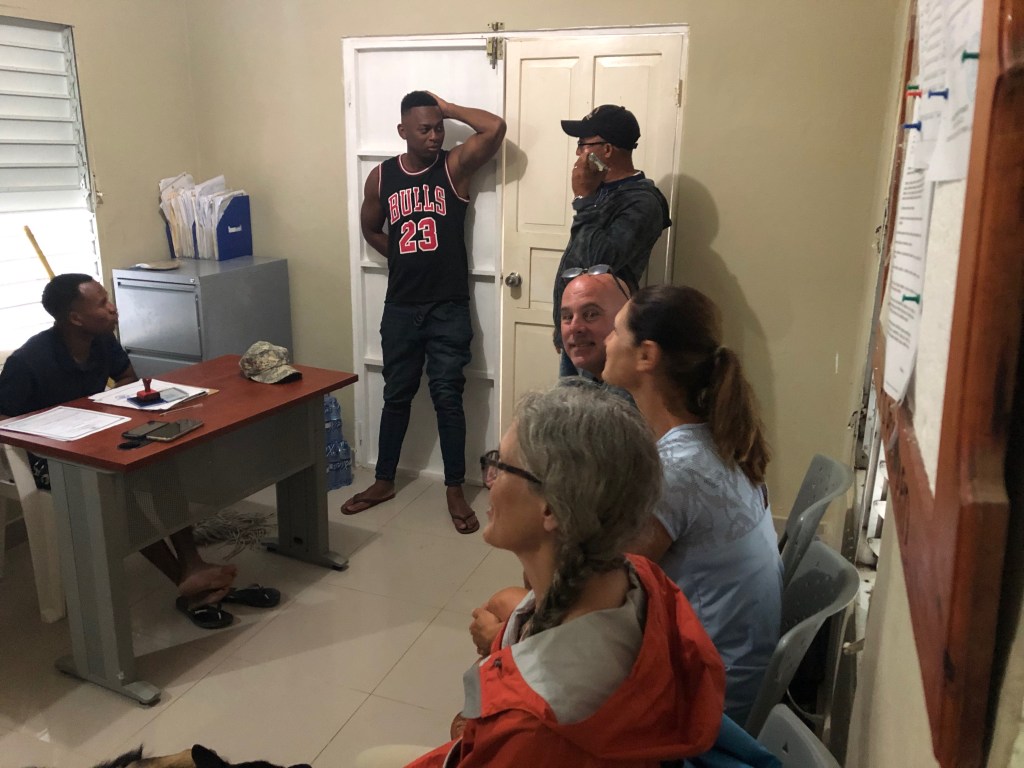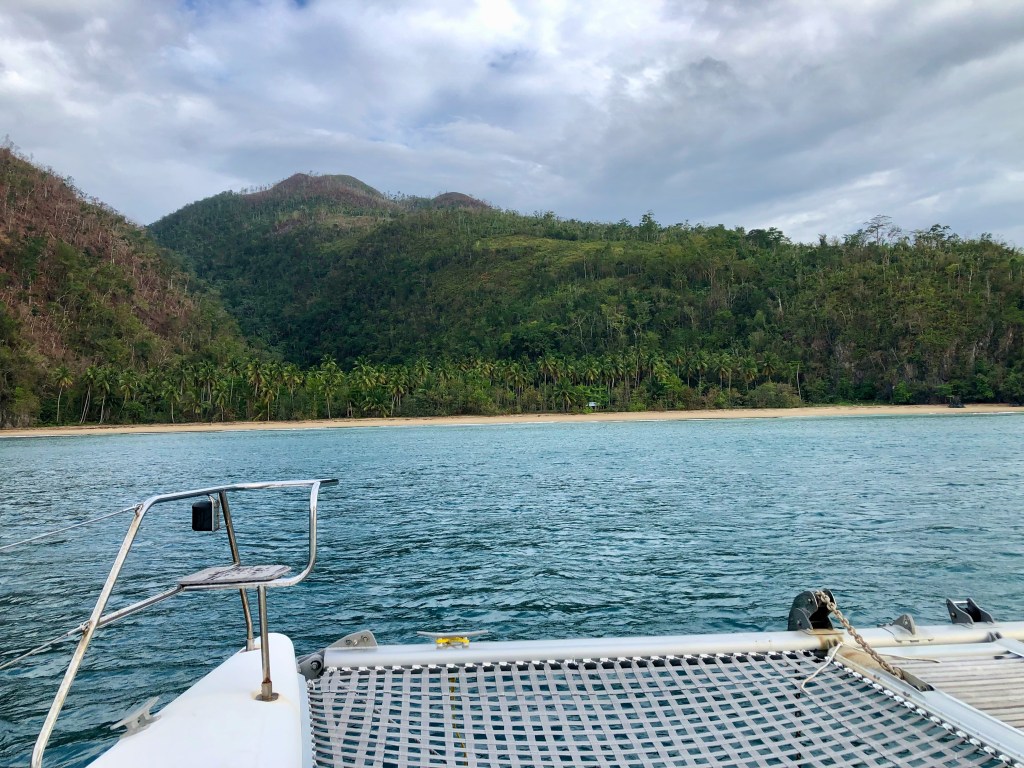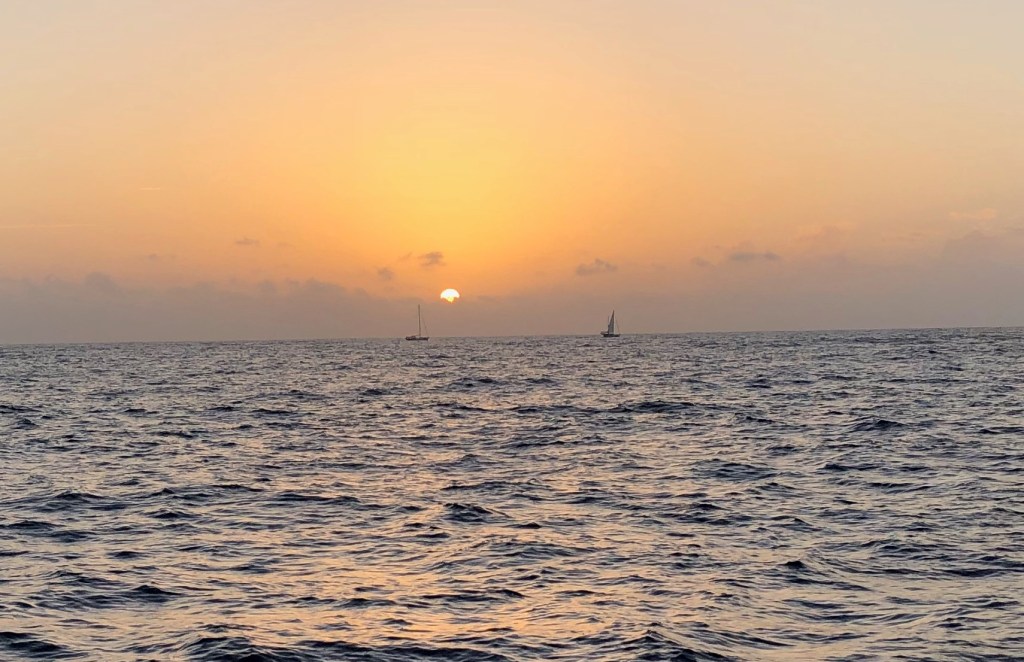
Guadeloupe to Antigua, at last!

I last wrote on April 1st (posted the 5th) and we were still in Guadeloupe. 

We were in Guadeloupe another eight days and in that same anchorage for five of them. Honestly, we were a bit bored. We snorkeled another time and dove two more times. I mentioned last time that we had met a couple of American cruisers when we went ashore one day. They are on a sailing catamaran called Pulpo (Italian for octopus). That was the saving grace for our sanity. We told them to stop by if they wanted to see our solar electric system, since they were interested in it. A couple of days later, they did so. The tour of our system turned into a few hours of socializing with cheese, crackers, salami and apple as dinner once we realized it was too late for a real dinner and we were all hungry. 😂  A couple days after that, we invited them over for pizza and had another enjoyable, rambling conversation for several hours. 

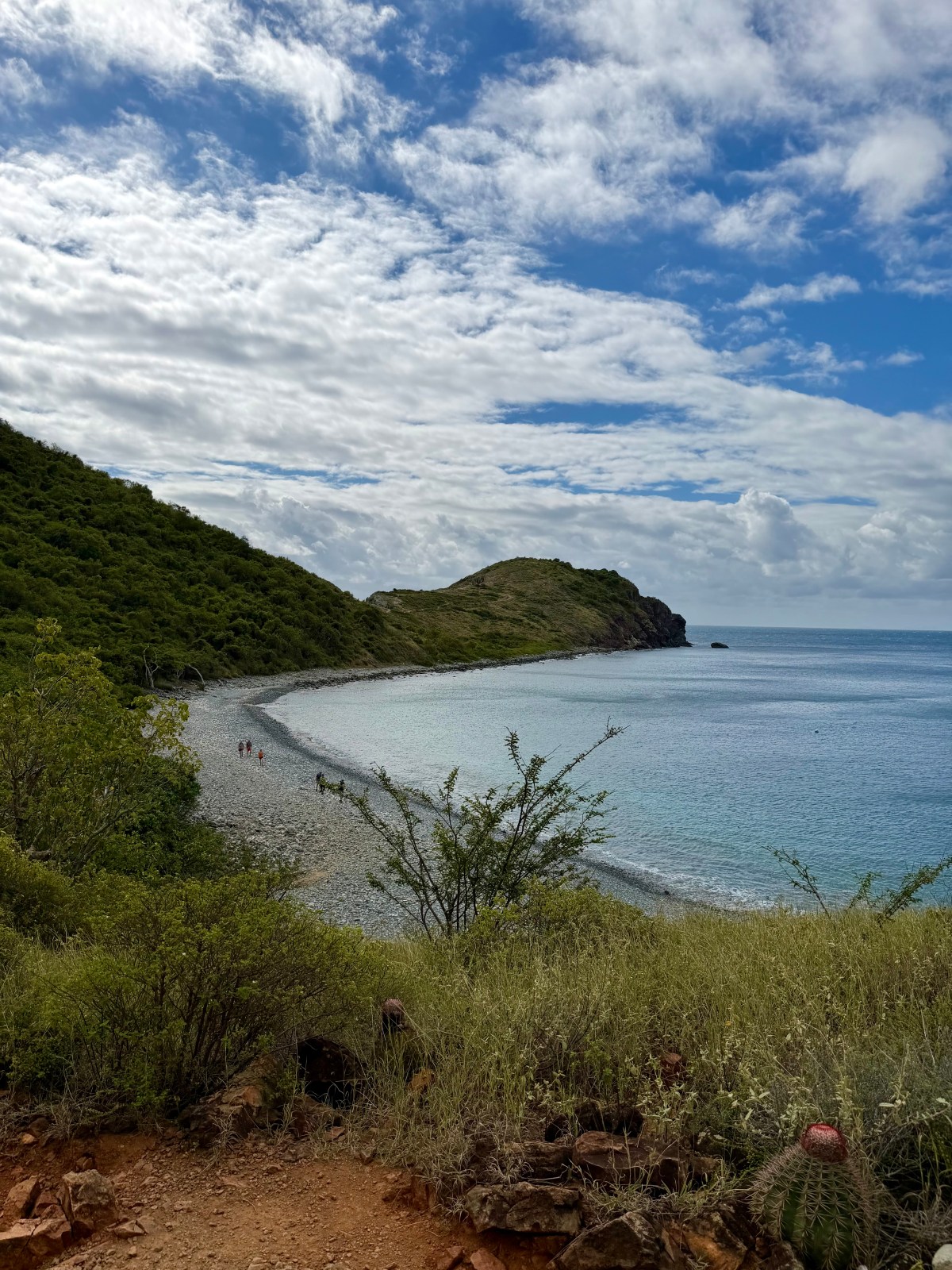
We and Pulpo ended up both moving north to Deshaies on April 7th. They picked up a mooring ball. We tried to anchor, but dragged, and the anchoring section was pretty tight anyway, so we went north one more mile to Grand Anse and anchored in lovely sand. Just the change of scenery was mood-lifting, and we spent the rest of the day reading in our hammocks and enjoying the new view. 

The following day, we did some travel planning over breakfast and decided that conditions looked sufficient for moving on to Antigua two days later, on Thursday, August 10th. In the meantime, we had two days to explore. So we packed a dry bag with stuff we’d need ashore, donned our swimwear, masks, fins and snorkels, and swam ashore. The swell, though not bad at anchor, was too dangerous for landing dinghy ashore, she would have been swamped; so we swam instead.

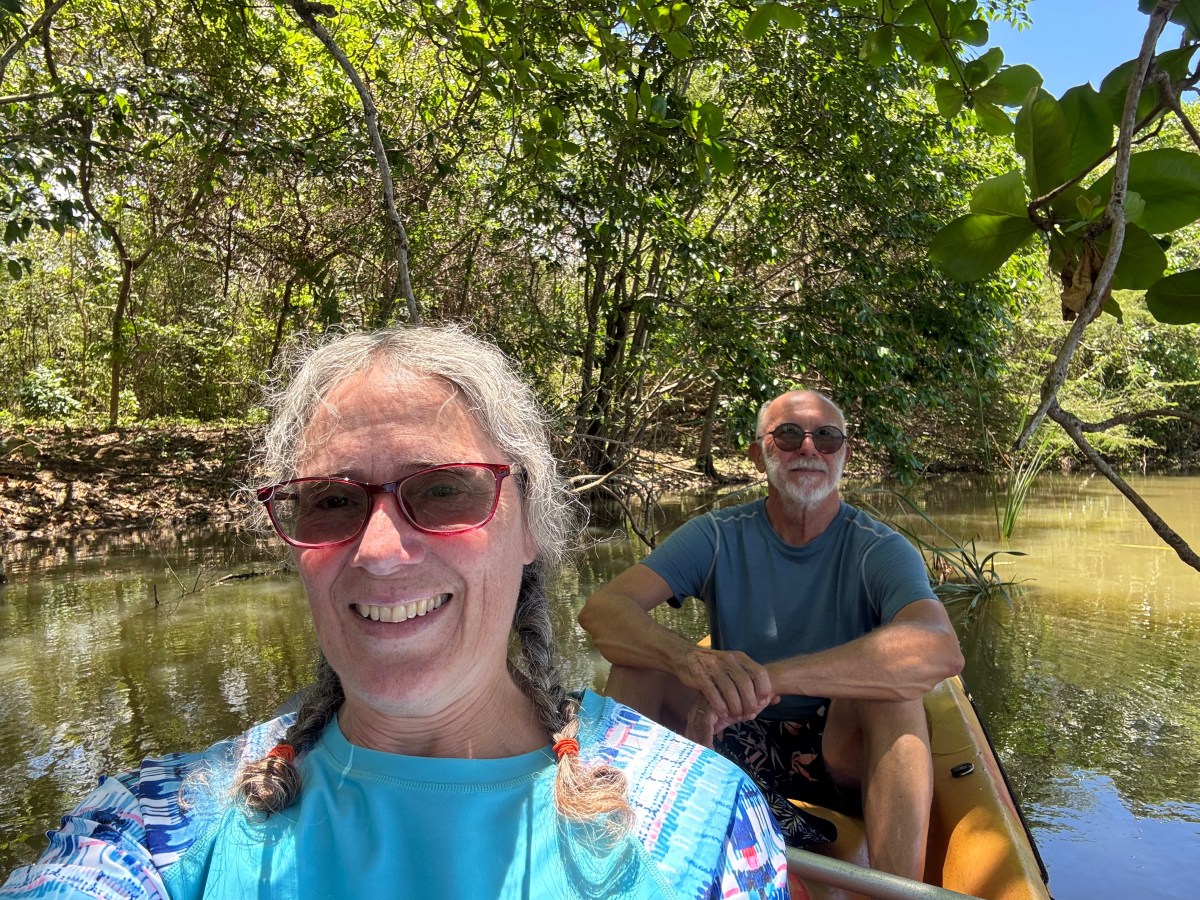
Once ashore, we put our snorkeling gear in the mesh bag we’d packed, retrieved our glasses, hats and shoes, and headed for a little shack that rents kayaks for paddling around the mangrove. We rented a two-person kayak from a very friendly man who told us the mangrove has only existed for forty years and resulted from dredging for sand to build elsewhere on the island. He gave us the mangrove map and explained the various “stopping points” labeled on it. Then we set off. It was lovely! It was mostly an open mangrove lake, but there was one area where we could wend our way up the mangrove “river” several hundred feet, dodging mangrove roots and ducking under branches. It was soothing and mystical-feeling, and absolutely beautiful. There was another spot where we could pull the kayak onto a dry patch and then hike a short path into a 200-year old stand of very tall palm trees. Imagine the storms they’ve seen and survived! They were quite impressive. There was very little growing under them, since they block most of the sun. The ground was littered with fallen palm fronds, very big palm fronds. Occasionally there was a frond still attached to the piece that wrapped it to the palm’s trunk. This felt sort of like vinyl, which surprised us both. After about 20 minutes of gazing in awe, we went back to the kayak and continued around the mangrove lake to a shady spot under a sea grape tree where we sat for a while listening to the birds all around us. One little bird perched on a low branch just in front of us and serenaded us for a while. How sweet! Eventually our tummies started rumbling, so we returned the kayak and sought out lunch.

We ate at one of the many small restaurants lining the parking area of this popular beach destination. This beach area is more like White Lake State Park in NH, minus the camping. It’s not at all like the New England beaches. Yes, it’s a long sand beach, but between the sort of paved parking and the beach is a good-sized area of sand and palm trees, offering people a place to set up for the day in the shade. The restaurants, a couple of food trucks, and one little souvenir shop outline the parking area.  The restaurants are more like glorified shacks, covered but open at the front and often the sides. Lunch was yummy. 

The following day, Wednesday, we needed to get our clearance papers stamped at customs in Deshaies. Although we could have dinghied from Grand Anse, we wanted the ease of dropping mooring lines rather than hauling anchor when we got underway at 6:00am the next morning, plus we wanted to see Pulpo again. So we texted them to ask if there were any mooring balls open, to which they responded yes. As soon as we finished breakfast, we hauled anchor and ended up grabbing a recently vacated mooring right next to Pulpo. Yay! We each did our own thing that day. They went for a monster bike ride around the area. Dave and I stopped at Customs for that clearance stamp, grabbed croissants at the local bakery, then walked back toward Grand Anse via the main road through town and then along a shaded road/path. We walked a bit into the forest to an old battlement, now sporting one lonely old cannon, then we exited the trees onto the far south end of Grand Anse and walked over the sand back to the main swimming area, then out to the main road and back into town. Pulpo invited us over for dinner and we spent another lovely evening eating and chatting. They would also be heading to Antigua the next day, but didn’t need to leave as early as us, since they can sail faster than we can motor.

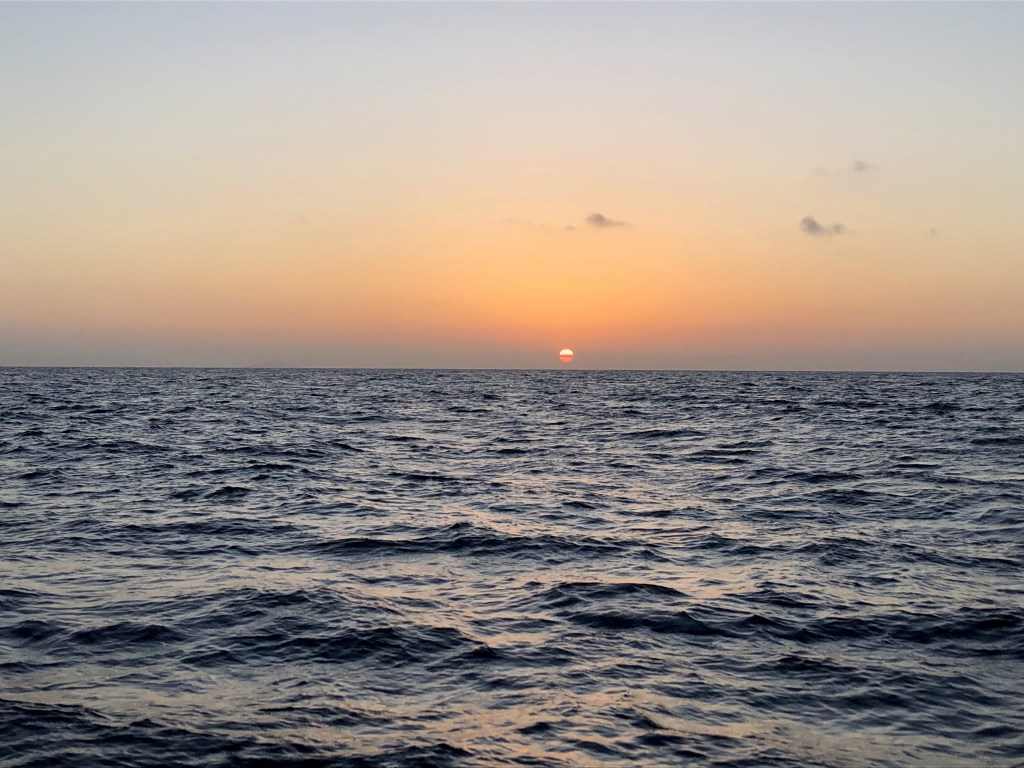
Our alarm went off at 5:00am on the 10th. We had a quick breakfast, then dropped the mooring lines as planned at 6:00am and were off to Antigua. It was a tolerable passage, but not enjoyable. It was rolly and salty (that means we got splashed with sea water). As anticipated, Pulpo caught up with us, then passed us, arriving at Jolly Harbor about an hour ahead of us. The only two enjoyable events on the crossing included the sighting of what we think may have been a sperm whale off in the distance. We could see it tail slapping the water. The other brief event was Dave hooking a marlin, which, unfortunately, he did not land. He got to see it tail walk just before it shook off the lure. Bummer! For the first half of the trip we used the generators, until the sun was high enough that we could switch to just solar and battery. It was fairly cloudy, but the sun peeked out just often enough, and we were making good speed at an average of 6 knots, that we arrived in the anchorage at Jolly Harbor with 35% left on each battery bank. Dave dinghied into Customs to clear us in and met Pulpo there. They had brought their big boat into one of the Customs docks. They followed him back and anchored near us. They came over that evening for tacos and games. 

It is so good to finally have a new place to explore! There are many anchorages all around this island, and we’ll have 5-6 weeks to explore them. Pulpo will be here for another week or so, before they have to start heading back south for hurricane season. Our friend Ian will be joining us at the end of this month. 

The next time I write, it will be about our time here in Antigua. For now, enjoy the short video of our tour through the mangroves.

Until next time, stay safe and take care of each other!

Cheeseburgers in three different countries in seven days

I hope the title got your attention, and perhaps made you chuckle. Normally we eat local dishes when we eat out during our cruising season, but every now and then we crave comfort food, and we’ve needed it over the past seven days. 

If you’ve been following along this year, you know we set out for Guadeloupe from Nevis on January 29th and had to ditch at Montserrat due to generator issues. It had been a rough ride, and two stopped generators didn’t improve our mood. Lunch in Montserrat was cheeseburgers and fries. (We solved the generator issue fairly quickly, but you can read my last post on 2/1 for the details if you missed it.)

It was a bumpy ride to Montserrat on the 29th, and it was an equally bumpy ride to Deshaies, Guadeloupe on the 30th. We thought we might hang out on the west coast of Guadeloupe for about a week and a half. The weather gods had other plans. If we were going to make it to Dominica in time for the Salty Dawgs Rendezvous, we needed to take an early weather window on February 5th. Yes, that’s today. It was going to be another of those “least adverse” windows, which means bumpy and salty. The second cheeseburger and fries lunch was consumed in Basse Terre, Guadeloupe yesterday in anticipation of today’s bumpy ride.

Yup, the crossing from Guadeloupe to Dominica today was bumpy and salty. In fact, it was bumpier and saltier than the prior two. We left Guadeloupe just after first light, about 6:15am. We arrived at Prince Rupert Bay at Portsmouth, Dominica around 11:45am. At least it was a fairly quick (for us) ride, averaging about 5.25 knots. The seas started out about 3-5’, building to 4-6’ and then eventually more like 6-8’. They were anywhere from just off our port bow to on our port beam. There were two notable waves. One washed over the port bow, up the galley window and onto the cabin roof (not all the way to the cockpit), but it did deposit some water on our stovetop. I closed that hatch firmly afterward. The other notable wave washed over the port bow up onto the solar panels on the solar roof, depositing a puddle in our “rain gutter,” which then proceeded, in the wind, to drip all over Dave at the helm for several minutes. There was a lot of splashing sea water, in fact, during the 28nm trip- over the bows, up the port side, splashing up through the teak slats on the rear walkway, and up from the sugar scoops at the stern. Indigo Lady and her crew were quite salted upon arrival. Dave would say we’d been “a-salted.” You can go ahead and groan now. Today’s lunch was the third cheeseburger and fries.

All that said, we are happy to be here in Dominica. We were greeted at the harbor entrance by one of the PAYS guys (Portsmouth Association of Yacht Safety). The association was created by a group of local tour guides to help cruisers enjoy their stay in Dominica and keep them safe. They do a lot. They greet arrivals, provide inexpensive moorings, help with boat issues, provide water taxi rides, do tours, and patrol the mooring field at night for security. Alexis was the one who met us at the harbor entrance, and his cousin, Kelvin, showed us to a mooring. We got to customs before they closed for lunch and then found immigration easily. We paid our mooring fee at the PAYS office and then enjoyed those cheeseburgers and fries right behind the office. One more quick trip into town got us a Digicel SIM card, so now we have data. We relaxed in our hammocks when we got back to Lady. We will start to listen to the Bruins game tonight, but we might not make it through the whole game. 

Tomorrow we don’t have to get up at any particular time. We don’t have to check the sea conditions. We don’t have to go ashore. We’ll probably rinse Lady with fresh water if tonight’s rain doesn’t take care of that. We’ll dub around with boat chores and spend time resting up. We are here for about three weeks. Happy sigh of relief.

At some point, I’ll catch you up on what we actually did while in Nevis and Guadeloupe. Until then, stay safe and take care of each other!

Well, that didn’t go as planned.

We are safe and happy in Guadeloupe. Our trip here did not go as planned, however. 

We departed Nevis at midnight on Wednesday, 1/29, as planned. Conditions were rolly, as predicted, and we had to hold onto things to move about the boat, but it wasn’t uncomfortable. We wouldn’t normally choose these conditions, but since we decided to attend a scheduled rendezvous, it had to be. I guess I’m getting a little saltier with experience.

Being dark at midnight, we started the trip with both generators running. Starboard had been struggling to start up, but Dave did get both going that morning and we set off. Somewhere around 5:00 AM, both generators shut off. Fortunately, Dave was able to restart the port generator right away. As he worked on trying to restart the starboard generator, we let the starboard motor run on battery. When that got down to 35%, Dave turned off that battery bank, turned on the cross ship cable, and let the port generator run both motors. This was not a new situation for us. We spent an entire year with the starboard generator not working and had to use this approach. All was well.

Just around sunrise, we accidentally shut off the port generator (stupid buttons are too close!). Only this time, the generator display/control panel went blank. So Dave hooked up the computer to the generator controller in the port engine room to restart the generator that way. No dice. Okay, now my anxiety level is through the roof. One battery bank is at 35%, the other at 100% and we’re only halfway to Guadeloupe. If we don’t have at least one working generator, we are not going to make it. (Those of you who have been following me from the start of our journey, know this is my worst nightmare. If you don’t know the story, you can read it here. Dave tried for a good 15-20 minutes to restart port to no avail. The only reason this event wasn’t quite as scary for me as 2019, is because we were only 8-9 nm from the anchorage on Montserrat. We turned to head for that anchorage. That put the seas behind us, giving us a good push (6 knots speed instead of 4.5 knots), and the sun was getting higher (happens pretty quickly down here), so we knew we’d make it with battery power to spare. We did. Phew! My stress level dropped significantly.

Dave was pretty sure what the problem was. I told you in my January 15th post that we had to change out the 12V batteries that start our generators, run our anchor windlass, hoist our dinghy, and a couple other things. The only 12V batteries we could find on St. Kitt’s were car batteries. They just didn’t have enough juice. We needed something more robust. We got lucky at Montserrat. It only took 2 phone calls for Dave to find a place ashore that had 12V truck starting batteries with the cranking capacity to start our generators. Sweet! 

I did our preclearance online (can’t go ashore until you clear in with Customs & Immigration, and in this case, pay a port fee). Dave went to lower dinghy – winch wouldn’t run. Not a peep. Are you kidding me?! It took Dave about 5 minutes to find a blown fuse in the port engine room, where the dinghy winch is also wired. Turns out that same fuse also prevented the helm station generator display/control AND the computer from communicating with the port generator. That’s why we couldn’t restart it. (It had been starting okay, even with the weak 12V batteries). Fortunately, Dave had spares of that fuse onboard. 

By the time we finally got ashore and cleared in, it was time for lunch, so we grabbed that first. Then we set off for the car park where we’d seen some taxis. En route, a gentleman asked us how our day was and where we were heading. When we mentioned a taxi, he said we could borrow his car. We asked how much. He shrugged and said, whatever you want to give me will be fine. Wow! He handed us his keys and we set off for the auto parts store. It was closed for lunch, but it was the end of the lunch hour, so we waited. The owner came by and saw us and let us in, apologizing for our having to wait. We found the batteries, and the nice owner helped us order them via his website (the live location is really a wholesale/online place) and pay for it with Paypal because we didn’t have any local currency with us, and he couldn’t take US money and he wasn’t set up to take credit cards because the local bank is difficult about that. He was very patient, helpful and kind. By the time we were done with that purchase, we popped one door down to the retail side of his business where the salesman was back from lunch where we purchased the post connectors Dave also needed. The salesman told us he noticed we’d borrowed Moose’s car (so that’s his name! Why didn’t we think to ask?!), and told us he is a very kind man. Yes he is.

Back we went to the dinghy dock to unload the batteries and me to stay with them while Dave returned the car to Moose. He thanked Moose profusely and paid him only slightly less than a taxi would have cost us for the trip. Once we were back on Lady it took Dave about 30 minutes to connect the two new batteries up to the two old batteries. Both generators purred to life immediately. Thanks goodness!

I want to note now that we had been considering stopping at Montserrat if it worked out, but it wasn’t a top priority for us. After our emergency stop of less than 24 hours, we’ve decided that we will definitely come back, if not later this season, then at the start of next season. The people are wonderfully friendly and the island is gorgeous! We look forward to being able to spend more time for a proper visit.

Before we’d gone ashore, I’d emailed Chris Parker, the weather routing guy we use sometimes, telling him about our trip interruption and asking for a forecast/route suggestions for Thursday, 1/30. Conditions were going to be similar, but possibly deteriorating late afternoon/early evening. He suggested we leave as early as possible to arrive by mid-afternoon at the latest. Since we’d been up since midnight and stressed/busy most of that time, we were in bed by 7:30pm. We slept well, knowing our generators would work properly and that we hadn’t entirely missed the weather window to get to Guadeloupe before conditions became inclement for at least a week.

We were underway by about 6:15 am on 1/30 and were moored at Deshaies, Guadeloupe by about 3:15 pm. It was a bit saltier than the day before, but that was mostly between the south end of Montserrat and the halfway point to Guadeloupe, otherwise it was about the same as the prior day’s trip. We opted for a mooring ball instead of anchoring, partly as a treat, because they’re easier than anchoring, and partly because we still don’t have depth data, which makes it more challenging to decide how much scope to put out when anchoring. We had a good night’s sleep.

We’ll be here in Guadeloupe for a little over a week, exploring the west coast between here in Deshaies and Basse-Terre to the south. We’ll look for a window between February 8-12 to make the 5-6 hour cruise over to Dominica from the Basse-Terre area. 

So there’s our two-day Nevis to Guadeloupe saga. Maybe next time I’ll actually get to catch you up on our two weeks in Nevis and the start of our time here in Guadeloupe.

Until then, stay safe and take care of each other!

We interrupt the planned post to tell you this…

Well, I was in the middle of writing a post to update you about our past two weeks here in St. Kitt’s & Nevis, but I got interrupted by a potential weather window, which turned into a real (albeit not ideal) window we’re taking to go to Guadeloupe. 

So…we’re leaving at midnight for what will hopefully be not a horrible passage that will hopefully land us in Guadeloupe before sunset Wednesday. I’ll post sometime later this week to let you know how the passage went, and to fill you in on our past couple of weeks.

🙏 🤞🛥

Bye Bye BVI, Hello St. Martin

Happy Mother’s Day to all you mom’s out there!

Sorry for the 2 week delay in posting. The day of my last post was also the day our friend Ian arrived, so I haven’t been in the mood to write blog posts. 

We had a lovely time with Ian. We spent a lot of our BVI time relaxing onboard and did a little diving and snorkeling as well, plus had several meals ashore (most, courtesy of Ian). The weather (both atmospheric and sea) wasn’t cooperative for good diving or snorkeling, but we got some in anyway. The dive-able days followed days of wind or rain, which stirs up the water and decreases visibility. Still, we all love dubbing around in the water whenever we can. We ended up back in Benures Bay on Norman Island a couple of times. One time we launched hookah and dove the eastern point of the bay, something Dave & I had not done on our prior stops there. There was a lot of turtle grass strewn with boulders that had some healthy coral and sponges growing on them, and plenty of fish. It’s fun to look for little fish among the grass and in the boulder crevices. As a bonus, that side of the bay had good visibility. Always nice to be in the water.

We were eyeing a weather window for the weekend of May 4th to cross to St. Martin. Ian assisted us in our preparations by helping us clean our hulls. It sure goes faster with three people and the hookah. Earlier in the week I had posted in the USVI and BVI Cruisers Facebook groups, asking if anyone was heading to St. Martin on the same weather window. Wild Rose responded; they’d been thinking of making the same type of post. Indigo Lady worked her way over to Spanish Town on Virgin Gorda and cleared out of the country just before lunch Saturday. Then we moved up to Gorda Sound on the northeast end of Virgin Gorda and laid a track out through the reef, which we were going to have to navigate at night, before backtracking and anchoring next to Wild Rose on the west side of Prickly Pear. They dinghied over to meet us in the afternoon and we planned our departure time and radio check-ins. Then we each set about our night crossing preparations and napping. 

Indigo Lady and Wild Rose hauled anchor around 12:00 AM Sunday. Wild Rose opted to go around the north side of Virgin Gorda while we passed through the reef following the track line we’d laid earlier. In hindsight, we wouldn’t go out through the reef again at night. It is a very well buoyed channel, and the buoys are lit, but they also flash at different times. It was distracting. We successfully got through the reef and out to the open ocean just as Wild Rose was coming around the corner. They hailed us shortly thereafter to let us know that there were fish pots around and they had narrowly missed one. Yikes! We kept as watchful an eye as one can in the dark. I’ll spare you the suspense; we each had a close call, but neither of us snagged a fish pot. Phew! 

The crossing was quite rolly/bumpy, but there wasn’t a lot of slamming, for which I was thankful. Other than fish pots and rolling, which smoothed out a bit as we neared St. Martin, it was an uneventful crossing. I enjoyed starting out at midnight knowing we were cruising into daylight, and it was comforting having another boat with us. We were anchored in Marigot Bay (French side of St. Martin) around 3:30 PM Sunday afternoon, 15.5 hours from anchor up to anchor down. Wild Rose was anchored shortly after us. We’d arrived too late to clear into the country that day, so we ran up our yellow Q-flag, tidied up the boat and rested. Monday morning we met up with Wild Rose to clear into the country, then we went to a fabulous breakfast spot they’d found on the Dutch side last time they were here- Zee Best. It was delicious! We chatted for quite a while, taking the chance to get to know each other a little better. Eventually we each headed off to tend to our own things. Hopefully we’ll hook up with them again before they continue their trek south to Grenada for hurricane season.

Shortly after our arrival in St. Martin, we had another “small world” experience. I received a text from our friends Roxanne and Craig on Seas the Moment. It was a picture of Lady at anchor in Marigot Bay. They are here, too! We met them in Bimini, Bahamas in 2021 and have run into them each cruising season since. We arranged to have dinner together at a restaurant in Marigot. Joining us would be Tom on Imiloa. We met Tom in Charlotte Amalie in January. Turns out Roxanne and Craig know Tom because he was the broker who helped them buy their first catamaran years ago, which was a Voyage 440 just like Indigo Lady. Tom, himself, had also owned a Voyage 440 in the past. We enjoyed a lovely dinner and a lot of conversation. Again, we will hopefully hook up again before they each head off to their hurricane season locations.

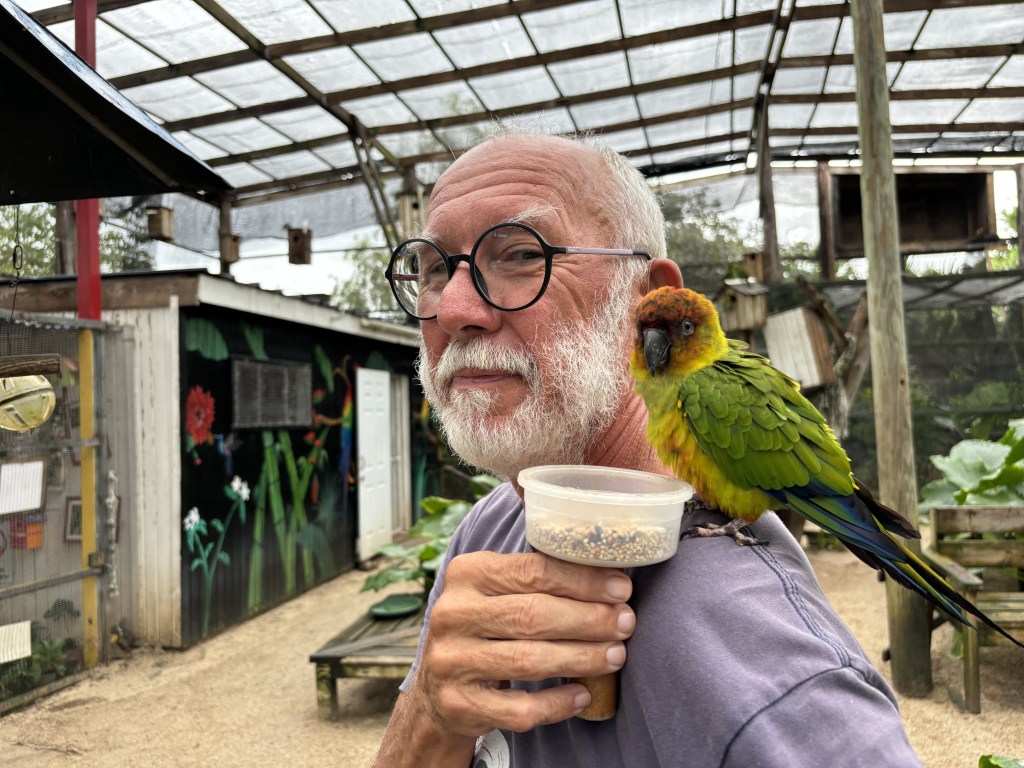
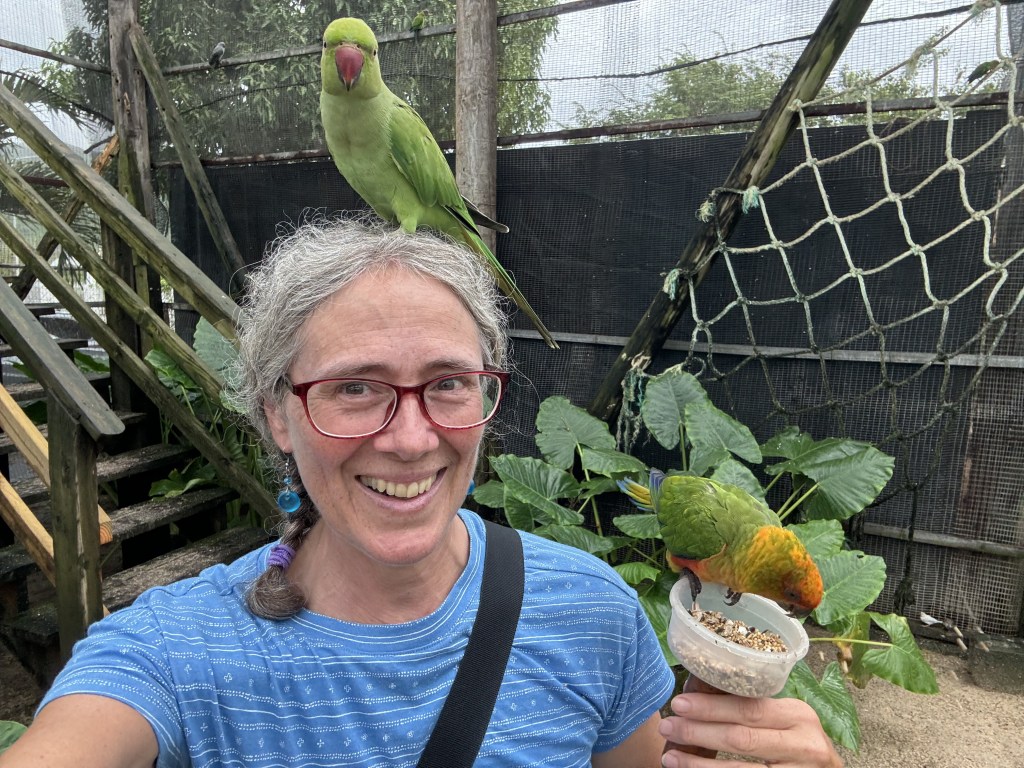
One day, we rented a car so Dave, Ian and I could drive around the island, which doesn’t take very long. It was a very rainy day, so touring by car was better than sitting on the boat playing ‘hatchlisthenics’ (jumping up to repeatedly close, and later reopen, the hatches). It was a lovely drive until we hit traffic in Philipsburg, the capital of Dutch St. Maarten, and in Simpson Bay (cruise ship port. It was crazy! We managed to find a fabulous lunch spot slightly off the beaten path with a parking spot to boot. Score! The circumnavigation of the island took us less time than we’d anticipated, so we had time to kill. We visited the Parotte Ville Bird Sanctuary where we fed the birds as they landed on our arms and heads. It was worth the $10/person. After a failed attempt to have drinks at a local brewery (closed!) we ended up at the Dinghy Dock Sailors Bar, then poked around in Budget Marine where we finally found security chain for dinghy at a reasonable price. (Dinghies are frequently stolen in the Caribbean, so we lock her to the docks we park her on during the day and hoist her into her lift each night back at Lady. We wanted to replace our thin cable and lock with a more substantial chain.) After our wonderful dinner that night with Roxanne, Craig, and Tom, we unloaded our purchases at the dinghy dock where Dave had to bail out shin-deep water. Told you it rained a lot. Thankfully, Ian found a 5 gallon bucket nearby, which expedited the task. We parked the rental and returned to Lady.

After we returned the rental car the next morning, we hauled anchor and headed up to Creole Rock for a snorkel. The leeward side (away from wind & seas) was uninspiring, and it was too rough on the windward side to swim around to that side. Alas! We crossed the channel to anchor in Grand Case Bay where we had a less than satisfactory BBQ dinner. Well, my chicken was fine, but the boys’ pork chops & ribs were tough and not very flavorful. The rice and beans were dry. Sometimes things just don’t pan out the way one hopes. We did spend a quiet, calm night in the lovely anchorage, though. After breakfast on Friday we hauled anchor and popped down to Friars Bay for a snorkel. Again, not scenic, but there were lots of boulders and canyons between them to poke around in and we had a lovely, long swim. From there we passed Marigot Bay to check out Baie Rouge (Red Bay) seeking ‘The Arch’ and ‘David’s (aka Devil’s) Hole.’ Red Bay would make a lovely day anchorage, but there was too much surge this day to safely snorkel The Arch and Devil’s Hole. Dave and I will try to come back another time before we leave. We turned Lady around and headed back to anchor in Marigot Bay. We had a lovely final dinner ashore at a restaurant on the French side of the Lagoon, again, courtesy of Ian. (Thanks for all the meals ashore, Ian!) Ian enjoyed St. Martin enough that he’s thinking of taking his wife, Linda, here for a vacation.

Yesterday morning we all went ashore for a light breakfast and then Dave & I walked Ian to the taxi stand and bid him farewell. We then walked around Marigot Market, an open square market with many tent stalls set up. Most sell tourist kitsch made in India or China, but hidden among the kitsch are some real local delights. We purchased, from the artist herself, an African face made of painted coconut fiber on wood. It will look very nice in our living room back home. We continued on to walk through the farmers/fish market, picking up some local produce, and we enjoyed a live performance from a well-known local band called Remo and the Barbwire Band. We returned to Lady for lunch and an afternoon of relaxation.

As I conclude writing this, I’ve just finished the 6th and final load of laundry. Dave has spent the day making water, attaching our new security chain and lock to dinghy, and troubleshooting our leaky holding tank (still no solution, but he thinks he’s getting closer). It’s hot and humid. Thank goodness for the breeze! We will take a dip in the ocean to cool off, then likely retire to our hammocks for the rest of the afternoon.

I’m not sure if my next post will backtrack to some stuff we did in the USVI that I haven’t written about yet, or if I’ll continue writing about our time here in St. Martin. It will depend on my mood this week. Until then, stay safe and take care of each other!

St. Kitt’s to USVI- following seas & dolphins!

We finally got our chance to leave St. Kitt’s, only not for St. Martin, as we’d originally planned. The conditions just weren’t conducive for that NNW course and wasn’t going to be for the foreseeable future, 1-2 more weeks. The conditions were good, however, for going straight to the USVI, so we took it.

It’s been a long time since we’ve made an overnight passage with following seas. I’d forgotten that winds 12-18 gusting to 23 with 4-6’ seas, even on a short period, are fine when they’re on your stern pushing you forward. For the past few years, conditions like that were a no-go because we were most likely going to be heading into them and getting slammed. It took my brain a while to embrace the reality. A phone call with Chris Parker (weather router we use) helped, because he confirmed the weather window and that it would hold more than long enough for us to get to St. Thomas, 141 nm away. We hauled anchor in Basseterre, St. Kitt’s at 5am on Saturday morning, 1/20 and arrived at the mouth of St. Thomas Harbor, USVI about 7am Sunday morning.

The passage was blissfully uneventful. Well, there were no bad events. There was one really wonderful event- a visit from a very large pod of dolphins just before sunset. There had to be at least 3 dozen of them playing in our bow waves, riding the surges that funneled between our bows from the stern, and jumping in the waves all around us. It was amazing! They stayed with us for about 15 minutes before the final stragglers peeled off. It was partly cloudy, but there was a brilliant half-moon and we could see a fair amount of stars. The light reflected off the clouds, lighting our horizon such that it was never pitch dark. I personally do not enjoy pitch dark night crossings, so I was quite happy being able to actually see all around us.

We were making 6 knots with our motors set at only about 4kW each. A fish hit one of Dave’s lines, so we had to slow down to reel it in. He cut back the power on the motors, but we were still moving too fast. We had to actually stop both motors to reel in the fish and we were still making 2 kts. That’s some push we were getting! We would repeat this one more time before Dave gave up on fishing, because both times it was just barracuda. When I came up for the 12-3am watch, I cut our speed down to 4.5 kts because we were going to arrive in the dark, which is not good for anchoring. Dave cut our speed even further when he came on at 3am, and by the time we were about 2-3 nm out from the harbor, the motors were set at about 1kW each because the sun still hadn’t risen. 

The sun rose just before 7am, but a cruise ship was also arriving. The pilot boat waved us off from the harbor entrance. We could have entered and anchored before the cruise ship got there, but whatever. Instead of waiting out the cruise ship, we altered course to the western entrance to the harbor and went in that way. We were anchored in 15’ of water just east of the Coast Guard dock by 8am. I ran up our Q-flag and submitted our entry via the CBP Roam app. Then I started tidying up the boat from all our passage gear and snacks while Dave tried to catch a nap. I awaited the call from Customs. The call never came, but an email did, about an hour after I submitted our entry (it was Sunday, after all). Welcome to the USVI; enjoy your stay! We were officially cleared in, so I replaced the Q-flag with the USVI courtesy flag and had breakfast. We just relaxed the rest of Sunday and slept pretty hard that night. 

As I write this on 1/24, we are still anchored in the same place. We’ve done some planning and reconnaissance for collecting our new lithium batteries and doing a big provisioning run. Hopefully tomorrow we will start acting on all that. Hopefully early next week our new batteries will be successfully installed and we can give them a good test run by heading to another anchorage. Please keep your fingers crossed for us.

Until next time, stay safe and take care of each other!

Luperón to Puerto Rico

We interrupt the chronology of our trip to notify you that we made it to Puerto Rico. Sound the horns! Ring the bells! Huzzah! 

Here’s the story…

In case you missed it, we arrived in Luperón on March 13th. We were there for 25 days waiting for a weather window to continue east. The first potential weather window presented itself for March 27th, but we didn’t take it for various reasons I may describe at another time; it turned out to be a good decision. We had our eyes on a potential second window for the following week, but it didn’t pan out. Our chance finally arrived Easter weekend and it was going to be a good one. We would get our despacho (departure papers) on Saturday and head out either that night or the wee hours of Sunday morning to start our direct shot to Puerto Rico. Silly us! 

Easter is a BIG deal in the DR. We didn’t understand how big until we learned Thursday morning that Customs & Ports was closing at noon that day and wouldn’t reopen until Monday morning. In the DR, one checks out with Customs & Ports first, then goes to the Armada for the official despacho. With Customs & Ports closing Thursday, there would be no despachos until Monday morning. The other thing you need to know about DR despachos is that the day you get it is the day you leave port. Yikes! The conditions would not be good to depart until late Saturday night, and there was no guarantee that the weather window would hold long enough if we waited until Monday. What to do? 

Several boats were in the same situation, so we created a WhatsApp group to discuss strategy. Four of us (Indigo Lady, Wild Horses, Caretta, and Bitty Rose) decided to get our despachos Thursday, leave the harbor anchorage and stage in the little Pinzon anchorage just outside the official harbor and hope the Armada ignored us for the holiday weekend. 

The Armarda did not ignore us. 

At 2pm on Friday, I got a call from a representative of the Armada. They wanted to know why the four of us were still there, and threatened to take our despachos if we didn’t leave right away. I begged a little time to confer with our buddy boats and said I’d call back to let them know of our decisions. After some texting amongst the group members, and a call to Chris Parker (the human weather router we use), we all decided to leave, but really wanted to wait until midnight once the seas and winds had settled. I called the Armada representative and explained that midnight was the safest time to leave and if we were forced to leave earlier, the Armada may have to come rescue a boat or two (perhaps a slight exaggeration). Irritated, he finally told me that if anyone was there in the morning he was taking our despachos, and he hung up. 

So…at 12am Saturday morning we all hauled anchor and had a very decent passage to Río San Juan, 52 nm east of Luperon. We dropped anchor for the day, when the winds & seas pick up, and rested until 12am Sunday morning when we all hauled anchor again and headed for Escondido another 55 nm east. It was a good passage and we brought up the rear, anchoring around 10am or so. We passed a quiet Easter Sunday in the shadow of some mighty fine mountains, with a little village barely visible just beyond a beach. Our next stop would be Puerto Rico. Bitty Rose left just after 5pm Easter night while the rest of us waited until 4am Monday morning. It was a quiet, calm cruise of about 15-20 nm around Cabo (Cape) Cabron and Cabo Samaná. As we were passing the mouth of Bahía Samaná (Samana Bay), Dave & I took a different route than the others, so at this point our stories diverge for about 24 hours.

Our friends on Wild Horses and Caretta went north of what’s called the Hourglass Shoals. Dave and I opted to continue down along the DR east coast to near Punta Cana (Cana Point) before turning into the Mona Passage south of Hourglass Shoals. The first 7 hours from Escondido around the capes and across the mouth of Samaná Bay were wonderfully calm. Then, around 11am, the wind and seas started picking up a bit. Then they started picking up a lot. It was a very bumpy, wet ride for the next 3-4 hours as we hobby-horsed and took water over both bows. Good thing Dave installed and deployed the wind/rain shield or he would have been soaked! We slowed to 3 kts and started talking about bailing out at Punta Macao to wait until the seas subsided. The wind and seas started calming a bit, but we were still only making 3 kts. Hmmm… We’ve been in worse seas making better time, so Dave suspected that something wrapped one or both of our propellers. Now we had two reasons to stop at Punta Macao. We’d lost radio contact with our buddy boats not long after we learned they were experiencing the same bumpy conditions (too far away), but we picked up another sailboat that hailed us. We both decided to stop at Punta Macao and did, in fact, meet there. 

I started to get a little nervous because our despacho was for Samaná; it was not an international despacho to clear out of the country. We had read that most folks who stop in Punta Macao get a visit from the Armada, who would want to see our despacho and would ask why we had not stopped in Samaná. Why didn’t we get an international despacho? From what we had read, most boats that set out from Luperón end up stopping in Samaná anyway because the weather window doesn’t hold. If we had officially cleared out of the country with an international despacho, and then had to stop in Samaná, we would have had to pay to check back into DR. We wanted to avoid that, so we took a gamble. Turns out I worried needlessly. 

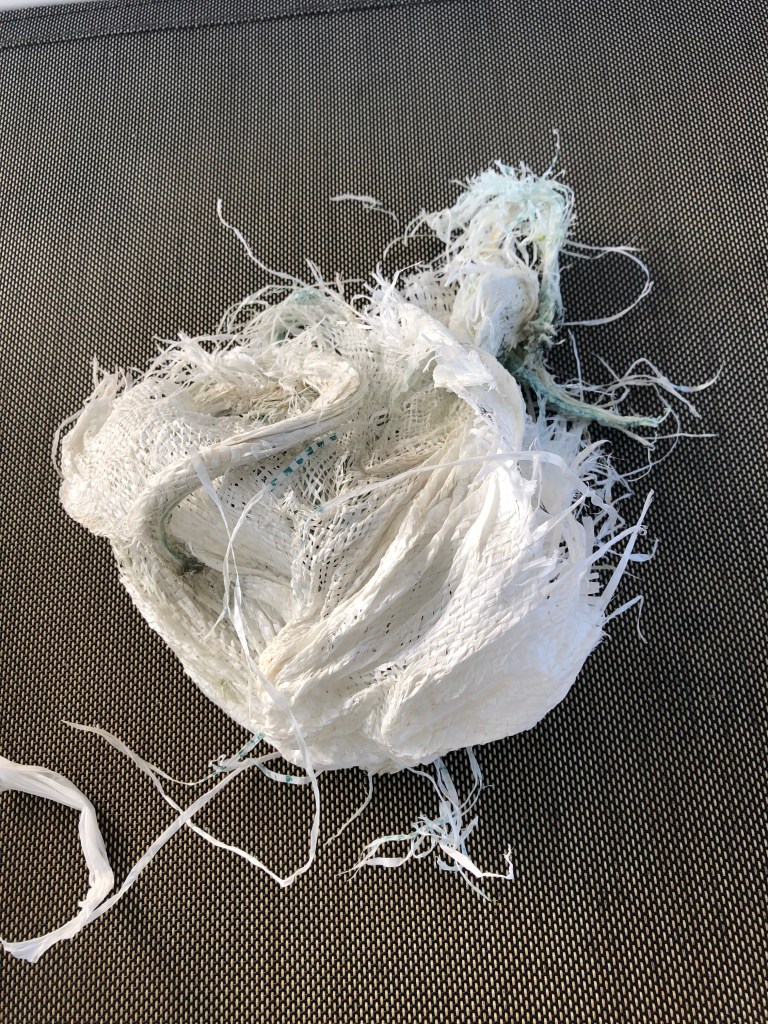
We set anchor at Punta Macao around 5:30pm and immediately started pulling out snorkel gear and tools for Dave to check our props. We had something wrapped around the shaft of our port prop, but starboard was clear. Dave had to launch the hookah so he didn’t have to keep coming up for air while he worked. I sat in the sugar scoop and handed him tools and took what he handed me. He removed the prop and was then able to remove the wrapped stuff quickly and reassemble the prop. Turns out it was not a fish net, as we had anticipated, but was one of those synthetic burlap type bags. While he cleaned gear, I warmed our dinner. We ate quickly and then hauled anchor, along with our new buddy boat. Maybe the Armada saw that we were making a repair and decided to hold off visiting until they knew whether or not we would leave. Maybe they were recovering from the busy holiday weekend and had no intention of visiting us at all. Regardless, they did not visit us and we did not need to defend our travel plans. Phew!

This is what wrapped our prop

The seas had calmed and our passage continued smoothly but for a couple of hours during one of Dave’s wee hour watches when it got a bit bumpy again, but not as bad as the afternoon. It was nice having a buddy boat in sight and in radio communication, especially during the night watches. I saw sunrise over the Mona Passage in calm seas. We learned to stop the boat and clear our propellers of accumulated sargassum seaweed occasionally, by pulsing them in reverse, to keep up our speed. Seas were glassy for a bit, then a bit bumpy about 10 nm out from Puerto Real until we were close enough to be in the lee of the island. We arrived in port around 1:30pm. Wild Horses and Caretta had arrived about 8am, and Bitty rose the day before. Hail, hail, the gang’s all here!

Sunrise over the Mona Passage

Now we are at our second Caribbean island and one step closer to the Caribbean Sea. By the time you read this, we’ll actually be there, because as I type, we are en route to our first anchorage on the south coast of Puerto Rico, the northern border of the Caribbean sea. 

Next week I’ll probably wrap up our stay in Luperón and then after that, pick up with our Puerto Rico adventures. Until then, stay safe and take care of each other!

Turks & Caicos to Dominican Republic

This was our first overnight passage with just Dave & I onboard, which meant standing 3-hour watches with little sleep in between. I needed it to be an easy passage, so we used Chris Parker of the Marine Weather Center to help us find the right weather window and route. It was a straightforward trip, so he suggested we depart late morning on March 12th so we would arrive by noon on the 13th in Luperón, and he gave us a waypoint to head for that would keep us out of the worst of the westward flowing current as long as possible before heading more southerly for Luperón. It was a beautiful, calm passage! 

We hauled anchor at 11:00 AM on the 12th and cruised on solar and battery alone until 4:00 PM. Then we turned on the port generator and cross-ship cable and ran both motors off the one generator the rest of the way. Most of the time our motors were set at 2.8 KW each and we made 4.5-5 knots. We started 3-hour watch rotations at noon, with the off person trying to catch a nap. The moon just started to rise during the last 15 minutes of my 9pm-12am watch. When Dave came up to relieve me, we both went forward to sit in the tramp at the bow for a few minutes to admire the stars. We could even see the Milky Way! During Dave’s 12-3 AM watch we hit the westward flowing Antilles current which slowed our eastward progress a little, so Dave bumped up the power to 4 KW each to maintain our speed at 4.5 kts. On my 3-6 AM watch I had to slow us down again so we would be approaching Luperón Bay after sunrise allowing us to see the fish net floats we’d heard about. During that shift, the half moon and stars were casting enough light that I could see the horizon in all directions. It was during this watch that I also started seeing boats again, both on the AIS  and radar, and visually by their lights. Sometime around 5am, two cruise ships crossed our stern about 1.5 miles off heading to Puerta Plata a little to the east of Luperón. We entered Luperón Bay around 8:00am on the 13th.

Friends who had arrived a week ahead of us had given us some information about the check-in process and mooring balls. I had also been asking questions in a Dominican Republic FB group run by the Seven Seas Cruising Association station host, who happens to be based in Luperón Bay. She and her husband told us to hail them when we arrived, which we did, and they got the ball rolling or the Armada to come out to our boat to start the paperwork, and for the local mooring ball owner, Papo, to escort us to a good spot to anchor until he had an open mooring. It was nice to have all that facilitated for us. The Armada showed up within the hour, with an English-speaking interpreter, and gave us the paper allowing us to be here. We gave them fresh-baked (on the way in) chocolate banana bread and soda. We later went ashore to complete the check-in process by visiting Immigration ($75 for 30 days), Customs & Ports ($30 port fee) and Agriculture ($10 and a promise we had no forbidden produce onboard). We returned to Indigo Lady, took down the Q-flag and ran up the DR flag (which we had to buy from Papo because did not have one- ack!). Papo wouldn’t have a mooring for us until the next day, so we moved to a better anchoring location out of the channel. Our friends on Guajira invited us over for drinks and snacks around 6pm. So we rested for the afternoon and joined them for a couple of hours of low-key conversation and camaraderie. Dave and I returned to Lady for a late, light dinner and bed. We slept like rocks until 8am the next morning!

After three years, we finally made it to our first Caribbean country! Technically, we’re still in North Atlantic waters, because the north border of the Caribbean Sea is the south coasts of Hispaniola and Puerto Rico. (For those geographically challenged, Hispaniola is the island containing Haiti and The Dominican Republic.) We arrived March 13th and we’re still here as I type this today, April 1st (no fooling) waiting for a good weather window to continue east to Puerto Rico. That wait will continue at least until late next week. Our fingers are crossed that that potential weather window actually materializes. This is the longest we’ve been stuck waiting for the right conditions to continue our journey, and perhaps I will write about that another time. As I’ve said before, there are worse places to be stuck, and we are enjoying ourselves with exploring and meeting new people while we wait.

This is enough for one entry. I’m going to continue to write while I’m in the mood, but I’ll parse that out over a couple of posts. Until then, stay safe, and take care of each other!

Why I fear passages

Our bumpy ride to George Town was a minor nuisance compared to the second half of our overnight passage from Rum Cay to Mayaguana Island, and this latter passage isn’t even the worst we’ve had. My fear of passages has a history. So I’m going to use this post to explain. 

My boating experience pre-Dave consisted of day trips in coastal waters with good conditions. I did one 8-day stint on a research vessel when I was in college where we had one day with 15-20 foot seas, but we were on a larger vessel and I was 19 years old, so what did I know or care? The first passage I ever did was in 2009 when we helped Dave’s brother and sister-in-law, Mark and Deb, sail their catamaran from Jamaica to Panama with another couple. I was nervous but there was a lot of experience and expertise on board. As soon as we left the harbor, we had 10-12 foot seas on the port beam, so we were constantly banging and getting splashed, even in the cockpit, which was the least noisy place to sit. Sleeping was impossible because of all the banging. I was not impressed, but nobody else seemed all that concerned, so I grinned and bore it. The final three days of that passage were calm and smooth. 

The second passage I did was in 2014 when we bought Indigo Lady in the BVIs and sailed her home. I was part of the trip from BVI to West Palm Beach, Florida, from where I then flew home to go back to work. We were at sea for nine days, almost always out of sight of land. I was nervous, and I still really knew nothing about cruising. For a while we had 10-12’ following seas. That means they were coming from our stern, as was the wind, giving us a push, which is helpful and comfortable. I know now that those seas would have made for an abysmal ride if we’d been going in the opposite direction trying to get to the BVIs. Also, it was July and therefore early hurricane season, which hadn’t fully registered with me when we planned this. My biggest concern was about what would happen if someone needed medical attention at sea. Well, we had Mark aboard, recently retired doctor, and he brought a satellite phone for emergency communication. I was more concerned that our 160 gallons of water would last five people 9 or more days. It did, with some to spare.

I started learning more about cruising, and gaining real-time cruising experience as we cruised NH and ME waters on Indigo Lady both before and after her conversion to solar electric, all coastal cruising. Knowledge is a good thing, but for a natural worry wart like me, some knowledge resulted in stress, stress about things I hadn’t known to worry about when I was still ignorant. Oh goody. On top of this, we are ‘early implementers’ of solar electric propulsion as the primary means of propulsion; we have diesel generators to run the electric motors when necessary, such as during overnight passages or cloudy days.

Since we started offshore cruising with Indigo Lady in 2019, we’re about 50:50 for comfortable passages when we include day-long (8+ daylight hours) and overnight passages. The one that left a psychological scar that I’m still trying to recover from, was our first multi-day passage that left us stranded 80 nm offshore of Georgia in 2019. 

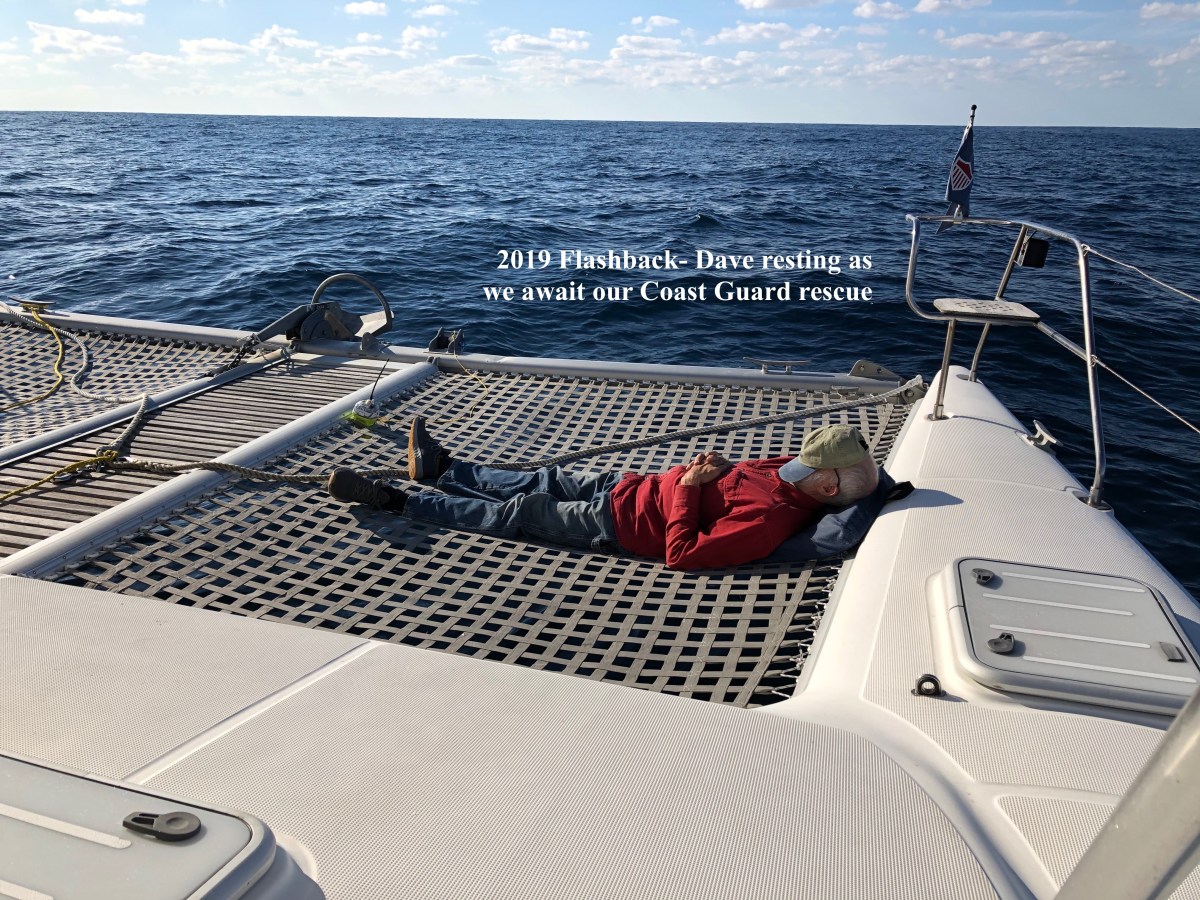
As I’ve come to learn, being ‘early implementers’ of our type of propulsion system means that things won’t work quite the way they should, and our systems certainly did not. We were en route from Beaufort, NC to Vero Beach, FL in November of 2019. The forecast was for improving conditions over the four days we would be at sea, and they were pretty good when we set out on a Monday morning. Until they weren’t. Long story made short: the sea state turned nasty on Tuesday with lots of slamming of waves against our bridge deck, and we were being blown further off our course out to sea; Wednesday the starboard system shut down and we were chugging along with one motor; Thursday morning the port system shut down. We were stranded at sea with no propulsion, fortunately with calm conditions at this point. For those of you unfamiliar with this story, this post gives the complete details. 

Fortunately for my psyche, the day we ended up stranded was gorgeous and calm, and we were able to coordinate rescue quickly. What left the scar was the fact that our systems were not trustworthy at a time when we needed them to be. All I could think of was what could have happened if they had shut down when we were in those big seas. What would have happened to us if we’d lost propulsion when we were pushed into the Gulf Stream, which flows northeast? Ever since then, I associate the banging of rough seas against our hulls with our propulsion systems failing and being stranded 80 nm from shore in need of a Coast Guard rescue. 

The lasting impact of that event is that I worry every time we have to make a long passage. What if the events of November, 2019 repeat themselves? That fear has resulted in many an argument between me and Dave about when we should set out on a passage. It doesn’t help that he has a very high risk tolerance, while I have a very low one; always have had. We look at weather routing apps and see very different things. I tend to see potential disaster. It’s been trying for both of us, but I’m working on getting over the fear, and we’re working together on making passage decisions that work for both of us. 

I didn’t run away screaming after that stranding event. I got back on the boat, and we’ve made more passages since, and I’ve continued to learn. I’ve been following other cruisers’ social media long enough now to have learned that everyone who makes offshore passages gets stuck in unpredicted, nasty conditions, often more frequently than they would like. Only Mother Nature truly knows her own mind, and she changes it frequently. This bit of knowledge, however, has actually been a comfort to me, because I’ve stopped doubting our ability to interpret the forecasts and weather routes we get from the services to which we subscribe. We’ve also made a ton of upgrades to our systems since 2019. The companies have worked with Dave to make changes and upgrades that greatly reduce the likelihood that we would get stranded again. Dave has learned more about the weeds of our systems than he ever imagined he’d need to know, but that has gone a long way to getting those systems to where they are today. We have better safety and communications equipment onboard now, so that I feel more confident about dealing with at at-sea emergency, should one arise. I’ve also found therapy to be useful in helping me work through the fear and in helping me communicate with Dave better about my concerns. There are fewer passage-making arguments now. I’m making progress.

So that is why I fear making passages, and why I hate it when a passage gets rough. Neither our bumpy ride to George Town, nor our subsequent bumpy ride to Mayaguana scratch the surface of our offshore passage in 2019. Still, I hated them because they made me relive that fear. If you’re still up for reading a little more, below is a brief description of our passage to George Town, during which we implemented some strategies that help me stress less about bumpy rides. I don’t want to break the chronology of our trip any more than I have, so I’ll save the description of the Rum to Mayaguana passage for later.

The bumpy ride to George Town

We set out into very calm conditions for George Town. We were in good company, too, because not long after sunrise, we saw more than another dozen boats behind us and heading in the same direction. I guess we all read the forecast the same way and were looking forward to the forecasted conditions. Too bad we were all wrong.  

Within two hours the less than 3-foot seas became 4-5 foot seas (almost double what was predicted), from two directions, and with a shorter period between waves than predicted. It was a noisy, bumpy ride that triggered that old fear again, despite the beautiful, sunny skies and numerous other boats for company. This time, however, we had planned several bail out points in case conditions got too bad or I just couldn’t take it anymore. The last of these was 13 nm from George Town, about 2-3 hours for us. We also knew that if we passed that last bail out and then got uncomfortable, we could turn around, putting the seas behind us, and go back to that anchorage. Another thing I’ve learned about making passages is what is dangerous vs. just uncomfortable. This was just uncomfortable, mostly mentally, so when we were nearing the final bail out point, Dave checked in with me and I said we should just keep going, which we did. The final hour of the trip had us traversing the extensive and protected, and therefore calm, Elizabeth Harbor at George Town where we found ourselves a lovely spot to anchor. Another step forward in dealing with the fear.

That’s my saga about passages, complete with a recent example of putting some techniques in place to quell my fears. This coming weekend I’ll pick up where I left off in the chronology of our trip and tell you about our time at Long Island and Rum Cay. Until then, stay safe and take care of each other!

The Northern Exumas

As promised, my post about our time in the northern Exumas. 

We left Rock Sound Harbor at 6:30 am on May 27th and headed for the northern Exumas where we would stay until June 18th. We enjoyed our explorations of Eleuthera, but it was time to switch gears from town-based anchorages and shore excursions to lesser inhabited islands with more snorkeling and diving. 

We spent the first 12 days in the north anchorage at Highborne Cay. This is a private island with a marina and private rentals. If you’re not a guest of either of those, you are not allowed to be ashore, other than to visit the marina’s store or restaurant. The store we visited twice for a few minor food items. The rest of the time we spent on boats or in the water.

During this first stint at Highborne Cay we did a lot of diving and snorkeling the area corals, either timing them around slack tide to avoid the strong current, or tethering hookah to dingy and drifting along the corals together. We rode out the outer wind fields and rains of Tropical Storm Alex. We did boat chores, read, played games, swung in the hammocks, listened to music, watched movies, did some baking. We met Dustin and Laura on SV Elpis. More kindred spirits. We shared conversation, food, drinks, and Tropical Storm Alex with them before we had to bid them farewell as they started their return to the US. (If you’re reading this, Laura & Dustin, thanks for the company and the flour!)

Eventually we moved 7 nm south to Long Cay to explore the corals there. The first night, a couple of liveaboard diving catamarans showed up but were gone in the morning. Dave noticed that they had not anchored, but had instead picked up moorings. So we used these to tether dingy while we dove- very convenient. There was great coral with a variety of structure and lots of fish, thoroughly enjoyable! One day it rained during slack high tide, so instead we did a low tide drift snorkel with dingy along some small coral heads between Long and Oyster Cays, then we did the same thing almost the entire length of Long Cay. There was no current along Long Cay, so we ended up pulling dingy along with us. It was a fabulous mile-long snorkel with pretty coral and fish.

The Bahamas Land and Sea Facebook group has been invaluable to us over the past three seasons cruising here. So when I learned that the creator and lead administrator of the group, Addison Chan, was also in the northern Exumas, I messaged him to see if we could meet up. He and his wife Pat were in Norman’s Cay, so the following day we traveled the 4.2 nm south to Norman’s Cay. He’s working on a digital cruising guide and spends time each cruising season taking soundings of anchorages and shallow passages for the book. We met up on the west side of Norman’s, but they were heading over to the east side anchorage, so we followed them over. They had sounded it the day before, so we were relieved to know that our charts showing we were in 2 feet of water were not accurate! (The lowest we saw was 5.8’.) They invited us over for sundowners and snacks, so we got to enjoy a couple of hours with them onboard Three Penny Opera (their boat). What a great, welcoming couple! We had a wonderful visit.

The next morning we checked out the coral by dingy and determined conditions weren’t worth snorkeling. We knew we would not stay another night in this busy anchorage, so we headed back to Lady to decide where to go next. On our way, we stopped by our neighbor, SV Mako, to say hello. Corbin and Andrea welcomed us aboard to chat. Turns out their boat was partially disabled during a wicked squall following TS Alex. They had to put out a mayday call and were rescued by a power boat from Norman’s who heard their call. The damage included the loss of one of three blades from their feather prop (which means they can replace just the blade and not the whole propellor). They had already been having trouble with their steering and needed a new chain for that. This rendered them incapable of motoring or sailing well unless conditions were just right. We offered to accompany them back to Highborne Cay, prepared to tow them if they got into trouble, which, fortunately, they did not. Once we saw them safely anchored, we invited them for dinner and had a lovely evening together. They returned the favor the next night, and the day before we left the area, we got to have drinks with them one last time. They are in the process of sorting out getting parts ordered and shipped to Nassau. They will find the right day to sail to Nassau to meet the parts and make their repairs. It’s only about 35 nm to Nassau from Highborne area, across shallows, so in a pinch they could easily drop anchor and call for assistance. It’s a very busy area for boats, so help would arrive quickly. We wish them well!

Back at Highborne we met up again with Sea Dragon! That’s the family we had met and spent some time with in Rock Sound. It was great to catch up with them again! Dean and Cohen came over for a visit a couple of days later (the girls couldn’t make it). We chatted it up for a couple of hours and Dave had Cohen set up a daisy chain of sluggos for hand trolling in the deep water on their way back to the US. He really, really wants to catch a big fish! They set off for Bimini a couple of days later, and we were up to hail them on the radio and wish them a good trip. Hopefully our paths will cross again soon.

We spent our last couple of days in this area anchored on the west side of Allens Cay to check out a couple of reefs that Dave’s friend Ian had given us the lat/long for. These sites have mooring buoys, which always makes it easier to dive. We found the first mooring ball, launched hookah, got in and found an amazing reef full of fish. About 10-15 minutes into the dive, the hookah quit. The bearing in the compressor piston rod seized up, again. Dave had done his best to lubricate it twice before (it’s sealed), but it really needs replacing. No more diving this trip. So we put hookah back in dingy and went up to the north end of Long Rock Cay and did a half mile drift snorkel with dingy. It wasn’t spectacular coral, but we were impressed with the number and variety of fish we saw. There were tons of parrotfish, triggerfish, queen and French angelfish, small grouper, etc. I also practiced my free diving. At least I can get down and stay down for about a minute, but I have a long way to go. It was a great way to spend a couple of hours. We did something similar the next day on the west side of Allens Cay, but it wasn’t nearly as interesting. 

We could no longer dive, we had snorkeled the interesting coral, and the weekend promised to be good cruising conditions. So we decided to head for Nassau (on New Providence) the next day, Saturday the 18th, and on to the Berries Sunday. We had two excellent cruising days. Nassau Harbor was a bit jolting after three weeks in the quiet of the northern Exumas, and we anchored off Junkanoo Beach- party central. Fortunately, the beach party wound down before we went to bed. We had planned to do some reconnaissance in Nassau for provisioning next year, but it was too darned hot with too little breeze, and there was a really big, dark storm cloud looming over the island. So we took a quick dip to cool down, swung in the hammocks and listened to the storm rage on land (never got to us), then dingied to Señor Frogs for dinner. We were off for the Berries at 6:15 the next morning.

So that wraps up our trip, aside of the final week of closing up the boat. Normally I’d include a diving slide show from all the underwater photos I took, but those take a long time to create, so I’ll post that sometime in July. For now, you get a collage of pictures at the top of the post. I’m taking off from blogging the next couple of weeks as we work to close up Lady and transition back to life in New England. Until then, stay safe and take care of each other.