Quest for the Flying Gurnard

I had never even heard the name, flying gurnard, until the last day of our cruising season in June of 2024. Indigo Lady had been anchored in White House Bay at the southeastern end of St. Kitt’s for a couple of weeks. We had spent several of the latter days at anchor deep cleaning and otherwise preparing Lady to be hauled out for hurricane season. Each afternoon, we’d wrap up our hot, sweaty work somewhere around 3-4 pm and go for a snorkel in the anchorage. On our last day at anchor before heading up to the boatyard, we knocked off work as usual and suited up for a snorkel. We’d snorkeled the area a lot and would see the usual sea life suspects, so this time I decided not to take my camera. I joked with Dave that he should thank me, because it meant we’d see cool stuff. The joke was on me, because that one snorkel excursion revealed to us two banded coral shrimp, several constellations of cushion sea stars sporting 4-6 legs, a mass migration of whelk, a golf ball-sized octopus, and the prize of them all, a flying gurnard!

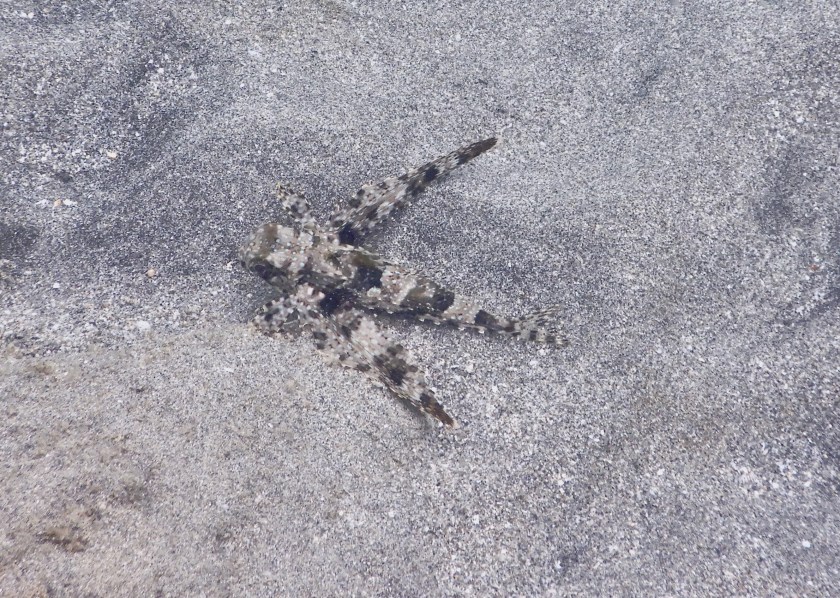
We were snorkeling over a shallow, sandy patch, maybe twelve feet deep. We both saw the creature at the same time and stopped to examine it. It sort of looked like a lizard fish, of which we’ve seen many, but not quite. Its pectoral fins were quite long, almost the full length of its body, and pointed backward. We popped our heads up and wondered aloud at what it might be, then stuck our heads under water again. Then the creature started to crawl! It looked like there were two tiny hook-like claws near where the pectoral fin joined the body. A crawling fish? 

We popped our heads up again and wondered some more. Dave decided to dive down and encourage it to swim, so back down we went. When he flicked near its tail, the fish opened up “wings” (its pectoral fins) that were edged in a beautiful iridescent blue, and it “flew” across the bottom for several feet before settling again. We were determined to burn the image into our brains so we could identify it later back onboard. As soon as we dried off after our return to Lady, we pulled out our identification book and started searching. We found the flying gurnard. With that name, we searched the internet and found various other pictures that looked just like our fish. What a find! Too bad we could only describe it to people and show them other peoples’ pictures online.

Cruising season 2025 started in January. We spent a few days in that same anchorage, but only had time for a couple of snorkels. We did not see a flying gurnard. In early March, we were in the Îles des Saintes in Guadeloupe. While reading the section of our cruising guide about those islands, we read that flying gurnards could be spotted at Îlet a Cabrit. We snorkeled there four or five times over three days, and again in April once or twice. We saw several species we hadn’t encountered before, but no flying gurnard. Bummer! We kept our eyes peeled during every subsequent snorkel and dive, of which there were many, in Guadeloupe and later Antigua, but we never saw a flying gurnard. Until our last snorkel of the season…

We were back in White House Bay, St. Kitt’s by late May for an early haul out this year. It was a much shorter stay this time, so our close-up tasks were condensed to only three days. We were too exhausted at the ends of the first two days and did not snorkel, but we vowed to snorkel on our last day before moving up to the boat yard for haul out. Into the water we went on that last day, and this time I took my camera. We stopped at every patch of sand we crossed over, searching for the elusive flying gurnard. At last, it happened. We both saw the fish at the same time- lizardfish looking but with pectoral fins too long. We popped up our heads at the same time and planned for Dave to flick its tail and for me to have my camera ready with recording already started. So that’s what we did, and we got video! The fish just scooted away a bit from Dave’s first attempt, without opening its wings, but eventually, Dave coaxed it to display all its glory and I captured it on film. Quest complete! 

So here are a couple of pictures and a video I took of the flying gurnard for you to enjoy. If you’d like to learn more about this fish and its unusual fins, go here.
Barbuda, on the other hand…

Barbuda is better. Much better!

We didn’t do much in Antigua after my last post on 4/26, other than prepare for the arrival of our friend, Ian. We moved back to Jolly Harbor, did a little provisioning and some boat chores. Ian arrived Sunday afternoon and we just talked the rest of the day, through dinner and until bed. The morning of the 29th we popped ashore so I could use some WiFi and see a doctor to make sure there was nothing wrong with my right ear, which had been off and on extremely itchy deep in the eustachian tube. Other than a little irritation, all was clear. Good. That afternoon we moved up to Dickenson Bay at the NW part of the island to stage for our jump to Barbuda the following morning. 

We hauled anchor around 8:00am the morning of 4/29 and had a comfortable 6-hour cruise up to Barbuda. Thus far, it’s been the most comfortable crossing we’ve had this season. We were anchored up near Codrington Lagoon by 2:00pm. 

Barbuda, with a population around 1600-2000, lies about 30 miles north of Antigua. Together with Antigua, they gained their independence from Great Britain in 1981. Barbudans didn’t necessarily want to be part and parcel of a single nation-state with Antigua, and their relationship is fraught, to say the least, especially since Hurricane Irma, but that’s a story I don’t know much about. The 62 square mile island’s length is oriented NW to SE. It is composed largely of limestone and volcanic rocks from a long-extinct volcanic arc. The highest point of land on the east side tops out at about 125 feet above sea level. The west side of the island is characterized by Codrington Lagoon, a saltwater lagoon about 6 miles long and about 1½ miles wide at its widest point. 

For most of its existence, the lagoon’s connection to the open ocean has been an inlet through the mangroves on the northwest corner of the island. It is otherwise separated from the open ocean by a long, narrow, sand spit. Codrington Lagoon is ecologically important for several reasons. First, it serves as the nesting grounds for the largest Magnificent Frigatebird colony in the world. It is also home to several other bird species, the rare Antiguan racer snake, and the smooth-headed iguana. It is a nursery for lobster, conch and fish that are important to the Barbudan economy. For example, they export lobster throughout the world. The lagoon and its sand spit also protect the island’s main settlement of Codrington from impacts of storm surge and hurricanes. In the past, two hurricanes (one the 1960s and the other in the 1990s, I believe) have breached this sand spit, but it repaired itself within two years or so. Hurricane Irma in 2107 breached this divider again, only instead of repairing itself over the past several years, the breach has become wider, reaching almost 2 miles! If this breach doesn’t repair itself, it will have lasting impacts on the island and its inhabitants, both human and non-human. (Cited from Smith Warner International.)

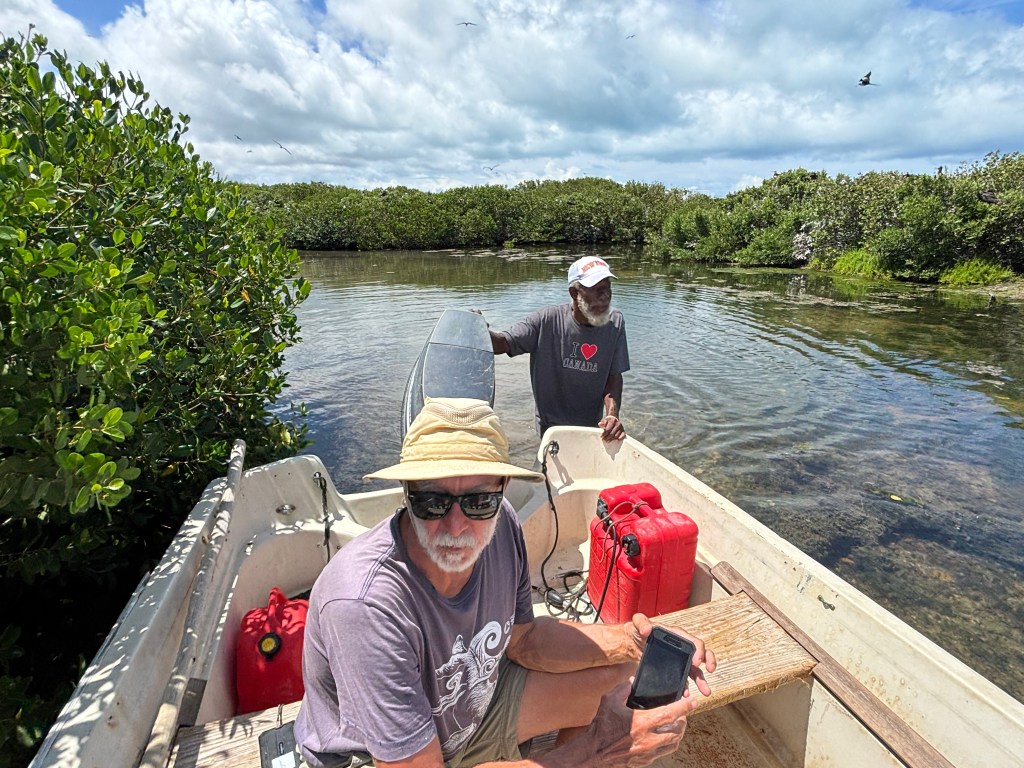
The morning after we arrived at Barbuda, we set out in dinghy at 8:30am to meet our guide for the Frigate Bird Sanctuary, a tour we had arranged before our arrival.  We met George Jeffrey at the Codrington fishing dock, and the three of us, plus two other cruisers set off with George to see the birds. The first stop he made was well outside of the sanctuary where George told us a bit about the sand spit breaches I mentioned before, plus a little about the current troubles between Barbuda and Antigua. Then he took us to a small sandbar where he stopped again. That sandbar, devoid of all but a handful of tiny new growth mangroves, is the former site of the sanctuary. In 1960 (maybe 1961?) a hurricane hit Barbuda. Before its arrival, the Frigatebirds flew off to evade the storm. Upon their return, they found their mangroves gone, so they just flocked to another section of mangroves a little further north, and they’ve been there ever since. Then it was time to meet the birds.

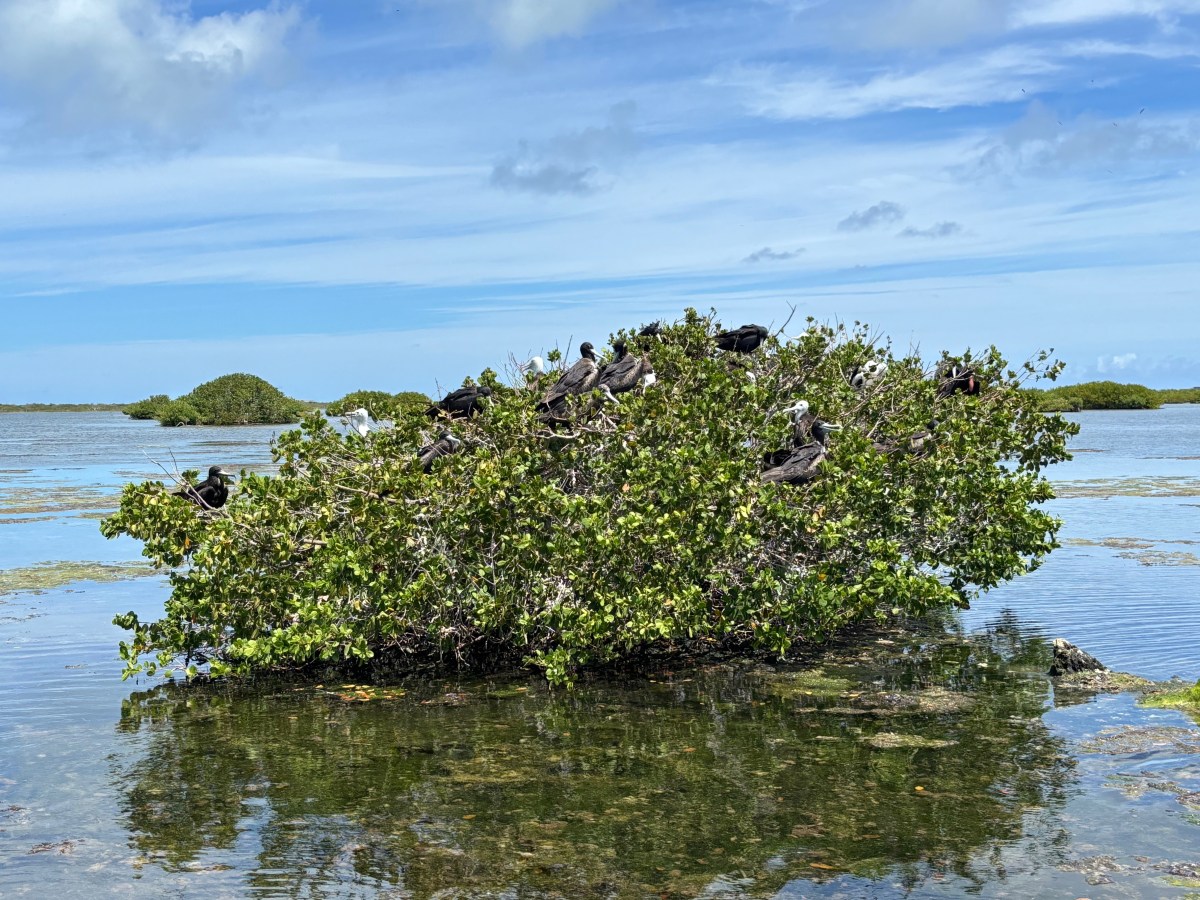
What an amazing sight! In a stretch of mangroves approximately ¼ x ¾ of a mile, are thousands upon thousands of birds (I’ve seen estimates ranging from 12,000-20,000). The mangroves were heavily laden with (mostly female) adults and chicks of various ages. They were squawking, but it wasn’t as loud as I’d expected. George got out of the boat and slowly maneuvered us through the shallow waters, through upsidedown jellyfish-infested waters (they don’t sting) around the mangroves so we could observe them closely. We spent about a half hour just watching the birds. They are the national bird of Antigua & Barbuda and are on the Barbudan flag. George told us a bit about them, and I looked up more information later, all of which I share below (and include the links I used so you can read more if you like). There are pictures at the end of this post.

Frigatebirds are agile aerialists, that can fly for days on end, but they don’t go into the water. Their feathers, in fact, are not waterproof; they would be unable to lift themselves back out of the water. They feed on small fish (locally, flying fish are a favorite) which they scoop from the water’s surface, or steal from other birds. Adults are about 3½ feet long (beak to tail) with a wingspan of about 7½ feet. They have a deeply forked tail. All adults have black feathers, but the females’ chests are white while the males sport a bright red throat pouch. That throat pouch is how they woo females during mating season, which generally runs from September-April (peaking in December), which explains why we saw chicks of varying ages. Once a female has chosen her mate, the two build a nest where the female deposits a single egg. Both parents share the work of incubating the egg, which lasts about 50 days, and then feeding the chick. The males take off after about three months. The chicks fledge at about five months. The female continues to feed the chick for another four months or so. The chicks are fuzzy white and grow into their black feathers over time, with their heads changing color last. We saw newer chicks of fluffy white with only a few small black feathers forming on their wings, and we also saw older chicks just waiting for their heads to go black. (Audubon)(Lonely Planet)(Wikipedia)

Codrington Lagoon, where this colony resides, became a National Park in 2004. One can only enter the sanctuary with a local guide. The National Park only charges $5 per person to enter the sanctuary. Our tour with George cost $60 for all five of us together, so $12 per person. If you’re ever in Barbuda, I highly recommend taking this tour. If you can’t get George, there are several other guides as well.

The day after our Frigatebird tour, May 1st, we hauled anchor late morning and moved Lady to a reef anchorage on the south side of Barbuda, settling in Gravenor Bay. We spent two nights there, and this morning we moved about a mile closer to Spanish point at the southeast end of the island. There is a lot of shallow patch reefs to explore in this area, and we’ve explored many of them over the past 3 days. These are not very healthy reefs, but they’re better than what we’ve seen in Antigua. They are certainly heavily storm damaged, as evidenced by the coral rubble, and they also suffer from what ails all the reefs we’ve snorkeled and dived on in the Caribbean- bleaching, disease, and overuse (by incautious tourists). Unlike our experiences in Antigua, however, there is more sign of recovery here. We did not see any sponges, but there were many corals. A large number of them were sea rods, but there was quite a variety of other corals as well, just in smaller numbers. There were the usual fish suspects, and we saw several southern stingrays and sea turtles, and Dave saw an eagle ray. It was nice to finally have some snorkeling worth doing, and it was encouraging to see the regrowth.

Either tomorrow or Monday we will head back to Antigua to do some snorkeling on the north side reefs. Then we may move south to Falmouth Harbor to do some snorkeling there and explore the island’s interior by car before Ian returns home. 

Until next time, stay safe and take care of each other!

Octopus sighting!

I’d rather be in my hammock reading than blogging. So today I’m going to give you some eye candy.

In early March, we saw a football-sized common octopus at Îlet à Cabrit, Les Saintes, Guadeloupe. I managed to catch a video of him swimming, crawling and then hiding.

Enjoy the show!

Until next time, stay safe and take care of each other.

Swimming with a wild dolphin

A couple of posts back I promised to tell you more about Dave and I swimming with a wild dolphin. I’m finally making good on that promise. 

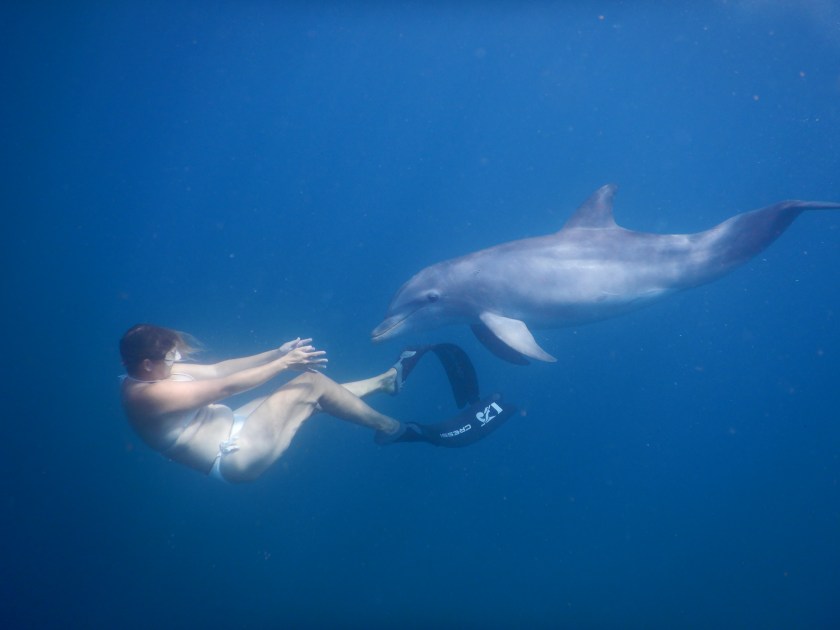
We were in Prince Rupert Bay, Dominica. One day before the Salty Dawg Rendezvous even started, Dave noticed a fin in the water a fair distance behind our boat, then he noticed a dinghy hanging out near the fin, and two swimmers in the water. Using our binoculars, we realized there was a dolphin playing with the two swimmers. This went on for about 30 minutes before the dolphin disappeared and the swimmers returned to their boat. We later learned from one of the PAYS guys that there was a dolphin that had been frequenting the bay for the past two years, frequently playing with swimmers.

The day after my cousins arrived, one of them noted a dolphin not far from our boat. Dave got in the water, but the dolphin disappeared, so Dave came back. Then we saw the dolphin reappear with a group of swimmers off to our starboard. This time we both got in the water and swam over to join the group. 

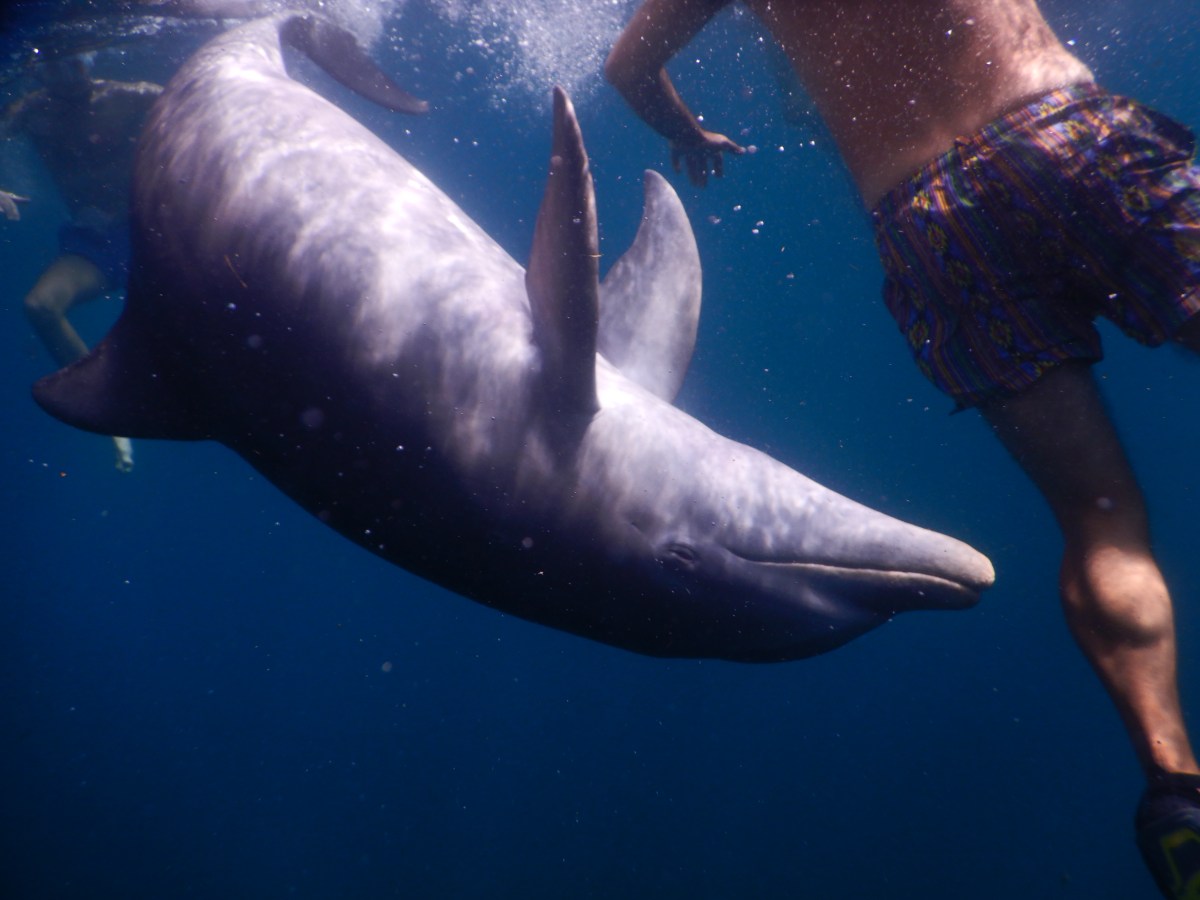
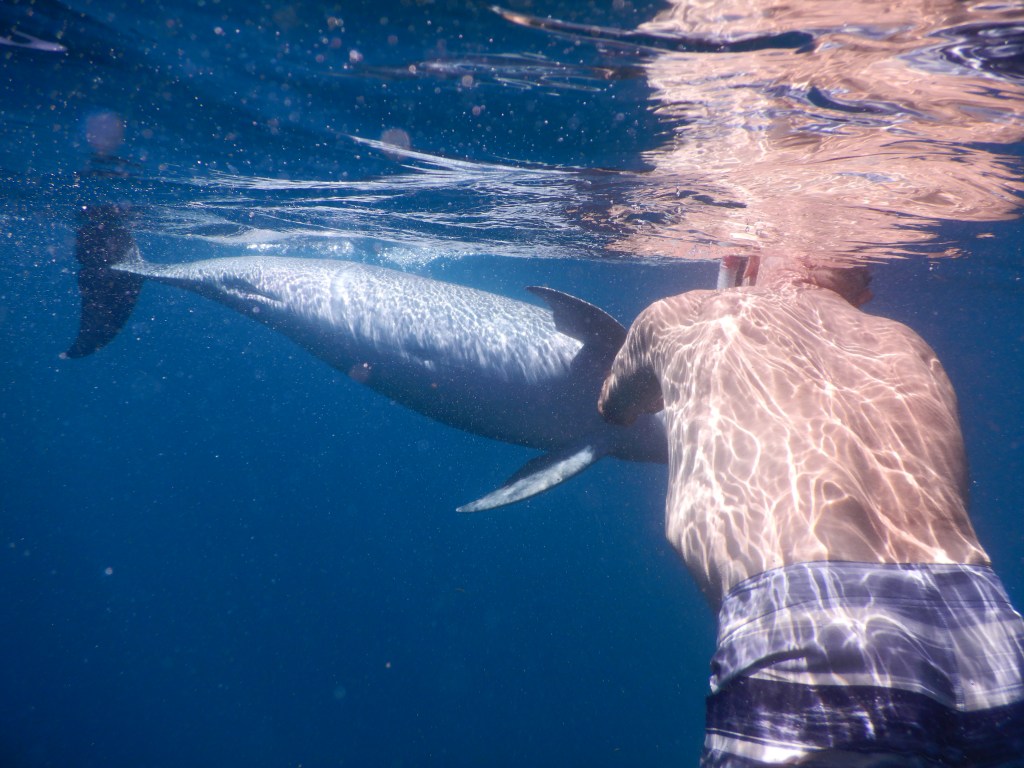
It was amazing! The dolphin swam from swimmer to swimmer for about 20 minutes, sometimes just cruising by, sometimes pausing for a moment. It appeared to enjoy belly rubs, as it would often swim up and turn its belly toward a person. Dave got a brief ride holding its dorsal fin once. We both got to run our hands along its side a few times. It felt almost like cool, hard rubber. Despite its close passes by the humans, it never hit anyone with tail or flipper; it has an amazing sense of its surroundings. When it got tired of the play, it simply swam away.

Best wildlife encounter ever!

I did remember to grab my underwater camera before jumping in, but we were more focused on interacting with the dolphin than capturing photos and video, but we got a few good shots. Enjoy the stills and the video of the first drive by the dolphin gave me.

Until next time, stay safe and take care of each other!

Dave should enter this in a photo contest!
Wish we knew who the woman is so we could send this to her.