Greetings from New Hampshire! Yes, you read that right; we’re still in NH.
We were supposed to have rejoined Indigo Lady in the Bahamas at the beginning of this month, but yet again, we find ourselves delayed. Dave is in need of another surgery, poor guy. It’s not an emergency, but it is important. This morning he was finally able to schedule a surgery date for early March. It’s a day surgery, but he has to follow-up in person three weeks later. If all goes according to plan, we should be able to go to the Bahamas in April. Until then, he’s been instructed not to travel out of country, just in case. That means no Bahamas until he’s done and given the all-clear. So we wait.
I find it difficult to blog about travel and living on a boat when I’m stuck on land. At home in the fall of 2020, your may recall, I bombarded you with videos of our diving in the Florida Keys from August of that year. This past fall, however, I just wasn’t in the mood. I figured I’d take a four-month hiatus and restart in early January, back in the Bahamas. Well, it’s now late January and I’m not in the Bahamas, but I finally felt inspired to sort through the photos and videos from our short 2021 cruising season and that inspired me to restart my blog.
First up, a slide show of the artist trail we found on Manjack Cay, Abacos. I wrote about Manjack cay and the art trail and posted a handful of pictures from the trail this past July, but that was only a tiny fraction of the pictures I’d taken. I’ve whittled it down to 95 pictures and let the Photos app on my Mac create the slideshow. Don’t worry; it’s not 95 separate slides. I chose the origami theme, so you get several at once, and it’s set to music.
Enjoy the show, and until next time, stay safe and take care of each other!
No, we haven’t ditched Indigo Lady. She’s still in the Bahamas waiting for us to return in January. We still plan to cruise on her through the Caribbean for several years to come. We’re just going to shorten our Caribbean cruising season and spend a couple of months each year cruising New England waters. There’s a story here, of course. There’s always a story. So I’ll tell you the story first, then get back to introducing you to Dumbledore.
Those of you who have been following my blog for a while know I do not enjoy being in the hurricane belt during hurricane season, at least from July onward. I’ve given it the old college try. We cruised the Florida Keys from late July through early September 2020. Isaias missed us by about 30 nm the first week of August before we even left the marina and later the same month we ran up to North Miami waiting for Tropical Storm Laura to decide her path. This past summer we were in the Bahamas through mid-August. We were lucky to only have to concern ourselves with Fred. We buttoned up Lady and flew back to the States the day before Fred threatened. Fortunately, he ended up not being much of a threat to Bahamas and tracked further south instead. We were lucky on all counts, but how long can that luck last?
From July onward I perseverate on the weather. When are tropical WAVES coming off South Africa? Will they become storms? Will they come our way? My stress level creeps up as summer progresses. Yes, we have the knowledge and gear we need to secure Lady and ourselves should a tropical storm/hurricane hit. I just don’t ever want to have to use that knowledge or gear. I don’t need or want that kind of stress. I’d rather just not be there. Thus our purchase of Dumbledore.
When Dave and I first started dating, I knew he had a plan to sell his house and live on a boat in the Caribbean. Before we were even engaged, I assured him there was no way I was living on a boat all year. I wanted to be home from September through New Year’s Day because I’m a homebody and I want that time to spend with family and friends. The first concession to his dream was that we would only cruise from early January through August. Then I started learning about cruising and the reality of hurricane season. On our drive home from Florida this past August, I knew I couldn’t do another July and August in the hurricane belt, but I also didn’t want to ask Dave to shave another two months a year off his dream. So I hatched a plan. Hoping our investments were still doing well, just after we got home this year I brought up the idea of buying a smaller boat, more like a pop-up camper with slide-outs, for cruising New England waters. Dave liked the idea so much he started looking for boats right away. Now we own Dumbledore. Dave still gets 8 months of cruising each year, two of them will be in home waters, and I don’t have to spend July & August stressed in the hurricane belt. Win-win!
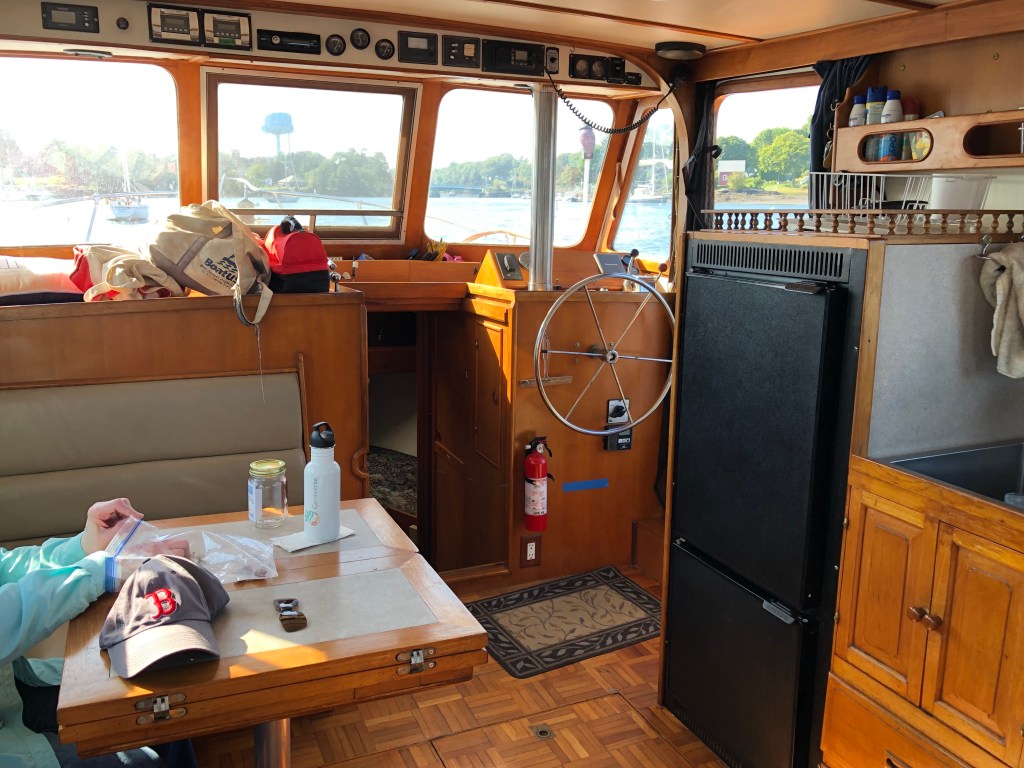
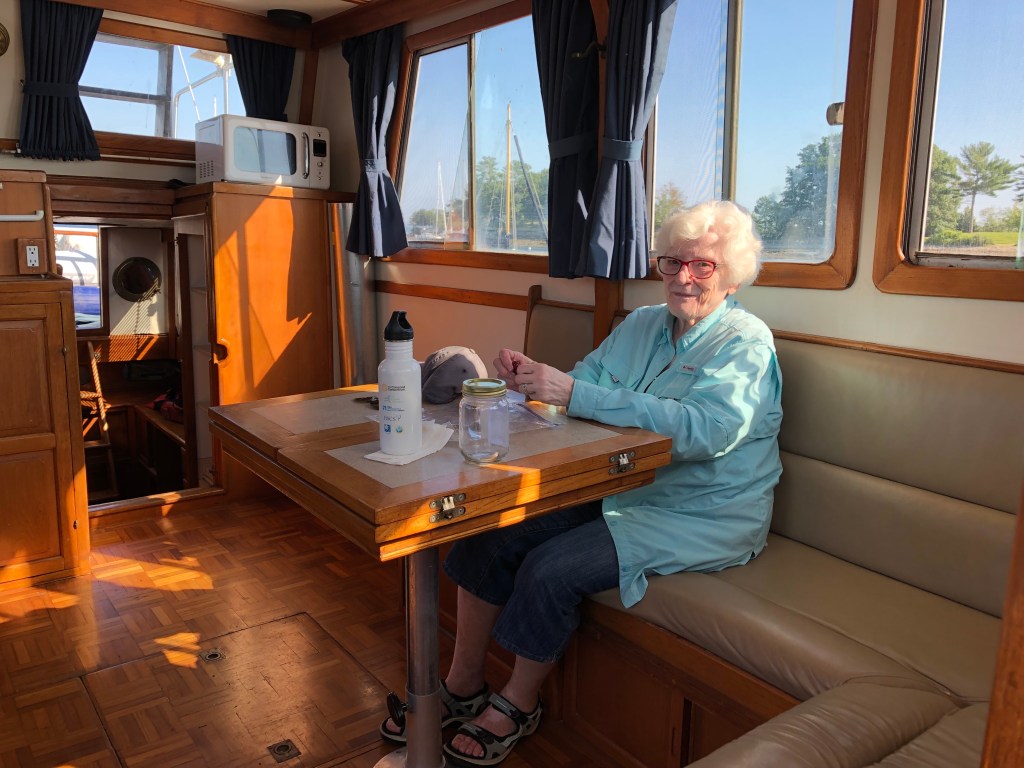
Dumbledore is a 1979 36-foot Marine Trader. He has a comfortable, rectangular salon/galley with an indoor forward helm station next to a sliding door to the starboard gunwhale, an L-shaped seating area with under-seat storage around a table with two drop leaves, a fridge/freezer, and a four-burner propane stove with oven. There is decent counter space for food prep and a coffee pot, and lots of cabinet storage for a boat this size. The prior owners installed a second freezer in a storage locker in the aft companionway. This was an important addition because the other tiny one doesn’t keep ice cream frozen. Mmmm…ice cream. They also installed three shelves above the freezer. Hello pantry!
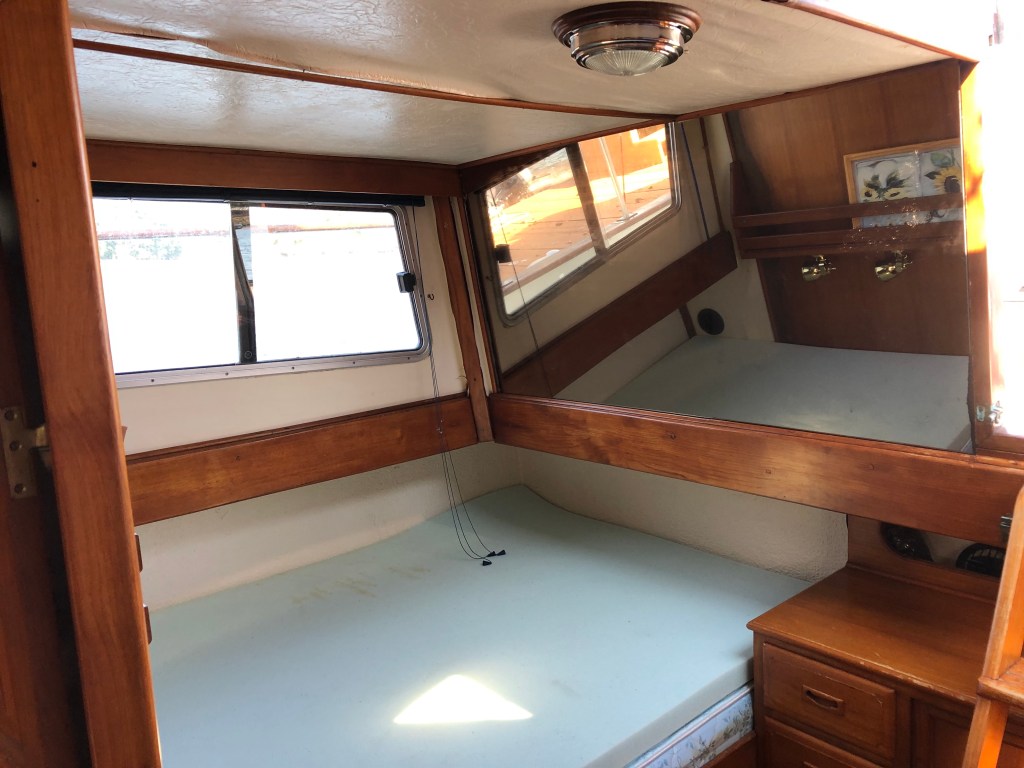
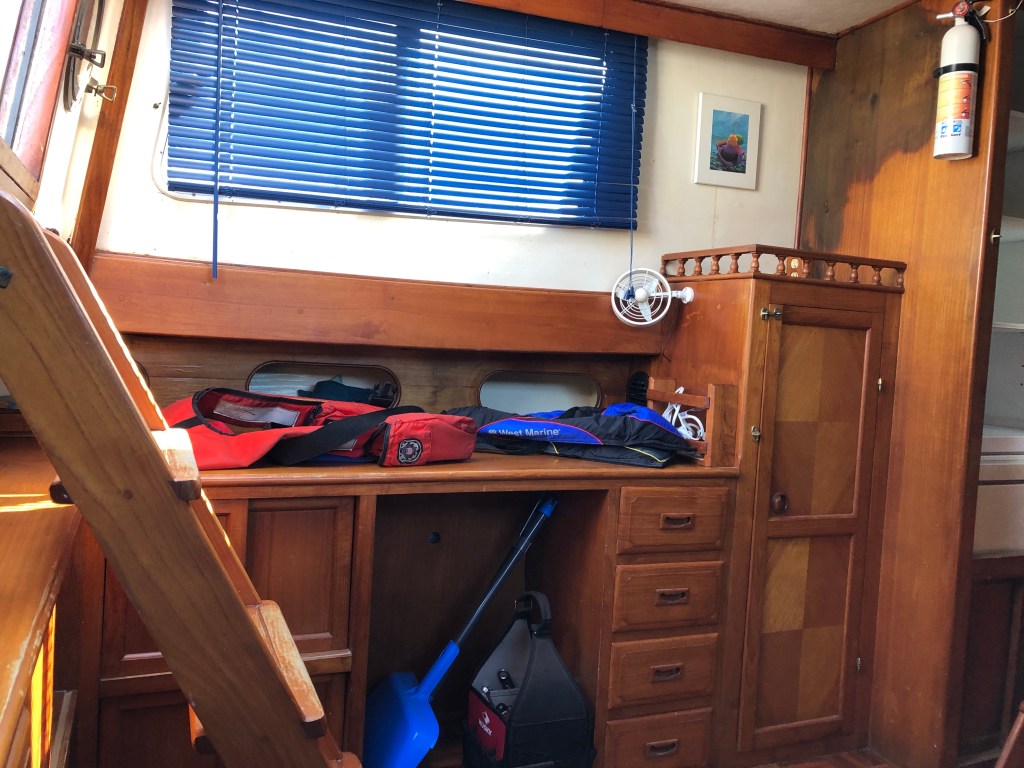
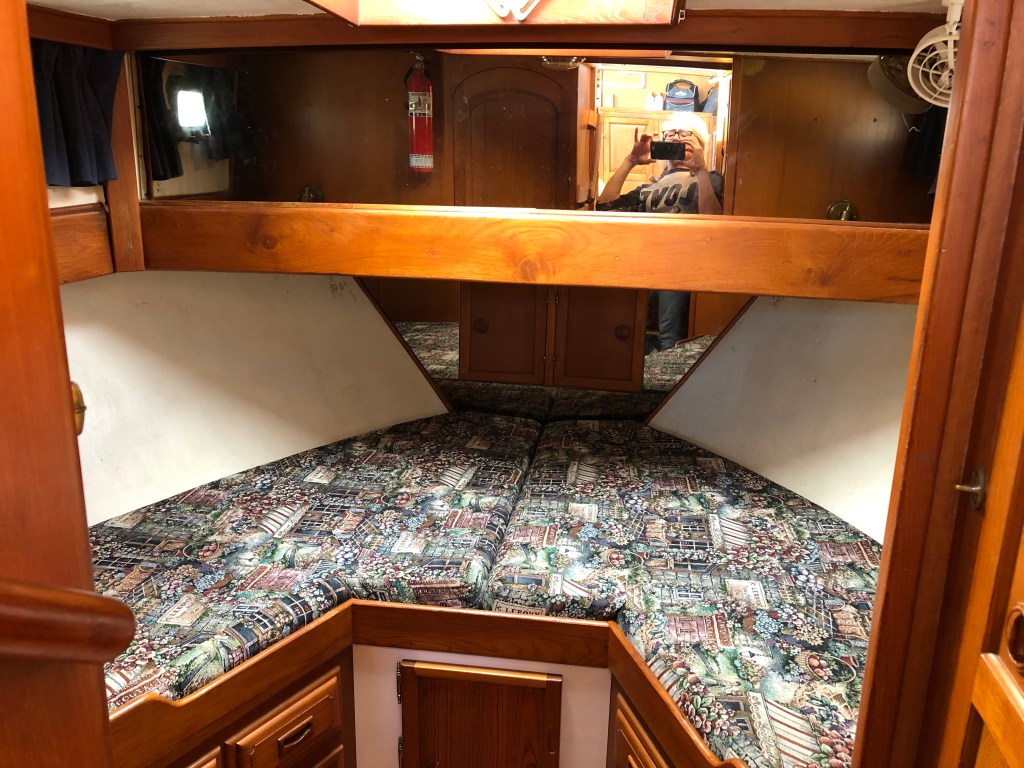
The aft cabin is the main sleeping cabin with a full sized bed against the starboard wall, a small hanging locker, an L-shaped built in desk with drawers and cabinets galore (for a boat, anyway), and a head with tub- shower. Okay, the tub is a bit silly as one would have to sit with their knees up to their nose to use it, but the important thing is that the shower is confined to the tub area and has a real shower head, unlike on Lady where the whole head is also the shower. There is also a forward v-berth with the equivalent of two twin beds, its own head, drawers and hanging locker. We can have guests and they will be comfortable!
Then there’s the fly bridge with second helm station. This will be our outdoor living space. Dumbledore came with a bimini frame, but no bimini. We are considering installing a hard roof and some solar panels next season and that will give us the shade we will want up there. There are two comfortable navigator and copilot seats plus two comfortable bench seats with under seat storage, and a few folding chairs. There’s also a small propane grill up there.
Dumbledore came with lots of goodies: an 8-foot inflatable dinghy with 5hp Honda motor and a really nice dinghy davit system, a recently installed water maker, two water tanks totaling about 100 gallons, AC/heat, holding tanks that can be pumped out or overboard, a VHF radio, depth finder (although that stopped working the other day), a Ford Lehman 120hp Diesel engine, two fuel tanks for 150 gallons of fuel, 21 lead acid batteries (group 27 size), a diesel powered generator to charge the batteries and run the house load, bow and stern thrusters, a bow speed bulb, and autopilot (which needs a new part). Plus the prior owners left fenders, boat hooks, lines, etc. Bonanza! We will be adding a chart plotter and radar, plus a hard roof and solar panels, as I mentioned before.
He’s old and needs a little bit of work, but we knew we could use him right from the get go regardless. We also knew the work that needs doing is not going to be costly and Dave can do it himself. We’ve already spent one night aboard out at Gosport Harbor and will squeak in another night or two before we have him hauled in late October. Dumbledore is big enough, comfortable enough and has enough goodies onboard for us to live comfortably on him for a month or two at at time while we cruise anywhere from Maine to Rhode Island, perhaps even as far as Long Island.
The pictures below are from the day we took possession of Dumbledore and moved him to our floating dock. Next season I’ll post pictures once we have him all tidied up and decorated.
We’re safely back home. Let me back up and get you from our final days in the Bahamas to now.
I left off with the day before we were to return to Bullocks Harbor at Great Harbor Cay, and I promised to tell you about the repair Dave was working on. I’ll start with the repair.
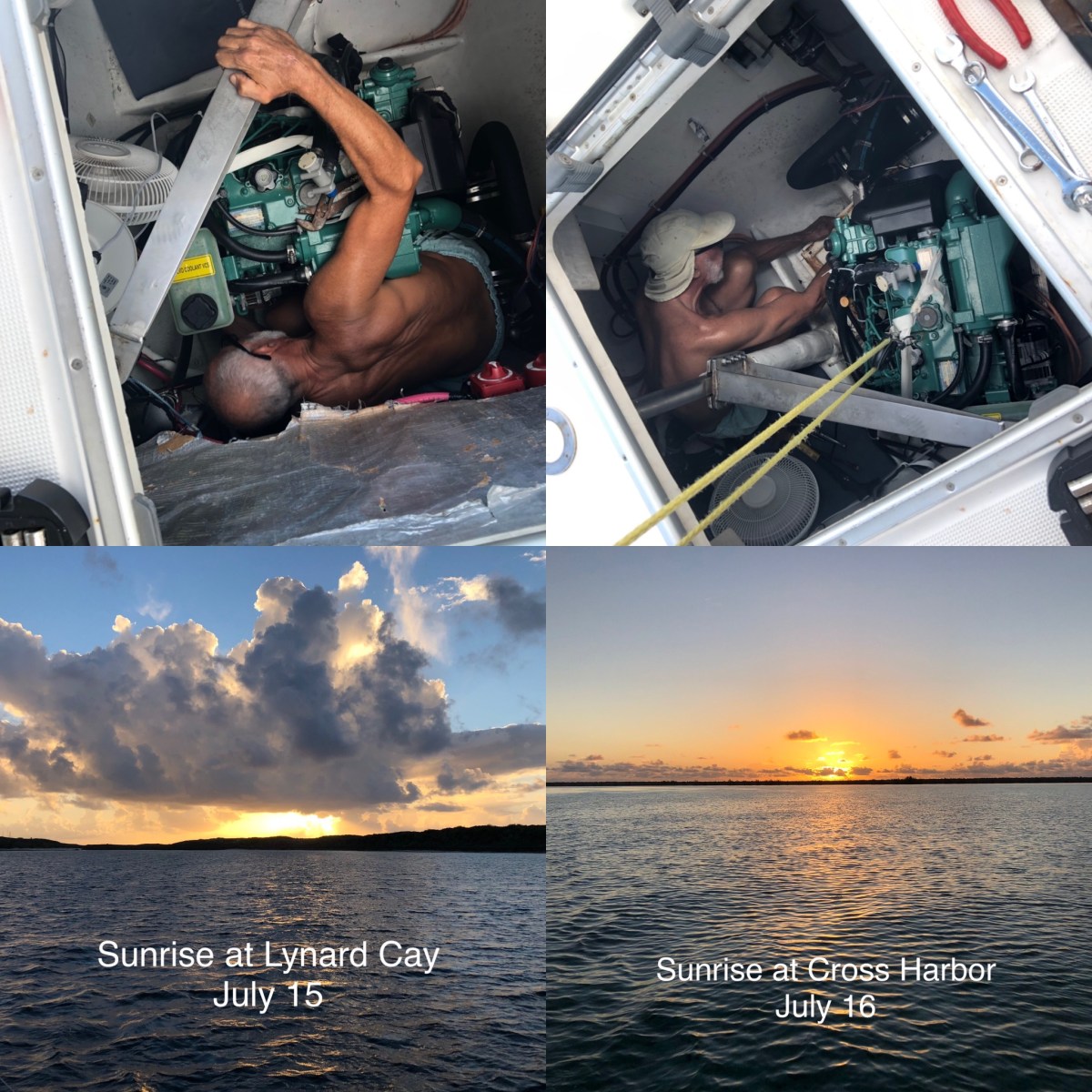
Our holding tank wouldn’t pump overboard. Worse yet, after some testing and troubleshooting Dave suspected the tank had become pressurized due to a blockage, most likely the intake to the macerator pump that pumps the tank overboard. A full, pressurized holding tank is bad because whatever needs doing to fix it requires opening the system, resulting in sewage leaking into the boat. Doesn’t that sound fun? Inevitably, when Dave initially opened things up, there was a little spray, but very minimal (I’ve read other cruisers’ horror stories). After that he was able to control the leakage so that it leaked into the bilge (that’s below the floors) which drains overboard. The blockage was where he expected, thankfully, and he eventually cleared it using a hose and pressurized saltwater (which forced more sewage into the bilge). Then he had to replace the pathetic macerator pump that had been problematic for a while anyway. I don’t know how he did it. It was a stinky job and I had to stay in the breeze in the cockpit the entire time to avoid getting sick. Dave’s a trooper! All told he spent a little over 3 hours on the repair and cleanup, that includes cleanup of himself. I followed his cleanup by mopping the floors and walls in that area with bleach water. Glad that’s over!
The following day was Sunday and we returned to Bullocks Harbor. Monday we met the Immigration officer at the marina and extended our visas. We dropped by Brown’s Garden later in the afternoon for snacks and drinks and a final conversation with the owner, Ronny, before we left. That was our last bit of fun for the trip. The rest was all work.
We were monitoring tropical storm Fred and decided that if he were to hit the Berries, it would likely be the coming weekend, so we changed our flights from Saturday to Friday hoping to stay ahead of Fred. (Fred ended up staying far enough south to have no significant impact on the Berries.) Then we changed our inn reservation to match and started preparing the boat and ourselves for our departure. We got a good amount of work done Tuesday while still at anchor in Bullocks Harbor where we had a delightful breeze coming through the hatches. Wednesday morning we brought Indigo Lady into the marina to get her tied up properly for the remainder of hurricane season and to complete the rest of our closeup tasks. We also got our Covid tests, which are required for re-entry to the US by airplane. Conveniently, the woman who conducts these tests is at the marine M-F starting at 10am. Much of Wednesday and Thursday are sweaty blurs- 8 hours each day dripping sweat the whole time. There was a breeze, but we had to go out to the cockpit to avail ourselves of it because it was from the wrong direction to blow into the boat. Thank goodness we’d booked the inn, which was mere steps from the marina, because it had blessed air conditioning plus a small fridge and microwave. We had prepared dinners in advance and were able to reheat and enjoy them in the comfort of our room at the inn. And we could take real showers! By 5pm Thursday, Lady was buttoned up and we waved goodbye to her.
Friday morning a taxi took us to the tiny airport and our 8am flight arrived about 8:30 and departed for Nassau by 8:45. Fortunately, the Nassau airport wasn’t very busy and, despite what looked like long lines, we made it through flight check-in, security, and US Customs pre-clearance in time to sit for about 45 minutes before boarding our Bahamas Air flight to Fort Lauderdale. We were back on US soil by 12:30, in our rental car by 1:30 and at my cousin’s house in West Palm Beach to retrieve our car by 3:30 after a quick lunch at Five Guys (oddly, I was craving a burger and fries, go figure). We chatted for about half an hour with my cousins then headed to our hotel where we took much needed naps. Dave stayed in for the night while I went to meet my cousins Susie and Sarah for dinner at an outdoor restaurant nearby. It was a brief get together, but most welcomed. Saturday morning we started our 2-day drive back to NH, stopping for the night in Rocky Mount, NC. We finally arrived home at 10:30pm a week ago Sunday night. Phew!
We’ve spent the past week getting our land lives restarted and recuperating from the hot, sweaty, busy final days in The Bahamas followed by the long drive home. We did see my family soon after our return. Since we’d been on two airplanes, I ate at a restaurant (even though it was outside, it was in FL), and there was very little masking at any of the rest areas or takeout restaurants at which we stopped, we decided to take Covid home tests before seeing my family, just to be extra safe. Negative- yay! Most of the grudge work of returning to land life is done and now I’m itching to settle back into my land routine and to reconnect with friends and family on a more regular basis.
I’ll probably post once every 2-3 weeks while we’re at home. I believe I promised some diving video slideshows, and I will get to those. I have a couple of other posts planned, such as one displaying the art of the art trail we walked at Manjack Cay (I took a lot of pictures), and I want to create a map of our travels this short cruising season. If there’s anything you’d like me to post about, let me know in the comments section or email me and I’ll try to accommodate your request.
Until next time, stay safe and take care of each other!
Grab a beverage and find a comfy seat; this is a long one.
The Berry Islands are a small chain of islands about 57 nm (nautical miles) SE of Freeport on Grand Bahama and about 72 nm east of Bimini (or about 115 nm east of Miami). The island chain is bordered by the Northwest Providence Channel, the Northeast Providence Channel, and the vast, shallow Grand Bahama Bank. The northernmost islands are Little and Great Stirrup Cays, owned by Royal Carribbean and Norwegian cruise lines, respectively. Royal has dubbed Little Stirrup as “Perfect Day at Coco Cay.” Cocoa Cay is full of beaches, beach bars, water slides, and even a hot air balloon. Great Stirrup is set up as more of an adventure island with ziplines and such. This is from what we’ve read and seen as we’ve cruised by them (7 times thus far). The only town in the chain is on Great Harbor Cay, just south of the Stirrups, population around 400. The Stirrup Cays provide employment for a very large portion of the town. One local we spoke with estimated about 75-80% of adults are employed by those cruise lines in some way. Currently, the cruise lines do not offer excursions to Great Harbor Cay. In town there are two small grocery stores, several restaurants, a marina (one of the best hurricane holes in the Bahamas), several rental properties/inns, an air strip, a bunch of privately owned houses outside of town (owned by foreigners), and lots of friendly people. At the southernmost end of the island chain is Chub Cay, which is a big sport fishing spot that gets a lot of traffic from high speed powerboats from Florida, plus they also provide sport fishing charters for those who fly in. The inbetween islands are either uninhabited or privately owned. I’ll let you look at a map and try to count the number of islands that make up the Berries; I stopped counting at 45. The Berries are not a tourist hot spot, except for Chub Cay, but they do have their regular visitors by land and sea who appreciate them for their quiet, remote anchorages and friendly town.
From Explorer Chartbook: Near Bahamas
If you’ve been following my blog for a while, you may recall that Dave and I were here with my folks, on Indigo Lady, back near the start of the pandemic in late March/early April of 2020. There are worse places to be stuck for two weeks during uncertain times, but I’m glad we’ve had the opportunity to return and enjoy them differently this year. Yes, the pandemic still rages on, but the Bahamas figured out a way to reopen their borders to the much-needed tourists. Just like at home in the U.S., we follow whatever mandates each island group has in place at the time.
You don’t come here for the abundant daytime activities and the night life. This is a place where you meet and talk with the locals and get to understand their way of life. When we were here in late May this year, we biked the southern half of the island, walked about town, and met Ronny and Gaynell who own and run Brown’s Garden restaurant. We returned here from the Abacos in mid July and spent a few days anchored off town again. We returned to Ronny’s & Gaynell’s restaurant. The day we lunched there, Ronny invited us to come back for a cookout that evening that was a sendoff for his wife. She was promoted and would be spending a couple of years mainly living and working in Nassau, visiting with Ronny on weekends as one or the other of them would fly over to the other island. What a sacrifice! But they have plans and are working towards them. It was very sweet of Ronny to invite us and Gaynell introduced us to his family. This is the kind of experience one has on an island like this. Had we been here earlier in the cruising season, we would have availed ourselves of the socializing that goes on in Great Harbor Cay Marina. We heard that they do a group cookout on Fridays and pizza takeout on Saturdays. Alas, the marina was mostly empty when we returned in July; only a few boats stopping for a night or two.
We left Bullocks Harbor the morning of July 21st and started our trek down the eastern side of the island chain to spend some time at those quiet, secluded anchorages. We weren’t in a rush, so we took three days to get to Little Harbor Cay, the furthest south we planned to go. My post from July 24th takes you from Bullocks Harbor through our running aground and to the anchorage behind Little Gaulding. We spent two nights at that anchorage, which we did not enjoy because of the current and opposing swell. The morning of the third day we caught the rising tide down to the northwest end of Little Harbor Cay where we anchored on the west side of the island just below the NW point. It was another sandy-bottom, clear water anchorage and well protected, so it was blissfully calm. There was only one (very large) boat moored bow and stern. We stopped by briefly to say hello as they were heading off in their tender one morning. Turns out the owner of the boat also owns Big Gaulding Cay and they were heading over for a cookout. He graciously invited us to come over, but we weren’t in the mood for a hot day ashore so we declined. We spent three nights anchored here.
While at this anchorage, we found the little trail across to the Atlantic side and walked the beach. We dinghied over to the west side of nearby Comfort Cay to explore the underwater blue holes someone had told us about. Dave explored the blue holes snorkeling. We weren’t sure about the holding for dinghy’s anchor, so I stayed aboard just in case. I wasn’t terribly interested in this blue hole anyway. When Dave finished, he said he was glad he checked them out, but wasn’t interested in trying to move Lady over there to dive them with the hookah. He’s done his share of deepwater diving and is more interested in the reefs these days. After the blue holes, we decided to act upon the real reason we chose to go to Little Harbor Cay- the opportunity to eat at Flo’s Conch Bar. The restaurant was established in 1993 by Chester Darville, who returned to the island of his upbringing after almost 20 years. His mother, Flo, was the head chef until her passing in 2011. The family and workers are the only inhabitants on this island and they occupy a couple of buildings next to the restaurant. Other than a “camp” on the north end of the island, there are no other signs of civilization. Flo’s is not always open, so one has to make a reservation in advance. Unable to reach the restaurant by email, phone, or VHF, we stopped by after our blue hole excursion to arrange to have lunch there the following day. The restaurant is renowned for its Bahamian dishes and they did not disappoint! We did in fact have lunch there the following day, having arranged to have “a little of everything.” We enjoyed conch fritters, lightly battered and fried fish fingers, coleslaw, and Bahamian peas and rice, accompanied by a rum punch. Delicious! We also got to enjoy conversation with a lovely family who was also lunching there. The son/grandson (about 9-10 years old) regaled us with his knowledge of all things science. He was a joy! Lunch was so huge that we ended up bringing leftovers back to Lady that served as lunch the next day. “Dinner” later that night was cheese, crackers and pepperoni, quite late because we were still full from lunch Flo’s was certainly worth the trip!
Flo’s Conch Bar
The following day we caught the afternoon rising tide back to Hoffmans Cay where we anchored and stayed for 10 days. Hoffmans is uninhabited and the epitome of a quiet, remote anchorage. The only other boats we saw were a half mile or more away and anchored either off Little Gaulding or White Cay. A bit different than last year when we shared the anchorage with several boats also waiting to see what the pandemic would bring for cruisers. It is also much hotter here in July and August than it was in late March/early April. The temperature might get as low as 84-85oF overnight and as high as 89oF during the day (only saw 90oF once). There was a period of several days with very little breeze, making it feel even hotter. The days kind of run together at this point. Most days we did at least one thing off boat, but we spent a couple of really hot, nearly windless days onboard in the shade of our solar panel roof, in the hammocks, dipping into the water to cool off as necessary. Most afternoons were spent in the hammocks, followed by dinner and then either games, a movie, or the Red Sox. We also tended to basic chores and some projects.
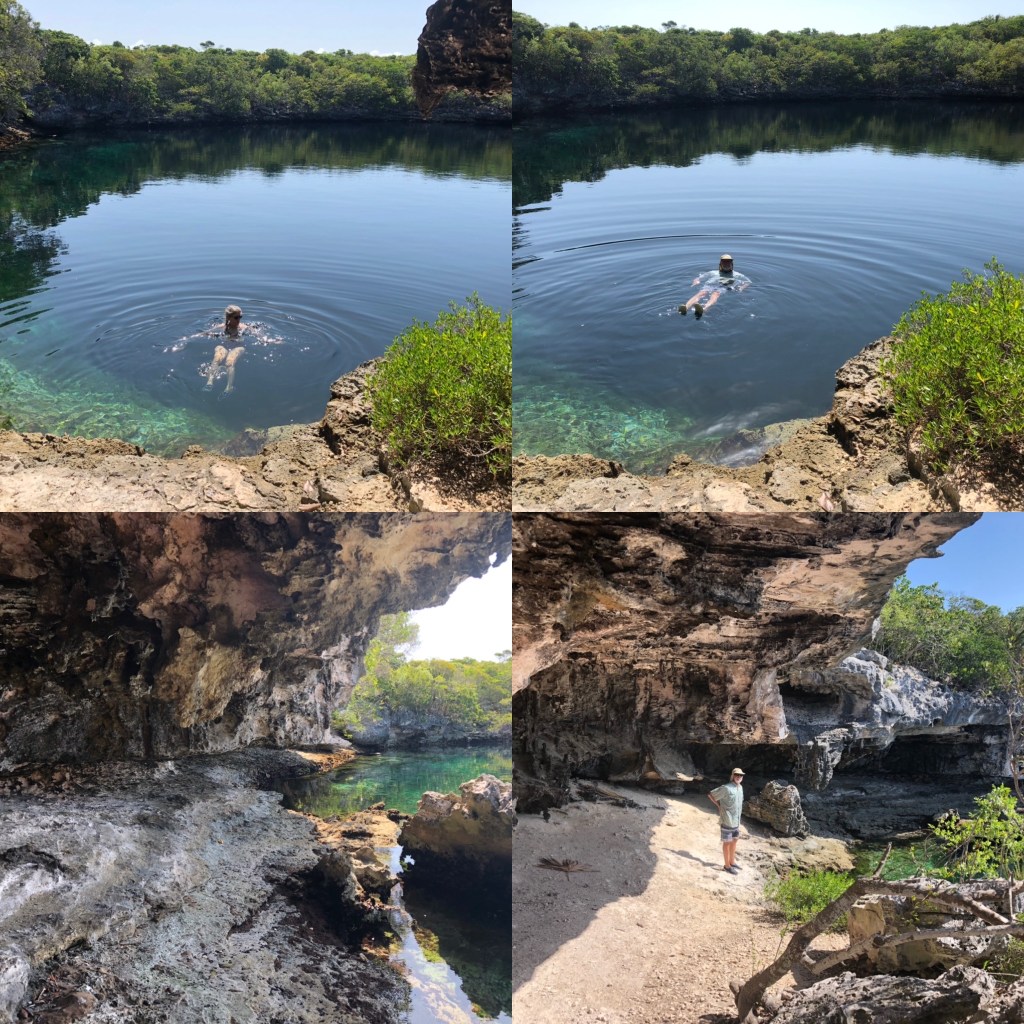
Over the course of our stay at Hoffmans we walked to and took a dip in the blue hole on the south end of the island. This blue hole is on land and is fed by the ocean from an opening on its bottom. Someone we met said it’s around 55’ deep. We walked the Atlantic side beach twice, the second time visiting the stranded power boat we saw last year. It has moved! We dinghied into a little bay full of sea turtles and up into the mangrove river on the rising tide. Last year we saw a bunch of fish among the mangrove roots, but this time we saw only a small school of needlefish and a couple of other small fish. Last year we’d seen a school of bonefish in the bay, so this time Dave set up to cast for them but, alas, there weren’t any. We snorkeled the ledges around two small beaches in sight of our anchorage. We didn’t see as much big life this time, although we did see a couple of trigger fish and a 5-6’ shark, which we thankfully only caught a glimpse of before it swam off. It wasn’t close enough long enough for us to identify it properly, but it was probably a reef shark. We walked the long, northernmost beach (also anchorage side) a couple of times. It’s only a “long,” one-mile beach at low tide. You can wade out into the water quite a way in a couple of spots and be standing on exposed sand. At the far end there is a remnant spit of coral that sort of forms a little bay where we saw a baby shark, very whitish and only about 2’ long, likely a juvenile and no idea what species. These walks also revealed one good sized ray, one barracuda, and several trigger fish, all right up in the shallows, plus a bunch of yellowfin mojarras (had to look those up) and little crabs that would scurry away from our feet and burrow into the sand. Along the shore there were many curly-tailed lizards, laughing gulls, plus we saw some sort of heron and an osprey. Our last day at Hoffmans we decided to snorkel off the long beach to see the sealife from in the water. Of course none of the big stuff graced us with their presence that day, but it was a fun and cooling way to spend a hot couple of hours.
Before we knew it, it was time to head back to Great Harbor Cay. As I write, we are two thirds of the way back. We spent Thursday night anchored off Soldier Cay again. This time we snorkeled to the beach and around the southern point and took a brief walk ashore. Last night and tonight we are anchored in Great Harbor behind the Stirrup Cays. Tomorrow we return to Bullocks Harbor. Monday we will go to Immigration to renew our expiring visas; we’ve spoken to the immigration officer, who is expecting us. Then we start the process of closing up and securing Indigo Lady for the next 5 months or so. We’ll do some of the closeup prep at anchor in Bullocks Harbor where we can benefit from the breeze, but the final couple of days we’ll need to be on a slip in the marina. We booked a room at the nearby inn for those final two nights.
I’m not sure if I’ll have the time or energy to post next weekend. Maybe I’ll knock off something when we’re back in the U.S. and at the hotel next Saturday night. Dave is having an interesting day today, with a couple of troubleshooting/repair jobs, one of which I wouldn’t wish on anybody. You’ll have to wait until next post to find out what that is.
Until then, stay safe and take care of each other!
Our stint at Manjack Cay was our last touristy hurrah before heading back to the Berry Islands. We left Manjack the morning of Friday, July 9th and arrived at Great Harbor Cay in the Berry Islands mid-afternoon on Friday the 16th. Our focus at this point was readying ourselves and Indigo Lady for the two days we would take to get back to GHC and we decided to do most of the preparations at Marsh Harbor.
We arrived at the little bay anchorage just outside of Marsh Harbor on the afternoon of Saturday the 10th. We spent three nights and three very busy days there. Sunday-Tuesday were all work, especially for Dave. In late June Dave discovered there was a leak in the port engine room around the rudder post. It was small, but no leak through the hull is good and small ones have a habit of becoming bigger, so Dave wanted to repair it before heading back to GHC. That repair took from 9:00 am – 7:00 pm Sunday (some of that time was waiting for JB Weld putty to dry). Monday morning we walked to Maxwell’s Supermarket for some final provisions. Back onboard I tended to the unpacking and moving around of provisions while Dave started cleaning our hulls. I made him stop about 2/3 of the way because it was late and he was exhausted. We barely mustered enough energy to heat leftovers for dinner and listen to music in the hammocks before bed. We got little sleep that night due to a storm that started around 11:30 pm and didn’t finish until after 3:00 am. Once again, the storm came from the only unprotected direction in the anchorage, making it bouncy and noisy with the waves hitting the hulls. We dragged ourselves out of bed just after 8:00 am Tuesday. Dave managed to finish cleaning the hulls after breakfast and I did some interior cleaning. Though tired, we decided to make the short 6 nm hop over to Hope Town knowing it would be a bumpy ride. It was, but it was short, and we were rewarded by a calm afternoon and night on a mooring and a final loaf of coconut bread from Vernon’s Grocery.
Wednesday morning we headed over to Lynard Cay. This was the first place we had anchored when we arrived in the Abacos in late May and it was now our launching spot for the return trip, retracing our steps around Hole in the Wall to Cross Harbor, then the following day from Cross Harbor to GHC. Lynard Cay to GHC is a 16-20 hour trip that we could do in a single shot, but I prefer to avoid overnight passages when they’re not necessary and it was not necessary in this case. The weather routing apps we use looked good enough to set out as planned at first light the next morning. We agreed that if conditions weren’t good we’d turn around and try again the next day.
As planned, we set off Thursday morning at 6:30 am, just as the sun was rising, and stuck our nose out into the Atlantic. The conditions weren’t perfect, but seemed doable, better than our trip up anyway. Conditions deteriorated about 2 hours out. We’re still learning how to apply all aspects of a forecast to a planned route. A forecast of 2-4’ seas from the SE with an 8 second period is based on the average top 1/3 of waves and assumes open water with no other influences; there can still be waves shorter or taller and from other directions. We did not account for the wind chop, which layers wind-driven waves over the predicted ones, and on that day the wind and seas were from different directions, which means we had waves from multiple directions- “confused” seas. On top of that, we were heading almost into some of the wave sets, which shortens the wave period making it bumpier. We chose to continue anyway for a few reasons. First, despite the bumpiness we were making better time than the trip up because the wind and some of those confused seas were more off our stern and giving us a bit of a push; it was only going to be an 8 our trip and we’d already done 2 hours. We knew when we made the turn to go around Hole in the Wall we would have the seas completely behind us and once around the point we’d be in the lee of Great Abaco where the water would flatten- that was another 2 hours of the trip. So I had 4 more hours of bumpy conditions to suffer through (the bouncing doesn’t really bother Dave). I’d taken one seasickness pill but should have taken two because I still wasn’t feeling great, mostly tired, and all I could do for 5 of the first 6 hours was stand and stare at the horizon waiting for the torture to end. Onward we trudged. I rejoiced when we made that turn to go around Hole in the Wall! We anchored in Cross Harbor by mid-afternoon and got a nap in before dinner (which I’d had the sense to prepare in advance) and we got a good night’s sleep. The next morning, Friday the 16th, was much better. We left at about the same time of the morning and had following seas the entire 8 hours. We were anchored in Bullocks Harbor by 3:00 pm and in the hammocks with celebratory drinks shortly thereafter.
We’re currently exploring the Berry Islands for the remainder of our time in the Bahams, which is quickly nearing its end. We have booked flights back to the US for mid August. We will pick up our car from my West Palm Beach cousins and start slowly driving home, stopping to visit family and friends along the way, assuming the stupid Delta variant of COVID doesn’t get any worse.
Next week I’ll tell you about our time in the Berry Islands. Until then, stay safe and take care of each other!
The photo is a spoiler. We ran aground yesterday. Oops!
We’re fine. Indigo Lady is fine.
I’ll back up a little to bring you up to speed.
We left Bullocks Harbor at Great Harbor Cay on Wednesday to hang out in the eastern Berry Islands for a while. On Wednesday we rounded the Stirrup Cays and decided it was a bit too bumpy to continue to Hoffmans, so we ducked into Great Harbor (not to be confused with the cay of the same name). Great Harbor is a shallow bay formed by the back side of Great Harbor Cay, Little and Great Stirrup Cays and Lignumvitae Cay. There were perfect conditions for this anchorage so it was nice and calm with crystal clear water over a sandy bottom. There was a cruise ship on Little Stirrup (aka Perfect Day at Coco Cay, owned by Royal Caribbean), but that is so far away it had no impact on us. We had the anchorage to ourselves. The water, being clear with a sand bottom, was cool and refreshing, a nice change from the warm, turbid waters of Bullocks Harbor.
Next morning, Thursday, we hauled anchor around 10am to head for Soldier Cay. It was another gorgeous day this time with good sea state and light wind, so the Soldier Cay anchorage was comfortable. We got another sandy bottom with clear, refreshing water. We walked on the tiny beach at low tide. The rocky north end, plus the small rocky islands north of Soldier are nesting areas for laughing gulls and other birds and they have chicks now. They were not happy when we dinghied along the shores to go snorkeling, and they let us know it by swooping over us. Fortunately none of them lightened their load over us. It was low tide rising for a shallow snorkel. If some of the reefs we’ve dived on were “nursery” reefs, this area was for “newborns.” We saw the standard reef fish, but most of them were so wee! There was a smattering of full-sized reef fish, but mostly tiny ones. So cute! Our big fun here was swimming along the rocky shore toward the cut, kicking as hard as we could to get as far into the cut as possible, then riding the incoming tide back inside. Fun! We did it twice.
Yesterday morning, Friday, we hauled anchor at 7:30am for the high tide through the shallow cut to Hoffmans Cay. We’d done this in reverse last year during the pandemic when we hung out at Hoffmans before heading back to the US. No problem. We cruised the length of Hoffmans and decided to try for the next batch of islands down for a more protected anchorage given that some squall activity was heading our way for this weekend into Monday or Tuesday, possibly from the exposed direction. We should have stayed at Hoffmans.
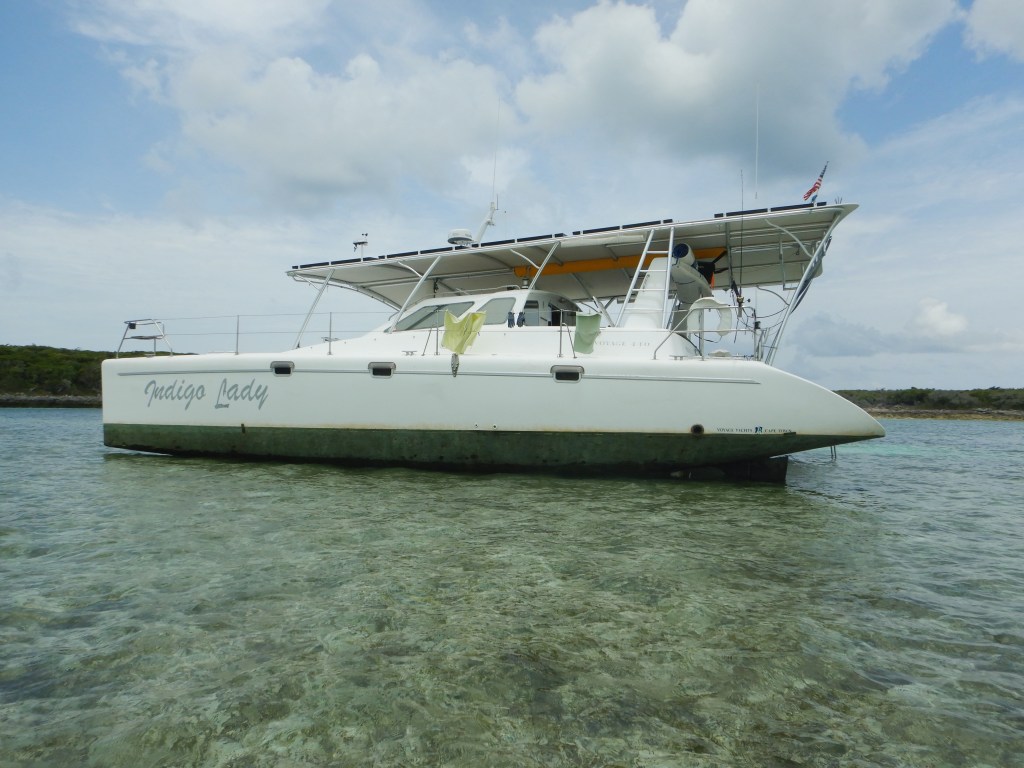
We were on the falling tide, about 60-90 minutes after high, when we had to navigate a short, shallow cut between Saddleback Cay and Big and Little Gaulding Cays. The shallow draft route marked on the charts conflicted with the notation that said to hug Saddleback about 20’ off its shore. We opted to steer closer to the route line. Mistake! Had we been one boat width (25’) closer to Saddleback we never would have grounded. Had we been half a boat width closer to Saddleback, port hull would have grounded, but we would have wiggled off using starboard. If we’d arrived at peak high tide instead of an hour after high, we wouldn’t have grounded. But ground we did. We were only moving 3 kts, there were no waves, and the bottom was sand and weeds over hard. So we just ground to a slow stop. Dave tried to back us off with the motors. Then he hopped in dinghy and tried to pull us backwards and off. Unfortunately neither effort worked, especially since we wanted to move backwards while the current was pushing us forward. Nothing to do but wait for the next high tide to float us off. The second high tide would also be about half a foot higher, so we knew we’d have plenty of water to float us off, and we were only 0.25nm from our intended anchorage. So close, yet so far!
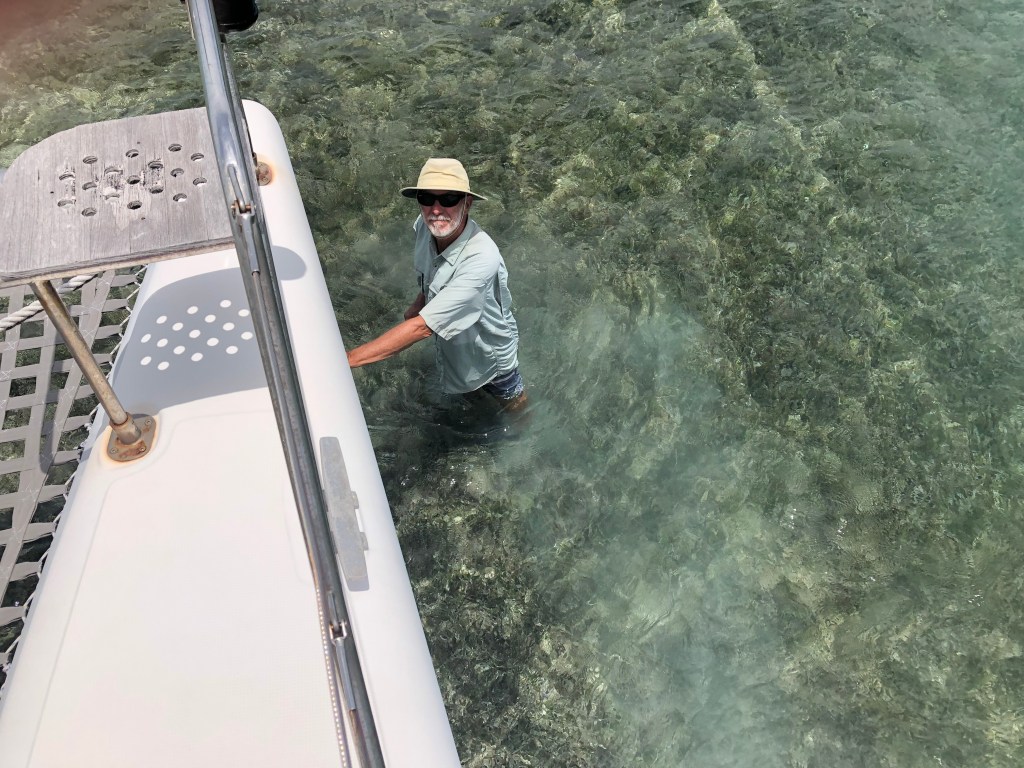
We were very lucky that not only was it a soft grounding resulting in no damage, but it was also a calm day. We entertained ourselves with some boat tasks in the morning and early afternoon. About an hour before full low, Dave got into the water to walk around the boat to check for depths near and beyond the boat, and to check her hulls. She was sitting fine with no damage. Port was in shallower water than starboard. Deeper water was only about 20’ off our starboard and about the same behind us. We knew starboard would float first and were pretty sure the incoming tide would push us backwards. Dave kept tabs on the water level and when it reached dead low, marked the distance to waterline on our boat hook. This allowed us to check how quickly the tide was rising as the afternoon progressed. We retired to the hammocks mid-afternoon to read and enjoy a drink as the water rose. For once, they weren’t swinging.
Around 5:30pm, Dave noticed that the water was at the waterline on starboard and that starboard bow was bouncing up and down a bit- movement! For the next 20 minutes we sat at the helm station, watching and waiting as we slowly rotated toward starboard. We considered trying to motor the port side off, but then decided not to bother, mother nature was taking care of it. By 5:50pm we were fully afloat, started the engines and proceeded to the anchorage. Anchor down just after 6:00pm.
Phew!
We’ve learned some lessons with this. First, don’t ignore your gut instinct. Dave’s gut had hinted at maybe not attempting the passage on the falling tide; he ignored it. He won’t do that again any time soon. We also should have thought through the discrepancy between the charted shallow draft route and the notation to hug the Saddleback shore and at least split the difference between the two. I was on the bow spotting, which is important in shallow route areas, but with the current pushing us from behind, that hump we grounded on came up too quickly for us to respond, another reason to not tempt fate on a falling tide, even if it is only “shortly” after high. At least for today, those lessons have stuck. We had set an alarm for 7:00am intending to backtrack 2 miles to a more sheltered anchorage south of here. We awoke to overcast skies with 15 kt winds and 3’ choppy seas from the SW (of course, the exposed side of this anchorage). Today’s planned route would have passed through three shallow spots, two of which we were unfamiliar with. Bouncy water is not good crossing shallow areas, even on the high tide, because the bottom of a wave trough can bounce you off of the seafloor. Overcast skies means you can’t read the bottom as you proceed, also a bad idea in shallows. So despite this anchorage being a bit uncomfortable, and not certain our anchor won’t drag if a squall kicks up, it was still the lesser of two evils. Dragging isn’t fun, but we know how to handle that, and there’s deep enough water around us to give us time to respond to a drag even at low tide. Getting stuck in the shallow with squalls threatening would be very bad.
Next week I will backtrack to our final days in the Abacos and the two day trip that got us back to Great Harbor Cay, which is what I’d intended to cover this week. Until then, stay safe and take care of each other!
I was going to tell you about our 4 days and nights in the protected anchorage on Manjack Cay. We had arrived early in the evening of July 5th, the day that storm cell that blew in from the north, and we tucked into the north shore of the anchorage to be out of the biggest of the winds.
The anchorage is a shallow bay about a half-mile wide on the Sea of Abaco side, and about half a mile across from the Sea of Abaco until you reach the junction of the two cays that form it- Crab Cay south to east and Manjack Cay east to northwest. Depths are about 5-9 feet (mean low water, MLW) for about a quarter mile in, then quickly drop to as low as 1 foot (MLW) as you near the cut between the two Cays. The southeast end of Manjack reminds me of a Maine lobster claw. The longer, upper portion of the claw on the Atlantic side curves gently from NW to SE, the tip pointing straight down at the narrow eastern portion of Crab Cay. The lower, shorter part of the claw runs east to west and points at the northern most point of Crab Cay. This yin/yang forms what the charts label Manjack Harbor, between the two cays. It’s not really a harbor, just a very shallow cut to the south and east leading to the Atlantic. If one turns NW inside the cut, you enter the space between the two halves of the Manjack “lobster claw” that forms a mangrove river running SE-NW for about three quarter of a mile.
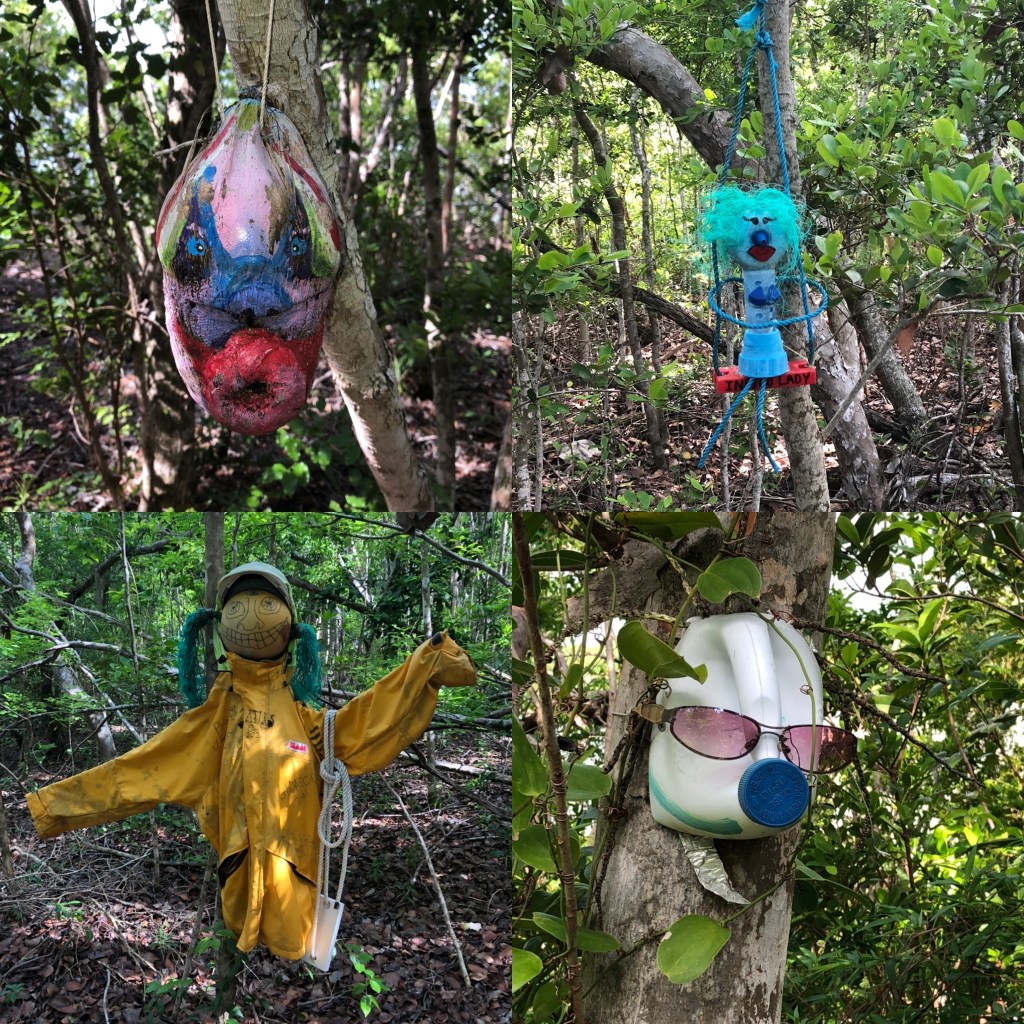
The morning of the 6th, we were just getting into dinghy to head for the art trail we’d read about, when we were greeted by an older couple (my folks’ ages) in their tender. They had come over to say hello and ask about our boat. Turned out they own the property adjacent to the beach we were heading to. They told us to stop by after our walk if we saw them out and about. We continued to the beach and the art trail. It was a fun, interesting walk. Many cruisers and other vacationers who walk the trail contribute a piece of art made mostly of flotsam and jetsam (plastics, nets, etc.) and/or flora (palm fronds, coconuts) and fauna (shells and seabiscuits). Paint and markers are often used in the decorating. I took a ton of pictures and will eventually turn that into a slideshow, but for now you’ll have to enjoy the handful of pictures I’ve included here. Dave and I spent the afternoon and part of the next day ruminating over what our contribution would be and collecting raw materials when we walked on a beach the following morning. We ultimately decided to create something to represent us, so we made an Indigo Lady- as in a “lady” that was made of blue materials. Can you find her among the pictures in this post?
After our trail walk we decided to eat our granola bar snacks and look for the ocean beach trail. On our way there we bumped into the couple we’d run into that morning. They were doing yard work. Leslie and Bill have lived on Majack for almost 30 years; they hail from south Florida originally. They own about 5 acres and built everything on it. They are downsizing, however, and are moving to a new, smaller house they’re building a little further up on the bluff. Did I mention they’re in their 70s? They are installing enough solar in the new house to run AC, a small comfort for their aging bodies, as they put it. I’ve read comments other cruisers have written about the “lovely couple” on Majack who are very welcoming of cruisers. They are indeed. They have a little cabana on a post in the shallows of the beach that had swings on it pre-Dorian. They have some picnic tables in the shade at the head of the beach for cruisers to use, and a station for opening coconuts. They gave us a tour of their property and extensive gardens (which they also plan to downsize, a little). Leslie gave me some herbs from her garden; so sweet! Dave helped them hitch a trailer of rock wool insulation to his truck and we bid our farewells as they headed up the hill to install the insulation and we headed back to Lady for lunch.
The normal SE-ish winds had resumed. The wind was brisk, which set up a bit of chop across the open expanse of water (fetch) between us and the opposite shore making it a bit bouncy. After lunch we hauled anchor and tucked in near that opposite shore to reduce the bounce. Then we waited for just past low tide, around 2pm, and set out on a dinghy safari through the mangroves. We saw dozens upon dozens of small sea turtles, but no stingrays or young sharks, which we’d heard were often spotted here. At any rate, it was lovely and we went as far as water depth would allow, which was the back side of part of Bill & Leslie’s property where they have a dock onto the mangroves. Back at Lady we cooled off in the water off our stern for a bit and were just drying off in the tramps when we heard the approach of a dinghy. Two men and two women from the catamaran anchored in front of us had come over to say hello and ask about our solar-electric system. Dave had the guys come aboard the sugar scoop to see the engine room. The women stayed in the dinghy and I chatted with them a bit. We told them what we knew about things to see and do in the area. When they left us they were heading for the mangroves. We passed a quiet afternoon in the hammocks with fruity rum drinks.
After breakfast on the 7th we headed back ashore, this time to find the trail to the beach on the ocean side of Manjack. We arrived just in time to help Leslie and Bill stack one dinghy on top of another. Then we proceeded to the trail. It was about a mile walk through the woods to the beach. As we got nearer, we started to hear the surf, then see a preponderance of sand on the trail, and then the view. What a view greeted us! The water in dazzling shades of blue, the white sand, and we had it all to ourselves! We were sweating at this point, so we waded into the shallow water to cool off before combing the beach for “art” supplies. Once we’d had our fill (sun was getting higher and it was getting hotter), we headed back to the trail and to Lady for lunch. En route we encountered the foursome from the other catamaran and wished them a lovely day. We had lunch, then Dave got into the hammock to read. I made granola bars first and then got into my own hammock with a book (e-reader, actually). I started feeling creative around 5pm, so I pulled out our art supplies and we created our Indigo Lady, our contribution to the art trail. Just as we were finishing, my alarm went off to remind us that we had a Zoom meeting with our boating club (hello ABC-Portsmouth crew!). We had a strong enough signal to join with video; it was nice to see faces. We followed that with a late dinner and a short movie before bed.
Next morning, the 8th, we dinghied ashore after breakfast to place our artwork on the artists trail. Then we went back to Lady, hauled anchor and headed back to the NW end of Manjack to see about a dive on the Atlantic-side reef. It was too bumpy on the larger outer reef to anchor dinghy, and no place to anchor Lady out there – too much reef and not enough sand. After cruising the inner portion of the reef a bit, we found a perfect tongue of sand to anchor Lady in and launched the hookah. It was nice enough, and good to be on another dive, but we’ve discovered that all the reefs in this section of the Abacos look the same, so it was a short dive. We were stalked by a 3-foot barracuda the whole time. Dave stared him down once; just like a dog, the ‘cuda looked down and away. He still followed us, though. We had lunch at anchor, then returned to our anchorage. As we ate dinner that night, we got to listen to a livestream of the Soggy Po Boys at the Lu (a friend’s barn/music venue in SW Maine). It was a fundraiser for our friends’ nonprofit- Continuum Arts Collective. Just as we finished dinner, it started to rain. So we listened to New Orleans Jazz while we danced in the rain (we may or may not have been clothed at the time). It was a refreshing evening, both because of the music and the cooling rain.
Mid-morning on Friday the 9th we hauled anchor and started our trek south. It was time to head back to the Berry Islands. Here we are a week later, Friday the 16th, and we are on the last leg of our journey to the Berries as I type, hopefully arriving by mid afternoon. Next week I’ll tell you about our last few days in the Abacos and the two day trek from there to the Berries.
Until then, stay safe and take care of each other!
I hope everyone enjoyed their Independence Day celebrations. We didn’t do anything here to celebrate, unless you count making burgers for dinner. Our “interesting” 4th of July had nothing to do with the holiday itself. Keep reading.
On the morning of the 4th we awoke to no breeze in White Sound, a harbor at Green Turtle Cay, and a bunch of mosquitoes hanging out on the screen door, fortunately on the outside. So right after breakfast we hauled anchor and headed for the anchorage on the NW end of Manjack Cay for hopefully fewer bugs and at least a little breeze. We were not disappointed.
We arrived at the anchorage around 10:30 AM to find two enormous catamarans rafted together at anchor; one 70 feet long, the other 82feet! It wasn’t 5 minutes after we set our anchor when we heard what we thought was a call for help. We saw splashing in the water between us and the shore and grabbed the binoculars to make sure it wasn’t people playing around. It wasn’t. The water wasn’t turning red either, so it wasn’t a shark attack, thank goodness. Perhaps I should clarify that last sentence. Tour boats feed sharks and rays in this anchorage, so I needed to know if I should grab the med kit. It wasn’t necessary. We saw a young man’s sit-atop kayak sinking underneath him. He was stranded, and panicky, probably because he knew there are sharks in the area. Nobody onboard the catamarans he came from seemed in a rush to help their own friend. They didn’t even attempt to drop their dinghy. One guy did, slowly, get ready to head over in another kayak. Really, people? So we dropped our dinghy and beat the kayak over. We got the young man into our dingy and towed the sunken kayak back to his boat. Interestingly, he asked how he could have handled the situation differently. We assured him there was nothing he could have done to prevent the kayak from sinking; it had developed a leak and the airspace just filled with water. We did suggest having a life vest with him if he’s not a strong swimmer, and to not thrash around if he’s concerned about sharks.
After the rescue, we gathered our snorkeling gear and dinghied to mid-beach to snorkel from there. The SW corner of this anchorage is where tour boats feed the stingrays and sharks. I’m a bit of a wuss when it comes to sharks, so I wanted to start where there likely weren’t any. There were two small power boats in that corner, but they weren’t feeding the sea life, just hanging out on the fourth of July and swimming. We worked our way over there and did in fact see several rays, a couple of nurse sharks, a couple of small reef sharks, a sea turtle and a bunch of the same fish we’ve seen everywhere in the Abacos. More and more small power boats started showing up making it too dangerous for us to continue snorkeling, so we swam back to our dinghy and went back to Indigo Lady.
We had ourselves a leisurely morning the next day and finally suited up for another snorkel just after lunch. This time we headed straight for the SW corner. There were no tour boats feeding the sea life and we had no intention of doing so ourselves. Turns out intention is irrelevant. As soon as we got within 20 feet of the beach, motor still running, the rays moved in. The mere presence of our dinghy was like ringing the dinner bell. There were half a dozen or more good sized rays skating in the shallows, in inches of water. As soon as we waded to our ankles they swam to and over our feet. A couple of 3-foot reef sharks showed up too but stayed 15 or so feet off the beach. I wasn’t excited about trying to get my snorkel gear on as I was being harassed by rays, so I let Dave get in first and draw them off. I’m so brave. Eventually I got in and we were treated to another lovely snorkel. The rays mostly lost interest in us once we were in the water with them. The reef sharks kept well away from us. A 6-foot nurse shark covered in remoras swam close by, followed by a smaller 4-foot one. Realizing we had no food, they lost interest quickly. At one point Dave stopped swimming and I saw a 6-foot reef shark swim past him about 10-20 feet in front. It leisurely disappeared into the dark beyond and we did not see it again. We also saw a fairly large sea turtle that Dave swam with for a bit. Getting back into dinghy was challenging. As soon as we were standing in the shallows again, there were the rays looking for food. We had to carefully work around them to get dinghy back into the water without stepping on them. I was afraid they’d get too close to the motor when we started it, but it all worked out.
On our way back to Lady, we stopped at a smaller charter catamaran that had pulled into the anchorage earlier in the day. We chatted with the couple for a bit until it started to rain. We got back to Lady just in time to avail ourselves of the free fresh water to rinse off ourselves and our snorkel gear. There were clouds as far as the eye could see, so we had ourselves a little snack and decided to spend the rest of the afternoon watching movies. It was about 3:30pm.
All day up until now, we’d seen rain cells passing to the east heading in a northerly direction. That means all the anchored boats were pointing southward, the direction the weather was coming from. As we were heading back to Lady from our snorkel we realized all the boats were pointing north, but the rain appeared to have come from the south. Curious. We didn’t think much more about it until the wind started blowing 25-30 kts kicking up 3-5 foot waves…from the north. Then the anchor drag alarm went off. Dang! We knew our anchor wasn’t buried well, but it was in what appeared to be a sand patch and it was south of a lip of mud and weed. Had the predicted SSE wind directions played out, we would have blown back on our anchor south to north, firmly rooting it in that mud & weed. Instead, we were blown north to south which just dislodged the anchor from what was apparently sand over rock. Rocna anchors usually reset if they drag, but we dragged 150 feet or more and our Rocna just skipped along the bottom. We decided it was unlikely we would be able to reset the anchor successfully with this wind and sea direction and this bottom, so we just pulled it up and headed south toward another anchorage 2 miles away, protected from the North. It was a pretty quick trip because once we rounded the point of the anchorage, the north winds and seas were at our backs giving us a push. Less than 90 minutes later we were anchored snugly in our new location. We opted for leftovers rather than cooking, and finally settled into our movie.
We would spend four wonderful days and nights in this anchorage and surrounding area, but I’ll write about that next week.
Until then, stay safe and take care of each other.
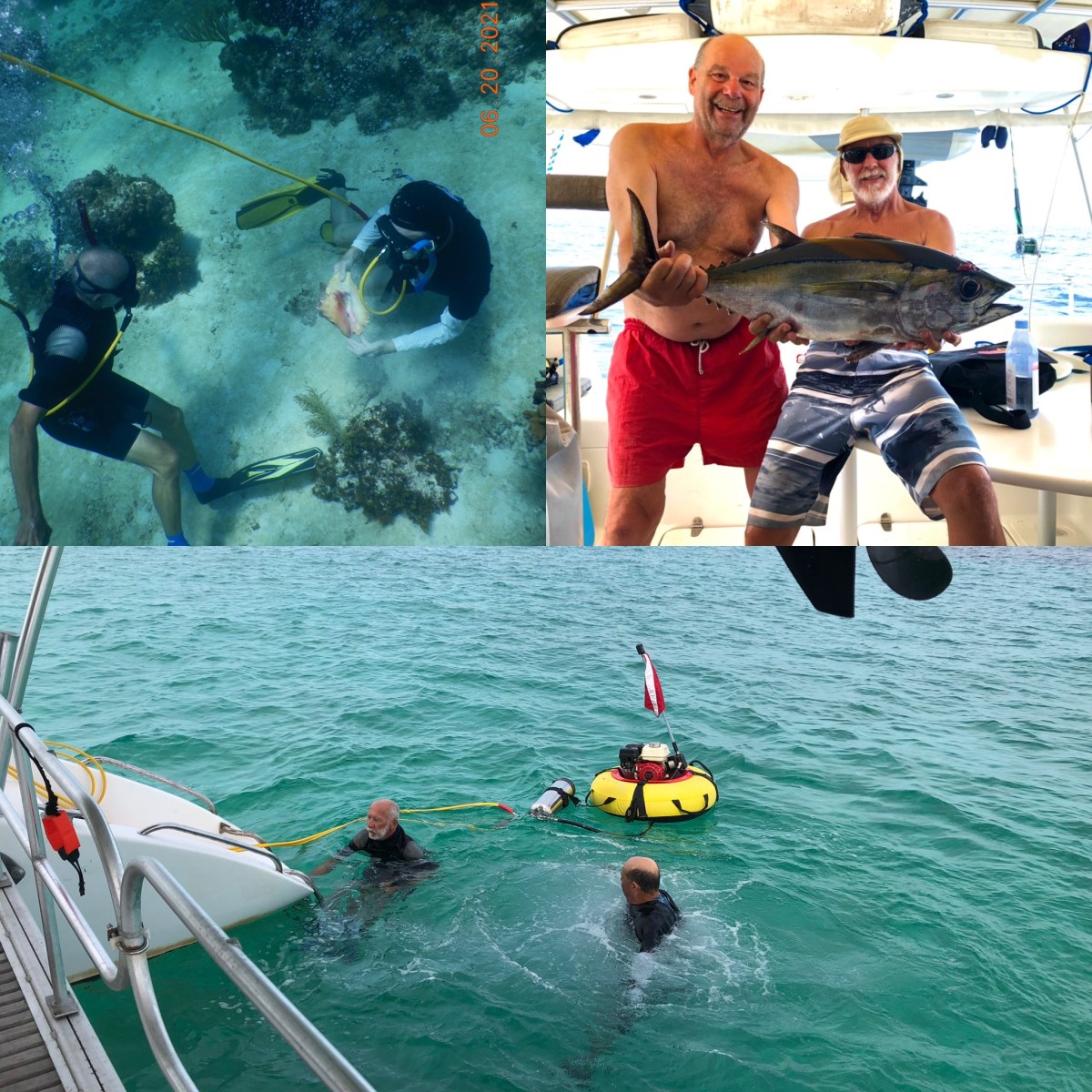
We continue to enjoy our time here in the Abacos. Our friend, Ian, was with us for a little over a week. We did a bunch of diving and eating lunches ashore, enjoyed quiet anchorages, we even caught a tuna (and by “we” I mean Ian and Dave). It was wonderful to share an extended period of time with another human after more than a year of social distancing. (Thanks for coming, Ian!) He flew home this past Sunday. Dave and I did some boat chores, rested up a bit, then started planning our remaining time here in the Abacos. There is one more island we want to explore, Manjack Cay (also called Nunjack, locally), about 5-6 miles NW of Green Turtle Cay. We’re en route there now, but the timing of our arrival will depend on the path and timing of Tropical Storm Elsa. As with every day cruising, Mother Nature will decide.
It may seem a bit early, but even as we head for Manjack Cay, we’re already thinking about how we will return to the Berry Islands for August. Again, we work on Mother Nature’s schedule and that is ever changing. We can’t afford to miss a good weather window. At this point we’re just exploring route options. My goals are to pick a route that (a) l is ikely to provide the most comfortable ride, (b) minimizes the number of days we just “make miles,” and (c) isn’t boring. We are weighing the pros and cons of each route. If we are incredibly lucky, we’ll be able to accommodate both goals, but I’m not holding my breath. There are a couple of options north from Manjack, or we can return the way we came via the south route around Hole in the Wall. From Manjack, the route distances are similar.
Going back the way we came means going back down to the area of Little Harbor and possibly waiting there for the right weather window to make the trip around Hole in the Wall. It would be a comfortable place to wait. This route would require us retracing our path through the Sea of Abaco. This isn’t a bad thing, because this is where we’ve been hanging out for the past 5 weeks and we like it here. We could transit the area quickly or take our time and revisit some of our favorite spots one last time. We know the anchorages and harbors we can avail ourselves of on this route. This route is not remote, well, compared to the north routes. The route from Cross Harbor across the Northwest Providence Channel to the Berries is a good angle for the prevailing seas and winds this time of year, plus we have our track line to follow and know we can anchor in the dark at GHC, so timing isn’t an issue on that leg of the journey. A potential disadvantage is finding a good weather window for the first leg around Hole in the Wall. We’ll be traveling SSW from Little Harbor and then NW a short distance up to Cross Harbor. This time of year, the prevailing winds and seas are E-SE. Winds under 10 knots and seas under 4 feet with a long period from SSE would be ideal. The more south or the more east, the bumpier the ride gets, unless the wind and seas are so light as to not matter. If we choose this route, we’re committed, because the other routes are too far north from Little Harbor for us to change our minds.
Alternately, we could continue northwest from Manjack Cay and then west across the top of Little Abaco and West End Cay, down into the Bight of Abaco to Mores Island, then from Mores Island cross the Northwest Providence Channel to Great Harbor Cay. This is a more remote route with many small, uninhabited islands. Remote and quiet can be very nice, when the conditions are good. This is also an exposed area with fewer anchoring options if winds shift in different directions. How much we would get to enjoy these quiet areas would depend on the weather. If we get a stretch of calm, we could dub our way to the Bight, otherwise we’ll find ourselves just making miles so we can get to the next protected area. A big advantage to this route is that the prevailing wind and sea directions this time of year would be in our favor, and the Bight tends to be calm unless winds are over 15 kts. One of the challenges of this route is the need to time our entry into the Bight with the tide at Spence Rock before continuing another 38 miles to Morse Island, with no option to stop in between. If mid tide rising isn’t early enough we’ll be trying to anchor at Mores Island in the dark. We’ve also heard that the Bight of Abaco is a thunderstorm magnet this time of year. Mores Island sounds like a reasonable place to wait for a weather window to cross to Great Harbor Cay, should that be necessary, and the route from Mores island to GHC is pretty good for the prevailing winds and seas.
If we didn’t want to take the south route and didn’t want to risk the shallow Bight of Abaco and its potential thunderstorms, we could continue about 50 miles past Little Abaco and then turn south to enter the north end of the Grand Lucayan Waterway, a canal system that bisects Grand Bahama Island. Again, prevailing winds and seas are likely to be helpful, which is an advantage. We’d have to time our entrance across the shallow north entrance of the canal with the tide again, but once inside the canal system there are numerous offshoots in which we can safely anchor if we can’t transit the entire canal the same day. The angle from the south end of the canal system to Great Harbor Cay is less likely to provide a comfortable ride given the prevailing winds and seas. It would seem less likely we would choose this route.
So there you have it, more information than you need about routes you probably don’t care much about. Dave and I keep wavering about which to choose. When we’re driving a car we will often return from a destination via a route different than that which we took to get there. Why go back the way we came when we can explore something else? It would be nice to check out the northern reaches of the Abacos, if the conditions were right. Alas, there’s no guarantee of the “right conditions” on the water, especially in a slow boat during hurricane season. Our decision point is Manjack Cay. When we’re done exploring there, we will have to commit to a route. Stay tuned!
Prior to the pandemic, when we thought last year was the real start to our cruising life, we did not plan to visit the Abacos because they’re in the extreme NW Bahamas, the opposite direction from the Caribbean, our ultimate target. Besides, they had just been hit by Dorian in September 2019 and were only about 6 months into their rebuilding efforts when we set out from Georgia in early February 2020. (If you’re new to my blog, read this post to find out why our boat was in Georgia). When we realized we wouldn’t have a full cruising season again this year we talked about what we would or could do given the ongoing pandemic and Dave’s hand surgery and recovery timeline. Regardless of where we chose, we knew Indigo Lady would be in the hurricane belt for the entire hurricane season, with us on board for part of it. We also knew we couldn’t go too far.
As lovely as it would have been to see more of the Florida Keys, we didn’t want to delay our trek to the Caribbean any longer. The Bahamas are the first leg of that journey for us and they have a wonderful hurricane hole in the Berry Islands where we can leave Lady when we go back home to New Hampshire this fall. Extra bonus, when we resume cruising next January we don’t have to cross the Gulf Stream; it can take weeks in the winter to find the right weather window to do so. Now the Abacos seemed like a viable destination. Other cruisers rave about it as a destination for its friendly people and the beautiful diving and scenery. We knew we could easily spend a couple of months there exploring. They could use all the visitors they can get, too, since their economy relies heavily on tourism, which they have not had a lot of these past two years. To the Abacos we would go.
We have been in the Abacos coming up on four weeks. We’ve had several days of diving and have explored each island we’ve been to. From what I’ve read, the reefs have been declining over the years, some due to increased tourism but mostly due to the changing climate. Still, they’re in better shape than I expected. There have been a couple of beautiful dives with a good crop of healthy corals and small reef fish, others have been mostly brown with either remnant healthy corals or returning corals, hard to tell. The Bahamian government has been creating more coral & fish preserve areas since the early 2000s and there are several here in the Abacos. No fishing is allowed in these areas and you have to either anchor in sand, avoiding all coral and sea grass, or pick up one of the dive moorings, few of which remain after Dorian. I’m glad to see these efforts. Hopefully they’re making a difference. Our friend Ian is with us for a little over a week. He dove this area about 20 years ago, so it will be interesting to hear from him how the reefs have changed over those two decades.
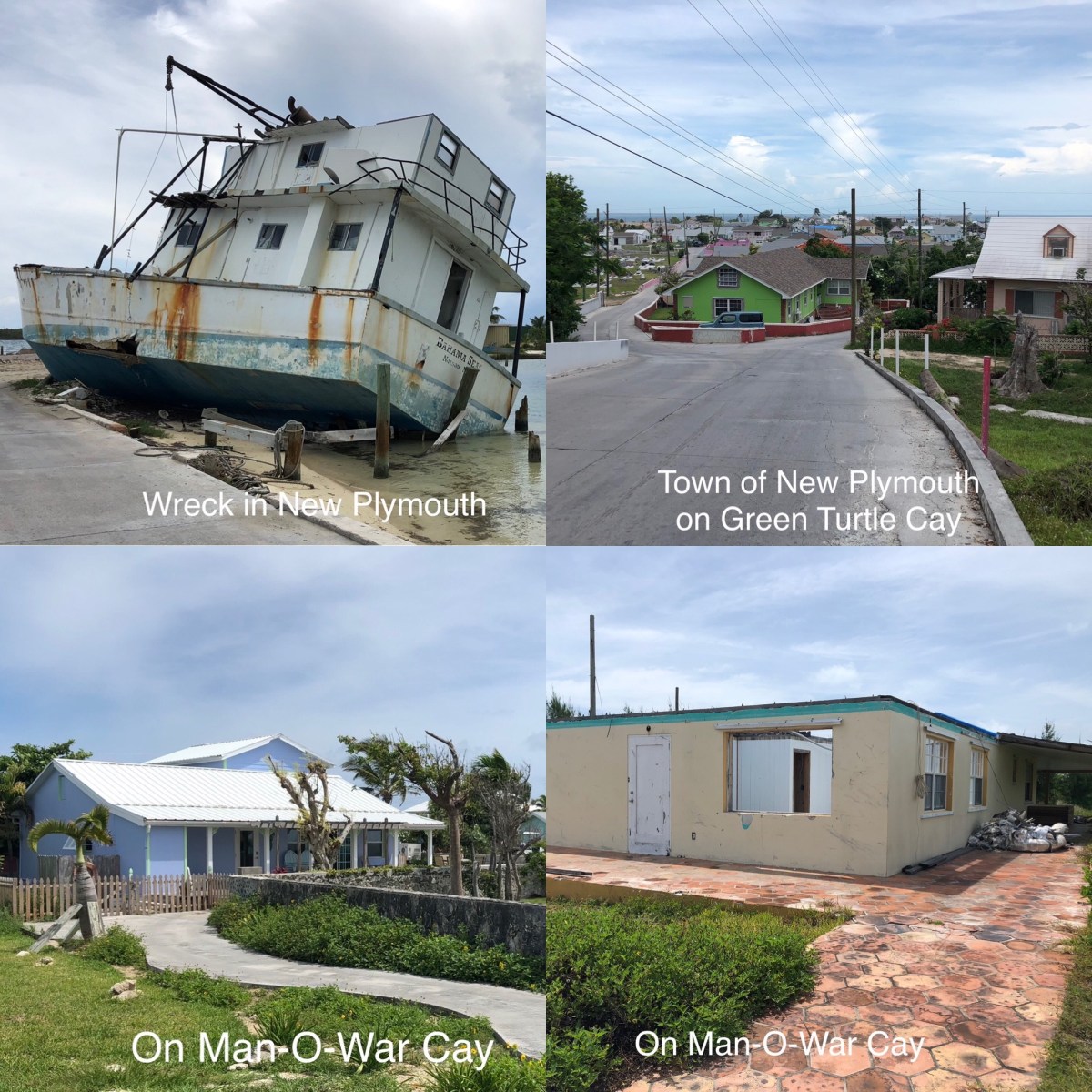
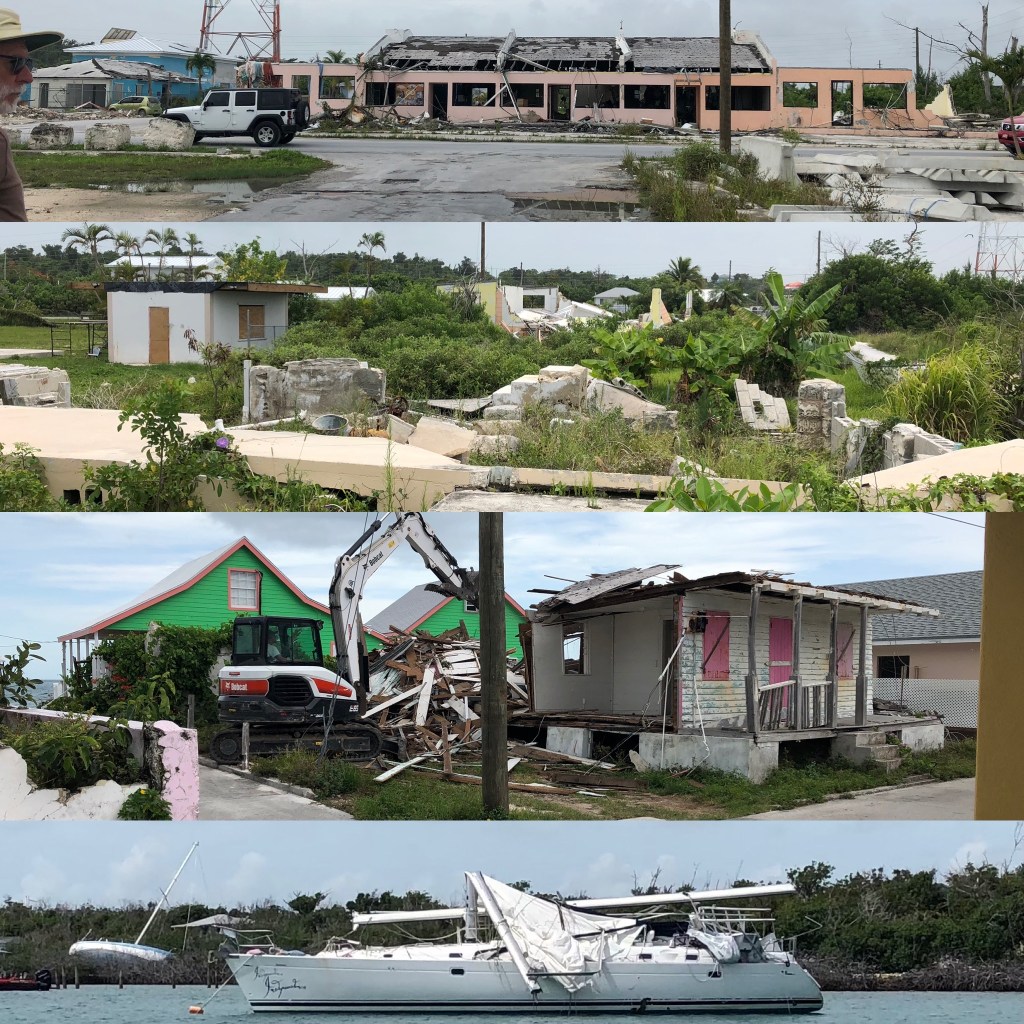
Thus far we’ve spent time exploring the out islands of Elbow Cay, Man-O-War Cay, Great Guana Cay, and Green Turtle Cay. These are barrier islands facing the Atlantic, on the east edge of the Sea of Abaco. We spent one night at anchor outside of the private canal development of Leisure Lee on the “mainland” of Great Abaco Island on the west side of the Sea of Abaco, and a couple of nights at Marsh Harbor, also on Great Abaco. These places are at varying stages of recovery. Hope Town, on Elbow Cay, and Green Turtle Cay seem to be the furthest along. Marsh Harbor is still looking wrecked. Dorian first made landfall in the Bahamas over Elbow Cay (Hope Town) with 1-minute sustained winds of over 180 mph and gusts over 200 mph. It crawled slowly over Grand Bahama and didn’t weaken for a couple of days and even as it eventually did weaken, it pulled northward slowly. Most of the locals were stuck here during Dorian. I can’t imagine the terror they felt or the emotional scars that experience left, especially on the children. One woman we spoke to on Green Turtle Cay told us that families moved from one house to another during the storm; as one was destroyed, everyone moved to the next.
There is a lot of active rebuilding in all these areas. It is through the unquenchable perseverance of the locals, supported by numerous aid organizations, that these islands are making their comeback. We see barges running back and forth between islands with heavy equipment and building supplies. On every island is the sound of saws and hammers and the sight of stacked new building supplies waiting to be used. On Green Turtle Cay we watched a house being demolished and loaded into a dump truck for removal. Something new will take its place. Each island we’ve visited has at least one open restaurant, a couple of open shops, and a grocery store (although the one on Great Guana looked closed to us). We’ve been able to find fresh produce easily, which I wasn’t sure would be possible in a remote area like this that’s still recovering from a hurricane. We’re going to have to remember to actually eat all the frozen veggies we stocked up on in the U.S.!
The pandemic hasn’t made the recovery any easier. At least 50% of the Bahamas’ economy relies on tourism one way or another. The Bahamian government has had to balance the need for tourism dollars with the need to keep its people safe from COVID. They have opened up more to travelers, requiring pre and post-arrival testing for those unvaccinated. As of May first, fully vaccinated travelers with proof of vaccination can forego the testing requirements. Masking and social distancing remain in place, with varying degrees of enforcement on the different islands. They have started a vaccination campaign here, and still impose island by island shutdowns as warranted to control spread.
There are other parts of the Bahamas we could have explored this year, equally as beautiful, equally as close to the Berry Islands where we will end this cruising season, but not devastated by the hurricane. We decided that this is a small way we can support their rebuilding efforts; show up and spend money. We’ve pulled into the harbors that have moorings and paid the (remarkably small) fee to support the mooring owners, which have surprisingly not been big marinas. We tour the town on each island and while ashore buy lunch, a handful of groceries, sometimes treats at the local bakery, and mementos and gifts in their shops. We’ve purchased some groceries in each location and some small mementos and gifts from their shops. We also learned that there is a way to donate online to support the dive moorings. We don’t care about amenities; we have everything we need onboard. Some islands have multiple lunch options, others only one. We don’t care, they all serve fabulous food. We can see hints of what the Abacos were before Dorian and why people flock here by land and sea each year, why other cruisers rave about the Abacos. Sure, we’re missing out on meeting a bunch of other cruisers, but we also don’t have the typical crowded anchorages and mooring fields and we’re having some great conversations with locals. We’re having a wonderful time. I’m glad we came.
It’s been a tough two years for the residents of the Abacos, and it will take them years to completely rebuild. If you feel so inclined, there are numerous ways to support the residents of the Abacos in their rebuilding efforts. Please share this link widely. (I’m just passing along information; I don’t get any compensation for advertising this list.)I’ll leave it at that. Stay safe and take care of each other!













 Life on Lady