Oh my aching head!

Yes, I’m talking about toilets. For you non-boaters, toilets on boats are referred to as “heads.” I’m sure there’s a history to that name, but I don’t feel like researching it right now. This is a post about the non-glorious side of cruising and it deals with toilets and holding tanks, so keep that in mind before you decide whether to keep reading. 

Allow me to set the stage a little. Indigo Lady was a charter boat, and as such, she was set up with four sleeping cabins and four heads (head can refer to the toilet, or the bathroom in general). They were all manual pump toilets. That means that once you do your business, you have to pump a handle to empty out the “black water” (waste). On Indigo Lady, we can set a valve, per toilet, so that the black water either goes directly overboard or into the holding tanks. Our holding tanks are our keels, which are hollow and molded onto our hulls. When the heads are set to go into the holding tanks, those eventually fill up and we have to pump the entire holding tank overboard. When we bought Lady, this was also done manually, and usually required 100+ pumps. In U.S. coastal waters, emptying black water from holding tanks must be done no less than 3 miles offshore. On inland waterways, like the ICW (Intracoastal Waterway), there is no pumping overboard. Instead, one must go to a pump out station to have the tank emptied by suction, just like having a septic tank pumped at home, except it usually has to be done weekly and you have to keep a log (just in case an authority asks; nobody ever asked for ours).

When Dave converted Lady to solar electric, he also installed two electric flush toilets on the port side. Likewise, pumping out the holding tank on that side is electric. On the starboard side, Dave removed the forward toilet so we could put in a washing machine. The washing machine, being “gray water,” pumps directly overboard when it drains. The aft (rear) toilet and overboard pump out remain manual. We left starboard manual in case anything ever goes wrong with the electric heads on port. There are a couple of advantages to electric pump toilets. First, one doesn’t build up callouses by repeatedly using a pump handle. More importantly, to my mind anyway, the electric toilet pump has a macerator that grinds everything up, as does the pump to empty the holding tank overboard. This means that what gets dumped overboard is a slurry which break down faster. The manual pump toilets and overboard pump leave everything pretty much intact. How’s that for an image? You’re welcome. 💩

We keep Indigo Lady’s toilets set to empty into the holding tanks. In the coastal waters of New England, it’s really easy to get 3 miles offshore to pump out holding tanks, and pump out stations and pump out boats are also becoming more common. In the ICW, being a no discharge zone entirely, pump out stations are very common. The reality from the Bahamas to St. Kitt’s, where we’ve cruised thus far, is a little different. Pump out stations are either nonexistent or exceedingly rare. Here’s some more reality, down here nobody goes 3 miles offshore to pump out their holding tanks, and I’d wager that toilets of most cruisers and charterers, especially charterers, pump directly overboard with each flush. Those of us with holding tanks try to empty them in an open waterway where there’s good water flow, but if one gets pinned down in a particular anchorage for too many days, well, tanks have to be emptied. Courteous boaters will wait to do that until nightfall. Not everyone is courteous.

You’re still reading. I’m impressed. On to our current head issues…

Like I said earlier, we have Lady’s toilets set to flush into the holding tanks. Last Monday morning, I flushed the electric toilet like every other time. We’re used to a brief stink after a flush, especially as the tank gets more full. When we add to the tank, air gets pushed out through the vent hose to the outside of the hull. Depending on wind direction, the smell can blow back toward us. With this flush, however, the stink didn’t go away and it was stronger than usual. So, Dave lifted the bilge1 floorboard2 in the port aft companionway3. (If you need translation for that sentence, see the end of this post.) There was black water in our bilge. First, yuck! Second, that should NEVER happen. If a holding tank is full, the next flush is supposed to go directly overboard through the vent hose. Uh oh! 

The exact order of things hat happened after that are a bit of a blur, but the first step was to run a bunch of sea water through the bilge to clean it out. (Each bilge has a pump that sends any accumulated water overboard.) Then we did a variety of things that included emptying the holding tank and flushing repeatedly while Dave used a flashlight in very tight places to try to see what was leaking. After we’d emptied the holding tank, flushing toilets did NOT put toilet water into the bilge. Dave could see nothing leaking on any hoses or connections (the ones he actually could see) when we flushed. 🤔 What we learned is that we have no idea why this is happening. So we did a fresh water rinse of the bilge with dish soap, followed by a bleach and water wipe down. Then Dave cleaned himself. No, he wasn’t covered in filth, but when dealing with sewage, better safe than sorry. Everything was fine again, until it wasn’t.

After 48 hours of using our head like normal, a flush backed up into the bilge again. We caught it earlier this time because we were checking after every flush, so it wasn’t quite as messy. More flushing and looking with a flashlight. Empty the tank again. We usually go about 8 days before needing to empty the tank. Why is it full after 48 hours? Do we have a leak in our keel that is allowing in sea water, thus filling the tank faster? How much did we fill the tank with sea water during out testing on Monday after we had pumped it out? A new round of troubleshooting still revealed nothing, but our tank was full, so we emptied it again. Then Dave set our toilet to pump directly overboard. He wanted to set the aft head to do the same, but those valves haven’t been moved since 2019, and they were stuck good. Fortunately, that head is rarely used except for when we have guests aboard. 

Where does this leave us? Our head is pumping directly overboard, so it’s not contributing to the port holding tank. After 3 days of this, the level in that tank has not changed (we can tell by removing the vent cover to look in). This is very good news, because it means we don’t have a leak in our keel letting in sea water. If we’re ever in an anchorage where we think we should not be pumping directly overboard, we can either use the port aft head or the starboard head. Our guest, who arrives today, can use the port aft head, as long as we are able to pump out the holding tank every 2-3 days, otherwise he will use our head or the starboard one. I’m very thankful that we have heads on each side of the boat!

I’m sure that’s more than you ever wanted to know about marine heads. I aim to educate; it’s in my blood. 😁

I promise to return to writing about the more enjoyable parts of our travels, at least until something else inglorious arises. I want to keep it real.

Until next time, stay safe and take care of each other!
USVI Dives 2024

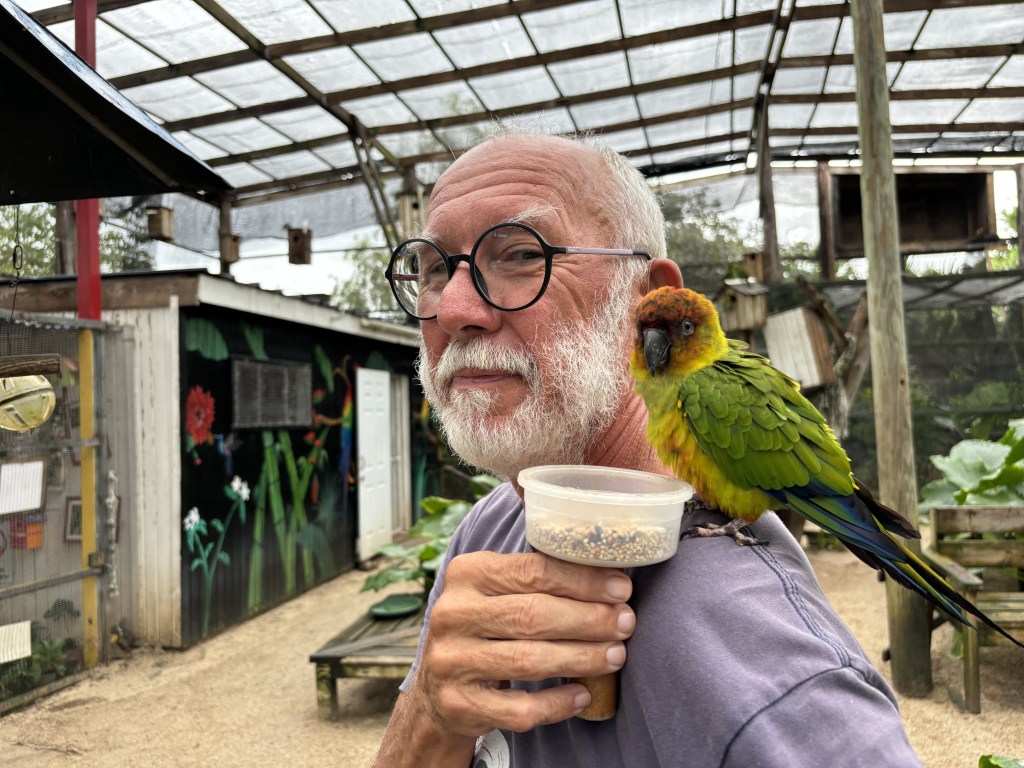
I have finally caught up with my dive photos from our time in the USVI. I managed to get my count down from about 250-300 photos/videos clips to 56 photos and 10 video clips. I’m going to attempt to stop taking so many underwater pictures. How many photos of barracuda does one need, really? I’m going to try to focus creatures of which I don’t yet have pictures. Sure, that’s gonna work. 😂 There are some sea creatures I enjoy so much that I can’t help but take just one more photo. (I’m looking at you, porcupinefish.)

I don’t have a fancy underwater camera, so the camera doesn’t always capture the way things looked to my eyes. I use Photos and iMovie to edit the lighting aspects of my images to get them closer to how I saw them. Nothing fancy; I don’t want to misrepresent the reality.

I spend quite a bit of time trying to identify the creatures I capture in photos; I like to know what I’m looking at. Take my identifications with a grain of salt, though; I’m not an expert. We have a good set of identification books onboard by Humann & DeLoach, but sometimes my pictures don’t jive with the books’ pictures and descriptions, in which case I can only attach a general level identification- sponge, parrotfish, etc. I’m especially bad at identifying specific sponges and corals, so when I name those in a slideshow, you may just see “pretty orange sponge” as a label. Those who know me personally, know that I used to be a biology teacher, but I’m not going to bore you with taxonomy. I will, however, say that sponges and corals are animals; perhaps not everyone knows that. Now you do. 

In this post I have divided my underwater finds into two separate slideshows- “scenery” and “creatures.” Just enjoy the scenery; I didn’t label anything in that one. The “creatures” slideshow names the organisms and organizes them into “not fish” and “fish.” No label beyond the name of a fish indicates that it’s an adult. Some reef fish young don’t look like the adult version, however. You may see me include in my labels: Juv (juvenile) or Int (intermediate) if the picture is not of an adult. For parrotfishes and wrasses, IP (Initial Phase), indicates an adult, while TP (terminal phase) identifies a sexually mature adult male. You can, of course, ignore the labels and just enjoy the pretty pictures.

We’re in the BVI for another couple of weeks and have a friend coming to visit a week from today. (Looking forward to having you aboard again, Ian!) At some point I’ll sort through my BVI dive photos, but since we’re not done diving here yet, that won’t happen for a while. Don’t worry, I have other things to write about.

Until next time, enjoy the USVI dive pics, stay safe, and take care of each other!

From our dives at Sprat Point on the south end of Water Island, at Buck Island off St. Thomas, and at Cow & Calf.
From the same dives as mentioned in the caption of the Scenery video.

Riding out big winds in the BVI

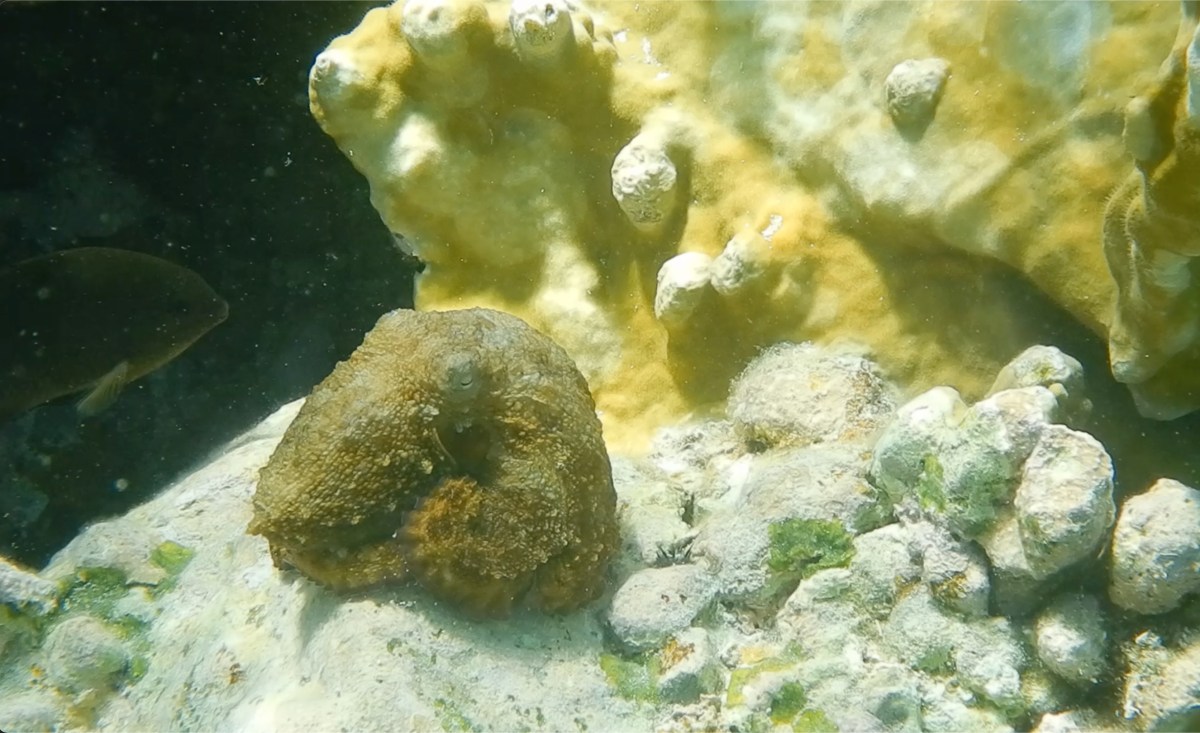
Our final night in the USVI was spent on a NPS mooring in Waterlemon Bay on the north side of St. John. The morning of 4/6 we had a final USVI snorkel around Waterlemon Cay where I saw my first octopus in the wild!  As usual, I was dubbing along quite a bit behind Dave, when I looked over at him to see him waving me over, his eyes fixed on a small coral head. I kicked over quickly and followed his finger to… a rock? The rock twitched, and it had an eye. It was a small octopus about 6-8” from head to tentacle tip. It was not happy that we were watching it, so it moved under the coral, where the fish it had replaced showed its displeasure by repeatedly nipping at it. The octopus went back to the coral’s surface, then swam on to another piece of coral. It was so exciting! After our snorkel, we set off to clear into the BVI at West End, all of 1.5 nm away. That done, we had lunch, then headed over to Benures Bay on the north side of Norman Island, a place we’d anchored when my folks were with us last month. We had a couple of days of calm seas ahead of us and we wanted to make the most of them by doing some diving. The first location was around the western side of Norman Island.

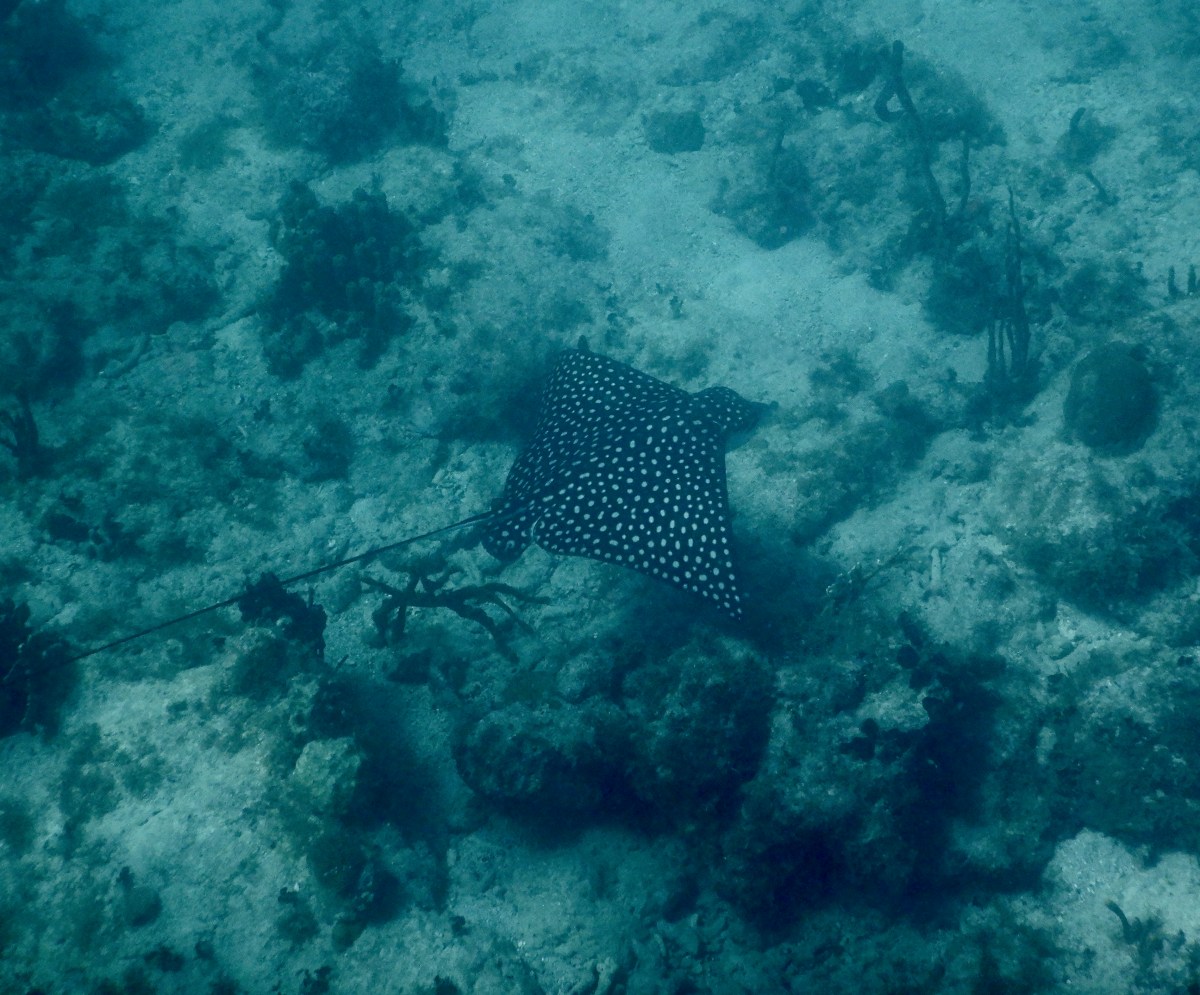
We hauled anchor right after breakfast the next morning and headed around the corner to the west side of Norman Island before it got crowded. It’s a popular spot. There were two things we wanted to do, a reef dive and a cave snorkel. We picked up a mooring ball between the two, loaded our dive equipment into dinghy, and grabbed one of the dive moorings at Angelfish Reef on the SW corner of Norman Island. At first, I was unimpressed. The reef is in a sad state, but once we got around the point to the south, there was much better coral structure, which means lots of nooks and crannies for fish. There were also a fair amount of sponges and corals. The highlights of the dive were the large eagle ray that passed within a few feet of us, and a 4’, ~80 lb snapper that emerged from a rock overhang. We believe it was a Culebra snapper. It was huge!

After our dive, we returned to Lady, grabbed a quick snack, and offloaded our dive-specific gear. Then we headed to the dinghy tether at the caves. There were three caves to explore. They do not go inward very far, and the water inside is not deep. We could easily stand in each. Most of the fish were schooling just outside the entrance to each cave, but two of them had schools of glassy sweepers inside. The cave farthest north was the deepest and required a dive light; it got dark pretty quickly in there. Dave illuminated the school of glassy sweepers, but, alas, none of my photos of them came out. Fortunately, I had video of them from an earlier dive; I just hadn’t yet identified them.

Dive and cave snorkel complete, our next stop was Deadman’s Bay on the eastern end of the north side of Peter Island. We went by way of Dead Chest, a rocky little island just outside of said bay, to scope out its three purported dive sites. The mooring ball for the western dive site was missing, but we found one on the north side and two on the south side. After a quiet night anchored in Deadman’s Bay, we popped across to the south side of Dead Chest with Lady and picked up one of those two moorings. The reef right below us was unimpressive, but Dave followed an easterly ridge and we found the good stuff. I haven’t sorted through those pictures yet. I’m backlogged on my BVI dive pictures. Back aboard Lady we had lunch, then set off for the anchorage we had selected to ride out the big winds that were forecast.

The big winds were predicted from the NE-ENE for several days, so we needed a place protected from those directions. Our other criteria were that it have cell signal so we could tend to some business, and so I wouldn’t lose my 3+ year streak on Duolingo, and we wanted to be able to anchor rather than pay $45-$55/night for a mooring ball. Many of the anchorages here in the BVI have been filled with mooring balls, greatly reducing the space available to anchor. It’s peak season here, too, so there are many boats vying for the same anchorages. We opted for the south side of Peter Island, which is not frequented by many charterers or liveaboards, and settled in at South Bay. We were there five nights, Monday-Friday. In hind sight, we probably could have spent Monday & Tuesday night elsewhere, done another dive or two, and been fine. The big winds didn’t really kick in until overnight Wednesday. Then it was very windy, overcast and rainy most of Thursday & Friday. Hind sight is always 20:20. Such is life. 

We weren’t completely idle while in South Bay. Tuesday, the day after we arrived, we hauled anchor and popped over to Key Bay and the wreck of the Willy T2. We’d already dived on the wreck, but we wanted to spend time on the extensive reef arms between which it is sandwiched. We returned to South Bay afterward. We cleaned our hulls. Dave made water, and he replaced the starboard engine room fan and a bilge switch that had failed, which he discovered when he went down to replace the fan. He also replaced the dying fan in our cabin. I did laundry and some baking and spent many hours sorting through and editing dive photos from the USVI.

This morning we decided to head elsewhere. We went around the west end of Peter Island and up into Drake’s Passage and found it manageable until we got past the east end of Peter where it’s more exposed to the open ocean. The seas were bigger there and it got a bit bumpy. We aborted our attempt to check out Cooper Island and turned toward the east end of Tortola and Buck Island, which was supposed to be a pretty sheltered, shallow anchorage. We dropped anchor in 10’ of water inside three other boats anchored there. It is indeed pretty sheltered here, just a little wrap around swell from the SE point of Buck Island, but not bad in a catamaran. We went ashore for a bit of a walk; it had been 4 days since we’d set foot on land and we wanted to stretch our legs. Dinghying back to our boat, we swung by our neighbor’s catamaran. They were about to head over the shallows into Fat Hogs Bay to go to the Riteway market, so we followed along. Fresh produce- yay!

Not sure where we’ll be off to next. The wind and seas will decide that. I ran out of energy to put together a slide show of dive pictures for you, so for now, enjoy the short video of that octopus we saw.

Until next time. Stay safe, and take care of each other!

While we were waiting…

This cruising season has felt like a lot of waiting. We’re used to waiting for weather windows, of which we fortunately don’t need many this year, but this season has been about a different kind of waiting. While we waited for a weather window to get from St. Kitt’s to the USVI, we were simultaneously waiting for our new battery cells to arrive in St. Thomas. Once they were in the USVI, we waited for winds and waves in the harbor to die down enough to be able to get the batteries onboard safely. Then we waited for my folks to arrive. We waited for our new freezer to arrive. We waited for the Salty Dawgs meetup in the BVI to start. Just as the meetup was starting, we learned that our current boat insurance provider would be dropping Caribbean coverage. That launched us into four weeks of waiting for a new policy to pan out, which included waiting for various responses to our numerous emails requesting policy and survey quotes, waiting for the day of the insurance survey we eventually booked, and waiting for the survey report to be finished (the latter happened quickly). Then we waited for the final insurance approval, which, thankfully, also arrived quickly. Yes, we have a new insurance policy that will commence as soon as our current one expires. Yay! Now we’re just waiting for wire transfer information to pay them, but that’s the icing on the insurance cake at this point. 

While we were waiting for insurance to pan out, it also meant waiting to determine the rest of our cruising plan before heading to wherever we would haul out the boat for hurricane season. This also meant waiting to book said haul out facility, as well as the lodging we’ll need during the boat closeup process. We are extremely lucky that our new policy allows us to keep our boat in St. Kitt’s again for hurricane season, so we don’t have to alter our original cruising plan. Hooray! This isn’t a cruising season where we’ve had to make a lot of miles, so we have had the luxury of being able to wait comfortably, and we have been enjoying ourselves. There are far worse places to be waiting.

There are some advantages to all this waiting. Since we’ve been staying close to good cell coverage areas in order to deal with insurance, we’ve been near easily accessible on shore WiFi where I’ve been able to do some data-intensive online stuff over WiFi rather than using our data. We’ve done a lot of snorkeling. We reconnected with cruising friends we made last year. A little over a week ago, we spent several lovely days in Brewer’s Bay where we made some new cruising friends, including Connor, Blake (@captain_blake_sparrow on IG) and Dan (Adventureman Dan on FB and IG). We’ve also had some of the best diving since Puerto Rico last April; three awesome dives in two days!

With the insurance monkey off our backs, we will continue our explorations, hopefully only with the typical waiting for the right weather conditions 🤞. Our current plan is to head to the BVIs for a few weeks, and from there to St. Martin for a few weeks before returning to St. Kitt’s. As always while cruising, we’ll see how that goes.

It will take me a while to sort through the dive pictures, but I’ll get to them eventually. For now, enjoy this slideshow compilation of our various snorkel excursions thus far. Until next time, stay safe and take care of each other!

The Wreck of the Willy T2

Last week, I promised you something fun. Here it is. 

The William Thornton Floating Bar & Restaurant has been an attraction in the BVIs since 1989, reachable only by boat. It is anchored in The Bight of Norman Island and serves lunch and dinner daily. It’s reputed to be quite the party spot at night, where many a cruiser and charterer jumps into the water from the top deck and drinks (sometimes simultaneously) until they peter out. The original “Willy T,” as it is affectionately known, was a wooden schooner named for the Jost Van Dyke-born architect, William Thornton, who designed the original U.S. Capitol. Sadly, it sank on its mooring sometime in 1996 when it sprung a leak in the night. An attempt was made to move it to become a reef, but the currents tore it apart. Its steel-hulled replacement, the Willy T2, was a decommissioned tanker that the owners fitted out for their needs. Alas, Willy T 2 was destroyed by hurricane Irma in 2017. The owners purchased a replacement in 2018 and had it renovated to look much like the Willie T2, and after a brief stint anchored in Great Harbor at Peter Island next door to Norman, it returned to its home in The Bight. Yes, we had lunch there with my folks one day, but that’s not the fun part. Keep reading.

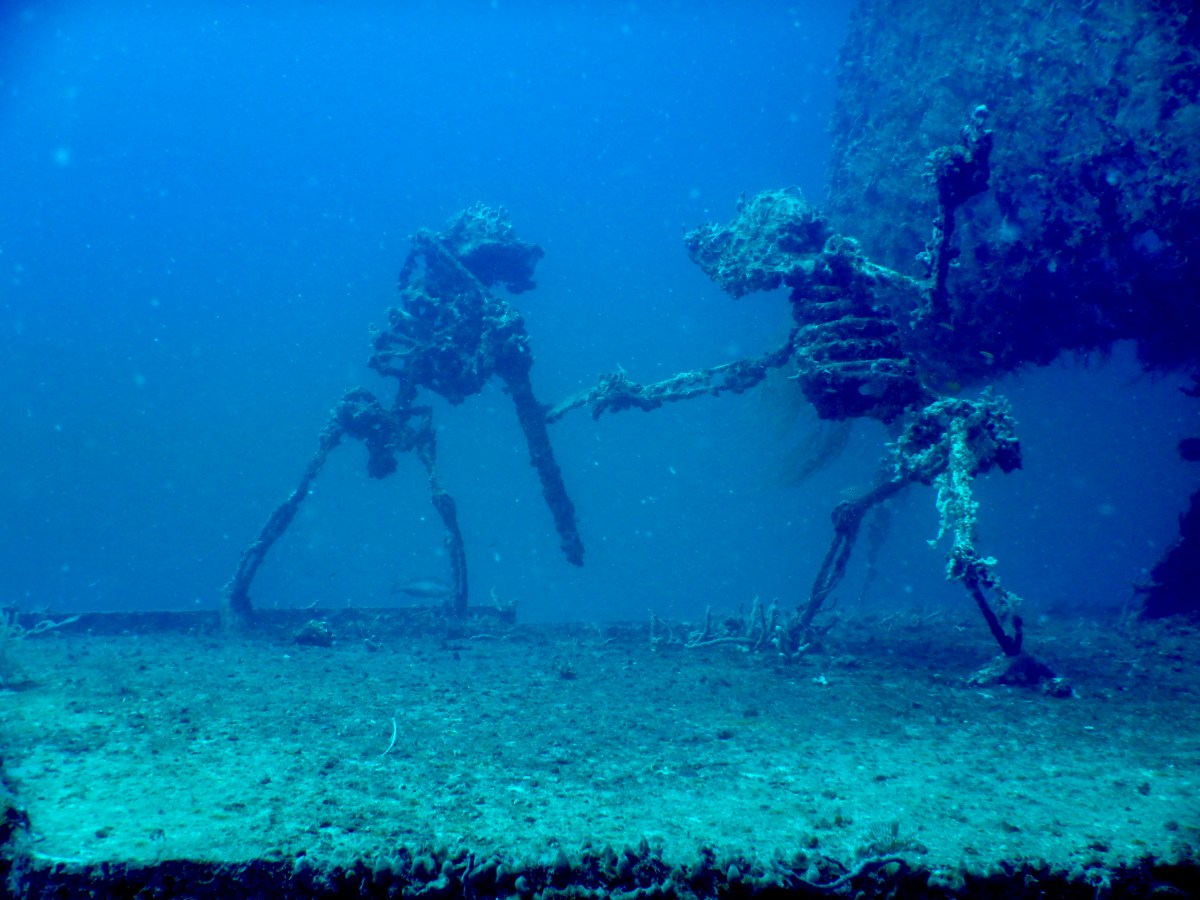
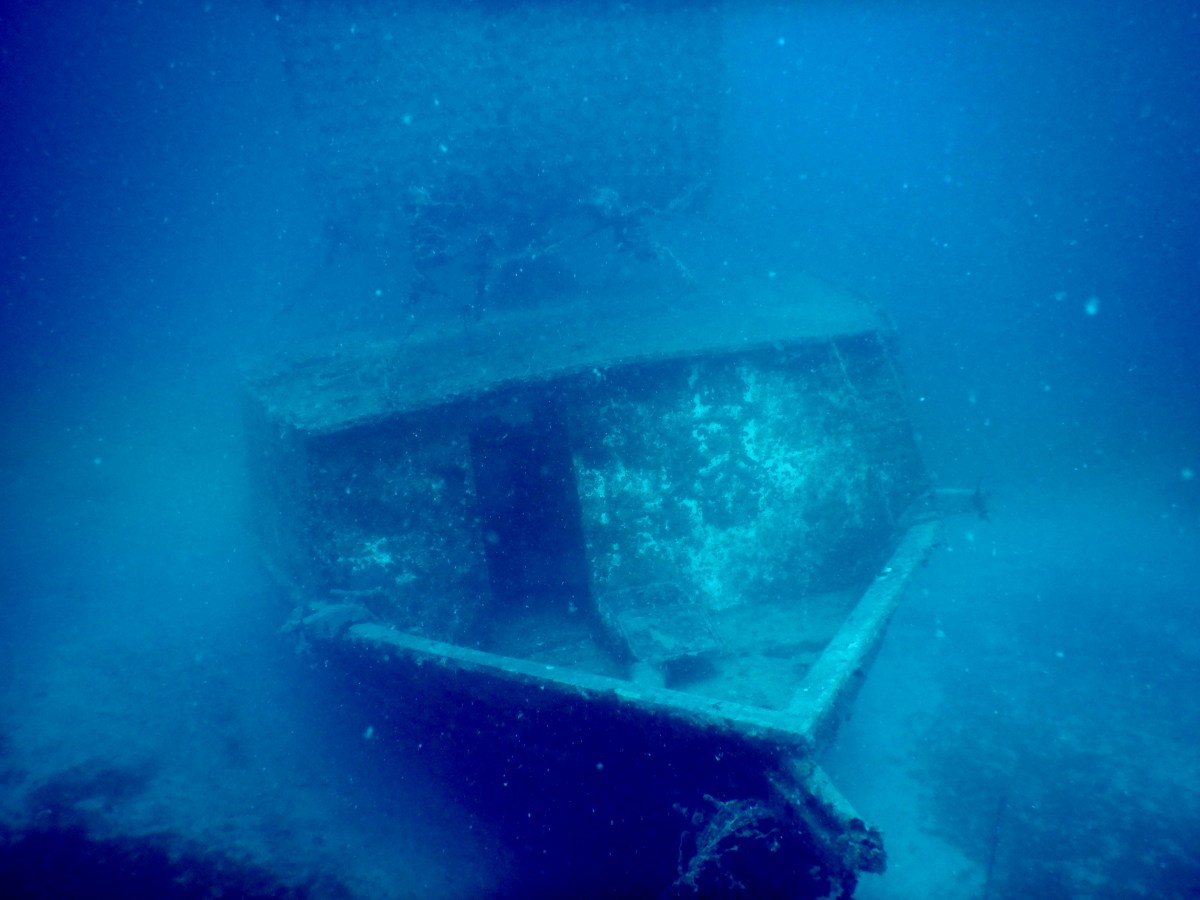
What does one do with the wreck of a floating restaurant that is languishing on the shores of Norman Island? If you’re the non-profit organization Beyond the Reef, you dress it up with some pirates, sink it, and install dive moorings so people can tie up their boats and enjoy a dive on this piece of art. (Dave says that now makes it a Wet Willy 😁.) Beyond the Reef successfully sank the Willy T2 in August of 2019 between two reef heads in Key Bay on the south side of Peter Island. All they ask is a $5 donation/person (honor system), which they donate to a local children’s swim program. You can learn more about Beyond the Reef and its other underwater artistic installations here

We anchored in the lovely Key Bay anchorage area, donned our dive gear, and towed our hookah out by dinghy to one of the dive moorings. In the water we went, about 55’-60’ down, the extent of our hoses. Due to our hose limitations, we could only enjoy the exterior of the vessel and the surrounding seabed, but enjoy it we did. It was a hoot! If you have the time, check out Beyond the Reef’s photos of the Willy T 2 build and sinking so you can compare those to the pictures I took for the slide show below. Which is where I am leaving you today.

Enjoy the slides of the Wreck of the Willy TB2. Until next time, stay safe, and take care of each other!

Catch 22

Wow, it’s been just over 3 weeks since I’ve posted! You could infer that it’s because I’ve been busy enjoying myself, and I have been. The truth, however, is that I haven’t been “feeling the blog.” I promise a blog focused on the fun we’ve been having, but right now I need to vent.

Our insurance company, Geico/BoatUS, is dropping Caribbean coverage. I get it; it’s becoming a more risky market during hurricane season, which is 6 months of the year. They came into that market late and it’s not really their gig. What I don’t like is how they essentially left us in the lurch. 

Our policy cycle is April 13 of one year through April 12 of the next year. We get our renewal notice via email during the first week of March, and each year since we started in 2019, the policy with the rider has automatically renewed. I suppose we should have seen the writing on the wall since they’ve been dropping boats over the past year, especially sailboats, which they seem to consider more problematic. Maybe it’s that big stick they have sticking up out of their middles (that would be the mast). At any rate, we got our renewal notice on Thursday, March 7. Only this time, it stated that they would be dropping Caribbean coverage. We could use the boat in mainland US and Canadian waters, and could call and request a “visitation extension” for the Bahamas and Caribbean for up to 120 days, but not for the period of June 1-November 30 (the entirety of hurricane season, for their purposes). For that, we had to call. Okay, Dave called. He told them we were in the BVI and asked for the visitation extension and told them we would seek an alternate plan for hurricane season. The following day, Dave had an email response. Not only would they not grant the visitation extension, they also told us that we weren’t even covered for the final month of our policy because we had left US waters without permission. Say what?!

I’ll cover that last point first. According to the NH Amendments page of our current policy, which is good through April 12 of this year, they can’t just cut us off like that, except for nonpayment. It took a couple of phone calls and emails to get them to admit that, but they finally did. So we are covered through that date. That gave us just over a month to find a new policy. 

Now for the part about not granting us the visitation extension. First, I should tell you that we started this policy in 2019 or 2020 and even purchased the rider that allows us to be in the Bahamas or Caribbean at any time of the year, without prior notification and with no restrictions other than excluding a few locations we’ve never visited. Each year since we started the policy it has renewed in its entirety, rider included, without our having to do anything except make sure they had the correct payment information for our automatic renewal payment. Now back to their refusal to grant the visitation extension.

They said they wouldn’t grant said extension because we’d left mainland US waters without notifying them ahead of time. Hmmm…..that little gem isn’t in our current policy document, not on any of the 20+ pages, which, I assure you, we reread thoroughly. More emails and phone calls. They were reading from the renewal policy, which wouldn’t go into effect until April 13. So….you won’t grant the visitation extension because we didn’t do something our current policy doesn’t require us to do? Starting to see the catch-22 here? They even gave examples of how “prior notice” might occur. We could have notified them prior to departing for the Caribbean, or when Caribbean coverage was added to the prior term and with a request to extend into the renewal. Hello, Geico/BoatUS, neither of those are part of our current policy and we’re not mind readers. Perhaps you should have told us about this after we renewed last year. On top of that, in a way we actually did notify them of our intent to remain in the Caribbean when, last spring, we asked for and were granted the relevant paperwork to store our boat in Puerto Rico for hurricane season. You know, an island in the Caribbean. 

Then there was this little tidbit at the end of the same email. They could grant an extension in the event of “extenuating circumstances beyond our control.” Really, Geico/BoatUS, you don’t see this? You CREATED an extenuating circumstance beyond our control. We know you won’t cover us past May 31, but at least give us until then so we have enough time to find a replacement policy! This is what happens when bean counters make decisions. 🙄

The griping part is over. We clearly are not going to get anywhere by appealing to Geico/BoatUS’s better nature. We will bring this to the attention of whichever entity monitors and regulates what insurance companies can and can’t do. Based on our interpretation of the NH Amendments to our policy, we think they’re in the wrong, but we’re not experts. 

Where does this leave us? We have asked our boating friends for referrals to the insurance companies they use and have sent out several requests for quotes. We’ve received some ballpark quotes, but before any quote can be finalized, we need to schedule a survey of our boat. The survey requires that our boat be hauled out of the water, so we have to coordinate a surveyor’s schedule with a boat yard’s schedule. We’re working on that. Hopefully we have it all taken care of before our current policy expires. 

Like I said at the beginning of this post, next time I’ll write about something fun that we’ve done. Maybe it will have something to do with the picture at the top of this post. 😉 Until then, please keep your fingers crossed for us, stay safe, and take care of each other!

Moving on to St. John

My folks arrive late on 2/13. We had rented a car for the day to reprovision for four people for a month, and to be able to pick up my folks at the airport so they didn’t have to get a taxi. We were all safely aboard Lady in St. Thomas Harbor by a little after 8pm. 

We kept it low key the next day so my folks could recuperate from their prior long day of travel. Our big adventure was taking them on the Safari Bus from one end of the island to the other and back, something Dave and I had done the week before. We got off in Red Hook for lunch at Duffy’s Love Shack, because it was so yummy last time. This visit, we were treated to their metal shark in motion. Dave & I thought it was just decoration on our last visit, but it’s actually animatronic. When somebody orders a drink called The Shark Tank, Love Shack (by the B-52s) starts playing loudly, the shark’s mouth starts munching, fog and bubbles are spewed out from the other end of the bar, and everyone starts singing. Well, the customers start singing. We asked our waiter how many times a day he has to listen to that song- about 10 times a day. I bet that wears thin.

The following day, Friday, we left St. Thomas for St. John, but first we popped up to Mingo Cay for a snorkel. There is one mooring ball there, right over the reef. We snorkeled and dove there last year with our buddy boats, Caretta & Wild Horses. It’s a great snorkel for my folks because they can do it right off Lady’s sugar scoops. After our snorkel we had lunch, then headed over to Caneel Bay where we picked up a National Park Service (NPS) mooring ball in Caneel Bay on the west side of St. John, just north of the town of Cruz Bay. We and our buddy boats had spent a few days there last year. We dinghied into town so my folks could check it out, and we stopped for a drink at High Tide’s happy hour, right on the water. The right side of the ferry dock, facing it from the water, is being renovated, but the dinghy dock was still open. However, we had to wade ashore in knee deep water because access through the ferry terminal was closed. We didn’t realize it at the time, but there’s also a dinghy dock on the left side with dry access to land through the terminal. We used that the next day, much drier and no sandy feet.

Saturday morning we headed back ashore to visit the NPS Visitor Center. First of all, their dinghy docks are all gone! Looks like they’re being rebuilt. We dropped my folks off at the Customs dock so they could walk around to the Visitor Center, then Dave & I went around to the dingy dock to tie up, on the dry access side this time. Then we ran into my folks coming back from the Visitor Center. Closed! Our pamphlet and the sign on their door said open daily 8am-4pm. Nope. Bummer! I called later and got their message that says their current hours are M-F from 8:15am-1:15pm. We stopped there briefly last year with our boat buddies just for some information and a park map, but we didn’t look at the exhibits. Oh well. We’re in the area through April; I’ll get there at some point this year. Instead, we walked over to the Catholic Church so my folks could find it the next morning, then returned to Lady for a dip in the water and a relaxing afternoon.

Sunday morning we dinghied my folks into town for Mass. Dave & I found a little coffee shop just up from the water. I enjoyed a latte and used their WiFi to tend to some boat club stuff. Dave went for a walk. When my folks got out of church, they met us there and bought us pastries to enjoy later. They enjoyed a coffee each while I trotted up the hill to the Dolphin Market for some produce, then we returned to Lady for lunch rather than eating ashore again. It gets pricey.

On Monday of this week, we left Caneel Bay for the north shore of St. John to explore the bays up there. During the winter months, the north shore is often impacted by northerly swell from cold fronts moving south and east from the U.S. If the swell is sufficiently large or short period, it can be uncomfortably rolly in those bays and landing a dinghy ashore can be treacherous. There can also be rip currents along the beaches. The first half of this week, however, was perfect for the north shore. We spent one night in Hawksnest Bay and two in Francis Bay, all of about 2.5 nm apart. In between the two are Trunk, Cinnamon and Maho Bays. We all snorkeled in Hawksnest. It was disappointing. These reefs are in a sad state. Maybe I’ll write about that another time. Dave & I dinghied to a couple of the beaches to check them out. Gibney Beach on the east side of Hawksnest is the legacy of an old island family. On the east end of this beach is the ruin of Oppenheimer’s house. Yes, the a-bomb Oppenheimer. Dave & I dinghied to Cinnamon Bay from Francis Bay to snorkel (again, disappointing) and then explore the sugar mill ruins across the road from Cinnamon Bay Campground.

About 2/3 of St. John is National Park, including the coastal waters around it. There is no anchoring in park waters; you must use the mooring balls provided. Fortunately, between all the NPS bays, there are about 200 of them. They cost $26/night, but since Dave is old enough for the lifetime senior pass, which we purchased last year, we get them for $13/night. Sweet deal! They are well maintained, and that must be quite a task for the NPS, because not everyone uses them properly. Thus far we’ve been fortunate to find balls open in each bay we’ve chosen to stop at, despite this being peak charter/cruising season.

As I type, we are transiting the west side of St. John en route to Reef Bay on the south side. If we’re lucky, at least one of the two day-use moorings will be available so we can dinghy ashore to explore the sugar mill ruins there before moving on to one of the other nearby bays with overnight moorings. We plan to go up into Coral Bay on Friday so Dave and my Dad can help our friend Juan trouble shoot his engine. The ladies will do their own thing.

We’ll spend the next week and a half continuing to explore St. John before heading up to the BVI for a bit. More about that next week. Until then, stay safe and take care of each other!
St. Thomas & New Batteries

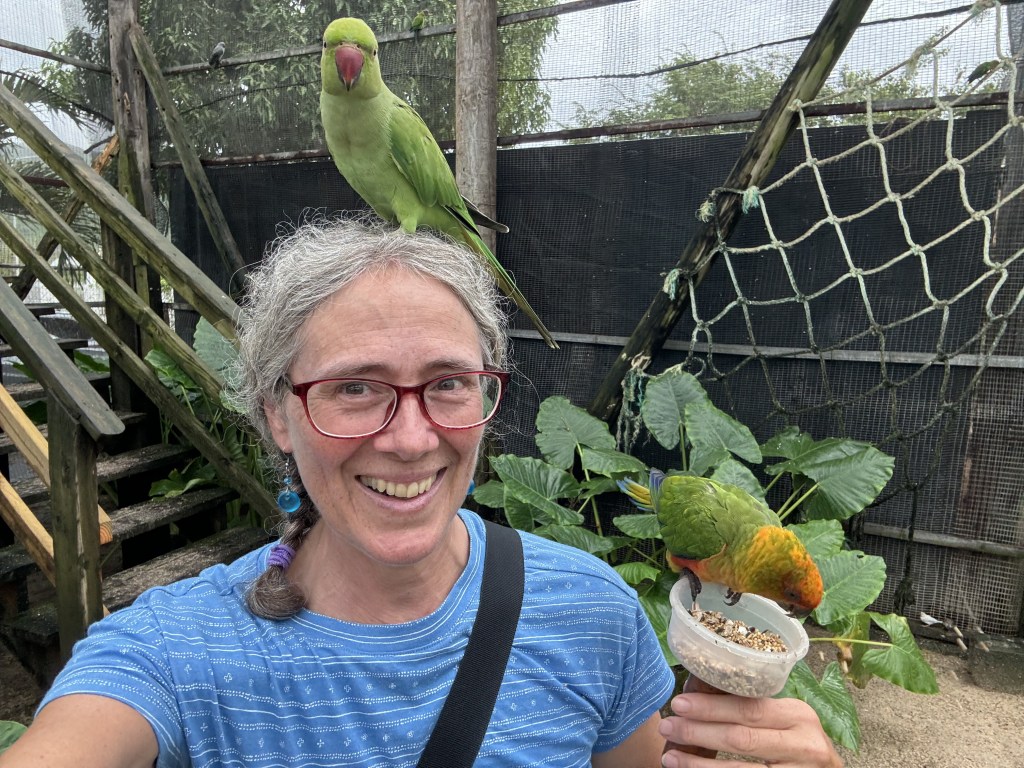
We’ve been in the USVI since January 21st and all but one of those days has been spent at St. Thomas, mostly in St. Thomas Harbor. The first week and a half was all about provisioning, getting our new batteries to Indigo Lady, and then Dave installing them. In that timeframe we left the harbor just once to cruise offshore to empty our holding tanks, then we went to a little anchorage on the west side of Hassel Island to make water. Making water in St. Thomas Harbor would be ill advised; harbor water tends to be icky. The next day it was right back to St. Thomas Harbor. 

For those who don’t know/remember why replacing our lithium-iron-phosphate batteries was important, here’s a quick synopsis. (If you know the story, skip to the next paragraph.) The original batteries were purchased with our entire solar-electric system when Dave did the original conversion in 2016-2017. By 2019 we started having issues with them and ended up replacing them, from the same company, in August of 2020 as a partial warranty. So yes, we paid for our batteries again, about half of the original cost. Within a year, the new batteries were giving us trouble! Despite the best efforts of a particularly helpful engineer at the company, and several upgrades later, at our expense, Dave was done with that company. Their batteries were never going to be capable of serving our needs. It was then that he started thinking about how to replace them. Go with another company or build them himself?

Back to the present. Dave ultimately determined that it was far more cost-effective to buy battery cells and build his own batteries than to buy premade batteries from another company. Purchased batteries cost about $28K, while the cells to get the same capacity as those cost about $7600, and that included the cells, shipping and all the parts to make the batteries come together. It took Dave four days to build the two battery banks, one in each hull. Even better, they work! We haven’t made any long trips on them yet, just a few 5-8 nm hops, but those were done entirely on battery & solar, and the batteries recovered beautifully. We were able to cruise at about 6 knots each time- woo hoo! 

Dave finished the batteries on January 30th. Other than one day and night spent at Christmas Cove at Great St. James Island, we continue to stay at St. Thomas. We’re not straying too far because my folks are coming on the 13th, assuming the impending snow doesn’t delay them. Cold fronts come through regularly this time of year and we don’t want to get trapped someplace, unable to get back here in time to meet them. We also had to ride out three days of big winds and rain last week, and St. Thomas Harbor is a good spot to do that. Still, we’ve managed to enjoy ourselves enough. We met a local, Ralph, who stopped to inquire about Lady when he was dinghying by. He gave us lots of helpful local information and helped us get the new batteries onboard. We’ve visited with him a few times. We met up with friends we met cruising in the Bahamas last year for errands (thanks Juan & Alison) and lunch. We learned how to use the Safari bus, and even rode its entire route one day out to Red Hook on the east end of St. Thomas and then out to the University of the Virgin Islands on the west end. We’ve been in Brewer’s Bay for a few days. Yesterday we dinghied to shore, locked dinghy to a tree, and walked up to the UVI bus stop to catch a Safari into town for the weekly farmers market, where we also met up with our new friend, Ralph. We hung out for a bit and bought some great produce. I am now in possession of a breadfruit that I have to figure out how to work into a recipe. I’m thinking it’s going to end up in a curry. Yum!   

It hasn’t been a show-stopping 3+ weeks, but it’s been enjoyable nonetheless. I enjoy getting to know an area and feeling comfortable in it. Did I mention that it’s comfortably warm?  Temps are generally in the low-mid 80s during the day, and not humid yet. We’ve even had to put on long sleeves a few times at night when the sun sets, the winds are up, and temps dip into the mid 70s. It’s awesome! 

Once my folks arrive, we will head to St. John as soon as we can to explore that island from land and water. In early March, we will all be heading to the BVIs. I’m going to try to post weekly from now on. Until then, stay safe and take care of each other!

Here’s what the harbor looked like during those big winds.

St. Kitt’s to USVI- following seas & dolphins!

We finally got our chance to leave St. Kitt’s, only not for St. Martin, as we’d originally planned. The conditions just weren’t conducive for that NNW course and wasn’t going to be for the foreseeable future, 1-2 more weeks. The conditions were good, however, for going straight to the USVI, so we took it.

It’s been a long time since we’ve made an overnight passage with following seas. I’d forgotten that winds 12-18 gusting to 23 with 4-6’ seas, even on a short period, are fine when they’re on your stern pushing you forward. For the past few years, conditions like that were a no-go because we were most likely going to be heading into them and getting slammed. It took my brain a while to embrace the reality. A phone call with Chris Parker (weather router we use) helped, because he confirmed the weather window and that it would hold more than long enough for us to get to St. Thomas, 141 nm away. We hauled anchor in Basseterre, St. Kitt’s at 5am on Saturday morning, 1/20 and arrived at the mouth of St. Thomas Harbor, USVI about 7am Sunday morning.

The passage was blissfully uneventful. Well, there were no bad events. There was one really wonderful event- a visit from a very large pod of dolphins just before sunset. There had to be at least 3 dozen of them playing in our bow waves, riding the surges that funneled between our bows from the stern, and jumping in the waves all around us. It was amazing! They stayed with us for about 15 minutes before the final stragglers peeled off. It was partly cloudy, but there was a brilliant half-moon and we could see a fair amount of stars. The light reflected off the clouds, lighting our horizon such that it was never pitch dark. I personally do not enjoy pitch dark night crossings, so I was quite happy being able to actually see all around us.

We were making 6 knots with our motors set at only about 4kW each. A fish hit one of Dave’s lines, so we had to slow down to reel it in. He cut back the power on the motors, but we were still moving too fast. We had to actually stop both motors to reel in the fish and we were still making 2 kts. That’s some push we were getting! We would repeat this one more time before Dave gave up on fishing, because both times it was just barracuda. When I came up for the 12-3am watch, I cut our speed down to 4.5 kts because we were going to arrive in the dark, which is not good for anchoring. Dave cut our speed even further when he came on at 3am, and by the time we were about 2-3 nm out from the harbor, the motors were set at about 1kW each because the sun still hadn’t risen. 

The sun rose just before 7am, but a cruise ship was also arriving. The pilot boat waved us off from the harbor entrance. We could have entered and anchored before the cruise ship got there, but whatever. Instead of waiting out the cruise ship, we altered course to the western entrance to the harbor and went in that way. We were anchored in 15’ of water just east of the Coast Guard dock by 8am. I ran up our Q-flag and submitted our entry via the CBP Roam app. Then I started tidying up the boat from all our passage gear and snacks while Dave tried to catch a nap. I awaited the call from Customs. The call never came, but an email did, about an hour after I submitted our entry (it was Sunday, after all). Welcome to the USVI; enjoy your stay! We were officially cleared in, so I replaced the Q-flag with the USVI courtesy flag and had breakfast. We just relaxed the rest of Sunday and slept pretty hard that night. 

As I write this on 1/24, we are still anchored in the same place. We’ve done some planning and reconnaissance for collecting our new lithium batteries and doing a big provisioning run. Hopefully tomorrow we will start acting on all that. Hopefully early next week our new batteries will be successfully installed and we can give them a good test run by heading to another anchorage. Please keep your fingers crossed for us.

Until next time, stay safe and take care of each other!