My husband is a fish when he’s diving. Okay, perhaps seal is a better comparison since they, like Dave, are mammals. My point is, he’s quite at home under the sea, which isn’t surprising since he’s been diving for almost 50 years. I love watching him when we dive, trying to coax critters from their hideouts, joining a school of fish, or simply following quietly behind or along. What I share with you today is a compilation of videos I captured of Dave interacting with the sealife and a couple of times when sealife interacted with him without his knowledge. I chuckled putting this together and watching the final cut. I hope it makes you chuckle as well.
I’m taking a blogging hiatus until sometime in January. So Happy Holidays, Happy New Year, and enjoy the show!
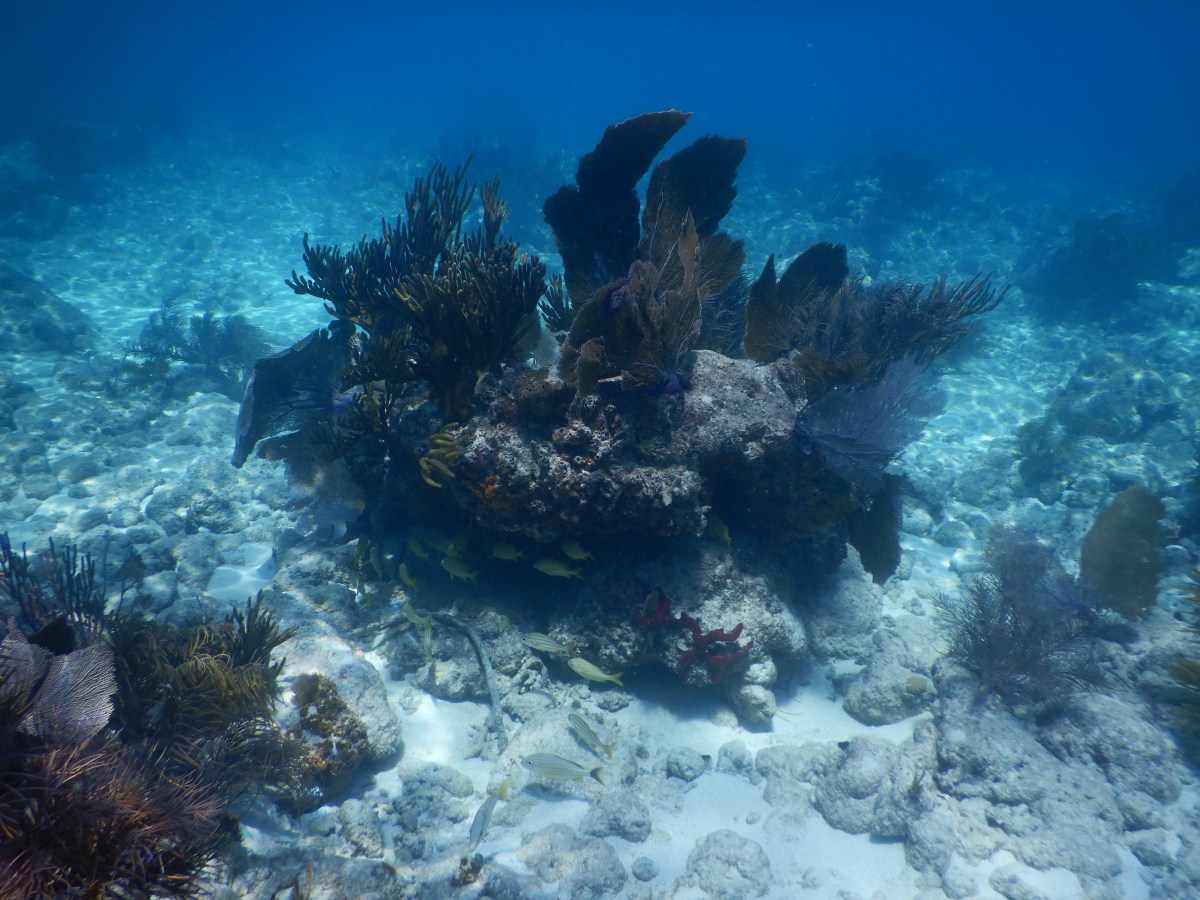
Our last dive stop before heading back to the marina and then home, was at Fowey Rocks Lighthouse at the northernmost end of the Maritime Heritage Trail. It is an iron-pile lighthouse that was built from 1875-1878. We’d hoped to also dive the Aratoon Apcar, sunk just off the lighthouse, which was still under construction at the time, in 1878. The current was too strong, however, and this was a less complete wreck than some of the others, so we gave it a pass. Instead we had a short dive in the shallow corals on the southwest side of the lighthouse. We once again started out against the current so we could ride it back to Lady afterward. The lighting was good and there were some lovely corals. I took a few pictures and one video which I share below.
After our dive and lunch, it was time to head back into the ICW for the trek back to the marina. From Fowey Rocks Lighthouse we headed toward Cape Florida, taking the Biscayne Channel into Biscayne Bay. This took us right through Stiltsville, which is also part of Biscayne National Park. The first of these shacks on stilts was built by one Crawfish Eddie Walker sometime in the 1930s. It has a somewhat colorful past, which you can read about by following that link. There were 27 such structures at its peak in the 1960s. Exposure, time and Mother Nature limited the life of these structures, and hurricane Andrew in 1992 left only 7 standing, none of which are original to the heyday of Stiltsville. The non-profit Stiltsville Trust was established in 2003 and is working cooperatively with the park to rehabilitate the buildings to support educational and interpretive services. One can acquire a permit to visit the structures from the Stiltsville Trust, but you’ll need your own (not large) boat to get there. We may try to visit one or two when we next go down if we can find a place nearby to anchor Lady and take the dinghy over.
This week’s video slideshow includes a handful of pictures and video from the Fowey Rocks dive, plus the stills I took of the Stiltsville structures. Several of the stilt houses line Biscayne Channel, but are still pretty far away for my camera, so close ups get a little blurred. Other of the houses are small blips in the distance. Regardless, you’ll get the idea of what they’re like. Enjoy!
Our final wreck dive was on the Lugano that sank in March 1913. The Lugano was a 350-foot, iron-hulled British steamer from Liverpool that Long Reef en route to Havana, Cuba with 116 passengers on board, plus a cargo valued at $1 million dollars. All passengers were successfully rescued while the crew stayed aboard for salvage work and to try to save the ship from a complete loss. After almost a month of salvage work, the crew finally abandoned the wreck. By mid April, efforts to refloat her were abandoned as well. Lugano’s remains lie in about 25 feet of water on Long Reef.
This was our third wreck dive on the same day. We picked up the dive mooring at her stern because the current was pretty strong at this point. So we slowly swam Lugano’s length against the current, then rode it back to Lady. The return swim was quite quick! Due to the current and it being our third dive that day, we only spent about 20 minutes here though we could have spent much more time had the conditions and our timing been better. Still, it was an impressive structure and we enjoyed the experience. Again, if you’d like to know more of the history and explore the 3D interactive model of the Lugano, check out the ArcGis storyboard. My video clips aren’t quite as good for this one because I found it difficult to film, swim against the current and enjoy the sights all at the same time. Still, you’ll get a decent appreciation for Lugano’s size. Enjoy!
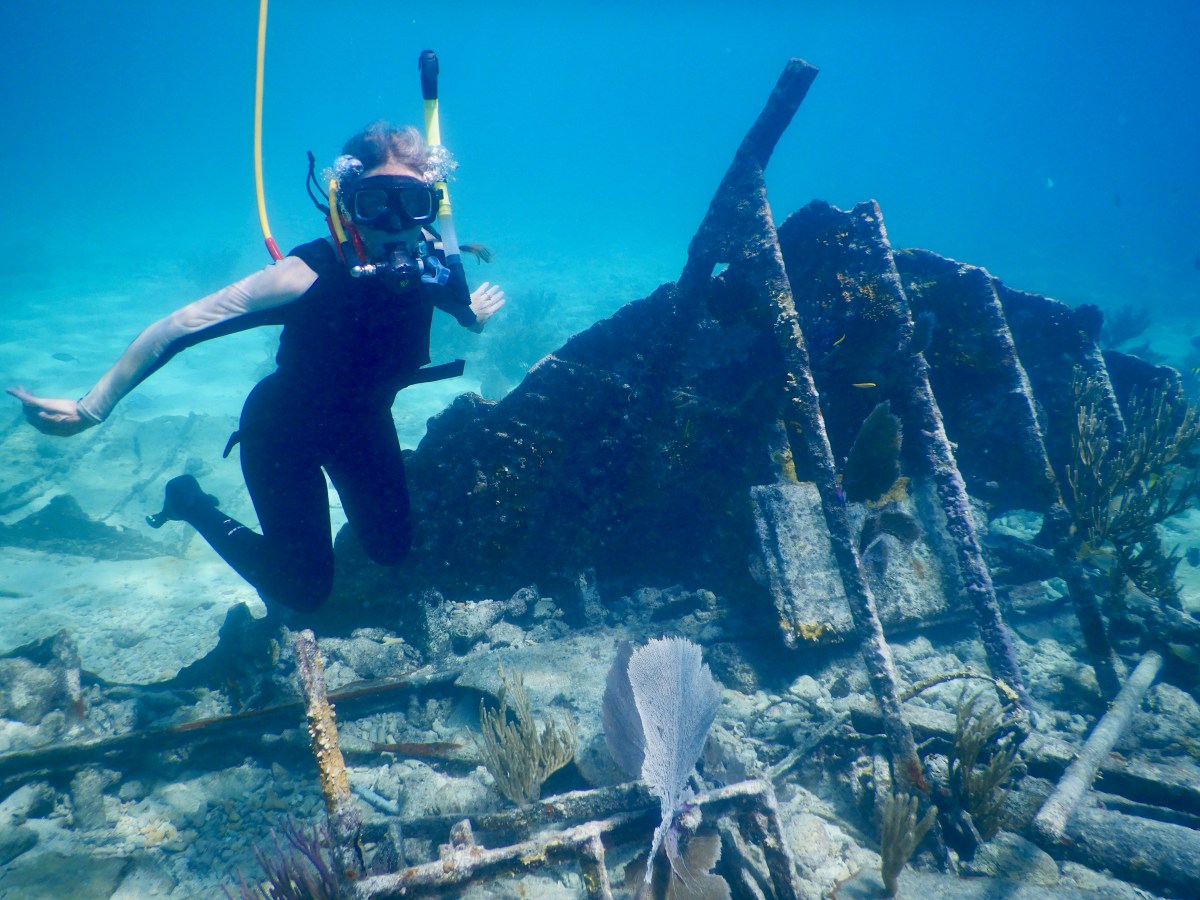
This was our second dive on the Maritime Heritage Trail, and is the most recent of the wrecks, having sunk on New Year’s Day in 1966. The Mandalay was a 110’ 6” long, steel hulled schooner built in 1928. It had several owners, the last purchasing it in 1965 for use as a luxury cruise ship for charter. It was returning to Miami from a 10-day Bahamas cruise when it ran aground on Long Reef in the wee hours of January 1st. She was 20 miles off course due to a distance miscalculation- oops! All 23 passengers and 12 crew were successfully rescued and there was only one minor hand injury to a crew member. Before any official salvage tugs could be deployed, the vessel was stripped to her skeleton by local boats, including the personal items of the passengers!
The wreck is in water shallow enough for snorkelers, but we used the hookah, which gives us more freedom to take our time exploring without surfacing to breathe. It’s a small wreck with a small debris field, so it only took us about 20 minutes to traverse her back and forth a couple of times.
My last post included a link to this ArcGis storymap about the Maritime Heritage Trail, complete with interactive 3D models of the wrecks. Check it out if you get a chance. For now, enjoy the show!
We had a break in our diving action after Davis Reef while we dodged what became Tropical Storm Laura. For that we holed up at Oleta River State Park in North Miami. As the remnant winds due to Laura were leaving the Keys we started back down the ICW to Biscayne Bay National Park on the Atlantic side of Elliot Key, which is the first of the Florida Keys. There are numerous wrecks along the Florida reef, which extends from Fowey Rocks Lighthouse down to the Marquesas Keys. Many are in water too deep for our hookah (or for me period!), but those on the Maritime Heritage Trail in Biscayne Bay National Park are all shallow, and I wanted to dive on some of those. We dove three of the six marked wrecks, plus we dove the corals at Fowey Rocks Lighthouse, which is also part of the maritime trail.
We first attempted to dive the Alicia which sank on Long Reef in 1905. (Long Reef refers to the section of the Florida Reef where the Maritime Heritage Trail wrecks are located.) We gave up after about 20 minutes due to the strong current and 3-5 foot surge that had not been forecast. We saw only a few pieces of debris, and I didn’t get any pictures from that dive worth posting.
The next day we dove three wrecks that were all within about 1.5 miles of each other. The conditions were perfect, so we had ample time to explore each wreck and I got lots of pictures and video from each. These are the fodder for this and my next two posts, one dive per post.
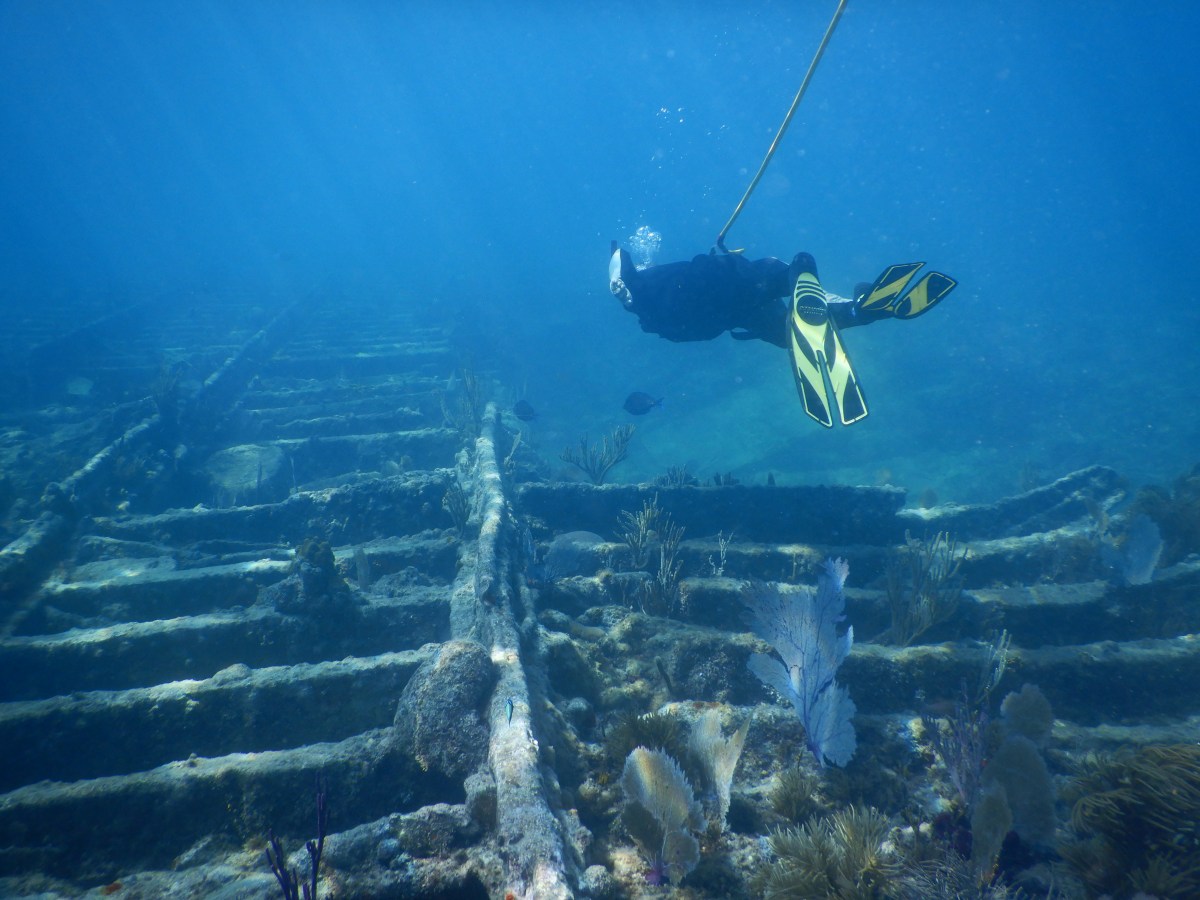
The Erl King was a 306 foot iron-hulled three-masted steamer built in Scotland in 1865. It ran aground on Long Reef in December 1891 en route from Swansea, England to New Orleans. Much of Erl King’s cargo and some of its machinery were salvaged at the time. The remains now lie in about 18 feet of water, including casts of the wooden barrels of dry concrete mix it had been carrying; the wood long gone, the concrete now solid. Before we picked up a dive mooring, Dave wanted to play with his sonar. He drove us around the area until the wreckage showed up on screen. It was really cool, because we saw it on screen, then looked over Lady’s side and saw that same wreckage through the calm ocean waters! We spent an hour exploring the wreckage and enjoying the fish, including a school that greeted us as we entered the water and saw us off as we exited later.
When I googled the wrecks for some history, I discovered this ArcGis storyboard of the Maritime Heritage Trail. For each wreck there is an interactive 3D model one can manipulate, with several key elements clickable for more information. This was how I was able to identify things like the mast step and disarticulated stern debris. I will be using this to help me accurately label the next two wreck dive video slideshows. Check it out if you get a chance and play around with it yourself.
I took a bunch of pictures and video. The videos capture the wreckage well, but the images let you pause more easily at individual spots with no video pause blur. So I’ve included both, which makes this slideshow longer than my others (~4.5 minutes) but, I hope, easier to process visually.
Davis Reef is part of the Florida Keys National Marine Sanctuary and is located about 4nm southeast of Plantation Key. It was established as a sanctuary for gorgonians, or soft corals. In Greek mythology the Gorgons were Medusa and her sisters, the ones with snakes for hair and who would turn you to stone if you looked into their eyes. They’re not particularly endearing characters to be named after, but some of these corals grow into snakelike structures (many-fingered, or I suppose, many-snaked), thus the name. There’s your science/history lesson for the day.
We dove Davis Reef in a bit of a current. The area ranges from 6-30 feet overall but the small section we dove was about 20-25 feet deep. There were soft corals aplenty, but we’d seen equally lovely, if not more lovely, colonies on other dives. There were, however, very many fish of quite a variety, including several schools, so we had fun watching those. On our return to the boat we swam over this little bulbous thing that we each thought looked like a funny hard coral (not gorgonian) until we passed over it and looked back. It was a little Budda statue about 12” tall! What a fun find. We of course took pictures of ourselves next to it, which you will see in this week’s video slide show.
Alligator Reef was my other favorite dive, along with Florida Keys Dry Rocks/Christ of the Abyss. Alligator Reef is part of the Florida Keys National Marine Sanctuary and is along a border between the shallower reefs of the upper Keys and the deeper reefs of the middle Keys, about 3.5 nm southeast of Upper Matecumbe Key. The water here ranged from 12-30 feet, mostly 20-30 feet in the spots we dove.
We’d cruised to Alligator the previous afternoon from Rodriguez Key so we could dive early the next day. We hit the water by 9:30 am accompanied by only one other dive boat. We enjoyed two dives, separated by only a quick snack and a hop over to another mooring ball at the other end of the reef. All told we were dove here for a glorious 2.25 hours and saw the greatest variety of fish here of all our dives. We saw several young nurse sharks, all swimming rather than hanging out on the bottom. We also saw two green morays, two sea turtles, numerous full grown barracuda and groupers, and quite a variety of adult parrotfish, plus all the other typical reef fish. I eventually gave up taking pictures on the second dive so I could just enjoy the view.
Our early dive strategy paid off because all six mooring balls had just filled up as we were surfacing from our second dive. We ate lunch then cruised toward Davis Reef to anchor for the night. We spent a lovely evening watching a movie in the hammocks after dinner then moved to the tramps to sip rum and gaze at the stars. We even caught a few shooting stars, probably the tail end of the Pleiades meteor shower.
So here is my Alligator Reef slideshow video. It takes me too long to select and apply music, so you’ll have to listen to my regulator for this one. Maybe I’ll add music and repost in the future. Enjoy!
P.S.- Dave had a close encounter with a barracuda while following a sea turtle here. I caught it on video, but you’ll have to wait until a future post to see it (unless you check out my FB page, where I posted it back in August). I’m planning a video post of Dave’s sealife interactions.
From our sugar scoop I lowered myself into the water with my dive gear on, submerged, turned around and gasped, yes through my regulator. The reef at Key Largo Dry Rocks was gorgeous! There were fish everywhere, from the top of the water column down to the ocean floor. There were large coral heads with zillions of soft corals and sponges. The lighting was perfect and the visibility excellent. I felt like I was diving in a giant aquarium.
We’d gone to Key Largo Dry Rocks to do the touristy thing and see the Christ of the Abyss statue. So after taking in that astounding first view of the reef, we set out to find the statue. Twenty minutes later we found it. This 9-foot bronze statue sits in 25 feet of water about 3 nm off the coast of Key Largo at Key Largo Dry Rocks in John Pennekamp Coral Reef State Park. It was placed there in 1965, one of three such statues in the world cast from the mold created by Guido Galletti. The original is in the Mediterranean off San Fruttuoso on the Italian Riviera. The other is off the coast of St. George’s Grenada (I look forward to diving at this one when we finally get to Grenada). We took the obligatory photos and moved on to exploring the reef.
Although the statue is what brought us to that particular spot, we ended up being treated to the best dive of the dozen or so places we dove in August. Nature laid out this reef as a series of fingers, the fingers being lines of large corn heads separated by sandy gullies. There was so much to see and in our two dives on the reef that day we hardly covered it all. There were fish above, around and hiding beneath the coral heads. It was an underwater wonderland!
My camera barely does it justice, but the clip below is the best of what I caught on video. No music this time, just the sounds of me breathing through the regulator. Enjoy!





 Life on Lady