

The photo is a spoiler. We ran aground yesterday. Oops!
We’re fine. Indigo Lady is fine.
I’ll back up a little to bring you up to speed.
We left Bullocks Harbor at Great Harbor Cay on Wednesday to hang out in the eastern Berry Islands for a while. On Wednesday we rounded the Stirrup Cays and decided it was a bit too bumpy to continue to Hoffmans, so we ducked into Great Harbor (not to be confused with the cay of the same name). Great Harbor is a shallow bay formed by the back side of Great Harbor Cay, Little and Great Stirrup Cays and Lignumvitae Cay. There were perfect conditions for this anchorage so it was nice and calm with crystal clear water over a sandy bottom. There was a cruise ship on Little Stirrup (aka Perfect Day at Coco Cay, owned by Royal Caribbean), but that is so far away it had no impact on us. We had the anchorage to ourselves. The water, being clear with a sand bottom, was cool and refreshing, a nice change from the warm, turbid waters of Bullocks Harbor.
Next morning, Thursday, we hauled anchor around 10am to head for Soldier Cay. It was another gorgeous day this time with good sea state and light wind, so the Soldier Cay anchorage was comfortable. We got another sandy bottom with clear, refreshing water. We walked on the tiny beach at low tide. The rocky north end, plus the small rocky islands north of Soldier are nesting areas for laughing gulls and other birds and they have chicks now. They were not happy when we dinghied along the shores to go snorkeling, and they let us know it by swooping over us. Fortunately none of them lightened their load over us. It was low tide rising for a shallow snorkel. If some of the reefs we’ve dived on were “nursery” reefs, this area was for “newborns.” We saw the standard reef fish, but most of them were so wee! There was a smattering of full-sized reef fish, but mostly tiny ones. So cute! Our big fun here was swimming along the rocky shore toward the cut, kicking as hard as we could to get as far into the cut as possible, then riding the incoming tide back inside. Fun! We did it twice.
Yesterday morning, Friday, we hauled anchor at 7:30am for the high tide through the shallow cut to Hoffmans Cay. We’d done this in reverse last year during the pandemic when we hung out at Hoffmans before heading back to the US. No problem. We cruised the length of Hoffmans and decided to try for the next batch of islands down for a more protected anchorage given that some squall activity was heading our way for this weekend into Monday or Tuesday, possibly from the exposed direction. We should have stayed at Hoffmans.
We were on the falling tide, about 60-90 minutes after high, when we had to navigate a short, shallow cut between Saddleback Cay and Big and Little Gaulding Cays. The shallow draft route marked on the charts conflicted with the notation that said to hug Saddleback about 20’ off its shore. We opted to steer closer to the route line. Mistake! Had we been one boat width (25’) closer to Saddleback we never would have grounded. Had we been half a boat width closer to Saddleback, port hull would have grounded, but we would have wiggled off using starboard. If we’d arrived at peak high tide instead of an hour after high, we wouldn’t have grounded. But ground we did. We were only moving 3 kts, there were no waves, and the bottom was sand and weeds over hard. So we just ground to a slow stop. Dave tried to back us off with the motors. Then he hopped in dinghy and tried to pull us backwards and off. Unfortunately neither effort worked, especially since we wanted to move backwards while the current was pushing us forward. Nothing to do but wait for the next high tide to float us off. The second high tide would also be about half a foot higher, so we knew we’d have plenty of water to float us off, and we were only 0.25nm from our intended anchorage. So close, yet so far!
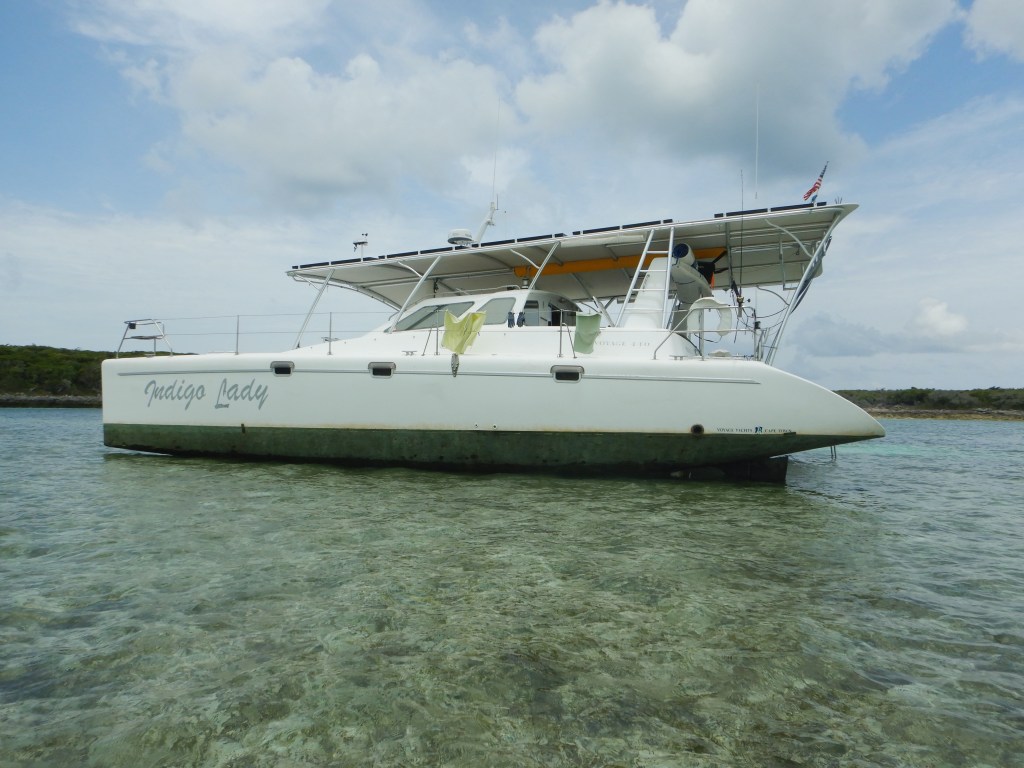
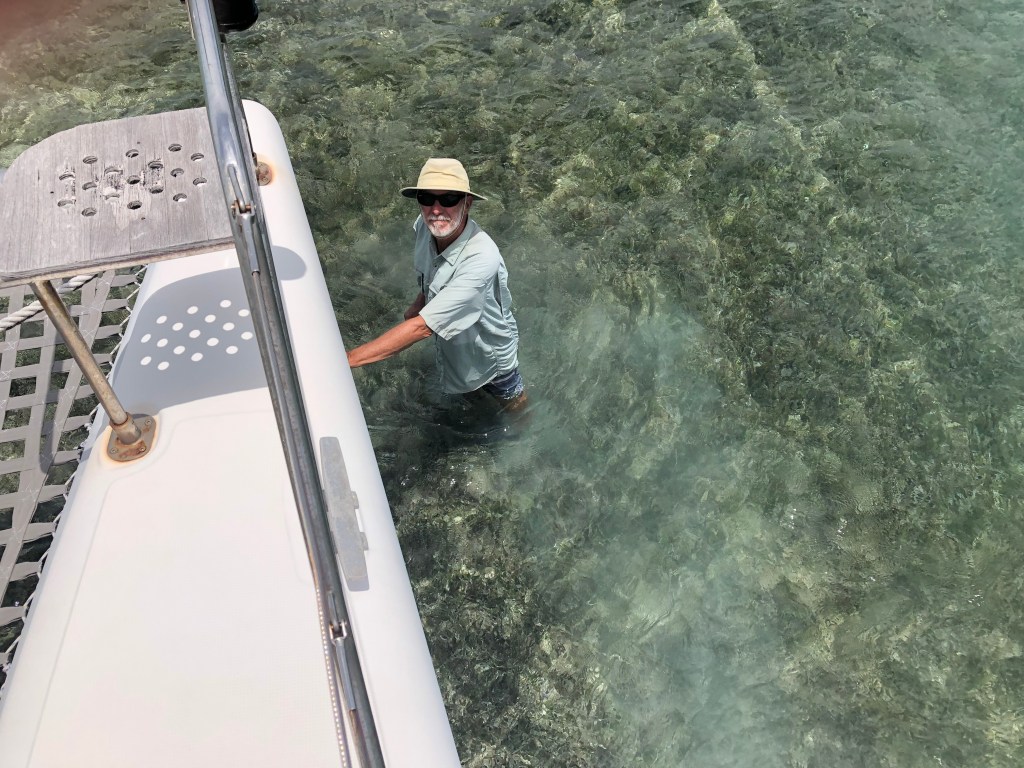
We were very lucky that not only was it a soft grounding resulting in no damage, but it was also a calm day. We entertained ourselves with some boat tasks in the morning and early afternoon. About an hour before full low, Dave got into the water to walk around the boat to check for depths near and beyond the boat, and to check her hulls. She was sitting fine with no damage. Port was in shallower water than starboard. Deeper water was only about 20’ off our starboard and about the same behind us. We knew starboard would float first and were pretty sure the incoming tide would push us backwards. Dave kept tabs on the water level and when it reached dead low, marked the distance to waterline on our boat hook. This allowed us to check how quickly the tide was rising as the afternoon progressed. We retired to the hammocks mid-afternoon to read and enjoy a drink as the water rose. For once, they weren’t swinging.
Around 5:30pm, Dave noticed that the water was at the waterline on starboard and that starboard bow was bouncing up and down a bit- movement! For the next 20 minutes we sat at the helm station, watching and waiting as we slowly rotated toward starboard. We considered trying to motor the port side off, but then decided not to bother, mother nature was taking care of it. By 5:50pm we were fully afloat, started the engines and proceeded to the anchorage. Anchor down just after 6:00pm.
Phew!
We’ve learned some lessons with this. First, don’t ignore your gut instinct. Dave’s gut had hinted at maybe not attempting the passage on the falling tide; he ignored it. He won’t do that again any time soon. We also should have thought through the discrepancy between the charted shallow draft route and the notation to hug the Saddleback shore and at least split the difference between the two. I was on the bow spotting, which is important in shallow route areas, but with the current pushing us from behind, that hump we grounded on came up too quickly for us to respond, another reason to not tempt fate on a falling tide, even if it is only “shortly” after high. At least for today, those lessons have stuck. We had set an alarm for 7:00am intending to backtrack 2 miles to a more sheltered anchorage south of here. We awoke to overcast skies with 15 kt winds and 3’ choppy seas from the SW (of course, the exposed side of this anchorage). Today’s planned route would have passed through three shallow spots, two of which we were unfamiliar with. Bouncy water is not good crossing shallow areas, even on the high tide, because the bottom of a wave trough can bounce you off of the seafloor. Overcast skies means you can’t read the bottom as you proceed, also a bad idea in shallows. So despite this anchorage being a bit uncomfortable, and not certain our anchor won’t drag if a squall kicks up, it was still the lesser of two evils. Dragging isn’t fun, but we know how to handle that, and there’s deep enough water around us to give us time to respond to a drag even at low tide. Getting stuck in the shallow with squalls threatening would be very bad.
Next week I will backtrack to our final days in the Abacos and the two day trip that got us back to Great Harbor Cay, which is what I’d intended to cover this week. Until then, stay safe and take care of each other!
 Life on Lady