Barbuda, on the other hand…

Barbuda is better. Much better!

We didn’t do much in Antigua after my last post on 4/26, other than prepare for the arrival of our friend, Ian. We moved back to Jolly Harbor, did a little provisioning and some boat chores. Ian arrived Sunday afternoon and we just talked the rest of the day, through dinner and until bed. The morning of the 29th we popped ashore so I could use some WiFi and see a doctor to make sure there was nothing wrong with my right ear, which had been off and on extremely itchy deep in the eustachian tube. Other than a little irritation, all was clear. Good. That afternoon we moved up to Dickenson Bay at the NW part of the island to stage for our jump to Barbuda the following morning. 

We hauled anchor around 8:00am the morning of 4/29 and had a comfortable 6-hour cruise up to Barbuda. Thus far, it’s been the most comfortable crossing we’ve had this season. We were anchored up near Codrington Lagoon by 2:00pm. 

Barbuda, with a population around 1600-2000, lies about 30 miles north of Antigua. Together with Antigua, they gained their independence from Great Britain in 1981. Barbudans didn’t necessarily want to be part and parcel of a single nation-state with Antigua, and their relationship is fraught, to say the least, especially since Hurricane Irma, but that’s a story I don’t know much about. The 62 square mile island’s length is oriented NW to SE. It is composed largely of limestone and volcanic rocks from a long-extinct volcanic arc. The highest point of land on the east side tops out at about 125 feet above sea level. The west side of the island is characterized by Codrington Lagoon, a saltwater lagoon about 6 miles long and about 1½ miles wide at its widest point. 

For most of its existence, the lagoon’s connection to the open ocean has been an inlet through the mangroves on the northwest corner of the island. It is otherwise separated from the open ocean by a long, narrow, sand spit. Codrington Lagoon is ecologically important for several reasons. First, it serves as the nesting grounds for the largest Magnificent Frigatebird colony in the world. It is also home to several other bird species, the rare Antiguan racer snake, and the smooth-headed iguana. It is a nursery for lobster, conch and fish that are important to the Barbudan economy. For example, they export lobster throughout the world. The lagoon and its sand spit also protect the island’s main settlement of Codrington from impacts of storm surge and hurricanes. In the past, two hurricanes (one the 1960s and the other in the 1990s, I believe) have breached this sand spit, but it repaired itself within two years or so. Hurricane Irma in 2107 breached this divider again, only instead of repairing itself over the past several years, the breach has become wider, reaching almost 2 miles! If this breach doesn’t repair itself, it will have lasting impacts on the island and its inhabitants, both human and non-human. (Cited from Smith Warner International.)

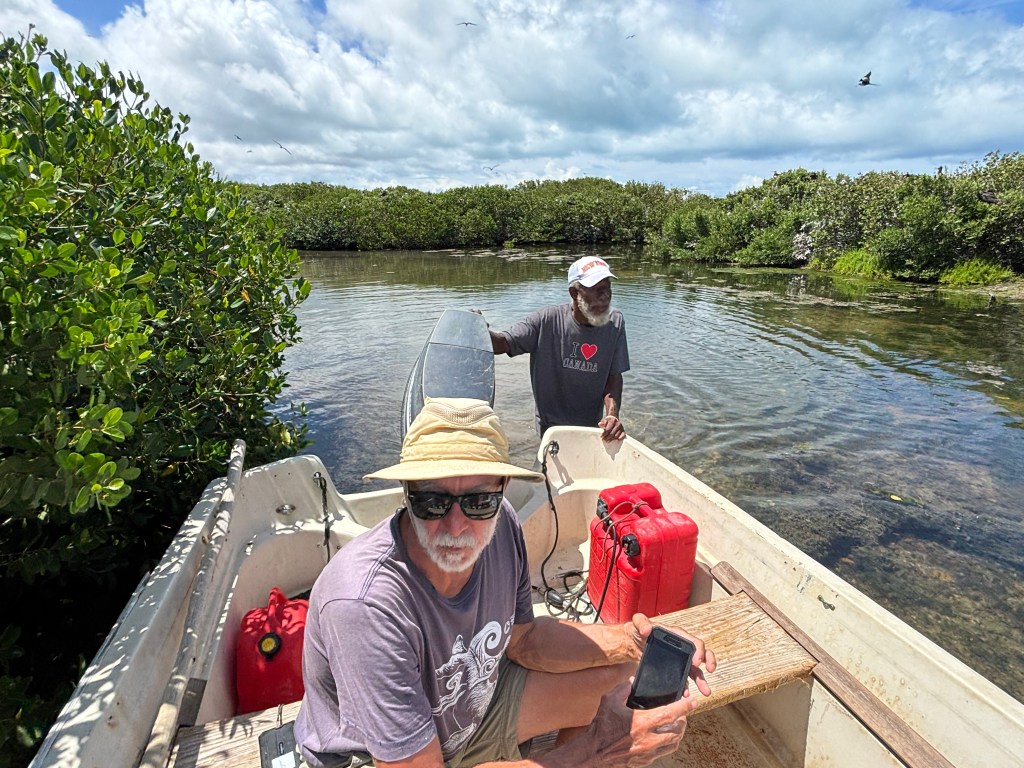
The morning after we arrived at Barbuda, we set out in dinghy at 8:30am to meet our guide for the Frigate Bird Sanctuary, a tour we had arranged before our arrival.  We met George Jeffrey at the Codrington fishing dock, and the three of us, plus two other cruisers set off with George to see the birds. The first stop he made was well outside of the sanctuary where George told us a bit about the sand spit breaches I mentioned before, plus a little about the current troubles between Barbuda and Antigua. Then he took us to a small sandbar where he stopped again. That sandbar, devoid of all but a handful of tiny new growth mangroves, is the former site of the sanctuary. In 1960 (maybe 1961?) a hurricane hit Barbuda. Before its arrival, the Frigatebirds flew off to evade the storm. Upon their return, they found their mangroves gone, so they just flocked to another section of mangroves a little further north, and they’ve been there ever since. Then it was time to meet the birds.

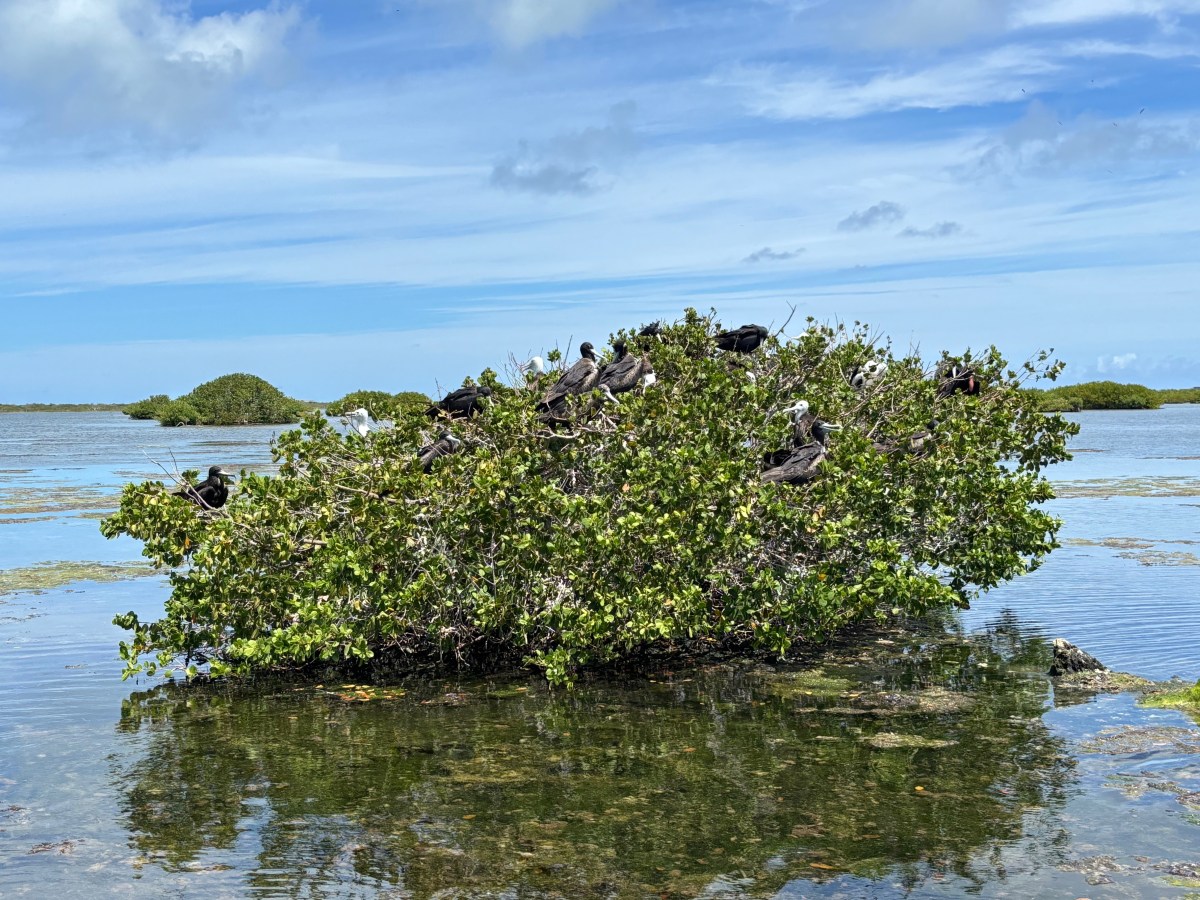
What an amazing sight! In a stretch of mangroves approximately ¼ x ¾ of a mile, are thousands upon thousands of birds (I’ve seen estimates ranging from 12,000-20,000). The mangroves were heavily laden with (mostly female) adults and chicks of various ages. They were squawking, but it wasn’t as loud as I’d expected. George got out of the boat and slowly maneuvered us through the shallow waters, through upsidedown jellyfish-infested waters (they don’t sting) around the mangroves so we could observe them closely. We spent about a half hour just watching the birds. They are the national bird of Antigua & Barbuda and are on the Barbudan flag. George told us a bit about them, and I looked up more information later, all of which I share below (and include the links I used so you can read more if you like). There are pictures at the end of this post.

Frigatebirds are agile aerialists, that can fly for days on end, but they don’t go into the water. Their feathers, in fact, are not waterproof; they would be unable to lift themselves back out of the water. They feed on small fish (locally, flying fish are a favorite) which they scoop from the water’s surface, or steal from other birds. Adults are about 3½ feet long (beak to tail) with a wingspan of about 7½ feet. They have a deeply forked tail. All adults have black feathers, but the females’ chests are white while the males sport a bright red throat pouch. That throat pouch is how they woo females during mating season, which generally runs from September-April (peaking in December), which explains why we saw chicks of varying ages. Once a female has chosen her mate, the two build a nest where the female deposits a single egg. Both parents share the work of incubating the egg, which lasts about 50 days, and then feeding the chick. The males take off after about three months. The chicks fledge at about five months. The female continues to feed the chick for another four months or so. The chicks are fuzzy white and grow into their black feathers over time, with their heads changing color last. We saw newer chicks of fluffy white with only a few small black feathers forming on their wings, and we also saw older chicks just waiting for their heads to go black. (Audubon)(Lonely Planet)(Wikipedia)

Codrington Lagoon, where this colony resides, became a National Park in 2004. One can only enter the sanctuary with a local guide. The National Park only charges $5 per person to enter the sanctuary. Our tour with George cost $60 for all five of us together, so $12 per person. If you’re ever in Barbuda, I highly recommend taking this tour. If you can’t get George, there are several other guides as well.

The day after our Frigatebird tour, May 1st, we hauled anchor late morning and moved Lady to a reef anchorage on the south side of Barbuda, settling in Gravenor Bay. We spent two nights there, and this morning we moved about a mile closer to Spanish point at the southeast end of the island. There is a lot of shallow patch reefs to explore in this area, and we’ve explored many of them over the past 3 days. These are not very healthy reefs, but they’re better than what we’ve seen in Antigua. They are certainly heavily storm damaged, as evidenced by the coral rubble, and they also suffer from what ails all the reefs we’ve snorkeled and dived on in the Caribbean- bleaching, disease, and overuse (by incautious tourists). Unlike our experiences in Antigua, however, there is more sign of recovery here. We did not see any sponges, but there were many corals. A large number of them were sea rods, but there was quite a variety of other corals as well, just in smaller numbers. There were the usual fish suspects, and we saw several southern stingrays and sea turtles, and Dave saw an eagle ray. It was nice to finally have some snorkeling worth doing, and it was encouraging to see the regrowth.

Either tomorrow or Monday we will head back to Antigua to do some snorkeling on the north side reefs. Then we may move south to Falmouth Harbor to do some snorkeling there and explore the island’s interior by car before Ian returns home. 

Until next time, stay safe and take care of each other!

Cheeseburgers in three different countries in seven days

I hope the title got your attention, and perhaps made you chuckle. Normally we eat local dishes when we eat out during our cruising season, but every now and then we crave comfort food, and we’ve needed it over the past seven days. 

If you’ve been following along this year, you know we set out for Guadeloupe from Nevis on January 29th and had to ditch at Montserrat due to generator issues. It had been a rough ride, and two stopped generators didn’t improve our mood. Lunch in Montserrat was cheeseburgers and fries. (We solved the generator issue fairly quickly, but you can read my last post on 2/1 for the details if you missed it.)

It was a bumpy ride to Montserrat on the 29th, and it was an equally bumpy ride to Deshaies, Guadeloupe on the 30th. We thought we might hang out on the west coast of Guadeloupe for about a week and a half. The weather gods had other plans. If we were going to make it to Dominica in time for the Salty Dawgs Rendezvous, we needed to take an early weather window on February 5th. Yes, that’s today. It was going to be another of those “least adverse” windows, which means bumpy and salty. The second cheeseburger and fries lunch was consumed in Basse Terre, Guadeloupe yesterday in anticipation of today’s bumpy ride.

Yup, the crossing from Guadeloupe to Dominica today was bumpy and salty. In fact, it was bumpier and saltier than the prior two. We left Guadeloupe just after first light, about 6:15am. We arrived at Prince Rupert Bay at Portsmouth, Dominica around 11:45am. At least it was a fairly quick (for us) ride, averaging about 5.25 knots. The seas started out about 3-5’, building to 4-6’ and then eventually more like 6-8’. They were anywhere from just off our port bow to on our port beam. There were two notable waves. One washed over the port bow, up the galley window and onto the cabin roof (not all the way to the cockpit), but it did deposit some water on our stovetop. I closed that hatch firmly afterward. The other notable wave washed over the port bow up onto the solar panels on the solar roof, depositing a puddle in our “rain gutter,” which then proceeded, in the wind, to drip all over Dave at the helm for several minutes. There was a lot of splashing sea water, in fact, during the 28nm trip- over the bows, up the port side, splashing up through the teak slats on the rear walkway, and up from the sugar scoops at the stern. Indigo Lady and her crew were quite salted upon arrival. Dave would say we’d been “a-salted.” You can go ahead and groan now. Today’s lunch was the third cheeseburger and fries.

All that said, we are happy to be here in Dominica. We were greeted at the harbor entrance by one of the PAYS guys (Portsmouth Association of Yacht Safety). The association was created by a group of local tour guides to help cruisers enjoy their stay in Dominica and keep them safe. They do a lot. They greet arrivals, provide inexpensive moorings, help with boat issues, provide water taxi rides, do tours, and patrol the mooring field at night for security. Alexis was the one who met us at the harbor entrance, and his cousin, Kelvin, showed us to a mooring. We got to customs before they closed for lunch and then found immigration easily. We paid our mooring fee at the PAYS office and then enjoyed those cheeseburgers and fries right behind the office. One more quick trip into town got us a Digicel SIM card, so now we have data. We relaxed in our hammocks when we got back to Lady. We will start to listen to the Bruins game tonight, but we might not make it through the whole game. 

Tomorrow we don’t have to get up at any particular time. We don’t have to check the sea conditions. We don’t have to go ashore. We’ll probably rinse Lady with fresh water if tonight’s rain doesn’t take care of that. We’ll dub around with boat chores and spend time resting up. We are here for about three weeks. Happy sigh of relief.

At some point, I’ll catch you up on what we actually did while in Nevis and Guadeloupe. Until then, stay safe and take care of each other!

What’s cruising without a few bumps in the road?

We’ve been back in St. Kitt’s for a week and the boat is still not in the water. The boat work we’d asked to have done started the day before we arrived. We told them what we needed done last June when we dropped her off for storage, and again in November, and December, and earlier this month. Last January, the boat work we’d asked for started on the day we arrived, so I suppose this year is an improvement. Island time.The big job that needed doing, which Dave and I could not do, was the bottom copper coat. Dave is extremelyallergic to the hardener in this epoxy-based paint. Before we launched last January, Dave spoke to the then yard manager about the job and learned there is a guy on the island who does it as an outside contractor. We’d buy the supplies in St. Martin and bring them back with us in June, which we did. Dave met the guy in June, at the boatyard, to discuss the job; all seemed good. When November rolled around, nobody could get in touch with him. When we still hadn’t heard anything after Christmas, Dave contacted the yard owner who put Dave in touch with another guy who could do it, I’ll call him Bob. Dave and Bob texted back and forth and Dave said it sounded like Bob knew what he was doing, so told him to go ahead.

We’re pretty sure our boat is the first one Bob has copper coated. First, the hull needs to be sanded and smooth and any pits that don’t sand smooth need to be filled. Our hull is still pitted in places. The time-sensitive, epoxy-based copper coat requires a crew of 3-4 to do it well. Bob had one other guy working with him who was less than dedicated to the work. Finally, the hardened copper coat needs to be sanded smooth. Bob and the other guy showed up Monday with one battery powered sander, no way to recharge it, and not enough sandpaper. By Tuesday morning, with only about one quarter of the final sanding done, Dave suggested buying electric sanders and more paper. Away Dave & Bob went and returned with the needed supplies. That helped, because the sanding was finished this afternoon. In speaking with Dave daily, Bob has acknowledged throughout the process what he should have done differently. If he ever does this type of job again, we’re sure he’ll do it even better. Bob is a good worker and learns from his efforts. The other guy did a lot of sitting and half-hearted sanding. It stinks to have to pay $45/hour/person for amateur work, but pay we shall. 

On the upside, Dave and Bob bonded a little. On Friday, Dave had given Bob a spare solar panel we’d gotten for free but couldn’t use. When Dave bought the sanders, he told Bob he could keep one after the work was done. During their drive, they discovered a shared love of hunting. Bob hunts wild boar on the island, a lot of wild boar. He gifted us with 8 pounds of boar meat! We do meet some mighty nice folk on our travels.

 That was just one bump in the road.

Our windlass needed attention. (For you non-boaters, the windlass raises and lowers our anchor and chain). Dave came prepared with a rebuild kit. The job took longer than anticipated. Dave not only did the anticipated rebuild, but also a lot of correcting of things that were poorly done when it was initially built. The windlass had also been installed poorly, so he improved that before reinstalling it. I even got to play a role in this, doing a small epoxy repair job on the mounting base. Monday night, just after sunset, it was reinstalled and we tested it. As Dave punched the up and down buttons, the lights inside Lady flickered on and off. In addition, the anchor went down, but not back up. It also made some unfortunate, complaining sounds. There’s also a way to crank the gypsy (the part the chain links sit in) manually with a handle should the motor die, and that wasn’t working. Ack! By early Tuesday afternoon, Dave had it sorted. Our windlass works now!

The flickering lights during our windlass test, were the result of another bump in the road. Our 12V golf cart batteries run the house load of fridge, freezer, lights, stereo, dinghy lift and windlass. Their capacity was basically non-existent, so the windlass calling for all that power tanked them, causing the lights to go off. Dave had purchased two 12V car batteries last year, so he switched the wiring to those. They’re temporary, because their capacity is not as high as a that of healthy golf cart batteries. Unfortunately, nobody sells golf cart batteries on this island, so we’ll probably have to buy those in Guadeloupe.

Still with me? I have two more bumps to go.

Bump #4 was our replacement multifunction display (the chart plotter that allows us to set routes and navigate, see our speed and depth). The original started delaminating last year, which turned out to be a warranty issue. So last June Dave removed it, lugged it home, and shipped it back to Garmin who sent us a new, bigger and better replacement for free! Too bad they sent us the wrong model. We have front and side scan sonar transducers and a depth sounder. The multifunction display they sent does not have the proper ports for these. Depth is an important thing to know, especially when traversing or anchoring in shallow areas. Dave was able to connect the front scan sonar which can also serve as a depth reader. It’s not ideal, but if Garmin can’t (or won’t) ship the correct display to the Caribbean on their dime, the exchange will have to wait until we’re back in the U.S.

The final (for now) bump in the road was the theft of the gas can out of our dinghy. Had we not stupidly left the gas can in our dinghy, unlocked, it wouldn’t have been stolen. Mea culpa. Fortunately for us, the local Budget Marine store had one in stock. Off we went to Basseterre today to purchase said gas can and requisite attachments, as well as a couple of unrelated items we needed. This trip also provided us with the opportunity to eat at one of our favorite local restaurants, El Freddo. It wasn’t a bad way to spend a few hours today.

Upon our return to the boat yard this afternoon, we learned that the bottom work is finished, the power wash has been started and will be completed in the morning, and they can launch us tomorrow, although they have to schedule us around two other boats being launched. Bob needs about 2 hours while Lady is in the lift slings to copper coat the areas where she was resting on the jack stands. They won’t be able to be sanded smooth afterward, but it’s better than not having those areas coated at all. If all goes well, we should be in the water by late afternoon. They have an open slip at a rickety old dock that we can stay at for a night or two while we do our provisioning runs. 

Perhaps by the next time I post, we’ll be someplace more interesting. This season we hope to visit, in no particular order, Nevis, Montserrat, Dominica, Guadeloupe and Antigua. I will, of course, keep you posted. 

Until next time, stay safe and take care of each other!