
Our bumpy ride to George Town was a minor nuisance compared to the second half of our overnight passage from Rum Cay to Mayaguana Island, and this latter passage isn’t even the worst we’ve had. My fear of passages has a history. So I’m going to use this post to explain.
My boating experience pre-Dave consisted of day trips in coastal waters with good conditions. I did one 8-day stint on a research vessel when I was in college where we had one day with 15-20 foot seas, but we were on a larger vessel and I was 19 years old, so what did I know or care? The first passage I ever did was in 2009 when we helped Dave’s brother and sister-in-law, Mark and Deb, sail their catamaran from Jamaica to Panama with another couple. I was nervous but there was a lot of experience and expertise on board. As soon as we left the harbor, we had 10-12 foot seas on the port beam, so we were constantly banging and getting splashed, even in the cockpit, which was the least noisy place to sit. Sleeping was impossible because of all the banging. I was not impressed, but nobody else seemed all that concerned, so I grinned and bore it. The final three days of that passage were calm and smooth.
The second passage I did was in 2014 when we bought Indigo Lady in the BVIs and sailed her home. I was part of the trip from BVI to West Palm Beach, Florida, from where I then flew home to go back to work. We were at sea for nine days, almost always out of sight of land. I was nervous, and I still really knew nothing about cruising. For a while we had 10-12’ following seas. That means they were coming from our stern, as was the wind, giving us a push, which is helpful and comfortable. I know now that those seas would have made for an abysmal ride if we’d been going in the opposite direction trying to get to the BVIs. Also, it was July and therefore early hurricane season, which hadn’t fully registered with me when we planned this. My biggest concern was about what would happen if someone needed medical attention at sea. Well, we had Mark aboard, recently retired doctor, and he brought a satellite phone for emergency communication. I was more concerned that our 160 gallons of water would last five people 9 or more days. It did, with some to spare.
I started learning more about cruising, and gaining real-time cruising experience as we cruised NH and ME waters on Indigo Lady both before and after her conversion to solar electric, all coastal cruising. Knowledge is a good thing, but for a natural worry wart like me, some knowledge resulted in stress, stress about things I hadn’t known to worry about when I was still ignorant. Oh goody. On top of this, we are ‘early implementers’ of solar electric propulsion as the primary means of propulsion; we have diesel generators to run the electric motors when necessary, such as during overnight passages or cloudy days.
Since we started offshore cruising with Indigo Lady in 2019, we’re about 50:50 for comfortable passages when we include day-long (8+ daylight hours) and overnight passages. The one that left a psychological scar that I’m still trying to recover from, was our first multi-day passage that left us stranded 80 nm offshore of Georgia in 2019.
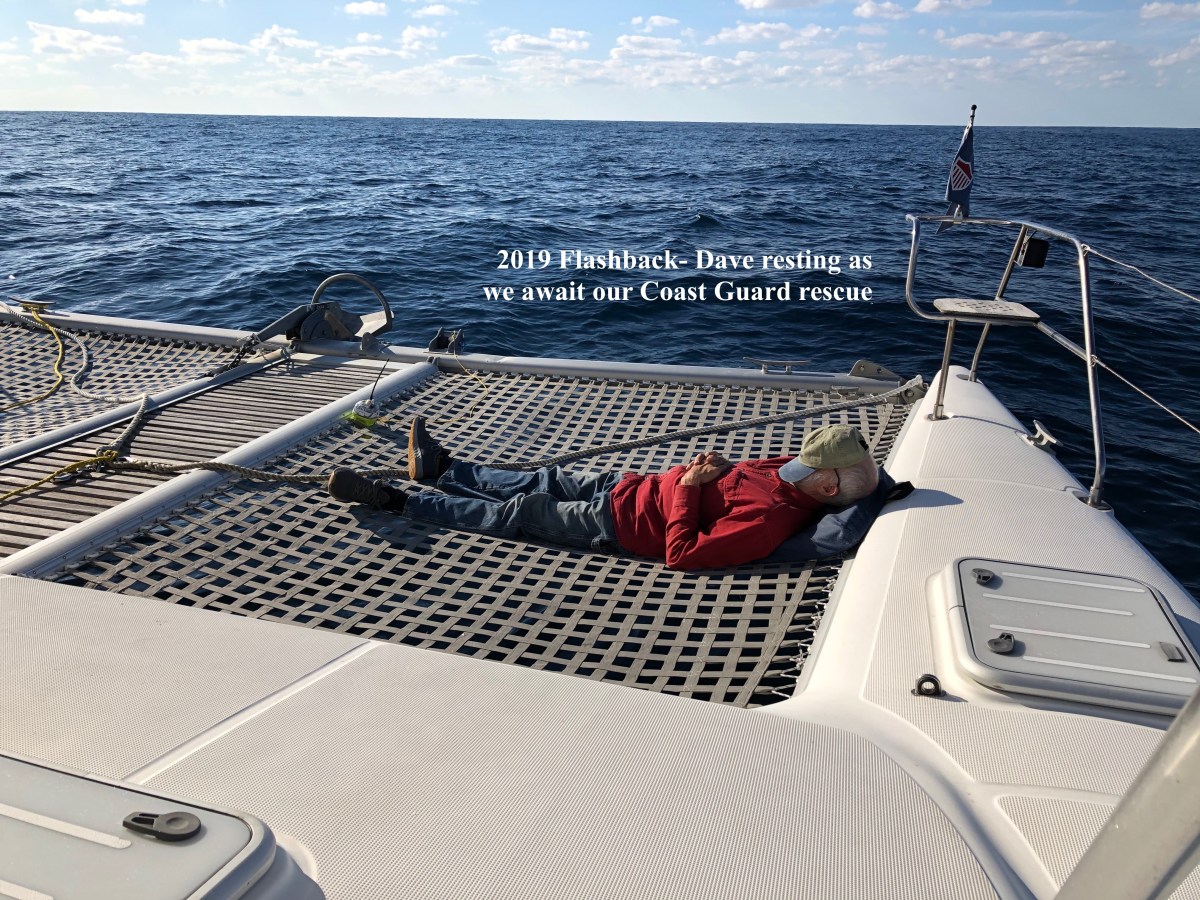
As I’ve come to learn, being ‘early implementers’ of our type of propulsion system means that things won’t work quite the way they should, and our systems certainly did not. We were en route from Beaufort, NC to Vero Beach, FL in November of 2019. The forecast was for improving conditions over the four days we would be at sea, and they were pretty good when we set out on a Monday morning. Until they weren’t. Long story made short: the sea state turned nasty on Tuesday with lots of slamming of waves against our bridge deck, and we were being blown further off our course out to sea; Wednesday the starboard system shut down and we were chugging along with one motor; Thursday morning the port system shut down. We were stranded at sea with no propulsion, fortunately with calm conditions at this point. For those of you unfamiliar with this story, this post gives the complete details.
Fortunately for my psyche, the day we ended up stranded was gorgeous and calm, and we were able to coordinate rescue quickly. What left the scar was the fact that our systems were not trustworthy at a time when we needed them to be. All I could think of was what could have happened if they had shut down when we were in those big seas. What would have happened to us if we’d lost propulsion when we were pushed into the Gulf Stream, which flows northeast? Ever since then, I associate the banging of rough seas against our hulls with our propulsion systems failing and being stranded 80 nm from shore in need of a Coast Guard rescue.
The lasting impact of that event is that I worry every time we have to make a long passage. What if the events of November, 2019 repeat themselves? That fear has resulted in many an argument between me and Dave about when we should set out on a passage. It doesn’t help that he has a very high risk tolerance, while I have a very low one; always have had. We look at weather routing apps and see very different things. I tend to see potential disaster. It’s been trying for both of us, but I’m working on getting over the fear, and we’re working together on making passage decisions that work for both of us.
I didn’t run away screaming after that stranding event. I got back on the boat, and we’ve made more passages since, and I’ve continued to learn. I’ve been following other cruisers’ social media long enough now to have learned that everyone who makes offshore passages gets stuck in unpredicted, nasty conditions, often more frequently than they would like. Only Mother Nature truly knows her own mind, and she changes it frequently. This bit of knowledge, however, has actually been a comfort to me, because I’ve stopped doubting our ability to interpret the forecasts and weather routes we get from the services to which we subscribe. We’ve also made a ton of upgrades to our systems since 2019. The companies have worked with Dave to make changes and upgrades that greatly reduce the likelihood that we would get stranded again. Dave has learned more about the weeds of our systems than he ever imagined he’d need to know, but that has gone a long way to getting those systems to where they are today. We have better safety and communications equipment onboard now, so that I feel more confident about dealing with at at-sea emergency, should one arise. I’ve also found therapy to be useful in helping me work through the fear and in helping me communicate with Dave better about my concerns. There are fewer passage-making arguments now. I’m making progress.
So that is why I fear making passages, and why I hate it when a passage gets rough. Neither our bumpy ride to George Town, nor our subsequent bumpy ride to Mayaguana scratch the surface of our offshore passage in 2019. Still, I hated them because they made me relive that fear. If you’re still up for reading a little more, below is a brief description of our passage to George Town, during which we implemented some strategies that help me stress less about bumpy rides. I don’t want to break the chronology of our trip any more than I have, so I’ll save the description of the Rum to Mayaguana passage for later.
The bumpy ride to George Town
We set out into very calm conditions for George Town. We were in good company, too, because not long after sunrise, we saw more than another dozen boats behind us and heading in the same direction. I guess we all read the forecast the same way and were looking forward to the forecasted conditions. Too bad we were all wrong.
Within two hours the less than 3-foot seas became 4-5 foot seas (almost double what was predicted), from two directions, and with a shorter period between waves than predicted. It was a noisy, bumpy ride that triggered that old fear again, despite the beautiful, sunny skies and numerous other boats for company. This time, however, we had planned several bail out points in case conditions got too bad or I just couldn’t take it anymore. The last of these was 13 nm from George Town, about 2-3 hours for us. We also knew that if we passed that last bail out and then got uncomfortable, we could turn around, putting the seas behind us, and go back to that anchorage. Another thing I’ve learned about making passages is what is dangerous vs. just uncomfortable. This was just uncomfortable, mostly mentally, so when we were nearing the final bail out point, Dave checked in with me and I said we should just keep going, which we did. The final hour of the trip had us traversing the extensive and protected, and therefore calm, Elizabeth Harbor at George Town where we found ourselves a lovely spot to anchor. Another step forward in dealing with the fear.
That’s my saga about passages, complete with a recent example of putting some techniques in place to quell my fears. This coming weekend I’ll pick up where I left off in the chronology of our trip and tell you about our time at Long Island and Rum Cay. Until then, stay safe and take care of each other!

 Life on Lady
This was a wonderful read; very informative and personal—it made me feel like I was out to sea, with you both, while comfortably rocking in my warm cushioned chair. The long passages without sight of land is seriously adventurous. Thanks for sharing Lisa—love your messages and hearing how you are—and sending you and Dave well wishes!
LikeLike
Lisa,
Your experiences on passages and vulnerability concerning your fears have only increased my immense admiration for your life and times aboard Lady. Your strategies for dealing with the totally reasonable fears are interesting and much appreciated .
Happy cruising to you!
Ellen
LikeLike
You had my absolute and complete attention throughout your post. Being an ex-boater having more than my share of uncomfortable situations I can relate. I recall one of them when Dave, my son and I were returning to the Narragansett Bay from Block Island on my 26′ Monterey facing similar scary conditions. We were dealing with heavy following seas pushing us in directions that were contrary to our plan. On top of that the ride seemed perilously bumpy as the seas were a bit high ( I don’t recall the exact height). Dave took the helm most of the way. It was an experience that I never wanted to repeat although I had a few more before I gave up on the sport. I love your posts – Thank you for sharing your experiences….
LikeLike